Homepage Blank Alabama Medicaid Referral Form
Outline

The Alabama Medicaid Referral Form, officially designated as Form 362, serves as a vital tool in the healthcare landscape, facilitating communication between primary care physicians and specialists. This form is designed to streamline the referral process, ensuring that patients receive timely and appropriate care. It captures essential recipient information, including the patient's name, Medicaid number, and contact details, alongside the primary physician's credentials. The form requires a clear indication of the type of referral being made, whether it pertains to the Patient 1st program, EPSDT screenings, or other specific needs. Additionally, it outlines the length of the referral, specifying the number of visits or duration for which the referral remains valid. The form also distinguishes between various levels of care, such as evaluation only, treatment only, or a combination of both, while allowing for cascading referrals to additional specialists when necessary. Furthermore, it emphasizes the importance of submitting findings back to the primary physician, ensuring continuity of care. By understanding the nuances of the Alabama Medicaid Referral Form, healthcare providers can enhance their collaborative efforts, ultimately improving patient outcomes.


Sample - Alabama Medicaid Referral Form

2/23/12
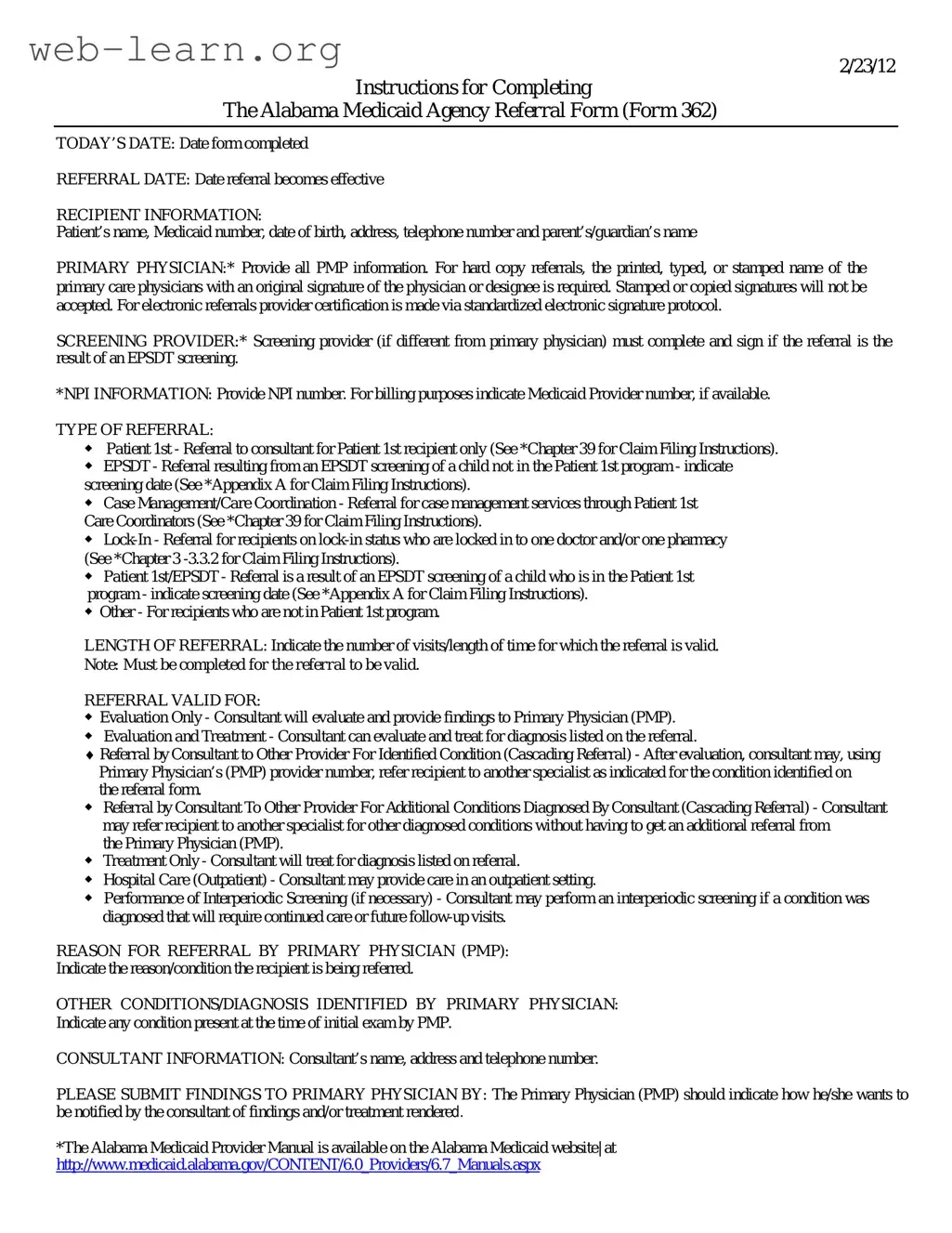
Instructions for Completing
The Alabama Medicaid Agency Referral Form (Form 362)
TODAY’S DATE: Date form completed
REFERRAL DATE: Date referral becomes effective
RECIPIENT INFORMATION:
Patient’s name, Medicaid number, date of birth, address, telephone number and parent’s/guardian’s name
PRIMARY PHYSICIAN:* Provide all PMP information. For hard copy referrals, the printed, typed, or stamped name of the
primary care physicians with an original signature of the physician or designee is required. Stamped or copied signatures will not be
accepted. For electronic referrals provider certification is made via standardized electronic signature protocol.
SCREENING PROVIDER:* Screening provider (if different from primary physician) must complete and sign if the referral is the
result of an EPSDT screening.
*NPI INFORMATION: Provide NPI number. For billing purposes indicate Medicaid Provider number, if available.
TYPE OF REFERRAL:
Patient 1st - Referral to consultant for Patient 1st recipient only (See *Chapter 39 for Claim Filing Instructions).
EPSDT - Referral resulting from an EPSDT screening of a child not in the Patient 1st program - indicate
screening date (See *Appendix A for Claim Filing Instructions).
Case Management/Care Coordination - Referral for case management services through Patient 1st
Care Coordinators (See *Chapter 39 for Claim Filing Instructions).
Lock-In - Referral for recipients on lock-in status who are locked in to one doctor and/or one pharmacy
(See *Chapter 3 -3.3.2 for Claim Filing Instructions).
Patient 1st/EPSDT - Referral is a result of an EPSDT screening of a child who is in the Patient 1st
program - indicate screening date (See *Appendix A for Claim Filing Instructions).
Other - For recipients who are not in Patient 1st program.
LENGTH OF REFERRAL: Indicate the number of visits/length of time for which the referral is valid.
Note: Must be completed for the referral to be valid.
REFERRAL VALID FOR:
Evaluation Only - Consultant will evaluate and provide findings to Primary Physician (PMP).
Evaluation and Treatment - Consultant can evaluate and treat for diagnosis listed on the referral.
Referral by Consultant to Other Provider For Identified Condition (Cascading Referral) - After evaluation, consultant may, using
Primary Physician’s (PMP) provider number, refer recipient to another specialist as indicated for the condition identified on
the referral form.
Referral by Consultant To Other Provider For Additional Conditions Diagnosed By Consultant (Cascading Referral) - Consultant
may refer recipient to another specialist for other diagnosed conditions without having to get an additional referral from
the Primary Physician (PMP).
Treatment Only - Consultant will treat for diagnosis listed on referral.
Hospital Care (Outpatient) - Consultant may provide care in an outpatient setting.
Performance of Interperiodic Screening (if necessary) - Consultant may perform an interperiodic screening if a condition was
diagnosed that will require continued care or future follow-up visits.
REASON FOR REFERRAL BY PRIMARY PHYSICIAN (PMP):
Indicate the reason/condition the recipient is being referred.
OTHER CONDITIONS/DIAGNOSIS IDENTIFIED BY PRIMARY PHYSICIAN:
Indicate any condition present at the time of initial exam by PMP.
CONSULTANT INFORMATION: Consultant’s name, address and telephone number.
PLEASE SUBMIT FINDINGS TO PRIMARY PHYSICIAN BY: The Primary Physician (PMP) should indicate how he/she wants to
be notified by the consultant of findings and/or treatment rendered.
*The Alabama Medicaid Provider Manual is available on the Alabama Medicaid website| at
http://www.medicaid.alabama.gov/CONTENT/6.0_Providers/6.7_Manuals.aspx
PRIMARY PHYSICIAN (PMP) INFORMATION SCREENING PROVIDER IF DIFFERENT FROM PRIMARY PHYSICIAN (PMP)
Name Name
Address Address
Telephone # with Area Code Telephone # with Area Code
Fax # with Area Code Fax # with Area Code
Email Email
NPI # NPI #
Medicaid Provider # Medicaid Provider #
Signature Signature
Findings should be submitted to Primary Physician (PMP) by
Mail E-mail Fax In addition, please telephone
REFERRAL VALID FOR
Evaluation Only Treatment Only
Evaluation and Treatment Hospital Care (Outpatient)
Referral by consultant to other provider for identified Performance of Interperiodic Screening (if necessary)
condition (cascading referral)
Referral by consultant to other provider for additional
conditions diagnosed by consultant (EPSDT Only)
ALABAMA MEDICAID REFERRAL FORM
PHI-CONFIDENTIAL
LENGTH OF REFERRAL
Referral Valid for __________ month(s) or __________ visit(s) from date referral begins.
Reason for referral by PMP Other conditions/diagnoses identified by PMP
CONSULTANT INFORMATION
Consultant Name
Address Consultant Telephone # with Area Code
Form 362 Alabama Medicaid Agency
Rev. 2-23-12 www.medicaid.alabama.gov
MEDICAID RECIPIENT INFORMATION
Recipient Name Recipient # Recipient DOB
Address Telephone # with Area Code
Name of Parent/Guardian
Note: Please submit written report of findings including the date of examination/service, diagnosis, and consultant signature to Primary Physician (PMP).
TYPE OF REFERRAL
Patient 1
st
Lock-in
EPSDT Screening Date ______________________ Other
Case Management/Care Coordination
Important NPI Information
See Instructions
Today’s Date _________________
Date Referral Begins _________________
(If different from above)
2-23-12

Form Information

Fact Name Description
Form Identification The Alabama Medicaid Agency Referral Form is officially known as Form 362. It is used to facilitate referrals for Medicaid recipients in Alabama.
Effective Dates The form requires both the date it is completed and the date the referral becomes effective. This ensures clarity on when the referral is valid.
Primary Physician Requirements All primary care physician information must be provided, including a signature. Stamped signatures are not acceptable, ensuring authenticity.
Referral Types The form categorizes referrals into several types, including Patient 1st, EPSDT, and Case Management. Each type has specific instructions for billing and processing.
Regulatory Compliance The Alabama Medicaid Referral Form is governed by the Alabama Medicaid Provider Manual, which outlines the rules and procedures for Medicaid services in the state.

Detailed Guide for Filling Out Alabama Medicaid Referral

Completing the Alabama Medicaid Referral form is an important step in ensuring that patients receive the necessary care. After filling out the form, it will be submitted to the appropriate parties for processing. This will help facilitate the patient's referral to specialists or additional services as needed.

  1. Fill in Today’s Date: Write the date you are completing the form.
  2. Enter the Referral Date: Indicate when the referral becomes effective.
  3. Provide Recipient Information: Include the patient's name, Medicaid number, date of birth, address, telephone number, and the name of the parent or guardian.
  4. Primary Physician Information: Enter the primary physician’s details, including their name, address, telephone number, fax number, email, NPI number, and Medicaid Provider number. Make sure to include a signature.
  5. Screening Provider Information: If applicable, provide the screening provider's information, including their name, address, telephone number, fax number, email, NPI number, and Medicaid Provider number. This section also requires a signature.
  6. Select Type of Referral: Choose the appropriate referral type from the options provided, such as Patient 1st, EPSDT, or Lock-in.
  7. Indicate Length of Referral: Specify the number of visits or length of time the referral is valid for.
  8. Choose Referral Valid For: Mark the appropriate box for how the consultant will manage the referral, such as Evaluation Only or Treatment Only.
  9. Reason for Referral: Clearly state the reason or condition for which the recipient is being referred.
  10. Other Conditions: Note any additional conditions or diagnoses identified by the primary physician.
  11. Consultant Information: Fill in the consultant's name, address, and telephone number.
  12. Submission of Findings: Indicate how the consultant should notify the primary physician of findings and/or treatment rendered, such as by mail, email, or fax.

Obtain Answers on Alabama Medicaid Referral

  1. What is the purpose of the Alabama Medicaid Referral Form?

    The Alabama Medicaid Referral Form is used to refer Medicaid recipients to specialists or other healthcare providers. This ensures that patients receive the appropriate care based on their specific medical needs. The form captures essential information about the patient, the referring physician, and the type of referral being made.

  2. What information do I need to provide about the patient?

    You must include the patient's name, Medicaid number, date of birth, address, and telephone number. Additionally, if applicable, you should provide the name of the parent or guardian. This information helps ensure accurate identification and communication regarding the patient's care.

  3. What details are required from the primary physician?

    The primary physician's information is crucial. You need to provide their name, address, telephone number, and NPI number. An original signature from the physician or their designee is also required for hard copy referrals. Remember, stamped or copied signatures will not be accepted.

  4. How do I determine the type of referral?

    There are several types of referrals to choose from, including:

    • Patient 1st
    • EPSDT (Early and Periodic Screening, Diagnostic, and Treatment)
    • Case Management/Care Coordination
    • Lock-In status referrals
    • Other specific referrals

    Choose the type that best fits the patient's situation. Each type has specific guidelines that you can refer to in the Alabama Medicaid Provider Manual.

  5. What does the "Length of Referral" section mean?

    This section indicates how long the referral is valid. You must specify either the number of visits or the duration in months. Completing this section is essential for the referral to be considered valid.

  6. What should be done after the consultation?

    The consultant is required to submit findings to the primary physician. This includes the date of examination, diagnosis, and consultant signature. You can indicate the preferred method of communication, such as mail, email, or fax, to ensure that the primary physician receives the necessary information promptly.

Common mistakes

Completing the Alabama Medicaid Referral form accurately is crucial for ensuring timely and appropriate care. However, several common mistakes can hinder the referral process. Awareness of these pitfalls can help individuals avoid delays in receiving necessary medical services.

One frequent error is failing to provide the correct recipient information. This section requires the patient's name, Medicaid number, date of birth, address, telephone number, and the name of a parent or guardian. Omitting any of this information can lead to confusion and delays in processing the referral.

Another mistake involves the primary physician's information. The form requires the printed, typed, or stamped name of the primary care physician along with an original signature. Using a stamped or copied signature will result in rejection of the form. It is essential to ensure that the signature is original to avoid processing issues.

Individuals often neglect to specify the type of referral. This section is critical as it determines the nature of the services required. Options include Patient 1st, EPSDT, and Case Management/Care Coordination. Failing to select the appropriate type can lead to miscommunication regarding the patient's needs.

Inaccuracies in the length of referral are also common. This section requires an indication of the number of visits or the duration for which the referral is valid. Leaving this blank or providing incorrect information can render the referral invalid, causing further delays in care.

Additionally, not clearly stating the reason for referral can create confusion. The primary physician must indicate the specific condition for which the patient is being referred. A vague or incomplete explanation may lead to misunderstandings about the patient's needs.

Another mistake is the omission of the consultant information. This includes the consultant's name, address, and telephone number. Providing complete contact details is essential for effective communication between the primary physician and the consultant.

Furthermore, individuals may forget to indicate how they wish to receive findings from the consultant. The section requesting notification preferences must be completed. Without this information, the primary physician may not receive timely updates regarding the patient's care.

Lastly, neglecting to review the entire form before submission can lead to overlooked errors. Taking the time to double-check all entries ensures that the form is complete and accurate, reducing the likelihood of delays in processing.

Documents used along the form

The Alabama Medicaid Referral Form is a crucial document that facilitates communication between primary care physicians and specialists. However, it is often accompanied by several other forms and documents that help streamline the referral process and ensure that all necessary information is communicated effectively. Below is a list of these important documents.

  • Patient Medical History Form: This form provides a comprehensive overview of the patient's medical background, including past illnesses, surgeries, medications, and allergies. It helps specialists understand the patient's health context before the consultation.
  • Authorization for Release of Medical Information: This document grants permission for healthcare providers to share a patient's medical records with other professionals involved in their care. It is essential for ensuring compliance with privacy regulations.
  • EPSDT Screening Form: The Early and Periodic Screening, Diagnostic, and Treatment (EPSDT) form documents the results of health screenings for children. This form is particularly important for referrals stemming from EPSDT screenings.
  • Consultant Report Template: After the consultation, this template is used by specialists to document their findings, recommendations, and any treatments provided. It is sent back to the primary physician for continuity of care.
  • Medicaid Provider Enrollment Form: This form is necessary for healthcare providers who wish to participate in the Alabama Medicaid program. It includes details about the provider's qualifications and practice.
  • Care Coordination Plan: This document outlines the strategies and resources needed to manage a patient’s care effectively, especially for those with complex health needs. It helps ensure all providers are aligned in their approach.
  • Follow-Up Appointment Scheduling Form: This form is used to schedule follow-up appointments after a consultation. It helps keep track of the patient's ongoing care and ensures timely follow-ups are made.

Utilizing these forms alongside the Alabama Medicaid Referral Form enhances the efficiency of the referral process. Each document plays a vital role in ensuring that patients receive comprehensive and coordinated care, ultimately leading to better health outcomes.

Similar forms

The Alabama Medicaid Referral form shares similarities with several other documents used in healthcare settings. Here’s a list of ten documents that are comparable in purpose or structure:

  • Referral for Specialist Services: This document is used to refer patients to specialists for further evaluation or treatment, similar to the Alabama Medicaid Referral form, which facilitates referrals to consultants.
  • Patient Authorization Form: Like the Medicaid Referral form, this document requires patient information and authorization for sharing medical records or treatment details with other providers.
  • Insurance Pre-Authorization Request: This form is used to obtain approval from insurance companies before a patient receives certain services, mirroring the need for prior approval in the Medicaid referral process.
  • Continuity of Care Document (CCD): The CCD provides a summary of a patient's health information and treatment plans, similar to how the Medicaid Referral form includes patient and consultant details.
  • Consultation Request Form: This document is specifically for requesting a consultation with another healthcare provider, paralleling the referral nature of the Medicaid form.
  • EPSDT Referral Form: Used for Early and Periodic Screening, Diagnosis, and Treatment services, this form is tailored for children and is similar in function to the EPSDT section of the Medicaid Referral form.
  • Case Management Referral Form: This form is designed to refer patients to case management services, akin to the case management option available in the Medicaid Referral form.
  • Emergency Room Referral Form: This document allows primary care physicians to refer patients to emergency services, similar to how the Medicaid Referral form directs patients to specific specialists.
  • Follow-Up Care Request: This form is used to ensure patients receive necessary follow-up care after treatment, reflecting the ongoing care aspect found in the Medicaid Referral form.
  • Patient Transfer Form: Used when transferring a patient from one facility to another, this document shares similarities in the need for detailed patient information and treatment history, as seen in the Medicaid Referral form.

Dos and Don'ts

When filling out the Alabama Medicaid Referral form, there are several important dos and don’ts to keep in mind. Following these guidelines will help ensure that your referral is processed smoothly and efficiently.

  • Do use the most current version of the form to avoid any issues.
  • Do provide accurate recipient information, including the patient's name and Medicaid number.
  • Do ensure that the primary physician’s name is printed clearly and includes an original signature.
  • Do indicate the type of referral correctly to avoid delays in processing.
  • Do specify the length of the referral, including the number of visits or duration.
  • Don’t use stamped or copied signatures; they will not be accepted.
  • Don’t leave any sections blank; incomplete forms can lead to rejection.
  • Don’t forget to indicate how findings should be submitted to the primary physician.
  • Don’t submit the form without double-checking for accuracy.
  • Don’t ignore the instructions provided for each section; they are there to guide you.

By following these dos and don’ts, you can help ensure that your Alabama Medicaid Referral form is completed correctly, making the process smoother for everyone involved.

Misconceptions

Below are some common misconceptions regarding the Alabama Medicaid Referral Form:

  • All signatures are accepted. Many believe that any form of signature is valid. However, only original signatures from the primary care physician or their designee are accepted. Stamped or copied signatures will not suffice.
  • Referral length is optional. Some think that indicating the length of the referral is not necessary. In fact, this information is crucial for the referral to be considered valid.
  • Electronic referrals do not require verification. It is a misconception that electronic referrals are less stringent. They require a standardized electronic signature protocol to ensure authenticity.
  • Any provider can refer a patient. There is a belief that any healthcare provider can issue a referral. Only the primary physician or designated screening provider can complete the referral form.
  • Referrals can be made without specifying the reason. Some individuals think that the reason for referral can be omitted. However, it is mandatory to indicate the reason or condition prompting the referral.
  • Consultants can treat without limitations. Many assume that consultants have the freedom to treat any condition. In reality, the referral specifies the conditions for which treatment is authorized.
  • Findings do not need to be submitted promptly. It is often thought that there is no urgency in submitting findings to the primary physician. In fact, timely submission is essential for ongoing patient care.

Key takeaways

  • Accurate Information is Crucial: Ensure that all recipient information, including the patient's name, Medicaid number, and contact details, is filled out correctly. Errors can delay processing and affect care.
  • Signature Requirements: The primary physician must provide a printed, typed, or stamped name along with an original signature. Stamped or copied signatures are not acceptable, which underscores the importance of authenticity in referrals.
  • Referral Types Matter: Clearly indicate the type of referral being made. Options include Patient 1st, EPSDT, and Case Management. Each type has specific instructions for billing and processing that must be followed.
  • Length and Validity of Referral: Specify the duration of the referral, whether it’s for a certain number of visits or a specific time frame. This detail is essential for the referral to be considered valid.