When couples in Alabama decide to separate, a Marital Separation Agreement can serve as a crucial tool in outlining the terms of their separation. This document addresses various aspects of the couple's lives, including the division of assets, liabilities, and responsibilities related to children, if applicable. It provides clarity on issues such as child custody, visitation rights, and child support, ensuring that both parties understand their obligations moving forward. Additionally, the agreement may cover spousal support, property division, and any other matters that the couple deems necessary to address during their separation. By formalizing these arrangements in writing, individuals can mitigate misunderstandings and foster a more amicable separation process. Understanding the components and significance of this agreement can help couples navigate their separation with greater ease and confidence.
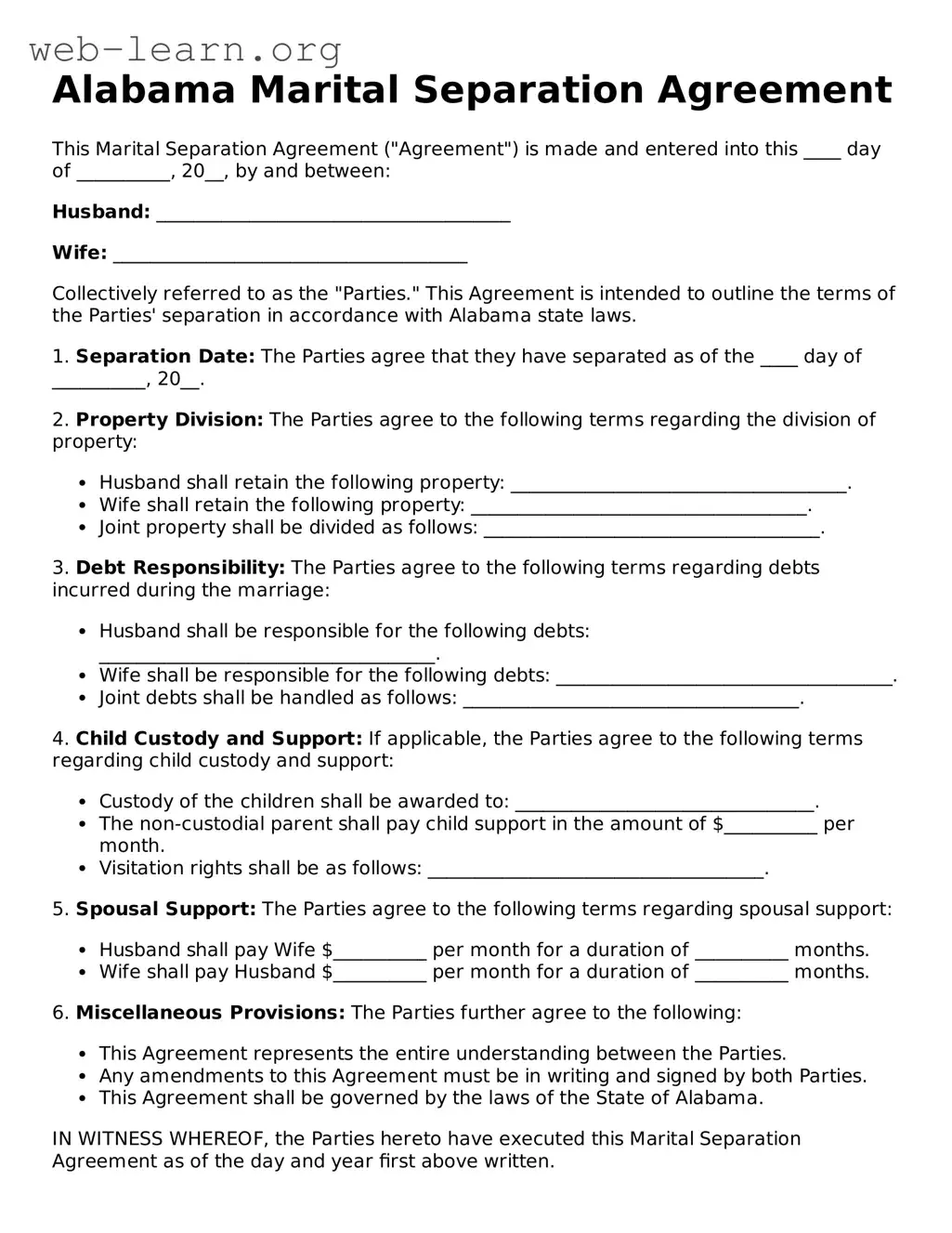
Alabama Marital Separation Agreement
This Marital Separation Agreement ("Agreement") is made and entered into this ____ day of __________, 20__, by and between:
Husband: ______________________________________
Wife: ______________________________________
Collectively referred to as the "Parties." This Agreement is intended to outline the terms of the Parties' separation in accordance with Alabama state laws.
1. Separation Date: The Parties agree that they have separated as of the ____ day of __________, 20__.
2. Property Division: The Parties agree to the following terms regarding the division of property:
3. Debt Responsibility: The Parties agree to the following terms regarding debts incurred during the marriage:
4. Child Custody and Support: If applicable, the Parties agree to the following terms regarding child custody and support:
5. Spousal Support: The Parties agree to the following terms regarding spousal support:
6. Miscellaneous Provisions: The Parties further agree to the following:
IN WITNESS WHEREOF, the Parties hereto have executed this Marital Separation Agreement as of the day and year first above written.
Husband's Signature: _____________________________ Date: _______________
Wife's Signature: _____________________________ Date: _______________
| Fact Name | Details |
|---|---|
| Definition | An Alabama Marital Separation Agreement is a legal document that outlines the terms of separation between spouses. |
| Governing Law | The agreement is governed by Alabama state law, specifically under Title 30 of the Alabama Code. |
| Purpose | It serves to clarify the rights and responsibilities of each spouse during the separation period. |
| Content | The agreement typically includes provisions related to property division, child custody, and support obligations. |
| Enforceability | Once signed by both parties, the agreement can be enforced in court, provided it meets legal standards. |
| Modification | Parties may modify the agreement later, but any changes must be documented in writing and signed by both spouses. |
| Legal Advice | It is advisable for each party to seek independent legal counsel before signing the agreement to ensure their rights are protected. |
Completing the Alabama Marital Separation Agreement form is an important step in the process of separating from your spouse. This form will guide you through the necessary information to outline the terms of your separation. After filling it out, you will be able to move forward with the next steps in your separation journey.
A Marital Separation Agreement is a legal document that outlines the terms and conditions agreed upon by spouses who choose to live separately. This agreement typically covers aspects such as property division, child custody, visitation rights, and spousal support. It serves to protect the rights of both parties and provides clarity on their responsibilities during the separation period.
Yes, a Marital Separation Agreement is legally binding in Alabama, provided it is properly executed. Both parties must sign the document, and it is advisable to have it notarized. This ensures that the agreement can be enforced in court if either party fails to comply with its terms.
Yes, a Marital Separation Agreement can be modified if both parties agree to the changes. It is essential to document any modifications in writing and have both parties sign the revised agreement. This helps prevent misunderstandings and ensures that the new terms are enforceable.
If one spouse does not adhere to the terms of the Marital Separation Agreement, the other spouse can seek legal recourse. This may involve filing a motion in court to enforce the agreement. The court can order compliance and may impose penalties for non-compliance, depending on the situation.
While it is not legally required to have an attorney to create a Marital Separation Agreement, it is highly recommended. An attorney can help ensure that the agreement is fair, comprehensive, and compliant with Alabama laws. They can also provide valuable guidance on issues such as child custody and property division.
Filling out the Alabama Marital Separation Agreement form is a crucial step in the separation process. However, many individuals make common mistakes that can lead to complications down the line. Understanding these pitfalls can help ensure that your agreement is valid and enforceable.
One frequent mistake is failing to provide complete information. When individuals leave out essential details such as full names, addresses, and the date of separation, it can create confusion later. Ensure that all parties involved are clearly identified to avoid any potential disputes.
Another common error is neglecting to address property division adequately. Many people assume that verbal agreements will suffice. However, without clear documentation in the form, misunderstandings regarding asset distribution can arise. It is vital to list all marital property and specify how it will be divided to prevent future conflicts.
Additionally, individuals often overlook the importance of including child custody arrangements. If children are involved, the agreement should detail custody, visitation rights, and child support obligations. Omitting this information can lead to significant legal challenges and emotional distress for both parents and children.
Many also fail to consider the tax implications of their agreements. For instance, the division of assets might have tax consequences that could affect both parties financially. Consulting with a tax professional before finalizing the agreement can save you from unexpected liabilities.
Lastly, not having the agreement reviewed by a legal professional is a critical mistake. While it may seem straightforward, legal documents can be complex. A lawyer can help ensure that the agreement complies with Alabama law and adequately protects your interests. Taking this step can prevent costly errors and future disputes.
When navigating the complexities of a marital separation in Alabama, several forms and documents may accompany the Marital Separation Agreement. Each of these documents serves a unique purpose and can help clarify the terms of the separation. Here’s a brief overview of some commonly used forms:
Understanding these documents can significantly ease the separation process. Each form plays a vital role in ensuring that both parties are treated fairly and that all aspects of the separation are addressed comprehensively.
Separation Agreement: This document outlines the terms under which a couple separates, covering issues like property division and child custody. It serves a similar purpose as the Marital Separation Agreement, providing clarity and structure to the separation process.
Divorce Decree: After a divorce is finalized, the Divorce Decree details the terms of the divorce, including asset division and support obligations. Like the Marital Separation Agreement, it aims to resolve conflicts and provide legal protection.
Child Custody Agreement: This document focuses specifically on the arrangements for children after a separation or divorce. It shares similarities with the Marital Separation Agreement by addressing the welfare of children and outlining parental responsibilities.
Property Settlement Agreement: This agreement details how a couple's assets and debts will be divided. It parallels the Marital Separation Agreement in that it seeks to clarify financial responsibilities and rights during a separation.
Postnuptial Agreement: Created during a marriage, this document outlines how assets will be handled in the event of separation or divorce. It is similar to the Marital Separation Agreement as both aim to provide a clear framework for financial and personal matters.
When filling out the Alabama Marital Separation Agreement form, it is crucial to approach the process with care and attention to detail. Below are important dos and don'ts to consider.
Understanding the Alabama Marital Separation Agreement form is essential for anyone considering separation. However, several misconceptions can lead to confusion. Here’s a breakdown of common misunderstandings:
Clearing up these misconceptions can help individuals navigate the complexities of separation with greater confidence.
When filling out and using the Alabama Marital Separation Agreement form, several key points should be kept in mind to ensure clarity and compliance.
Arizona Legal Separation - A Marital Separation Agreement can be an essential part of a thoughtful separation process.
Separation From Spouse - It can include timelines for the separation process.
Legal Separation in New York - This agreement can serve as a foundation for divorce proceedings if desired later.
Indiana Separation Laws - A Marital Separation Agreement can help couples avoid lengthy legal battles in the future.