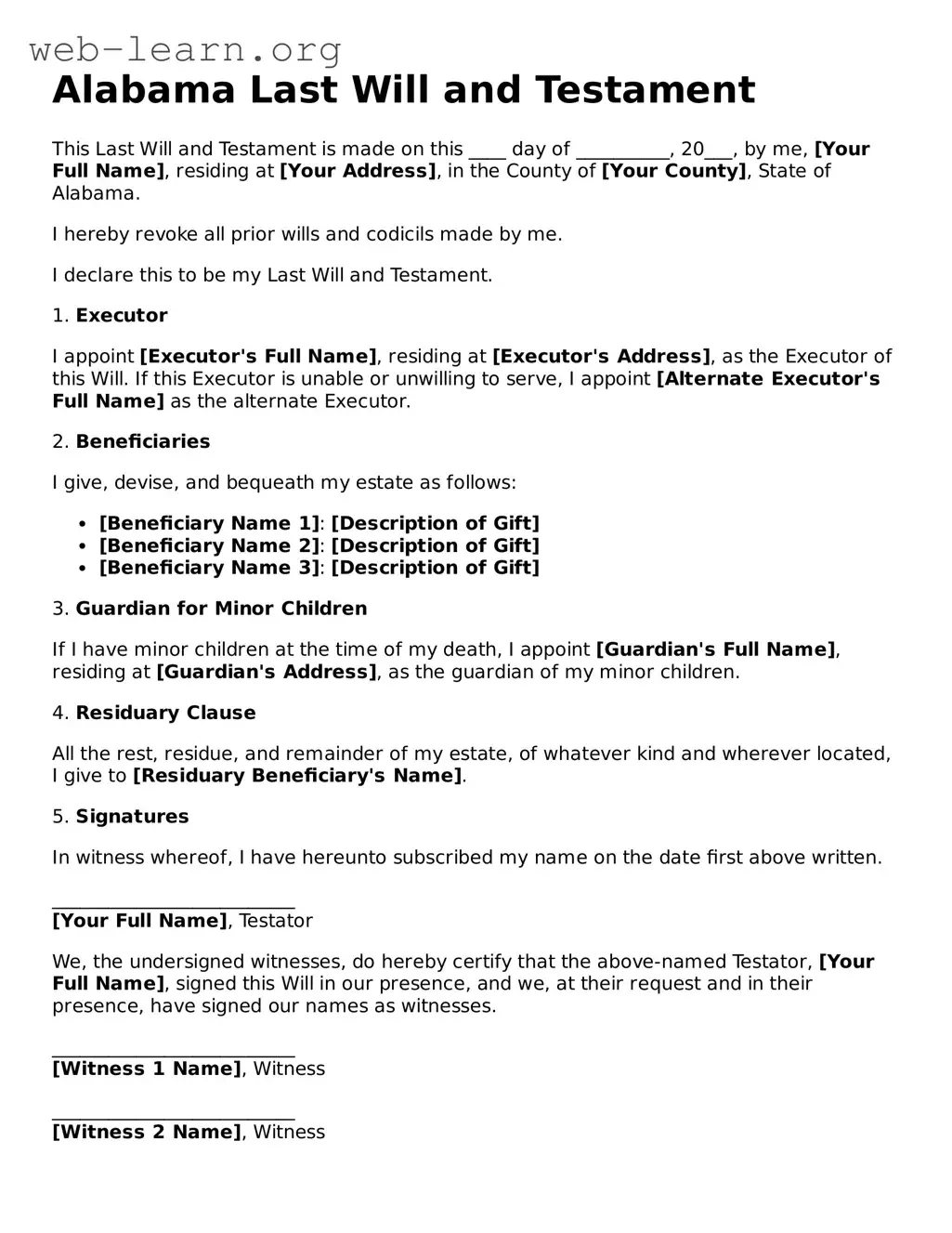
Creating a Last Will and Testament is an essential step in ensuring that your wishes are honored after your passing. In Alabama, this legal document outlines how your assets will be distributed, who will serve as your executor, and guardianship for any minor children. It provides clarity and peace of mind for both you and your loved ones. The form typically includes sections for naming beneficiaries, detailing specific bequests, and appointing an executor to manage your estate. Additionally, it must be signed and witnessed according to Alabama law to be considered valid. Understanding these key components can help you navigate the process more smoothly, ensuring that your final wishes are carried out as you intended.
Alabama Last Will and Testament
This Last Will and Testament is made on this ____ day of __________, 20___, by me, [Your Full Name], residing at [Your Address], in the County of [Your County], State of Alabama.
I hereby revoke all prior wills and codicils made by me.
I declare this to be my Last Will and Testament.
1. Executor
I appoint [Executor's Full Name], residing at [Executor's Address], as the Executor of this Will. If this Executor is unable or unwilling to serve, I appoint [Alternate Executor's Full Name] as the alternate Executor.
2. Beneficiaries
I give, devise, and bequeath my estate as follows:
3. Guardian for Minor Children
If I have minor children at the time of my death, I appoint [Guardian's Full Name], residing at [Guardian's Address], as the guardian of my minor children.
4. Residuary Clause
All the rest, residue, and remainder of my estate, of whatever kind and wherever located, I give to [Residuary Beneficiary's Name].
5. Signatures
In witness whereof, I have hereunto subscribed my name on the date first above written.
__________________________
[Your Full Name], Testator
We, the undersigned witnesses, do hereby certify that the above-named Testator, [Your Full Name], signed this Will in our presence, and we, at their request and in their presence, have signed our names as witnesses.
__________________________
[Witness 1 Name], Witness
__________________________
[Witness 2 Name], Witness
__________________________
[Witness 3 Name], Witness
This document is prepared in accordance with the laws of the State of Alabama.
| Fact Name | Details |
|---|---|
| Governing Law | The Alabama Last Will and Testament is governed by the Alabama Code, Title 43, Chapter 8. |
| Age Requirement | Testators must be at least 18 years old to create a valid will in Alabama. |
| Written Requirement | The will must be in writing. Oral wills are not recognized in Alabama. |
| Signature Requirement | The testator must sign the will at the end. If the testator cannot sign, they may direct someone to sign on their behalf. |
| Witnesses | At least two witnesses are required to sign the will. They must be present at the same time. |
| Holographic Wills | Holographic wills, which are handwritten and signed by the testator, are valid in Alabama if they meet certain criteria. |
| Revocation | A will can be revoked by the testator at any time before death, either by creating a new will or by destroying the old one. |
| Self-Proving Wills | Alabama allows self-proving wills, which can simplify the probate process by including a notarized affidavit from the witnesses. |
| Probate Process | After death, the will must be submitted to probate court for validation and execution of its terms. |
| Intestate Succession | If a person dies without a valid will, Alabama's intestate succession laws dictate how their assets will be distributed. |
Filling out the Alabama Last Will and Testament form is an important step in ensuring your wishes are honored after your passing. Once you have completed the form, you will need to sign it in the presence of witnesses and possibly a notary, depending on your specific needs.
What is a Last Will and Testament in Alabama?
A Last Will and Testament is a legal document that outlines how a person's assets and affairs should be handled after their death. In Alabama, this document allows individuals to specify who will inherit their property, appoint guardians for minor children, and name an executor to manage the estate. Creating a will ensures that your wishes are followed and can help prevent disputes among family members.
Who can create a Last Will and Testament in Alabama?
In Alabama, any person who is at least 18 years old and of sound mind can create a Last Will and Testament. This means that you should be able to understand the nature of your actions and the effects of your decisions. If you are a minor or deemed mentally incompetent, you will not have the legal capacity to make a will.
What are the requirements for a valid will in Alabama?
For a will to be considered valid in Alabama, it must meet several requirements:
It’s important to follow these steps carefully to ensure that your will is enforceable in court.
Can I change my will after it has been created?
Yes, you can change your will at any time while you are still alive. In Alabama, this is typically done through a document called a codicil, which is an amendment to your existing will. Alternatively, you can create a new will that revokes the previous one. It’s crucial to follow the same formalities for signing and witnessing as you did with the original will to ensure the changes are valid.
What happens if I die without a will in Alabama?
If you pass away without a will, you are considered to have died "intestate." In this case, Alabama's intestacy laws will determine how your assets are distributed. Generally, your property will be divided among your closest relatives, such as your spouse, children, or parents. However, this may not align with your wishes, which is why having a will is so important.
How can I ensure my will is properly executed?
To ensure that your will is properly executed, consider the following steps:
Taking these steps can help safeguard your wishes and make the process smoother for your loved ones.
Creating a Last Will and Testament is a crucial step in ensuring that your wishes are honored after your passing. However, many people make common mistakes when filling out the Alabama Last Will and Testament form. Understanding these pitfalls can help you avoid complications down the road.
One significant mistake is failing to properly identify the testator. The testator is the person making the will. It’s essential to include your full legal name and address. Omitting this information can lead to confusion about who the will belongs to, potentially invalidating the document.
Another frequent error is neglecting to name an executor. The executor is responsible for managing your estate and ensuring that your wishes are carried out. If you leave this section blank or choose someone who is unwilling or unable to serve, it can create unnecessary delays and complications for your heirs.
Many individuals also overlook the importance of signatures. In Alabama, a will must be signed by the testator and witnessed by at least two individuals. If you forget to sign the document or do not have the required witnesses, the will may not be considered valid. This could lead to your estate being distributed according to state law rather than your wishes.
Additionally, failing to update your will after significant life changes is a common mistake. Events such as marriage, divorce, or the birth of a child can alter your intentions regarding your estate. Regularly reviewing and updating your will ensures that it reflects your current wishes and circumstances.
Finally, some people make the mistake of using vague language when describing their assets or beneficiaries. Clarity is key. Be specific about what you want to leave and to whom. Ambiguities can lead to disputes among heirs, which can result in costly legal battles and emotional strain.
By avoiding these common mistakes, you can create a more effective Last Will and Testament that truly reflects your intentions and protects your loved ones.
When creating a comprehensive estate plan in Alabama, it is essential to consider several other forms and documents that complement the Last Will and Testament. Each document serves a specific purpose and helps ensure that your wishes are honored. Below is a list of commonly used documents that may be beneficial in conjunction with your will.
Incorporating these documents into your estate planning process can provide clarity and peace of mind for both you and your loved ones. Each form addresses different aspects of your wishes and needs, helping to create a well-rounded and effective estate plan.
When completing the Alabama Last Will and Testament form, it is essential to follow certain guidelines to ensure the document is valid and reflects your intentions accurately. Below is a list of important dos and don'ts.
Following these guidelines will help ensure that your Last Will and Testament is effective and legally sound.
Misconceptions about the Alabama Last Will and Testament form can lead to confusion and potentially unintended consequences regarding estate planning. Here are eight common misconceptions explained.
Understanding these misconceptions can empower individuals to make informed decisions about their estate planning needs in Alabama.
Creating a Last Will and Testament is an important step in ensuring your wishes are honored after your passing. Here are some key takeaways when filling out and using the Alabama Last Will and Testament form:
By understanding these key aspects, you can ensure that your Last Will and Testament reflects your intentions clearly and is legally enforceable.
Free Illinois Will Template - Serves as a formal declaration of your final wishes.
Living Will Vs Last Will and Testament - Can include a list of personal items and their intended recipients.
Will Template Georgia - May require specific language to ensure it meets legal standards.