Homepage Blank Alabama Irp 44 Form
Outline

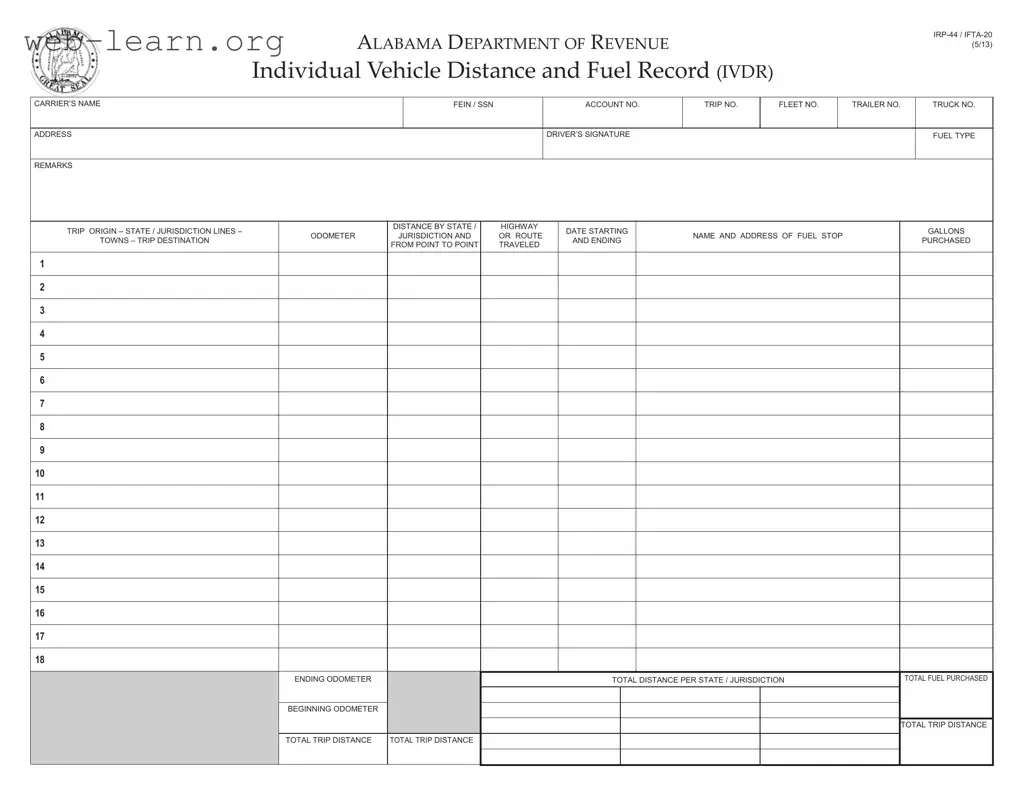
The Alabama IRP 44 form, also known as the Individual Vehicle Distance and Fuel Record (IVDR), is an essential document for carriers operating within the state and across jurisdictions. This form is crucial for tracking the distance traveled and fuel consumed during trips, ensuring compliance with state and federal regulations. It requires detailed information, including the carrier's name, address, and federal ID number, as well as specifics about the trip, such as trip origin, destination, and the routes taken. Each entry must include odometer readings, fuel purchases, and the type of fuel used, providing a comprehensive overview of the vehicle's journey. Additionally, the form captures vital data such as the total distance traveled per state and the total fuel purchased, which is necessary for calculating taxes and fees associated with the International Fuel Tax Agreement (IFTA) and the International Registration Plan (IRP). Completing this form accurately is not just a regulatory requirement; it helps ensure that carriers maintain proper records for audits and tax filings. With the right attention to detail, the IRP 44 can streamline operations and promote compliance, making it a critical tool for any trucking business in Alabama.

Sample - Alabama Irp 44 Form

ALABAMA DEPARTMENT OF REVENUE
Individual Vehicle Distance and Fuel Record (IVDR)
IRP-44 / IFTA-20
(5/13)
CARRIER’S NAME
FEIN / SSN ACCOUNT NO. TRIP NO. FLEET NO. TRAILER NO. TRUCK NO.
ADDRESS DRIVER’S SIGNATURE
FUEL TYPE
REMARKS
TRIP ORIGIN STATE / JURISDICTION LINES
TOWNS TRIP DESTINATION
ODOMETER
DISTANCE BY STATE /
JURISDICTION AND
FROM POINT TO POINT
HIGHWAY
OR ROUTE
TRAVELED
DATE STARTING
AND ENDING
NAME AND ADDRESS OF FUEL STOP
GALLONS
PURCHASED
1
2
3
4
5
6
7
8
9
10
11
12
13
14
15
16
17
18
ENDING ODOMETER
TOTAL DISTANCE PER STATE / JURISDICTION
TOTAL FUEL PURCHASED
BEGINNING ODOMETER
TOTAL TRIP DISTANCE
TOTAL TRIP DISTANCE
TOTAL TRIP
DISTANCE
DRIV
Sample Individual Vehicle Distance and Fuel Record (IVDR) With Instructions
ALABAMA DEPARTMENT OF REVENUE
1
3
Individual Vehicle Distance and Fuel Record (IVD
4
R)
5
6 7 8
IRP-44 / IFTA-20
(6/95)
Instructions
1. Carrier’s name.
2. Federal ID number or social security
number.
3 Carrier’s address.
4. IFTA/IRP account number.
5. Trip number.
CARRIER’S NAME
2
FEIN / SSN
ACCOUNT NO.
TRIP NO.
FLEET NO.
TRAILER NO.
TRUCK NO.
Jones Trucking Co.
ADDRESS
123-45-6789
10
9999
ER’S SIGNATURE
134 01 T477 156
FUEL TYPE
6. Fleet number.
1415 Main Street, Birmingham, AL 36109
REMARKS
Bob Smith
Diesel
7. Trailer unit number.
8. Truck unit number.
5/6 pickup load in B'ham
5/7 deliver to Jackson & load
9
5/8 deliver to Dallas & load
5/9 deliver to Jackson & load
14
5/9 return
15
to B'ham
16 17 18
11
9. Comments or additional information.
TRIP ORIGIN – STATE / JURISDICTION LINES
12
TOW NSTRIP DESTINATION
ODOMETER
DISTANCE BY STATE /
JURISDICTION AND
FROM POINT TO POINT
HIGHWAY
OR ROUTE
TRAVELED
DATE STARTING
AND ENDING
NAME AND ADDRESS OF FUEL STOP
GALLONS
PURCHASED
10. Driver’s signature.
11. Type of fuel used in the vehicle, i.e. diesel,
1
Birmingham, AL
2
AL state line
3
Jackson, MS
4 MS state line
5 LA state line
6
Dallas, TX
7
LA state line
8
MS state line
9 Jackson, MS
10
AL state line
11 Birmingham, AL
12
13
14
15
16
17
18
13
20 19
45,997
46,129
46,241
46,285
46,471
46,634
46,797
46,983
47,027
47,139
47,271
--
132
112
44
186
163
163
186
44
112
132
I-20
I-20
I-20
I-20
I-20
I-20
I-20
I-20
I-20
I-20
I-20
23
5-6-92
5-6-92
5-7-92
5-7-92
5-7-92
5-7-92
5-8-92
5-8-92
5-9-92
5-9-92
5-9-92
Browns Truck Stop
Jackson, MS
A-1 Truck Stop
Dallas, TX
I-20 Fuel Stop
Birmingham, AL
120
100
80
24
propane, gas.
12. Trip origin, state/jurisdiction lines crossed,
loading/unloading points, trip destination.
13. Odometer readings for each entry in No. 12.
14. Mileage between each entry in No. 12.
15. Road, highway, or interstate traveled.
16. Date trip started, date trip ended, and in
between.
17. Vendor name and address where fuel pur-
chased.
18. Number of gallons purchased.
19. Ending odometer reading for trip.
20. Beginning odometer reading for trip.
21. Difference between No. 19 and No. 20
equals total trip miles.
22. Add miles in No. 14 Miles By
State/
ENDING ODOMETER
47,271
BEGINNING ODOMETER
45,997
AL - 264
MS - 312
LA - 372
TOTAL DISTANCE PER STATE / JURISDICTION
TOTAL FUEL PURCHASED
300
TOTAL TRIP DISTANCE
Jurisdiction And From Point To Point. (This
should match the miles you have in No. 21.)
23. Add miles in No. 14 by state and enter total
TOTAL TRIP DISTANCE
1,274
21
22
TOTAL
TRIP DI
ISTANCE
1,274
TX - 326
1,274
25
for each state.
24. Add gallons purchased in No. 18 and enter
total here.
25. Add all miles for each state/jurisdiction in
No. 23 and enter total here. (This should
match the miles in No. 21 and No. 22.)

Form Information

Fact Name Details
Purpose The Alabama IRP 44 form is used to record the distance traveled and fuel consumed by vehicles for International Registration Plan (IRP) and International Fuel Tax Agreement (IFTA) compliance.
Governing Law This form is governed by the Alabama Code Title 40, Chapter 12, which pertains to motor fuel taxation and vehicle registration.
Required Information Essential details include the carrier's name, federal ID or social security number, trip details, odometer readings, and fuel purchases.
Submission Frequency Carriers must complete and submit the IRP 44 form for each trip to ensure accurate reporting of mileage and fuel consumption for tax purposes.

Detailed Guide for Filling Out Alabama Irp 44

Filling out the Alabama IRP 44 form is an essential step for tracking your vehicle's distance and fuel consumption. This record will help ensure compliance with regulations and facilitate accurate reporting. Below are the steps to guide you through the process of completing the form.

  1. Carrier’s Name: Write the name of your trucking company or the individual operating the vehicle.
  2. FEIN / SSN: Enter your Federal Employer Identification Number or Social Security Number.
  3. Address: Fill in the complete address of your business.
  4. Account No: Input your IFTA/IRP account number.
  5. Trip No: Assign a unique number to this trip for tracking purposes.
  6. Fleet No: Indicate your fleet number if applicable.
  7. Trailer No: Enter the trailer unit number used for this trip.
  8. Truck No: Write the truck unit number for the vehicle involved in the trip.
  9. Driver’s Signature: The driver must sign the form to confirm the information is accurate.
  10. Fuel Type: Specify the type of fuel used, such as diesel or gasoline.
  11. Trip Origin: State the starting point of your trip, including the state or jurisdiction.
  12. Distance by State/Highway: For each segment of your trip, note the distance traveled in each state or jurisdiction.
  13. Date: Record the date when the trip started and any other relevant dates during the trip.
  14. Starting Gallons: Enter the number of gallons of fuel in the tank at the beginning of the trip.
  15. Odometer: Log the odometer reading at the start of the trip and at each significant point.
  16. Jurisdiction and Route: Provide details about the route taken and the jurisdictions crossed.
  17. Name and Address of Fuel Stop: Include the name and address of each fuel stop along the route.
  18. Towns: List the towns where you loaded or unloaded cargo.
  19. Ending Odometer: Record the final odometer reading at the end of the trip.
  20. Total Distance: Calculate the total distance traveled for each state or jurisdiction.
  21. Total Fuel Purchased: Sum up the total gallons of fuel purchased during the trip.

Once you have completed the form, review it for accuracy. Ensure that all entries are correct and legible. After verification, submit the form as required by your local regulations. This will help maintain compliance and provide a clear record of your vehicle's operations.

Obtain Answers on Alabama Irp 44

  1. What is the purpose of the Alabama IRP 44 form?

    The Alabama IRP 44 form, also known as the Individual Vehicle Distance and Fuel Record (IVDR), serves a crucial role for carriers operating in multiple jurisdictions. It is primarily used to document the distance traveled and fuel purchased during a trip. This information is essential for calculating taxes owed under the International Fuel Tax Agreement (IFTA) and the International Registration Plan (IRP). By maintaining accurate records, carriers ensure compliance with state regulations and facilitate the proper distribution of tax revenues among jurisdictions.

  2. What information is required to complete the IRP 44 form?

    Completing the IRP 44 form necessitates a range of information to ensure accuracy and compliance. Key details include:

    • Carrier's Name and Address: The official name and address of the trucking company.
    • Federal ID Number or Social Security Number: This identifies the carrier for tax purposes.
    • Trip and Fleet Numbers: Unique identifiers for tracking specific trips and fleets.
    • Odometer Readings: Both starting and ending odometer readings are crucial for calculating total distance traveled.
    • Fuel Purchases: Details about the type of fuel used, gallons purchased, and the vendor’s name and address.
    • Route Details: Information about the jurisdictions crossed, including the origin and destination of the trip.

    Gathering this information helps ensure that the form is filled out correctly and meets all regulatory requirements.

  3. How should the distances and fuel purchases be recorded?

    Recording distances and fuel purchases accurately is vital for compliance. For each segment of the trip, the form requires you to note:

    • The jurisdiction or state crossed.
    • The odometer readings at the beginning and end of each segment.
    • The total distance traveled in each jurisdiction.
    • The gallons of fuel purchased at each stop.

    By meticulously documenting this information, carriers can ensure that their records align with the mileage and fuel tax calculations required by IFTA and IRP.

  4. What are the consequences of not accurately completing the IRP 44 form?

    Failing to accurately complete the IRP 44 form can lead to several serious consequences. Inaccurate records may result in:

    • Fines and Penalties: States may impose fines for non-compliance with IFTA and IRP requirements.
    • Audits: Inconsistent records can trigger audits by state revenue departments, leading to further scrutiny.
    • Tax Liabilities: Incorrect reporting may result in underpayment or overpayment of taxes, causing financial strain on the carrier.

    To avoid these repercussions, it is essential to maintain thorough and accurate records using the IRP 44 form.

Common mistakes

Filling out the Alabama IRP 44 form can be straightforward, but many people make common mistakes that can lead to issues later on. One frequent error is failing to include the carrier’s name. This essential detail identifies who is responsible for the vehicle's operation. Without it, the form may be rejected or delayed.

Another common mistake is not providing the Federal ID number or Social Security number. This number is crucial for tax purposes and helps in tracking the vehicle's fuel use. Omitting this information can complicate matters with the Alabama Department of Revenue.

Many individuals also overlook the importance of the trip number. Each trip should have a unique identifier. If this is missing or duplicated, it can create confusion and make it difficult to track mileage and fuel purchases accurately.

Inaccurate odometer readings are another prevalent issue. It's vital to record the beginning and ending odometer readings correctly. Mistakes here can lead to incorrect calculations of total trip distance, which could result in penalties or audits.

People often forget to include the date of the trip. This information is necessary for verifying the timeline of fuel purchases and distance traveled. Without it, the form may lack clarity and completeness.

Another mistake is neglecting to list the fuel type. The form requires specifying whether the vehicle uses diesel, propane, or gas. This detail is essential for compliance with fuel tax regulations.

Additionally, individuals may not provide complete information about the trip origin and destination. Failing to specify the states or jurisdictions crossed can lead to inaccuracies in fuel tax calculations.

Missing or incorrect entries in the distance traveled section are also common. Each segment of the trip must be documented accurately. If these distances do not add up, it can raise red flags during audits.

People sometimes overlook the vendor name and address where fuel was purchased. This information is important for tracking fuel tax credits. Omitting it can lead to complications when claiming these credits.

Lastly, failing to sign the form can render it invalid. The driver’s signature is a necessary confirmation that the information provided is accurate. Without it, the form cannot be processed.

Documents used along the form

When dealing with the Alabama IRP 44 form, several other forms and documents may be required to ensure compliance with state regulations regarding vehicle operations. Each of these documents serves a specific purpose in the context of vehicle registration, fuel tax reporting, and distance tracking. Understanding these forms can help streamline the process and avoid potential issues.

  • IFTA-20 Form: This form is used to report fuel consumption and distance traveled for vehicles operating in multiple jurisdictions. It helps determine the amount of fuel tax owed to each state based on the miles driven and fuel purchased.
  • IRP Application for Registration: This document is necessary for obtaining registration under the International Registration Plan. It provides details about the vehicle and its owner, enabling the allocation of registration fees based on the distance traveled in each participating jurisdiction.
  • Fuel Purchase Receipts: These receipts serve as proof of fuel purchases made during trips. They are essential for accurately reporting fuel consumption and ensuring compliance with tax obligations under the International Fuel Tax Agreement (IFTA).
  • Vehicle Title: This document proves ownership of the vehicle. It is often required when registering the vehicle or when making changes to its registration status.
  • Distance Recordkeeping Log: This log is used to track the distance traveled by the vehicle on a trip-by-trip basis. It complements the IRP 44 form by providing detailed records that support the information reported to tax authorities.

By familiarizing yourself with these forms and documents, you can better navigate the complexities of vehicle registration and fuel tax reporting in Alabama. Proper documentation not only aids in compliance but also fosters a smoother operational experience for vehicle owners and operators.

Similar forms

The Alabama IRP 44 form is used for recording vehicle distances and fuel purchases for interstate travel. Here are eight documents that share similarities with the IRP 44 form:

  • IFTA-20 Form: This form tracks fuel usage for vehicles traveling in multiple jurisdictions, similar to how the IRP 44 records fuel purchases and distances traveled.
  • IRP Application Form: Like the IRP 44, this application is used to register vehicles for the International Registration Plan, ensuring compliance with interstate travel regulations.
  • Vehicle Registration Form: This document is essential for registering a vehicle with the state, paralleling the IRP 44's role in documenting travel for registration purposes.
  • Fuel Tax Return Form: This form reports fuel taxes owed based on fuel purchases, much like the IRP 44 records fuel bought during trips.
  • Trip Log: A trip log captures details of each trip, including distances and stops, similar to the information collected in the IRP 44.
  • DOT Inspection Report: This report documents vehicle inspections, ensuring safety and compliance, akin to the IRP 44's focus on vehicle operation during trips.
  • Commercial Driver's Log: This log tracks driving hours and distances, which complements the IRP 44's purpose of documenting travel data.
  • State Mileage Report: This report summarizes miles driven in various states, aligning with the IRP 44's need to record distances by jurisdiction.

Dos and Don'ts

When filling out the Alabama IRP 44 form, it's important to pay attention to details. Here are five things you should and shouldn't do:

  • Do: Provide accurate information for your carrier’s name and address.
  • Do: Include your Federal ID number or Social Security number to avoid processing delays.
  • Do: Record odometer readings for each entry carefully to ensure accurate mileage calculations.
  • Do: Sign the form to validate the information provided.
  • Do: Double-check your total fuel purchased and total trip distance for accuracy.
  • Don't: Leave any sections blank; all fields must be filled out completely.
  • Don't: Use incorrect or outdated information for trip origin or destination.
  • Don't: Forget to list the fuel type used during the trip.
  • Don't: Miscalculate the distance traveled; ensure all entries match your odometer readings.
  • Don't: Submit the form without reviewing it for errors or omissions.

Misconceptions

Understanding the Alabama IRP 44 form is essential for compliance and accurate reporting. However, several misconceptions exist about this form. Below are some common misunderstandings and clarifications.

  • The IRP 44 form is only for large trucking companies. This form is applicable to any carrier operating commercial vehicles that travel across state lines, regardless of the size of the company.
  • You do not need to fill out the form if you only travel within Alabama. The IRP 44 form is required for vehicles that operate in multiple jurisdictions, even if they primarily operate within Alabama.
  • The form is only necessary for fuel purchases. The IRP 44 form tracks both distance traveled and fuel purchased, making it essential for accurate reporting of both metrics.
  • Filling out the form is optional. Completing the IRP 44 form is mandatory for compliance with state and federal regulations when operating commercial vehicles across state lines.
  • The IRP 44 form is the same as the IFTA form. While both forms deal with fuel taxes and distance traveled, they serve different purposes and may require different information.
  • Once submitted, the IRP 44 form cannot be corrected. If errors are found after submission, carriers can amend their reports to correct inaccuracies.
  • The form can be submitted electronically only. While electronic submission is an option, carriers may also submit the form in paper format, depending on their preference.
  • All fields on the form must be completed. While it is best practice to provide as much information as possible, some fields may not apply to every trip and can be left blank.
  • There are no penalties for late submission of the form. Late submissions can result in penalties or fines, making timely completion and submission important.

Key takeaways

When filling out and using the Alabama IRP 44 form, it is essential to follow specific guidelines to ensure accuracy and compliance. Here are ten key takeaways:

  • Complete all required fields: Ensure that the carrier’s name, address, and Federal ID or Social Security number are accurately filled in.
  • Document trip details: Clearly state the trip number, fleet number, and both the trailer and truck unit numbers.
  • Include driver’s information: The driver’s signature is mandatory, confirming the accuracy of the provided information.
  • Specify fuel type: Indicate the type of fuel used, such as diesel, propane, or gasoline, for proper record-keeping.
  • Record trip origin: Clearly state the starting point of the trip, including the state or jurisdiction crossed.
  • Accurate mileage tracking: Odometer readings must be recorded for each segment of the trip to calculate total distance accurately.
  • Detail fuel purchases: Include the name and address of the fuel stop along with the number of gallons purchased.
  • Calculate total distances: Sum the mileage for each state or jurisdiction traveled and ensure it matches the total trip distance.
  • Verify totals: The total gallons purchased should be accurately recorded, matching the distances traveled by jurisdiction.
  • Keep copies: Retain copies of the completed IRP 44 form for your records, as it may be required for audits or inspections.

Following these guidelines will help streamline the process and ensure compliance with state regulations.