Homepage Blank Alabama Incident Offense Report Form
Outline

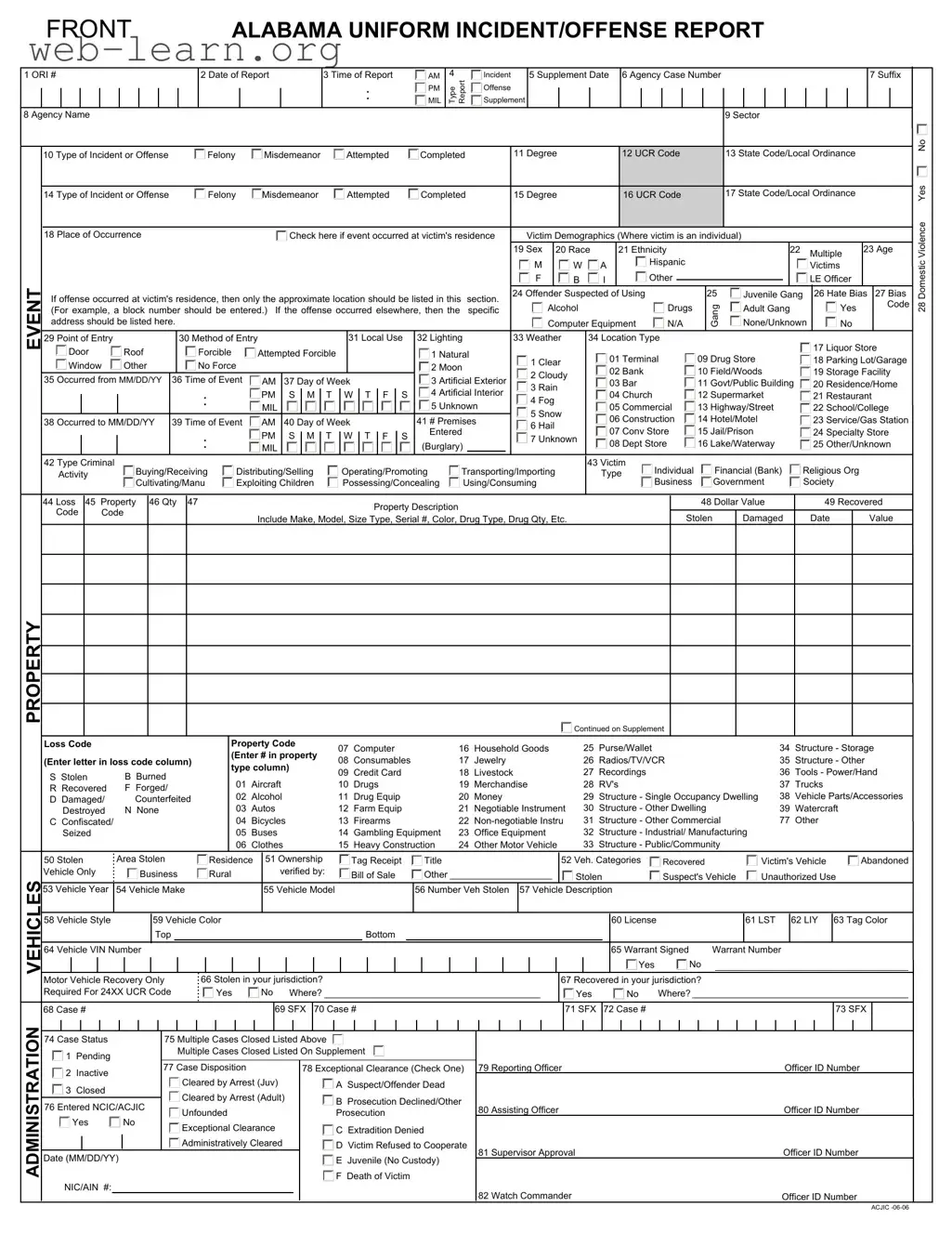
The Alabama Incident Offense Report form is a crucial document used by law enforcement agencies across the state to systematically record details about various incidents and offenses. This form includes essential sections that cover a wide range of information, such as the date and time of the report, the type of incident, and the agency case number. It captures demographic details about victims and offenders, including their age, sex, and race, which helps in understanding the context of the crime. Additionally, the form provides space to describe the nature of the offense, whether it is a felony or misdemeanor, and whether it was attempted or completed. Locations of incidents are meticulously documented, ensuring clarity on where events occurred, whether at a victim's residence or another site. The report also allows for the recording of property involved in the offense, detailing its type, value, and recovery status. Officers are required to include their identification numbers and case status, ensuring accountability and traceability throughout the investigative process. By compiling this comprehensive information, the Alabama Incident Offense Report form aids in law enforcement efforts, supports data collection for crime analysis, and enhances public safety initiatives.
Sample - Alabama Incident Offense Report Form

14 Type of Incident or Offense Felony Misdemeanor Attempted Completed
ALABAMA UNIFORM INCIDENT/OFFENSE REPORT
1 ORI #
2 Date of Report
3 Time of Report
AM
PM
MIL
5 Supplement Date 6 Agency Case Number
Offense
Supplement
:
7 Suffix
8 Agency Name
EVENT
10 Type of Incident or Offense Felony Misdemeanor Attempted Completed
11 Degree
12 UCR Code
16 UCR Code
15 Degree
13 State Code/Local Ordinance
17 State Code/Local Ordinance
18 Place of Occurrence
9 Sector
29 Point of Entry
Door
Window
Roof
Other
30 Method of Entry
Forcible
No Force
Attempted Forcible
35 Occurred from MM/DD/YY
36 Time of Event
AM
:
37 Day of Week
S
S
39 Time of Event
PM
MIL
:
S
T
M
W
F
T
MIL
PM
AM
M
T
W
S
T
F
31 Local Use
32 Lighting
33 Weather
34 Location Type
1 Clear
2 Cloudy
3 Rain
4 Fog
5 Snow
6 Hail
7 Unknown
1 Natural
2 Moon
3 Artificial Exterior
4 Artificial Interior
5 Unknown
VEHICLES
52 Veh. Categories
Stolen
56 Number Veh Stolen
50 Stolen
Vehicle Only
Area Stolen
Business
Residence
Rural
51 Ownership
verified by:
Tag Receipt
Bill of Sale
53 Vehicle Year
54 Vehicle Make
55 Vehicle Model
57 Vehicle Description
64 Vehicle VIN Number
60 License
61 LST 62 LIY 63 Tag Color
58 Vehicle Style
59 Vehicle Color
Top Bottom
Motor Vehicle Recovery Only
Required For 24XX UCR Code
66 Stolen in your jurisdiction?
Where?
67 Recovered in your jurisdiction?
Where?
ADMINISTRATION
74 Case Status
1 Pending
2 Inactive
3 Closed
76 Entered NCIC/ACJIC
Yes
Date (MM/DD/YY)
79 Reporting Officer
Officer ID Number
80 Assisting Officer
Officer ID Number
81 Supervisor Approval
Officer ID Number
82 Watch Commander
Officer ID Number
24 Offender Suspected of Using
Alcohol
Drugs
Computer Equipment
N/A
26 Hate Bias 27 Bias
Code
Yes
No
01 Terminal
02 Bank
03 Bar
04 Church
05 Commercial
06 Construction
07 Conv Store
08 Dept Store
09 Drug Store
10 Field/Woods
11 Govt/Public Building
12 Supermarket
13 Highway/Street
14 Hotel/Motel
15 Jail/Prison
16 Lake/Waterway
17 Liquor Store
18 Parking Lot/Garage
19 Storage Facility
20 Residence/Home
21 Restaurant
22 School/College
23 Service/Gas Station
24 Specialty Store
25 Other/Unknown
41 # Premises
Entered
(Burglary)
Juvenile Gang
42 Type Criminal
Activity
Buying/Receiving Distributing/Selling O Operating/Promoting Transporting/Importing
Cultivating/Manu Exploiting Children Possessing/Concealing Using/Consuming
S Stolen
R Recovered
D Damaged/
Destroyed
C Confiscated/
Seized
01 Aircraft
02 Alcohol
03 Autos
04 Bicycles
05 Buses
06 Clothes
25 Purse/Wallet
26 Radios/TV/VCR
27 Recordings
28 RV's
29 Structure - Single Occupancy Dwelling
30 Structure - Other Dwelling
31 Structure - Other Commercial
32 Structure - Industrial/ Manufacturing
33 Structure - Public/Community
34 Structure - Storage
35 Structure - Other
36 Tools - Power/Hand
37 Trucks
38 Vehicle Parts/Accessories
39 Watercraft
77 Other
44 Loss
Code
Property Code
(Enter # in property
type column)
45 Property
Code
Property Description
Include Make, Model, Size Type, Serial #, Color, Drug Type, Drug Qty, Etc.
43 Victim
Type
Individual Financial (Bank) Religious Org
Business Government Society
Stolen
Damaged
Date
Value
48 Dollar Value
49 Recovered
07 Computer
08 Consumables
09 Credit Card
10 Drugs
11 Drug Equip
12 Farm Equip
13 Firearms
14 Gambling Equipment
15 Heavy Construction
16 Household Goods
17 Jewelry
18 Livestock
19 Merchandise
20 Money
21 Negotiable Instrument
22 Non-negotiable Instru
23 Office Equipment
24 Other Motor Vehicle
46 Qty
38 Occurred to MM/DD/YY
Recovered
Suspect's Vehicle
Victim's Vehicle
Unauthorized Use
Abandoned
65 Warrant Signed Warrant Number
75 Multiple Cases Closed Listed Above
Multiple Cases Closed Listed On Supplement
68 Case #
70 Case #
69 SFX
71 SFX
72 Case #
73 SFX
20 Race
W A
B I
19 Sex
M
F
Victim Demographics (Where victim is an individual)
23 Age
Multiple
Victims
LE Officer
Hispanic
Other
21 Ethnicity
If offense occurred at victim's residence, then only the approximate location should be listed in this section.
(For example, a block number should be entered.) If the offense occurred elsewhere, then the specific
address should be listed here.
Check here if event occurred at victim's residence
Loss Code
(Enter letter in loss code column)
4
Type
Report
22
25
Gang
40 Day of Week
47
ACJIC -06-06
PROPERTY
Continued on Supplement
NIC/AIN #:
B Burned
F Forged/
Counterfeited
N None
28 Domestic Violence Yes No
FRONT
Adult Gang
None/Unknown
Title
Other
No
Yes
No
Yes
No
Yes
No
78 Exceptional Clearance (Check One)
A Suspect/Offender Dead
B Prosecution Declined/Other
Prosecution
C Extradition Denied
D Victim Refused to Cooperate
E Juvenile (No Custody)
F Death of Victim
77 Case Disposition
Cleared by Arrest (Juv)
Cleared by Arrest (Adult)
Unfounded
Exceptional Clearance
Administratively Cleared
THIS SIDE OF FORM IS CONFIDENTIAL UNLESS RELEASED AT THE
DISCRETION OF THE CHIEF LAW ENFORCEMENT OFFICER
83 Date of Report (MM/DD/YY)
84 Time of Report
AM
PM
MIL
85 Agency Case Number
:
86 Suffix
Incident/Offense
Report - Continued
Offender
Suspect
Missing Person
Check if
Multiple
VICTIM INFORMATION
88 Reported By (Last, First, Middle Name)
91 Home Phone
92 Work Phone
95 Victim (Last, First, Middle Name)
97 Address (Street, City, State, Zip)
103 Address (Street, City, State, Zip)
101 Employer/School
102 Occupation
106 Sex
M
F
109 HGT
110 WGT 111 Date of Birth
112 Age
113 Victim SSN
114 Complainant SSN
Resident
Non-Resident
117 Injury
Yes
No
118 Offender known to victim?
Yes No
119 Victim was? (Explain Relationship.)
120 Relationship
Code
121 Weapons Used
Firearm Hands, Fist, Feet, Voice, etc.
Knife Other Dangerous
122 Description of Weapons/Firearms/Tools Used in Offense
Handgun Rifle Shotgun Unknown
Describe:
123 Place of Occurrence (Enter exact street address here.)
125 Sector
126 Circumstances: Homicide & Assault
128 Assault
Simple
Aggravated
129 Treatment for Assault?
130 Verify for Rape Exam?
131 Treatment for Rape?
SUSPECT INFORMATION
WITNESSES
NARRATIVE
I hereby affirm that I have read this report and that all the information given by me is
correct to the best of my knowledge. I will assume full responsibility for notifying
the agency if any stolen property or missing person herein reported is returned.
Signature
211 Local Use
212 State Use
Name (Last, First, Middle)
Date of Birth
200 Witness # 1 SSN
202 Witness # 3 SSN
201 Witness # 2 SSN
209 Add. Cases Closed
Narrative
Y N
204 Continued on Supplement
Yes No
205 Assisting Agency ORI
206 Assisting Agency Case Number
207 SFX
94
Victim #
124
Type
Injury
None Internal Injury Minor Injury Loss of Teeth
Broken Bones Severe Laceration Other Major Injury Unconscious
English
Spanish
Other
Language
93 Other Phone
Contact Telephone Numbers
181 Home
182 Work
189 Home
190 Work
197 Home
198 Work
116 Ethnicity
Other
Multiple
Victims
LE Officer
208 Warrant Signed Warrant #
Victim Or
107 Race
W A
B I
89 Suffix
96
Suffix
W A
B I
W A
B I
W A
B I
Race
Address
183 Other
191 Other
199 Other
Scars Marks Tattoos Amputations
Arrested
Wanted
Dual Arrest (Domestic Violence)
155 Name (Last, First, Middle)
163 Address (Street, City, State, Zip)
168 Probable Destination
173 Clothing
154 Off #
158 Social Security #
156 SFX
162 Age
161 Date of Birth
160 Sex
M
159 Race
W A
B I
157 Alias
167 Language
Spanish
166 Ethnicity Hispanic
Other _____________
Scars Marks Tattoos Amputations
Arrested
Wanted
Dual Arrest (Domestic Violence)
133 Name (Last, First, Middle)
141 Address (Street, City, State, Zip)
146 Probable Destination
151 Clothing
132 Off #
136 Social Security #
134 SFX
140 Age
139 Date of Birth
138 Sex
M F
137 Race
135 Alias
145 Language
Spanish
144 Ethnicity Hispanic
Other _____________
142 HGT 143 WGT
165 WGT
164 HGT
98 Home Phone
99 Work Phone
100 Other Phone
104 Work Phone
105 Other Phone
147 Eye 148 Hair 149 Complexion
150 Armed
169 Eye 170 Hair 171 Complexion
172 Armed
87
90
108
115
152
153
174
175
176
184
192
178
186
194
179
187
195
180
188
196
203
210
Sex
177
M
F
185
193
M
F
M
F
ACJIC -06-06
Hispanic
127 Location: Rape
W A
B I
English
English
Continued on Supplement
BACK
Other
Other
F
Yes
No
Yes
No
Yes
No
No
Yes
Yes
No
No
Yes

Form Information

Fact Name Description
Form Title The form is titled "Alabama Uniform Incident/Offense Report".
Governing Laws This form is governed by Alabama state laws related to crime reporting and data collection.
Incident Types It allows for the classification of incidents as felonies, misdemeanors, attempted, or completed offenses.
Victim Information The form collects demographic information about victims, including sex, race, ethnicity, and age.
Property Loss Reporting Details about property loss, including type, quantity, and dollar value, are required.
Vehicle Information Specific sections are dedicated to reporting stolen vehicles, including make, model, and VIN.
Confidentiality Notice The back side of the form is confidential unless released at the discretion of the chief law enforcement officer.

Detailed Guide for Filling Out Alabama Incident Offense Report

Completing the Alabama Incident Offense Report form is an essential step in documenting incidents that require law enforcement attention. Once you have gathered the necessary information, you can begin filling out the form accurately to ensure a clear record of the event.

  1. Obtain the form: Access the Alabama Uniform Incident/Offense Report form from your local law enforcement agency or their website.
  2. Fill in the ORI number: Enter the Originating Agency Identifier (ORI) number in the designated box.
  3. Provide the date and time: Record the date of the report and the time it was filed, indicating AM or PM.
  4. Describe the incident: Specify the type of incident or offense, including whether it is a felony or misdemeanor, and indicate if it was attempted or completed.
  5. Agency information: Fill in the agency name and the case number assigned by your agency.
  6. Incident details: Note the type of incident, degree, UCR code, and any relevant state code or local ordinance.
  7. Victim demographics: Enter the victim's sex, race, ethnicity, age, and any other relevant information.
  8. Incident location: Specify the place of occurrence, checking the box if it occurred at the victim's residence. Provide the exact address or approximate location as needed.
  9. Details about the offender: Include information about the suspected offender, including any gang affiliations, hate bias, and whether they are known to the victim.
  10. Event timing: Document the date and time when the event occurred, including the day of the week.
  11. Property information: List any property involved, including descriptions, values, and loss codes.
  12. Vehicle details: If applicable, provide details about any vehicles involved, including year, make, model, and license information.
  13. Case status: Indicate the current status of the case and any relevant disposition information.
  14. Officer information: Fill in details about the reporting officer, including their ID number and any assisting officers.
  15. Signature: Finally, sign the report to affirm that the information is accurate to the best of your knowledge.

Obtain Answers on Alabama Incident Offense Report

  1. What is the purpose of the Alabama Incident Offense Report form?

    The Alabama Incident Offense Report form is designed to document incidents involving criminal offenses. Law enforcement agencies use it to record essential details about the crime, including the nature of the offense, victim information, and suspect details. This standardized reporting helps ensure accurate data collection for law enforcement and statistical analysis.

  2. Who is required to fill out this form?

    Typically, law enforcement officers are responsible for completing the Alabama Incident Offense Report. When a crime is reported, the officer on the scene collects relevant information and fills out the form. This ensures that all necessary details are captured in a consistent manner.

  3. What information is included in the report?

    The report includes several sections, such as:

    • Incident details (date, time, and type of offense)
    • Victim demographics (age, race, and sex)
    • Suspect information (if known)
    • Property involved (description, value, and recovery status)
    • Case status and officer information

    Each section aims to provide a comprehensive overview of the incident.

  4. How is victim information recorded?

    Victim demographics are recorded in specific fields. This includes the victim's sex, race, ethnicity, and age. If multiple victims are involved, the report allows for the entry of additional victim information. This data is crucial for understanding the impact of crime on different communities.

  5. What happens if the offense occurred at the victim's residence?

    If the incident took place at the victim's home, the report indicates this by checking a specific box. Only the approximate location is recorded in this case. This approach helps protect the victim's privacy while still documenting the essential details of the crime.

  6. Can the report be used in court?

    Yes, the Alabama Incident Offense Report can be used as evidence in court. It serves as an official record of the incident and may help establish facts related to the case. However, it is essential that the report is completed accurately and truthfully to maintain its credibility.

  7. Is the report confidential?

    Yes, the information contained in the Alabama Incident Offense Report is generally considered confidential. It is only released at the discretion of the chief law enforcement officer. This confidentiality helps protect the privacy of victims and witnesses involved in the case.

  8. What should I do if I notice an error in the report?

    If you notice an error in the Alabama Incident Offense Report, it is important to notify the law enforcement agency that filed the report. They can review the information and make necessary corrections. Accurate reporting is critical for effective law enforcement and community safety.

  9. How can I obtain a copy of the report?

    To obtain a copy of the Alabama Incident Offense Report, you typically need to contact the law enforcement agency that filed the report. There may be specific procedures to follow, and fees may apply. Be prepared to provide identification and any relevant case numbers to facilitate the request.

  10. What is the significance of the UCR Code on the form?

    The UCR Code, or Uniform Crime Reporting Code, categorizes the type of offense. This code is crucial for compiling crime statistics at local, state, and national levels. Accurate coding helps law enforcement agencies track crime trends and allocate resources effectively.

Common mistakes

Filling out the Alabama Incident Offense Report form can be a straightforward task, but several common mistakes can lead to complications. One significant error is failing to provide the correct ORI number. This unique identifier is crucial for tracking the report, and any inaccuracies can hinder the investigation process.

Another common mistake is not accurately indicating the date and time of the report. This information is essential for establishing a timeline. If the date or time is incorrect, it can create confusion regarding when the incident occurred versus when it was reported.

Many people also overlook the importance of specifying the type of incident or offense. Whether it’s a felony or a misdemeanor, marking this correctly helps law enforcement categorize the incident appropriately. Failing to do so can lead to misclassification and potential legal issues.

In the victim demographics section, errors often occur when recording the victim's age or ethnicity. Accurate demographic information is vital for understanding the context of the incident. Misreporting these details can skew statistics and affect community safety measures.

Another frequent oversight involves the place of occurrence. It’s crucial to provide a specific address rather than a vague description. If the location is unclear, it can complicate the investigation and response efforts.

Additionally, individuals sometimes neglect to check the box indicating if the event occurred at the victim’s residence. This detail is important for understanding the context of the crime and can influence the response strategy of law enforcement.

When describing the property involved, many fail to include all necessary details such as the make, model, and serial number. This information is essential for recovering stolen items and can significantly impact the case.

Providing insufficient information about the offender is another mistake. If the offender is known, details such as their name, address, and physical description should be included. Incomplete information can hinder law enforcement's ability to apprehend suspects.

Lastly, individuals often forget to sign the report. A signature is not just a formality; it confirms that the information provided is accurate to the best of the reporter's knowledge. Without a signature, the report may be considered incomplete.

Being aware of these common mistakes can help ensure that the Alabama Incident Offense Report is filled out accurately and efficiently, aiding in effective law enforcement response and community safety.

Documents used along the form

The Alabama Incident Offense Report form is an essential document used by law enforcement agencies to record details about incidents and offenses. In conjunction with this form, several other documents may be utilized to provide additional context and information regarding a case. Below is a list of commonly used forms and documents that complement the Alabama Incident Offense Report.

  • Supplemental Report: This document provides additional details or updates about an ongoing investigation. It may include new witness statements, evidence, or changes in case status.
  • Witness Statement Form: Used to collect detailed accounts from witnesses, this form captures their observations and any relevant information regarding the incident.
  • Victim Impact Statement: This form allows victims to describe how the crime has affected them personally, which can be important for court proceedings and victim support services.
  • Property Receipt: Issued when property is collected as evidence, this document tracks items taken into custody and ensures proper handling and storage.
  • Arrest Report: This report details the circumstances surrounding an arrest, including the suspect's information, charges, and the arresting officer's observations.
  • Search Warrant: This legal document authorizes law enforcement to conduct a search of a specified location for evidence related to a crime.
  • Incident Narrative: A detailed account written by the reporting officer, the narrative provides a comprehensive overview of the incident, including observations and actions taken.
  • Crime Scene Log: This log documents the personnel present at a crime scene and the timeline of events, which is crucial for maintaining the integrity of the investigation.
  • Case Closure Report: This report summarizes the findings of an investigation and indicates whether the case is closed, pending further action, or if charges have been filed.

These documents work together to create a thorough record of incidents and investigations, ensuring that all relevant information is captured and accessible for law enforcement and legal proceedings. Proper documentation is vital for maintaining the integrity of the justice process and supporting victims and witnesses throughout their experiences.

Similar forms

  • Police Report: Similar to the Alabama Incident Offense Report, a police report documents details about a crime, including the time, location, and nature of the incident. Both forms serve as official records that law enforcement uses for investigations and court proceedings.
  • Incident Report: An incident report captures the specifics of any event that requires police attention, such as accidents or disturbances. Like the Alabama form, it includes information about involved parties and the nature of the incident, ensuring a comprehensive account is available for reference.
  • Victim Impact Statement: This document allows victims to express how a crime has affected their lives. While the Alabama form focuses on the incident itself, both documents are crucial for understanding the broader implications of a crime on individuals and communities.
  • Arrest Report: An arrest report details the circumstances surrounding an arrest, including the suspect's information and the charges filed. Similar to the Alabama report, it provides a structured format for law enforcement to convey essential information about the case.
  • Case File: A case file compiles all documents related to a specific investigation, including witness statements, evidence logs, and reports. The Alabama Incident Offense Report serves as a foundational component of the case file, summarizing key details that guide further investigation.
  • Crime Statistics Report: This report aggregates data on various crimes within a jurisdiction, often used for analysis and policy-making. While the Alabama form captures specific incidents, both types of documents contribute to understanding crime trends and law enforcement effectiveness.

Dos and Don'ts

When filling out the Alabama Incident Offense Report form, it is important to adhere to certain guidelines to ensure accuracy and completeness. Below is a list of recommended practices and common pitfalls to avoid:

  • Do provide accurate and detailed information for each section of the form.
  • Do use clear and legible handwriting if filling out the form by hand.
  • Do double-check all dates and times for accuracy.
  • Do include all relevant details about the incident, including location and type of offense.
  • Don't leave any required fields blank; ensure all necessary information is filled in.
  • Don't use abbreviations or jargon that may not be understood by all readers.
  • Don't provide personal opinions or assumptions; stick to the facts of the incident.
  • Don't forget to sign and date the report to validate its authenticity.

Misconceptions

Misconceptions about the Alabama Incident Offense Report form can lead to confusion and errors in reporting. Here are nine common misconceptions, along with clarifications:

  • Misconception 1: The form is only for serious crimes.
  • In reality, the Alabama Incident Offense Report can be used for both felony and misdemeanor incidents. It is designed to capture a wide range of offenses, not just the most severe ones.

  • Misconception 2: Only law enforcement officers can fill out the form.
  • While law enforcement officers typically complete the report, victims or witnesses can provide information that assists in filling it out. Collaboration is encouraged to ensure accuracy.

  • Misconception 3: The report is confidential and cannot be accessed by the public.
  • Though certain sections are confidential, many parts of the report are public records. This means that individuals may request access to specific information under state laws.

  • Misconception 4: All incidents must be reported immediately.
  • While timely reporting is important, there can be circumstances where a report may be filed later. However, it is advisable to report incidents as soon as possible for accuracy and thoroughness.

  • Misconception 5: The report is only for physical crimes.
  • The form is versatile and can be used for various types of incidents, including financial crimes, drug offenses, and even domestic violence. It captures a broad spectrum of criminal activity.

  • Misconception 6: Victim information is not essential for the report.
  • Victim demographics are crucial for understanding the context of the crime and for statistical purposes. Including accurate victim information helps law enforcement address crime trends effectively.

  • Misconception 7: The report can be completed without specific details.
  • Completing the report requires detailed information, including the nature of the incident, involved parties, and circumstances. Vague or incomplete reports can hinder investigations.

  • Misconception 8: There is no need for supervisor approval.
  • Supervisor approval is often necessary to validate the report and ensure that all required information has been accurately captured. This step is vital for maintaining the integrity of the reporting process.

  • Misconception 9: The form is static and does not change.
  • The Alabama Incident Offense Report form may undergo updates to reflect changes in laws, reporting requirements, or best practices. Staying informed about these changes is essential for accurate reporting.

Key takeaways

Filling out the Alabama Incident Offense Report form requires careful attention to detail. Here are key takeaways to keep in mind:

  • ORI Number: Always include the Originating Agency Identifier (ORI) number at the top of the form.
  • Accurate Dates and Times: Enter the date and time of the report accurately. This is crucial for record-keeping.
  • Incident Type: Clearly specify the type of incident or offense, indicating whether it is a felony or misdemeanor.
  • Victim Information: Collect and input comprehensive victim demographics, including age, sex, and race.
  • Location Details: Provide precise location details for the incident. If it occurred at the victim's residence, note that appropriately.
  • Property Loss: Document any property loss, including descriptions and estimated dollar values.
  • Offender Information: Include as much information as possible about the offender, including any known aliases or physical descriptions.
  • Review and Verify: Before submitting, review the report for accuracy. Ensure all necessary fields are completed.

These takeaways can help ensure that the report is thorough and useful for law enforcement and legal proceedings.