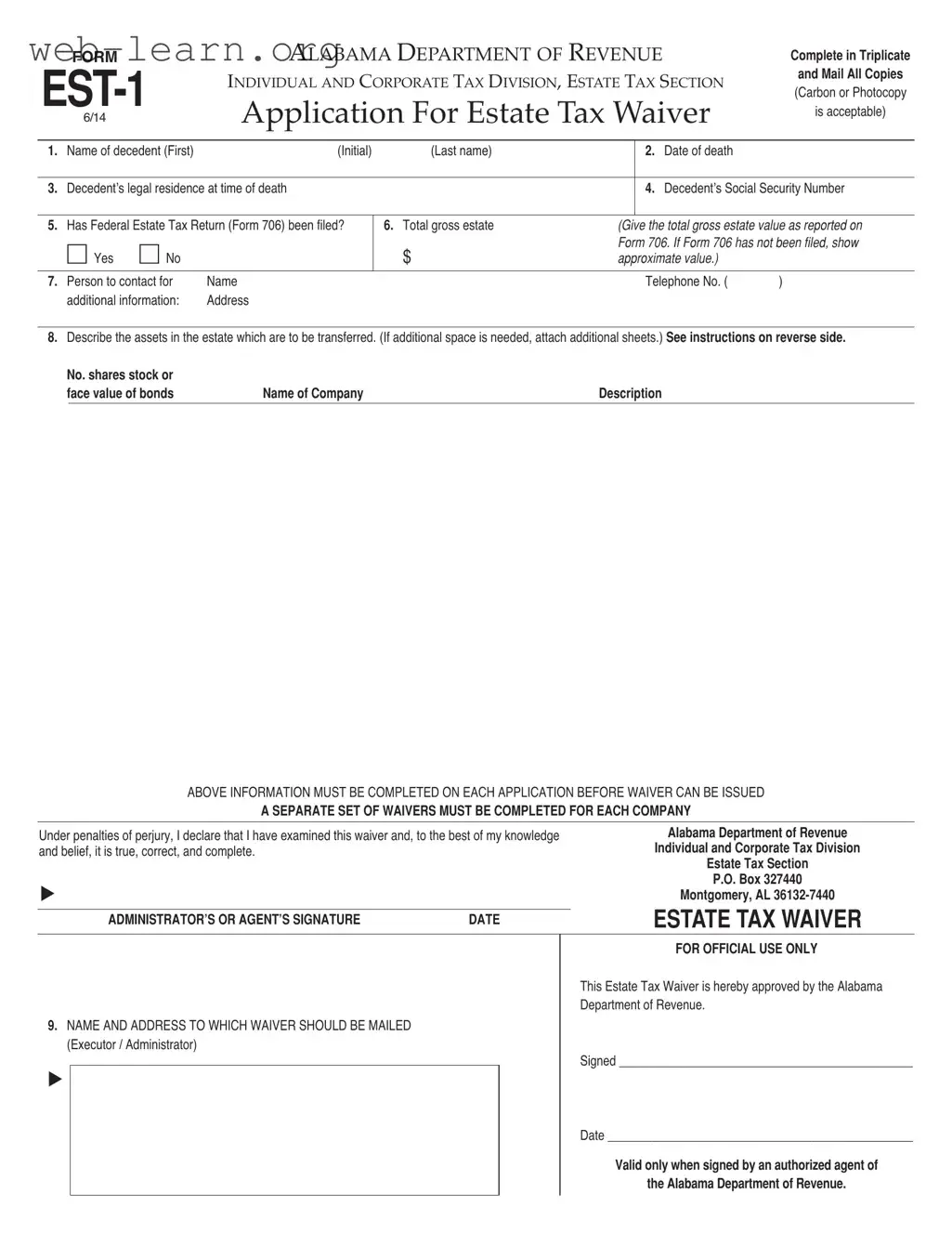
Homepage Blank Alabama Est 1 Form
Outline

The Alabama Est 1 form serves as a crucial document for individuals and corporations seeking an estate tax waiver from the Alabama Department of Revenue. This application must be completed in triplicate, ensuring that all copies are submitted to the appropriate tax division. Key information required includes the name of the decedent, their date of death, and legal residence at the time of passing. Additionally, the form prompts applicants to provide the decedent's Social Security Number and details about whether a Federal Estate Tax Return (Form 706) has been filed. A significant aspect of the form is the total gross estate value, which must be reported accurately. Applicants must also describe the assets in the estate intended for transfer, such as stocks, bonds, annuities, and real property. Each asset requires specific details to ensure clarity and compliance. Furthermore, the form mandates the signature of the administrator or agent, affirming the truthfulness of the information provided. After submission, the Alabama Department of Revenue will review the application, and if approved, return the original and one copy to the applicant, facilitating the estate's tax waiver process.


Sample - Alabama Est 1 Form

   
      

FORM
EST-1
6/14
1. Name of decedent (First) (Initial) (Last name) 2. Date of death
3. Decedent’s legal residence at time of death 4. Decedent’s Social Security Number
5. Has Federal Estate Tax Return (Form 706) been filed? 6. Total gross estate (Give the total gross estate value as reported on
Form 706. If Form 706 has not been filed, show
Yes
No $ approximate value.)
7. Person to contact for Name Telephone No. ( )
additional information: Address
8. Describe the assets in the estate which are to be transferred. (If additional space is needed, attach additional sheets.) See instructions on reverse side.
No. shares stock or
face value of bonds Name of Company Description
Complete in Triplicate
and Mail All Copies
(Carbon or Photocopy
is acceptable)
ABOVE INFORMATION MUST BE COMPLETED ON EACH APPLICATION BEFORE WAIVER CAN BE ISSUED
A SEPARATE SET OF WAIVERS MUST BE COMPLETED FOR EACH COMPANY
Under penalties of perjury, I declare that I have examined this waiver and, to the best of my knowledge
and belief, it is true, correct, and complete.
ADMINISTRATOR’S OR AGENT’S SIGNATURE DATE
Alabama Department of Revenue
Individual and Corporate Tax Division
Estate Tax Section
P.O. Box 327440
Montgomery, AL 36132-7440
ESTATE TAX WAIVER
9. NAME AND ADDRESS TO WHICH WAIVER SHOULD BE MAILED
(Executor / Administrator)
FOR OFFICIAL USE ONLY
This Estate Tax Waiver is hereby approved by the Alabama
Department of Revenue.
Signed ______________________________________________
Date ________________________________________________
Valid only when signed by an authorized agent of
the Alabama Department of Revenue.
LINES 1 through 7. 

LINE 8. 


(A) Stocks and Bonds. (1) (2) 
(3) 
(4) 


Example:
410 Shares – ABC Corporation – Common
John R. Doe and Mary Doe with right of survivorship
(B) Annuity Contract or Life Insurance Policy. (1) 
(2) 

(3) 
(4) 

(5) 
Examples:
ABC Insurance Company – Retirement Annuity Contract #12345
$3,840.00 Beneficiary Mary Doe
XYZ Insurance Company – Life Insurance Policy #67890
$5,850 Beneficiary John Smith
(C) Real Property. (1) 
(2)

Example:
Montgomery County, Lot 1, according to the map of John P. Jones
Survey, as recorded in Map Book 25 at page 8 in the office of the
Judge of Probate, Montgomery, Alabama, Jointly held property,
Co-Tenant Mary R. Doe.
LINE 9. 

must 




Mail The Original And 2 Copies
Of This Application To:
Alabama Department of Revenue
Individual and Corporate Tax Division
Estate Tax Section
P.O. Box 327440
Montgomery, AL 36132-7440



Form Information

Fact Name Details
Form Title Application for Estate Tax Waiver (Form EST-1)
Governing Law Alabama Code Title 40, Chapter 23, Article 2
Filing Requirement Must be completed in triplicate and mailed to the Alabama Department of Revenue.
Decedent Information Includes name, date of death, legal residence, and Social Security number.
Federal Estate Tax Return Questions if Form 706 has been filed, with options for yes or no.
Gross Estate Value Total gross estate value must be provided as reported on Form 706 or an approximate value.
Contact Information Requires name and telephone number of the person to contact for additional information.
Asset Description Details on assets to be transferred must be described, with space for additional sheets if necessary.
Signature Requirement Must be signed by the administrator or agent, declaring the information is true and correct.
Mailing Address Waiver should be mailed to the executor or administrator's specified address.

Detailed Guide for Filling Out Alabama Est 1

Filling out the Alabama Est 1 form is a straightforward process. After completing the form, you will need to mail all copies to the Alabama Department of Revenue. Make sure to provide accurate information, as this will help expedite the processing of your application.

  1. Begin with the decedent's name. Fill in the first name, middle initial, and last name in the designated fields.
  2. Next, enter the date of death. Ensure the format is clear and correct.
  3. Provide the decedent's legal residence at the time of death. This should be the full address.
  4. Input the decedent’s Social Security Number in the specified area.
  5. Indicate whether a Federal Estate Tax Return (Form 706) has been filed by selecting "Yes" or "No."
  6. If Form 706 has been filed, report the total gross estate value as shown on that form. If not, provide an approximate value.
  7. List the name and telephone number of the person to contact for additional information. Include their address as well.
  8. Describe the assets in the estate that are to be transferred. Provide details for stocks, bonds, annuities, life insurance policies, and real property. If more space is needed, attach additional sheets.
  9. Complete the name and address section where the waiver should be mailed. This should be for the executor or administrator.
  10. Sign and date the form, confirming that the information is accurate to the best of your knowledge.

After completing these steps, mail the original and two copies of the form to the Alabama Department of Revenue at the provided address. If you have any questions, reach out to the Estate Tax Section for assistance.

Obtain Answers on Alabama Est 1

  1. What is the purpose of the Alabama EST-1 form?

    The Alabama EST-1 form is an application for an estate tax waiver. This form is required when the estate of a deceased individual needs to be settled and assets are to be transferred. It ensures that the Alabama Department of Revenue has the necessary information to process the waiver for estate tax obligations.

  2. Who needs to complete the EST-1 form?

    The form must be completed by the executor or administrator of the estate. This individual is responsible for managing the estate’s affairs and ensuring that all legal obligations, including tax waivers, are met. It is crucial that the form is filled out accurately to avoid delays in processing.

  3. What information is required on the EST-1 form?

    The form requires several key pieces of information:

    • Name of the decedent
    • Date of death
    • Decedent’s legal residence at the time of death
    • Decedent’s Social Security Number
    • Whether a Federal Estate Tax Return (Form 706) has been filed
    • Total gross estate value
    • Contact information for further inquiries
    • Description of assets in the estate

    All of this information must be provided to process the waiver efficiently.

  4. How many copies of the EST-1 form need to be submitted?

    The EST-1 form must be completed in triplicate. This means three copies of the application need to be filled out and mailed to the Alabama Department of Revenue. Each copy serves a specific purpose in the processing of the estate tax waiver.

  5. What happens after the EST-1 form is submitted?

    Once the form is submitted, the Alabama Department of Revenue will review the application. If approved, the original form and one copy will be returned to the executor or administrator. This approval signifies that the estate tax waiver has been granted, allowing for the transfer of assets.

  6. Where should the EST-1 form be mailed?

    The completed EST-1 form should be mailed to the following address:

    Alabama Department of Revenue
    Individual and Corporate Tax Division
    Estate Tax Section
    P. O. Box 327440
    Montgomery, AL 36132-7440

    It is important to ensure that the form is sent to the correct address to avoid processing delays.

Common mistakes

Filling out the Alabama EST-1 form can be daunting, but avoiding common mistakes can make the process smoother. One frequent error is neglecting to complete all required fields. Each section of the form is crucial. If you leave out even a single detail, it could delay the processing of your application. Always double-check that you have filled in every box, especially the decedent's name and Social Security number.

Another common pitfall is failing to provide accurate information about the decedent's legal residence at the time of death. This detail is essential for the state to determine jurisdiction and tax obligations. Make sure to verify the address and include it correctly. Inaccuracies can lead to complications or even rejections of your application.

Many applicants also overlook the importance of the Federal Estate Tax Return (Form 706). If this form has not been filed, you must provide an approximate value of the total gross estate. Omitting this information or providing vague estimates can raise red flags and slow down the approval process. Clarity and precision are your allies here.

Additionally, when describing the assets in the estate, applicants often provide insufficient details. Each asset should be clearly identified, including the number of shares for stocks or the legal description for real property. Vague descriptions can lead to misunderstandings. For instance, saying "some stocks" is not enough; specify the number of shares and the company name.

Another mistake is not providing the name and contact information of a person who can offer additional information. This section is vital for the processing team to reach out if they have questions. Leaving it blank can cause unnecessary delays. Make sure to include a reliable contact with a phone number and address.

People sometimes forget to sign the application. The declaration at the end of the form requires the administrator’s or agent’s signature. Without it, the application is incomplete. It’s a simple step, but one that can easily slip through the cracks when you're focused on filling out the rest of the form.

Moreover, failing to make copies of the completed application is a common oversight. Remember, you need to submit the form in triplicate. Keeping a copy for your records is not just good practice; it can be invaluable if questions arise later.

Lastly, applicants often misinterpret the mailing instructions. Ensure you send all three copies to the correct address and confirm that they are properly sealed and stamped. A simple mistake in mailing can lead to significant delays in processing your application.

By being mindful of these common mistakes, you can navigate the Alabama EST-1 form with greater ease and confidence. Attention to detail will help ensure that your application is processed efficiently, allowing you to focus on what truly matters during a challenging time.

Documents used along the form

The Alabama EST-1 form serves as an essential document for individuals and corporations dealing with estate taxes in Alabama. When completing this form, several other documents may also be required to ensure compliance with state regulations. Below is a list of forms and documents that are commonly used alongside the Alabama EST-1 form, along with a brief description of each.

  • Form 706: This is the Federal Estate Tax Return. It is required for estates that exceed a certain value threshold. This form provides the IRS with information about the decedent's assets and any applicable deductions.
  • Form 1041: This is the U.S. Income Tax Return for Estates and Trusts. It is used to report income generated by the estate during the administration period and is filed annually until the estate is closed.
  • Death Certificate: This official document verifies the decedent's death and is often required for various legal processes, including the transfer of assets.
  • Will: The decedent’s last will and testament outlines how their assets should be distributed. It is a crucial document for probate proceedings.
  • Letters Testamentary: Issued by the probate court, this document grants the executor the authority to act on behalf of the estate, including managing assets and paying debts.
  • Inventory of Assets: This document lists all assets owned by the decedent at the time of death, including real estate, bank accounts, and personal property. It is essential for assessing the total estate value.
  • Tax Waiver Requests: Separate requests may be needed for waivers from various tax authorities, depending on the nature of the estate's assets and their locations.
  • Beneficiary Designations: These forms specify who will receive certain assets, such as life insurance policies or retirement accounts, and can impact the estate's overall distribution.
  • Trust Documents: If the decedent established a trust, these documents detail the terms of the trust and how assets should be managed and distributed after death.
  • Power of Attorney: If applicable, this document grants someone the authority to act on behalf of the decedent in financial or legal matters prior to their death, which can influence estate management.

Understanding the various documents that may accompany the Alabama EST-1 form can facilitate a smoother process in estate administration. Each document plays a unique role in ensuring that the estate is managed according to the decedent's wishes and in compliance with legal requirements.

Similar forms

The Alabama EST-1 form, which is used to apply for an estate tax waiver, shares similarities with several other documents related to estate management and taxation. Below is a list of eight such documents, highlighting how they are similar to the EST-1 form:

  • Federal Estate Tax Return (Form 706): This form is required to report the value of a deceased person's estate for federal tax purposes. Like the EST-1, it collects information about the decedent's assets and liabilities.
  • State Estate Tax Return: Similar to the EST-1, this document is used to report the estate's value to state authorities, ensuring compliance with state tax laws.
  • Application for Probate: This document initiates the legal process to validate a will. Both forms require details about the decedent and their estate assets.
  • Inventory of Estate Assets: This document lists all assets owned by the decedent at the time of death. Like the EST-1, it provides a detailed account of the estate's contents.
  • Will: The will outlines how the decedent wished to distribute their assets. Both the will and the EST-1 require information about the decedent's assets and beneficiaries.
  • Tax Clearance Certificate: This document certifies that all estate taxes have been paid. It is similar to the EST-1 in that it deals with tax obligations related to the estate.
  • Affidavit of Heirship: This document establishes the heirs of the decedent. Like the EST-1, it involves identifying individuals who have rights to the estate.
  • Transfer on Death Deed: This deed allows for the transfer of property upon death without going through probate. It shares the goal of facilitating the transfer of assets, similar to the purpose of the EST-1.

Dos and Don'ts

When filling out the Alabama EST-1 form, there are several important dos and don'ts to keep in mind. Following these guidelines can help ensure that your application is processed smoothly.

  • Do complete the form in triplicate. All three copies must be mailed to the Alabama Department of Revenue.
  • Do provide accurate information for each line. Ensure that details such as the decedent's name, date of death, and Social Security number are correct.
  • Do describe the assets clearly. Include specifics like the number of shares, company names, and types of assets.
  • Do sign the form. The application must be signed by the administrator or agent before submission.
  • Do include the name and address for the waiver's return. This information should be entered on line 9 of the form.
  • Don't forget to attach additional sheets if necessary. If you need more space to describe assets, do not hesitate to include extra pages.
  • Don't leave any required fields blank. Each section of the form must be filled out completely to avoid delays.
  • Don't submit the form without reviewing it first. Double-check for any errors or omissions before mailing it.
  • Don't mix up the copies. Ensure that the original and two copies are clearly marked and organized for submission.
  • Don't hesitate to contact the Estate Tax Section if you have questions. Their phone number is (334) 242-1000, and they can provide assistance as needed.

Misconceptions

Understanding the Alabama EST-1 form is crucial for those navigating estate tax waivers. However, several misconceptions can lead to confusion. Here are seven common misunderstandings:

  • Misconception 1: The EST-1 form is only for large estates.
  • This is not true. The form applies to any estate that requires a tax waiver, regardless of its size.

  • Misconception 2: Only attorneys can fill out the EST-1 form.
  • While legal assistance can be beneficial, anyone with the necessary information can complete the form.

  • Misconception 3: You can submit the form without all the required information.
  • All sections must be completed for the waiver to be processed. Incomplete applications will delay approval.

  • Misconception 4: The EST-1 form is only needed if a Federal Estate Tax Return has been filed.
  • The form is necessary even if the Federal Estate Tax Return (Form 706) has not been filed, as approximate values must still be reported.

  • Misconception 5: Once submitted, the form cannot be amended.
  • Amendments can be made, but it’s best to ensure accuracy before submission to avoid complications.

  • Misconception 6: You only need to submit one copy of the EST-1 form.
  • Three copies must be submitted in triplicate to the Alabama Department of Revenue for processing.

  • Misconception 7: The waiver is automatically approved once the form is submitted.
  • Approval is not guaranteed. The form must be reviewed and signed by an authorized agent before the waiver is issued.

By clarifying these misconceptions, individuals can approach the EST-1 form with greater confidence and understanding.

Key takeaways

When filling out the Alabama EST-1 form, it is important to follow specific guidelines to ensure a smooth process. Here are key takeaways to keep in mind:

  • Complete in Triplicate: You must fill out three copies of the EST-1 form and mail all of them to the Alabama Department of Revenue.
  • Decedent Information: Provide the full name, date of death, legal residence, and Social Security number of the decedent. Accuracy is crucial.
  • Federal Estate Tax Return: Indicate whether a Federal Estate Tax Return (Form 706) has been filed. This information is essential for processing your application.
  • Total Gross Estate: Report the total gross estate value as stated on Form 706. If you haven’t filed this form, provide an approximate value instead.
  • Contact Information: Include the name and telephone number of a person who can provide additional information if needed.
  • Asset Description: Clearly describe the assets in the estate that are to be transferred. Use additional sheets if necessary.
  • Separate Waivers: Remember, a separate set of waivers is required for each company involved in the estate.
  • Signature Requirement: The application must be signed by the administrator or agent, declaring that the information is true and complete.
  • Mailing Instructions: Ensure that you mail the original and two copies of the application to the specified address in Montgomery, Alabama.
  • Contact for Questions: If you have any questions about completing or submitting the application, reach out to the Estate Tax Section at (334) 242-1000.

Following these steps will help ensure that your application for the estate tax waiver is processed efficiently and without delays.