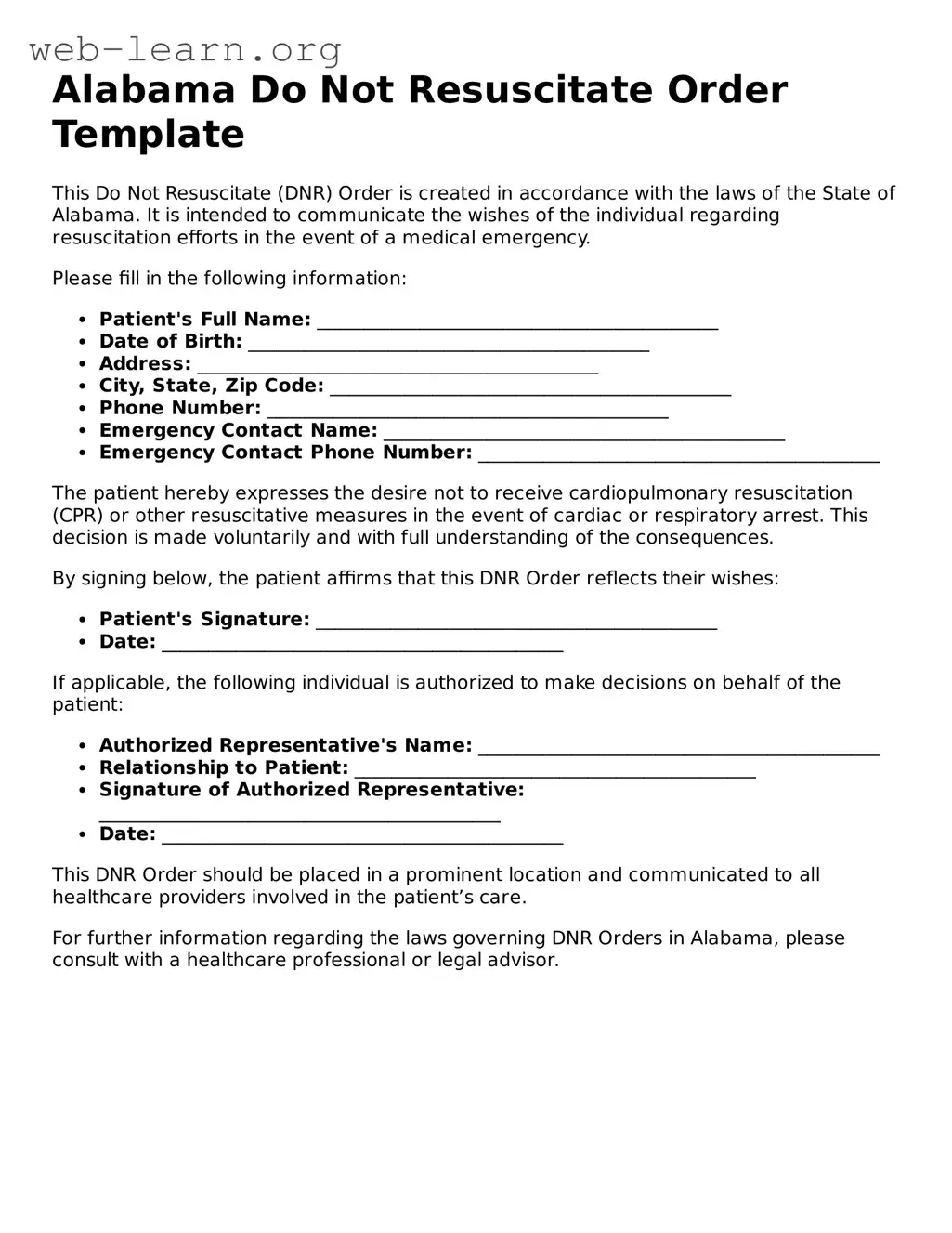
In Alabama, the Do Not Resuscitate (DNR) Order form serves as a vital tool for individuals who wish to express their preferences regarding end-of-life medical care. This document allows patients to communicate their desire to forgo resuscitation efforts in the event of a cardiac arrest or respiratory failure. By completing this form, individuals can ensure that their wishes are respected, relieving family members and healthcare providers from the burden of making difficult decisions during emotionally charged moments. The DNR Order must be signed by a physician and includes essential information such as the patient’s name, date of birth, and the signatures of both the patient and the physician. Additionally, it is important for individuals to understand that the DNR Order is not a one-size-fits-all solution; it should be discussed thoroughly with loved ones and healthcare professionals to align it with personal values and medical circumstances. By taking these steps, patients can navigate their healthcare choices with clarity and confidence, making their preferences known in a compassionate and legally recognized manner.
Alabama Do Not Resuscitate Order Template
This Do Not Resuscitate (DNR) Order is created in accordance with the laws of the State of Alabama. It is intended to communicate the wishes of the individual regarding resuscitation efforts in the event of a medical emergency.
Please fill in the following information:
The patient hereby expresses the desire not to receive cardiopulmonary resuscitation (CPR) or other resuscitative measures in the event of cardiac or respiratory arrest. This decision is made voluntarily and with full understanding of the consequences.
By signing below, the patient affirms that this DNR Order reflects their wishes:
If applicable, the following individual is authorized to make decisions on behalf of the patient:
This DNR Order should be placed in a prominent location and communicated to all healthcare providers involved in the patient’s care.
For further information regarding the laws governing DNR Orders in Alabama, please consult with a healthcare professional or legal advisor.
| Fact Name | Description |
|---|---|
| Definition | The Alabama Do Not Resuscitate Order (DNR) form allows individuals to refuse resuscitation efforts in case of a medical emergency. |
| Governing Law | The DNR is governed by Alabama Code § 22-8A-1 et seq., which outlines the legal framework for advance directives. |
| Eligibility | Any adult can complete a DNR order, provided they are of sound mind and understand the implications of the decision. |
| Signature Requirement | The DNR form must be signed by the individual or their legally authorized representative. |
| Witnesses | Two witnesses must sign the form, confirming that they observed the individual or representative signing the document. |
| Healthcare Provider Involvement | A physician must sign the DNR order, validating its medical necessity and ensuring it aligns with the patient's wishes. |
| Revocation | The DNR order can be revoked at any time by the individual or their representative, either verbally or in writing. |
| Placement | It is recommended to keep the DNR order in an easily accessible location, such as on the refrigerator or with medical records. |
| Emergency Medical Services | Emergency medical personnel are required to honor a valid DNR order during an emergency situation. |
| Additional Considerations | Individuals should discuss their wishes with family members and healthcare providers to ensure everyone understands their decisions. |
Completing the Alabama Do Not Resuscitate Order form is an important step in expressing your healthcare preferences. After filling out the form, it will need to be signed and witnessed to ensure its validity. This process helps ensure that your wishes regarding medical treatment are respected in emergency situations.
What is a Do Not Resuscitate (DNR) Order in Alabama?
A Do Not Resuscitate Order is a legal document that allows individuals to express their wishes regarding resuscitation efforts in the event of a medical emergency. In Alabama, this order instructs healthcare providers not to perform cardiopulmonary resuscitation (CPR) or other life-saving measures if a person’s heart stops beating or they stop breathing.
Who can request a DNR Order?
In Alabama, a DNR Order can be requested by an individual who is at least 18 years old and has the capacity to make healthcare decisions. If the individual is unable to make decisions, a legally authorized representative, such as a family member or guardian, may request the order on their behalf.
How do I obtain a DNR Order in Alabama?
To obtain a DNR Order, you must fill out the official Alabama DNR Order form. This form can typically be acquired from healthcare providers, hospitals, or online through state health department resources. After completing the form, it should be signed by a physician and kept in an accessible location, such as with other important medical documents.
What should I do with my DNR Order once it is completed?
Once your DNR Order is completed and signed, it is crucial to keep it in a location where emergency medical personnel can easily find it. Many individuals choose to keep a copy in their medical records, with family members, or on their refrigerator. Informing family and friends about your DNR Order is also important, as they can help ensure your wishes are respected in an emergency situation.
Can a DNR Order be revoked?
Yes, a DNR Order can be revoked at any time. If you decide to change your mind, you can do so verbally or by destroying the existing DNR Order form. It is advisable to inform your healthcare provider and family members of the revocation to avoid any confusion during a medical emergency.
Filling out the Alabama Do Not Resuscitate (DNR) Order form is a critical task that requires careful attention. Many individuals make common mistakes that can lead to confusion or unintended consequences. Understanding these pitfalls can help ensure that the form accurately reflects a person's wishes.
One frequent mistake is not including the patient's full legal name. Omitting this detail can create ambiguity and may lead to difficulties in enforcing the DNR order. Always ensure that the name matches official identification documents.
Another error occurs when the form is not signed by the appropriate parties. In Alabama, the DNR order must be signed by the patient or their legal representative. Failing to obtain the necessary signatures can invalidate the order.
People often overlook the importance of including the date on the form. Without a date, it can be unclear when the order was established. This oversight can complicate matters for healthcare providers who need to determine the order's validity.
In some cases, individuals forget to provide contact information for the physician who signed the order. This information is crucial for healthcare providers who may need to verify the DNR order or discuss the patient's wishes further.
Another common mistake is not keeping copies of the completed form. It's essential to distribute copies to healthcare providers, family members, and keep one in a readily accessible location. Without copies, the DNR order may not be honored in an emergency.
Some individuals mistakenly believe that the DNR order covers all medical interventions. However, it specifically addresses resuscitation efforts. Clarifying the scope of the order is vital to ensure that it aligns with the patient's overall healthcare preferences.
Failing to review the form periodically is another oversight. As health conditions change, so may a person's wishes regarding resuscitation. Regularly revisiting the DNR order ensures it remains relevant and accurate.
In addition, individuals sometimes neglect to discuss their wishes with family members. Open communication can prevent confusion and ensure that loved ones understand the patient's preferences regarding end-of-life care.
Lastly, people may not realize that the DNR order must be easily accessible in emergency situations. Keeping the form in a visible location, such as on the refrigerator or with other important documents, can help ensure that it is honored when needed.
In Alabama, the Do Not Resuscitate (DNR) Order form is an essential document for individuals who wish to express their preferences regarding resuscitation efforts in medical emergencies. Alongside the DNR, several other forms and documents can help clarify healthcare decisions and ensure that an individual’s wishes are respected. Below is a list of these important documents.
Each of these documents plays a crucial role in ensuring that individuals’ healthcare preferences are honored. By having these forms in place, one can navigate complex medical situations with greater clarity and peace of mind.
The Do Not Resuscitate (DNR) Order form is an important document for individuals who wish to outline their preferences regarding medical treatment in emergencies. Here are five documents that are similar to the DNR Order form:
When filling out the Alabama Do Not Resuscitate Order form, it is essential to follow specific guidelines to ensure the document is valid and accurately reflects the patient's wishes. Here are ten things to consider:
This is not true. A Do Not Resuscitate Order specifically applies to resuscitation efforts during cardiac or respiratory arrest. It does not prevent other forms of medical care or treatment.
This misconception is widespread. In Alabama, anyone can request a Do Not Resuscitate Order, regardless of their health status. It is a personal choice based on individual values and preferences.
In reality, a Do Not Resuscitate Order can be revoked or modified at any time. Patients or their legal representatives can make changes based on evolving health circumstances or personal decisions.
This is incorrect. In Alabama, a Do Not Resuscitate Order is valid in all healthcare settings, including homes, nursing facilities, and emergency situations, provided it is properly completed and signed.
Family members cannot unilaterally decide on a Do Not Resuscitate Order. The order must be signed by the patient or their legally authorized representative, ensuring that the patient's wishes are respected.
When filling out and using the Alabama Do Not Resuscitate Order form, consider the following key takeaways:
Dnr Hospital - Patients may want to discuss their DNR wishes with their healthcare team during routine check-ups.
Printable Dnr - Healthcare providers are required to honor a valid DNR order as part of their ethical obligations.
Free Printable Dnr Form - Patients may choose to include specific instructions regarding their care in conjunction with a Do Not Resuscitate Order.
Can You Get a Dnr at Any Age - Emergency medical technicians (EMTs) must follow the DNR order when responding to a call.