The Alabama Deed form is a crucial document in real estate transactions, playing a significant role in the transfer of property ownership. This form typically includes essential details such as the names of the parties involved, a description of the property being transferred, and the consideration paid for the property. Understanding the various types of deeds—such as warranty deeds, quitclaim deeds, and special warranty deeds—is vital, as each serves different purposes and offers varying levels of protection to the buyer. Additionally, the form must be signed by the grantor, and in many cases, a notary public is required to validate the signatures. Proper completion of the Alabama Deed form is essential to ensure a smooth transfer process and to avoid potential disputes in the future. Filing the deed with the appropriate county office is also necessary to make the transfer official and to protect the interests of all parties involved.
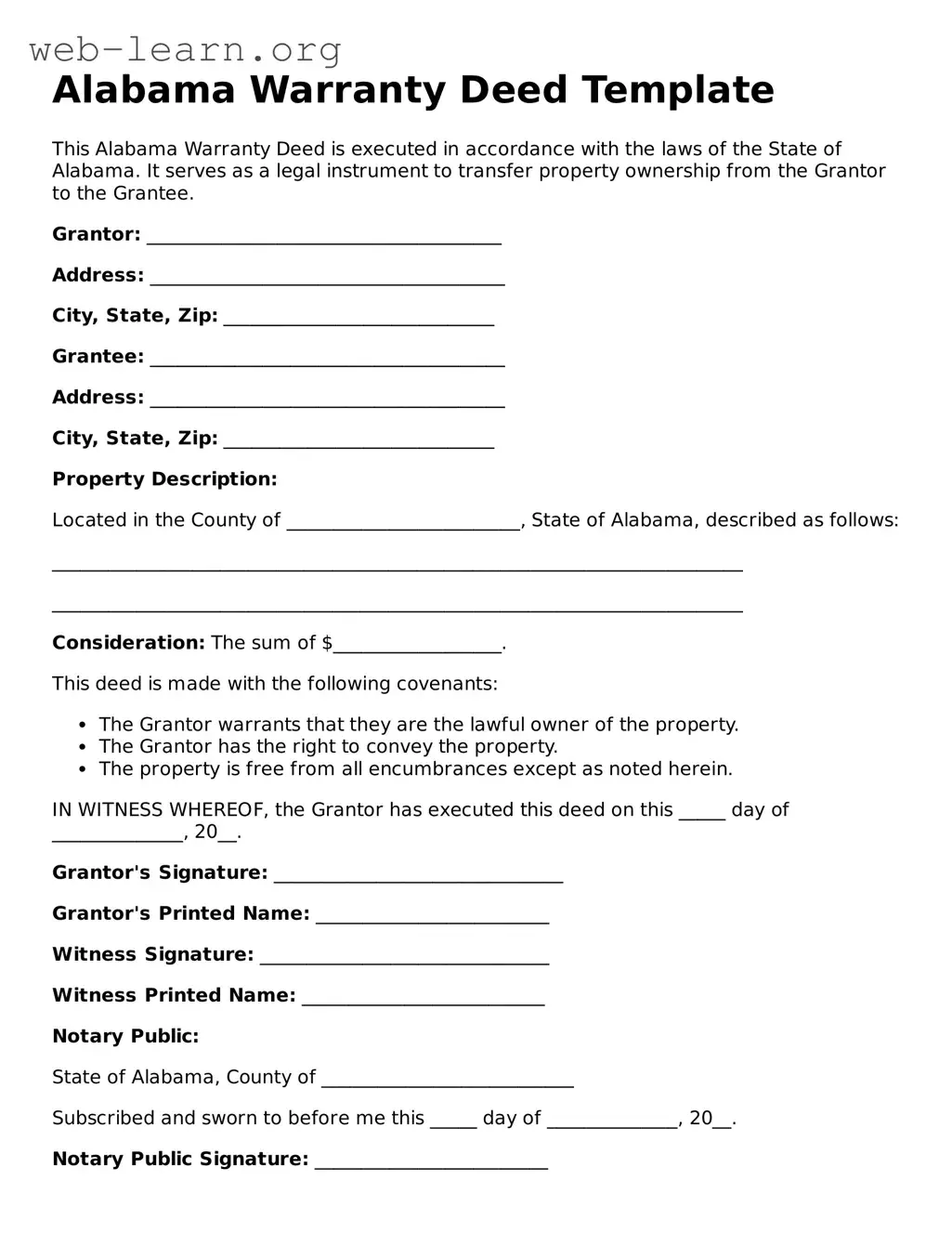
Alabama Warranty Deed Template
This Alabama Warranty Deed is executed in accordance with the laws of the State of Alabama. It serves as a legal instrument to transfer property ownership from the Grantor to the Grantee.
Grantor: ______________________________________
Address: ______________________________________
City, State, Zip: _____________________________
Grantee: ______________________________________
Address: ______________________________________
City, State, Zip: _____________________________
Property Description:
Located in the County of _________________________, State of Alabama, described as follows:
__________________________________________________________________________
__________________________________________________________________________
Consideration: The sum of $__________________.
This deed is made with the following covenants:
IN WITNESS WHEREOF, the Grantor has executed this deed on this _____ day of ______________, 20__.
Grantor's Signature: _______________________________
Grantor's Printed Name: _________________________
Witness Signature: _______________________________
Witness Printed Name: __________________________
Notary Public:
State of Alabama, County of ___________________________
Subscribed and sworn to before me this _____ day of ______________, 20__.
Notary Public Signature: _________________________
My Commission Expires: _________________________
| Fact Name | Description |
|---|---|
| Governing Law | The Alabama Deed form is governed by the Alabama Code, Title 35, Chapter 4. |
| Types of Deeds | Common types of deeds in Alabama include Warranty Deeds, Quitclaim Deeds, and Special Warranty Deeds. |
| Signature Requirement | The deed must be signed by the grantor (the person transferring the property). |
| Notarization | A notary public must witness the signing of the deed for it to be valid. |
| Recording | To ensure legal protection, the deed should be recorded with the local county probate court. |
| Consideration | While not always required, stating the consideration (price paid) in the deed is common practice. |
Filling out the Alabama Deed form is an important step in transferring property ownership. Once completed, the form will need to be signed and submitted to the appropriate county office for recording. Here are the steps to fill out the form correctly.
What is an Alabama Deed form?
An Alabama Deed form is a legal document used to transfer ownership of real property from one party to another in the state of Alabama. This document outlines the details of the transaction, including the names of the parties involved, a description of the property, and any conditions of the transfer.
What types of deeds are available in Alabama?
In Alabama, there are several types of deeds, including:
How do I fill out an Alabama Deed form?
To fill out an Alabama Deed form, follow these steps:
Is notarization required for an Alabama Deed?
Yes, notarization is required for an Alabama Deed. The grantor must sign the deed in front of a notary public to ensure the authenticity of the signatures. This step is crucial for the deed to be legally valid.
How do I record an Alabama Deed?
After completing the deed and having it notarized, the next step is to record it with the appropriate county probate court. This involves:
What happens if I do not record the deed?
If you do not record the deed, the transfer of property ownership may not be legally recognized. This can lead to disputes over ownership and may complicate future transactions involving the property. Recording the deed protects your rights as the new owner.
Can I use a template for an Alabama Deed form?
While you can use a template for an Alabama Deed form, it is essential to ensure that it complies with state laws and accurately reflects the specifics of your transaction. Consulting with a legal professional is advisable to avoid potential issues.
Filling out the Alabama Deed form can be straightforward, but many people make common mistakes that can lead to complications down the line. One frequent error is not including all required information. Each section of the form must be completed accurately. Omitting details such as the full names of the parties involved or the legal description of the property can render the deed invalid.
Another mistake involves the property description. Many individuals fail to provide a precise legal description of the property being transferred. Instead of using vague terms, it’s essential to include specific details, such as lot numbers, subdivision names, or metes and bounds. This clarity ensures that the property can be correctly identified in public records.
People also often overlook the need for signatures. Both the grantor and the grantee must sign the deed for it to be valid. Additionally, if the deed requires notarization, it’s crucial to have a notary public witness the signatures. Without these signatures, the deed may not hold up in court or during property transactions.
Lastly, many individuals forget to check the filing requirements. After completing the deed, it must be filed with the appropriate county office. Failing to file the deed can lead to issues with ownership and rights to the property. It’s important to understand the local regulations and ensure that all steps are followed correctly.
When preparing to transfer property in Alabama, several forms and documents may accompany the Alabama Deed form. Each of these documents serves a specific purpose in the property transfer process. Below is a list of commonly used forms.
These documents are essential for ensuring a smooth property transfer process in Alabama. It is important to gather and review them carefully to avoid any complications during the transaction.
The Deed form is a crucial legal document used in property transactions. However, several other documents serve similar purposes in various contexts. Below are ten documents that share similarities with the Deed form:
Each of these documents plays a significant role in legal transactions and property management, sharing common elements with the Deed form in terms of establishing rights, ownership, and responsibilities.
When filling out the Alabama Deed form, it’s important to follow certain guidelines to ensure the process goes smoothly. Here are five things you should do and five things you should avoid:
Things You Should Do:
Things You Shouldn't Do:
Understanding the Alabama Deed form is crucial for anyone involved in real estate transactions in the state. However, several misconceptions can lead to confusion and potential legal issues. Here are six common misconceptions:
Many believe that completing a deed automatically transfers ownership of the property. In reality, a deed is merely a document that conveys the title. The title itself represents legal ownership and may require additional steps to ensure proper transfer.
While notarization is highly recommended and often required for certain types of deeds, not all deeds in Alabama need to be notarized to be legally binding. However, notarization helps to prevent disputes regarding authenticity.
This is a dangerous assumption. Different types of transactions may require specific deed forms, such as warranty deeds or quitclaim deeds. Using the wrong form can lead to complications in ownership rights.
While it is true that a recorded deed is a public record, it can be amended or corrected under certain circumstances. If errors are found, a corrective deed can be filed to rectify the situation.
While having legal representation can be beneficial, it is not a legal requirement for every property transfer. Individuals can complete transactions themselves, though they should be cautious and informed about the process.
Many people think that deeds are only necessary when buying or selling property. However, deeds are also essential for other transactions, such as gifting property or transferring ownership due to inheritance.
It is essential to be well-informed about these misconceptions to navigate the complexities of real estate transactions in Alabama effectively. Taking the time to understand the nuances of the Alabama Deed form can save you from potential pitfalls in the future.
Filling out and using a deed form in Alabama is a crucial step in the process of transferring property ownership. Here are some key takeaways to keep in mind:
By following these takeaways, you can navigate the process of filling out and using the Alabama deed form with confidence.
Louisiana Deed Requirements - Deeds can also include covenants, which are promises regarding the property.
Kentucky Warranty Deed Form - They play a key role in establishing legal ownership and rights to property.