Homepage Blank Alabama Cr 58 Form
Outline

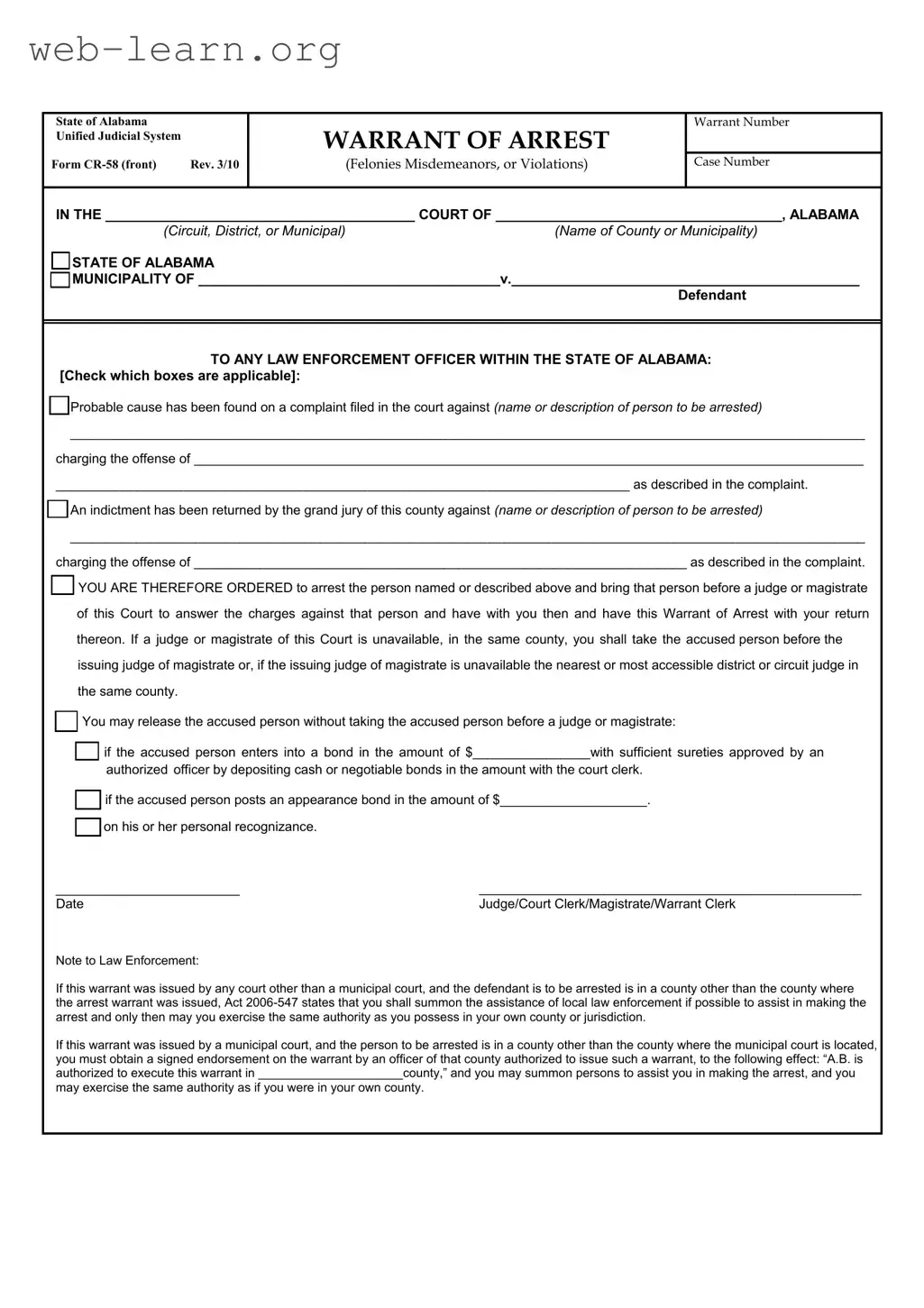
The Alabama CR-58 form serves as a critical document in the process of issuing an arrest warrant within the state. This form is utilized by law enforcement officers to formally request the arrest of an individual based on probable cause or an indictment. It outlines essential information, including the name or description of the defendant, the charges being brought against them, and the court in which the warrant is issued. The form also specifies the obligations of law enforcement regarding the arrest, such as bringing the accused before a judge or magistrate and the procedures to follow if the accused is in a different county. Additionally, the CR-58 includes provisions for the release of the accused under certain conditions, such as posting a bond or being released on personal recognizance. The form requires signatures from the issuing judge or court clerk and includes a section for law enforcement to certify the execution of the warrant. Furthermore, it necessitates the identification details of the accused and an acknowledgment section for the accused to confirm their understanding of their court appearance obligations. The comprehensive nature of the CR-58 ensures that all parties involved are informed of their rights and responsibilities during the arrest process.


Sample - Alabama Cr 58 Form

Warrant Number
State of Alabama
Unified Judicial System
Form CR-58 (front) Rev. 3/10
WARRANT OF ARREST
(Felonies Misdemeanors, or Violations)
Case Number
IN THE ________________________________________ COURT OF _____________________________________, ALABAMA
(Circuit, District, or Municipal) (Name of County or Municipality)
STATE OF ALABAMA
MUNICIPALITY OF _______________________________________v._____________________________________________
Defendant
TO ANY LAW ENFORCEMENT OFFICER WITHIN THE STATE OF ALABAMA:
[Check which boxes are applicable]:
Probable cause has been found on a complaint filed in the court against (name or description of person to be arrested)
____________________________________________________________________________________________________________
charging the offense of ___________________________________________________________________________________________
______________________________________________________________________________ as described in the complaint.
An indictment has been returned by the grand jury of this county against (name or description of person to be arrested)
____________________________________________________________________________________________________________
charging the offense of ___________________________________________________________________ as described in the complaint.
Y
OU ARE THEREFORE ORDERED to arrest the person named or described above and bring that person before a judge or magistrate
of this Court to answ
er the charges against that person and have with you then and have this Warrant of Arrest with y
our return
thereon. If a judge or magistrate of this Court is unavailable, in the same county, you shall take the accused person before the
issuing judge of magistrate or, if the issuing judge of magistrate is unavailable the nearest or most accessible district or circuit judge in
the same county.
You may release the accused person w
ithout taking the accused person before a judge or magistrate:
if the accused person enters into a bond in the amount of $________________w
ith sufficient sureties approved by an
authorized officer by depositing cash or negotiable bonds in the amount with the court clerk.
if the accused person posts an appearance bond in the amount of $____________________.
on his or her personal recognizance.
_________________________
____________________________________________________
Date Judge/Court Clerk/Magistrate/Warrant Clerk
Note to Law Enforcement:
If this warrant was issued by any court other than a municipal court, and the defendant is to be arrested is in a county other than the county where
the arrest warrant was issued, Act 2006-547 states that you shall summon the assistance of local law enforcement if possible to assist in making the
arrest and only then may you exercise the same authority as you possess in your own county or jurisdiction.
If this warrant was issued by a municipal
court, and the person to be arrested is in a county other than the county where the municipal court is located,
you must obtain a signed endorsement on the warrant by an officer of that county authorized to issue such a warrant, to the following effect: “A.B. is
authorized to execute this warrant in _____________________county,” and you may summon persons to assist you in making the arrest, and you
may exercise the same authority as if you were in your own county.
Form CR-58 (back) Rev. 3/10
WARRANT OF ARREST
(Felonies, Misdemeanors, or Violations)
CERTIFICATE OF EXECUTION
I, the undersigned law enforcement officer, certify that I executed the foregoing WARRANT OF ARREST by arresting the accused person
named (or described) therein at ________________o’ clock
a.m. p.m. on the__________ day of _______________________, __________.
in ____________________________________________________ COUNTY, ALABAMA.
After arrest, the accused person was:
Released as authorized at _________________o’clock a.m. p.m. ________________, __________.
Taken before ( Judge) ( Magistrate) at ___________________o’ clock a.m. p.m.
_______________________ ________.
____________________________________ ___________________________________________
Date Signature/Title/Agency
IDENTIFICATION OF ACCUSED PERSON
Name of Accused (or Alias) Telephone Number
Social Security Number Date of Birth Age Race Sex Height
Weight Hair Eyes Other
Address City State Zip Code
Name of Employer Employer’s Telephone Number
Address of Employer City State Zip Code
WITNESSES
Name Address Telephone Number
________________________________________ ______________________________________________ _________________________
________________________________________ ______________________________________________ _________________________
________________________________________ ______________________________________________ _________________________
________________________________________ ______________________________________________ _________________________
ACKNOWLEDGEMENT BY ACCUSED PERSON
I hereby acknowledge that at the time of my release from custody I was directed to appear in person before the court, as follows:
Place: ____________________________________________________________________________________
Date: _______________________________, ___________.
Time: __________________o’ clock
a.m. p.m., and as thereafter needed until discharge.
I promise to appear as directed before the court, as follows:
Place: ____________________________________________________________________________________
Date: _______________________________, ___________.
Time: __________________o’ clock
a.m. p.m., and as thereafter needed until discharge.
____________________________________________ _______________________________________________________________
Date Signature of Accused Person

Form Information

Fact Name Details
Form Purpose The Alabama CR-58 form is used to issue a warrant of arrest for felonies, misdemeanors, or violations.
Governing Law This form is governed by Alabama state law, specifically the Alabama Rules of Criminal Procedure.
Warrant Number Each warrant issued using this form is assigned a unique warrant number for tracking purposes.
Probable Cause Law enforcement must establish probable cause based on a complaint filed in court to issue this warrant.
Indictment Option If applicable, the form allows for the issuance of a warrant based on an indictment from a grand jury.
Arrest Procedure Officers are ordered to arrest the individual named in the warrant and bring them before a judge or magistrate.
Bond Release The accused may be released without a court appearance if they meet certain bond conditions.
Cross-County Authority Act 2006-547 requires law enforcement to summon local assistance if executing a warrant outside the issuing county.
Execution Certificate The form includes a section for law enforcement officers to certify the execution of the warrant.
Accused Acknowledgment The accused must acknowledge their release and promise to appear in court as directed.

Detailed Guide for Filling Out Alabama Cr 58

The Alabama CR-58 form is used to issue a warrant of arrest for an individual. Completing this form requires careful attention to detail to ensure all necessary information is accurately provided. After filling out the form, it must be signed and dated by the appropriate judicial authority before it can be executed by law enforcement.

  1. Begin by entering the Warrant Number at the top of the form.
  2. Next, fill in the Case Number below the warrant number.
  3. Indicate the court type (Circuit, District, or Municipal) and the name of the county or municipality in the designated fields.
  4. In the section labeled STATE OF ALABAMA MUNICIPALITY OF, write the name of the municipality issuing the warrant.
  5. Enter the name or description of the defendant in the space provided.
  6. Specify the offense being charged in the appropriate section, ensuring to describe it as stated in the complaint.
  7. Check the applicable box indicating whether probable cause was found on a complaint or if an indictment was returned by the grand jury.
  8. Fill in the date on which the warrant is being issued.
  9. Sign the form as the issuing judge, court clerk, magistrate, or warrant clerk.
  10. Complete the CERTIFICATE OF EXECUTION section after the arrest has been made. Include the time and date of the arrest, as well as the county where the arrest occurred.
  11. Document whether the accused was released or taken before a judge or magistrate, including the time and date of that action.
  12. Fill out the IDENTIFICATION OF ACCUSED PERSON section with the accused's personal information, including name, contact details, and physical description.
  13. List any witnesses in the designated section, providing their names, addresses, and telephone numbers.
  14. Complete the ACKNOWLEDGEMENT BY ACCUSED PERSON section, if applicable, including the place, date, and time the accused is required to appear before the court.

Obtain Answers on Alabama Cr 58

  1. What is the Alabama CR 58 form?

    The Alabama CR 58 form is a legal document known as a Warrant of Arrest. It is used by law enforcement to formally request the arrest of an individual based on probable cause or an indictment. This form is essential for ensuring that arrests are made in accordance with legal procedures, protecting the rights of both the accused and the state.

  2. Who can issue the Alabama CR 58 form?

    The CR 58 form can be issued by judges, magistrates, or court clerks in Alabama. These officials assess the evidence presented and determine whether there is sufficient probable cause to issue a warrant for an individual's arrest.

  3. What information is required on the form?

    The form requires several key pieces of information, including:

    • The name or description of the person to be arrested.
    • The specific charges being brought against the individual.
    • The name of the court issuing the warrant.
    • The case number and warrant number.

    Providing accurate and complete information is crucial for the validity of the warrant.

  4. What happens after the warrant is executed?

    Once the warrant is executed, the law enforcement officer must document the details of the arrest. This includes noting the time and location of the arrest, as well as the circumstances surrounding it. The accused must then be taken before a judge or magistrate to answer the charges against them.

  5. Can the accused be released without seeing a judge?

    Yes, the accused can be released without appearing before a judge under certain conditions. If they enter into a bond with sufficient sureties or post an appearance bond, they may be released. Additionally, they can be released on their personal recognizance, which means they promise to appear in court without needing to pay bail.

  6. What should law enforcement officers do if the warrant is issued in a different county?

    If the warrant was issued by a court in one county and the accused is located in another, law enforcement officers must follow specific protocols. They should seek assistance from local law enforcement in the county where the arrest is to be made. This ensures that the arrest is conducted legally and efficiently.

  7. What happens if the accused does not appear in court?

    If the accused fails to appear in court as directed, a bench warrant may be issued for their arrest. This can lead to further legal consequences, including additional charges and potential fines. It is crucial for the accused to adhere to the court's instructions to avoid these complications.

  8. Is there a time limit for executing the warrant?

    While there is no specific time limit stated on the CR 58 form, warrants generally remain valid until they are executed or canceled. However, it is advisable for law enforcement to act promptly to ensure that evidence remains fresh and that the accused does not evade arrest.

  9. How can the accused challenge the warrant?

    The accused has the right to challenge the warrant by filing a motion in court. They can argue that the warrant was issued without sufficient probable cause or that there are other legal reasons for dismissal. Consulting with an attorney can provide guidance on the best course of action in these situations.

Common mistakes

Completing the Alabama Cr 58 form can be a straightforward process, but several common mistakes often occur. One significant error is failing to provide accurate information regarding the defendant. The section that requires the name or description of the person to be arrested must be filled out carefully. Omitting details or providing incorrect information can lead to delays in the arrest process or even render the warrant invalid.

Another common mistake involves not checking the appropriate boxes to indicate the basis for the warrant. The form includes options for probable cause based on a complaint or an indictment. If the wrong box is checked, it can create confusion and complicate the legal proceedings. It is essential to read the instructions thoroughly and ensure that the correct circumstances are documented.

Additionally, individuals often overlook the importance of including the required bond amounts. The form allows for the accused to be released under certain conditions, such as posting a bond or being released on personal recognizance. Failing to specify these amounts can lead to misunderstandings about the terms of release and may result in unnecessary complications during the arrest process.

Lastly, not obtaining the necessary endorsements when the warrant is executed in a different county is a frequent oversight. If the warrant was issued by a municipal court and the arrest occurs in another county, an endorsement from an authorized officer is required. Neglecting this step can hinder the enforcement of the warrant and may cause legal challenges. Attention to detail is crucial when filling out the Alabama Cr 58 form to ensure a smooth and effective legal process.

Documents used along the form

The Alabama Cr 58 form is a crucial document used for issuing warrants of arrest in the state. Alongside this form, several other documents may be necessary to ensure proper legal procedures are followed. Below is a list of commonly used forms and documents that complement the Alabama Cr 58 form.

  • Complaint Form: This document outlines the allegations against the accused, providing the basis for the arrest warrant. It details the nature of the offense and the facts supporting the claim.
  • Indictment: Issued by a grand jury, this formal charge indicates that there is enough evidence to proceed with prosecution. It is often required to accompany the arrest warrant in felony cases.
  • Affidavit of Probable Cause: This sworn statement by law enforcement outlines the facts that establish probable cause for the arrest. It is essential for justifying the issuance of the warrant.
  • Arrest Report: After the arrest is made, law enforcement completes this report detailing the circumstances of the arrest, including time, location, and any evidence collected.
  • Bail Bond Form: If the accused is released from custody, this document outlines the terms of their release, including any financial obligations required to secure their freedom.
  • Notice to Appear: This document informs the accused of their required court appearance date and time, ensuring they are aware of their obligations following the arrest.
  • Personal Recognizance Form: Used when a defendant is released without bail, this form signifies their promise to appear in court as directed.
  • Warrant Return: After executing the warrant, law enforcement completes this form to document the arrest and any subsequent actions taken, such as the accused's appearance before a judge.
  • Witness Statements: These documents provide accounts from individuals who may have relevant information regarding the case. They can support the claims made in the complaint.
  • Court Scheduling Order: This document outlines the timeline for court proceedings, including hearings and trial dates, ensuring that all parties are aware of the schedule.

These forms and documents work together to create a comprehensive legal framework for handling arrests and subsequent court proceedings. Understanding each one’s role can help ensure that the process is smooth and efficient for all involved.

Similar forms

The Alabama Cr 58 form is a warrant of arrest used in various legal contexts. Here are ten documents that share similarities with it:

  • Arrest Warrant: Like the Cr 58, an arrest warrant authorizes law enforcement to detain an individual based on probable cause for a specific offense.
  • Search Warrant: This document allows law enforcement to search a specific location for evidence related to a crime, requiring a showing of probable cause, similar to the Cr 58.
  • Summons: A summons directs a person to appear in court, similar to how the Cr 58 instructs the arrest of an individual for court proceedings.
  • Indictment: An indictment formally charges a person with a crime, often leading to the issuance of an arrest warrant like the Cr 58.
  • Bench Warrant: Issued by a judge when a person fails to appear in court, it functions similarly to the Cr 58 in authorizing an arrest.
  • Probation Violation Warrant: This document is issued when an individual violates probation terms, similar in purpose to the Cr 58 in apprehending the individual.
  • Extradition Warrant: Used to transfer a suspect from one jurisdiction to another, it shares the goal of the Cr 58 in facilitating legal proceedings against an individual.
  • Citation: A citation can order a person to appear in court for minor offenses, paralleling the Cr 58's function of ensuring court appearances.
  • Civil Arrest Warrant: Issued in civil cases, it allows for the arrest of a person to enforce a court order, similar to the Cr 58's enforcement of criminal charges.
  • Temporary Restraining Order (TRO): While primarily a civil document, a TRO can lead to arrest if violated, akin to how the Cr 58 leads to arrest for criminal charges.

Dos and Don'ts

When filling out the Alabama Cr 58 form, attention to detail is crucial. Here are some important dos and don'ts to consider.

  • Do ensure that all sections of the form are filled out completely and accurately.
  • Do double-check the names and descriptions of the individuals involved to avoid any errors.
  • Do provide clear and specific information about the charges being filed.
  • Do sign and date the form where required to validate your submission.
  • Don't leave any sections blank unless instructed; incomplete forms may be rejected.
  • Don't use abbreviations or slang; clarity is essential for legal documents.

By following these guidelines, you can help ensure that the Alabama Cr 58 form is processed smoothly and effectively. This attention to detail not only aids in the legal process but also protects the rights of all parties involved.

Misconceptions

Understanding the Alabama Cr 58 form can be challenging due to various misconceptions. Here are nine common misunderstandings about this warrant of arrest form:

  1. It only applies to felonies. The Alabama Cr 58 form is used for felonies, misdemeanors, and violations. It covers a range of offenses, not just serious crimes.
  2. Only judges can issue this form. While judges typically issue the warrant, authorized court clerks and magistrates can also complete and sign the form.
  3. It’s only valid in the issuing county. The warrant can be executed in other counties, but specific procedures must be followed, such as getting local law enforcement assistance.
  4. Arresting officers have unlimited authority. Officers must adhere to the conditions outlined in the warrant and local laws. They cannot act outside of their jurisdiction without proper authorization.
  5. Defendants cannot be released before a judge. The form allows for the possibility of release under certain conditions, such as posting a bond or being released on personal recognizance.
  6. The form is only for law enforcement use. While primarily for law enforcement, the accused person also has rights and responsibilities outlined in the form, including acknowledging their court appearance.
  7. Witness information is optional. Providing witness information is crucial for the warrant's validity and can be essential in court proceedings.
  8. It does not require a specific format. The Alabama Cr 58 form must be filled out correctly, following the prescribed format to ensure its legality and enforceability.
  9. Once issued, the warrant is permanent. Warrants can be recalled or quashed by the court under certain circumstances, so they are not necessarily permanent.

Being aware of these misconceptions can help clarify the purpose and use of the Alabama Cr 58 form for everyone involved in the legal process.

Key takeaways

Here are some key takeaways regarding the Alabama Cr 58 form:

  • The Alabama Cr 58 form is used to issue a warrant of arrest for felonies, misdemeanors, or violations.
  • It requires specific information about the court, the defendant, and the charges being brought against the individual.
  • Law enforcement officers must bring the accused before a judge or magistrate as specified in the warrant.
  • If the issuing judge is unavailable, the officer should take the accused to the nearest available judge in the same county.
  • Officers may release the accused without a court appearance if certain conditions, such as posting a bond, are met.
  • For arrests made outside the issuing county, local law enforcement assistance may be required.
  • The form includes a section for the law enforcement officer to certify the execution of the warrant and details about the arrest.