Homepage Blank Alabama Cr 20 Form
Outline

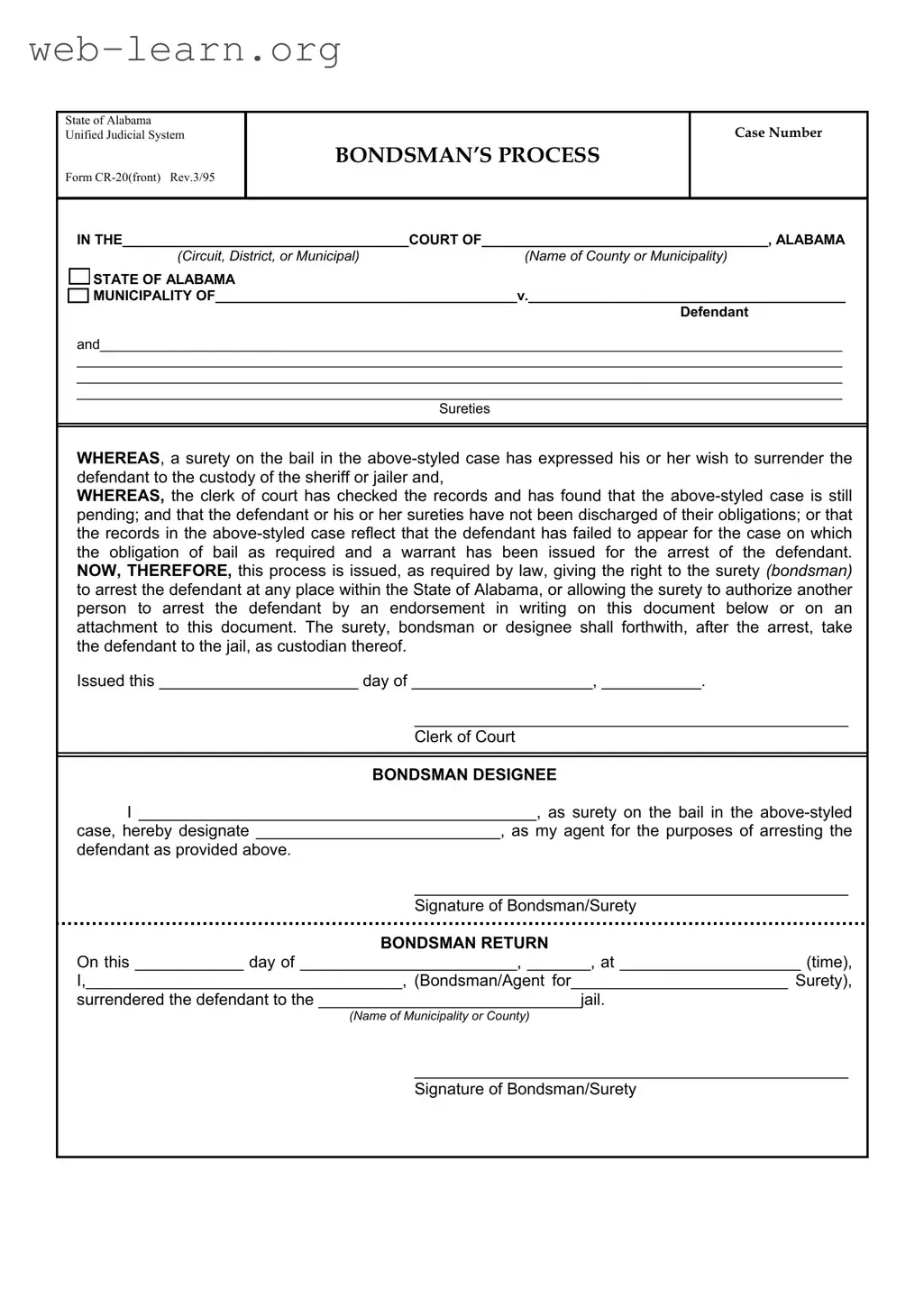
The Alabama CR-20 form is an essential document used in the state’s judicial system, particularly in cases involving bail bonds. It serves as a formal process that allows a bondsman or surety to surrender a defendant to the custody of law enforcement. This form is typically initiated when a surety wishes to take action against a defendant who has either failed to appear in court or whose case is still pending. The CR-20 outlines the rights of the surety, granting them the authority to arrest the defendant anywhere in Alabama. It also includes provisions for the surety to designate an agent to carry out the arrest on their behalf. The form requires specific information about the defendant, including personal details such as name, address, and physical characteristics, as well as the surety’s information. Additionally, there are clear instructions for both the bondsman and the jailer regarding the return of the process, emphasizing the importance of timely actions. Understanding the CR-20 form is crucial for those involved in the bail process, as it ensures that legal obligations are met and that the rights of all parties are respected.


Sample - Alabama Cr 20 Form

State of Alabama
Unified Judicial System
Form CR-20(front) Rev.3/95
BONDSMAN’S PROCESS
Case Number
IN THE_____________________________________COURT OF_____________________________________, ALABAMA
(Circuit, District, or Municipal) (Name of County or Municipality)
STATE OF ALABAMA
MUNICIPALITY OF_______________________________________v._________________________________________
Defendant
and________________________________________________________________________________________________
___________________________________________________________________________________________________
___________________________________________________________________________________________________
___________________________________________________________________________________________________
Sureties
WHEREAS, a surety on the bail in the above-styled case has expressed his or her wish to surrender the
defendant to the custody of the sheriff or jailer and,
WHEREAS, the clerk of court has checked the records and has found that the above-styled case is still
pending; and that the defendant or his or her sureties have not been discharged of their obligations; or that
the records in the above-styled case reflect that the defendant has failed to appear for the case on which
the obligation of bail as required and a warrant has been issued for the arrest of the defendant.
NOW, THEREFORE, this process is issued, as required by law, giving the right to the surety (bondsman)
to arrest the defendant at any place within the State of Alabama, or allowing the surety to authorize another
person to arrest the defendant by an endorsement in writing on this document below or on an
attachment to this document. The surety, bondsman or designee shall forthwith, after the arrest, take
the defendant to the jail, as custodian thereof.
Issued this ______________________ day of ____________________, ___________.
________________________________________________
Clerk of Court
BONDSMAN DESIGNEE
I ____________________________________________, as surety on the bail in the above-styled
case, hereby designate ___________________________, as my agent for the purposes of arresting the
defendant as provided above.
________________________________________________
Signature of Bondsman/Surety
BONDSMAN RETURN
On this ____________ day of ________________________, _______, at ____________________ (time),
I,___________________________________, (Bondsman/Agent for________________________ Surety),
surrendered the defendant to the _____________________________jail.
(Name of Municipality or County)
________________________________________________
Signature of Bondsman/Surety
Form CR-20 (back) Rev.3/95
BONDSMAN’S PROCESS
NOTICE TO BONDSMAN OR BONDMAN’S DESIGNEE
(1) When notified by the clerk of court to return this process, you must return it within five (5) days of
receiving the notice.
(2) Execution of this process after the defendant has been discharged is an illegal arrest.
NOTICE TO THE JAILER
Upon receipt of this Bondsman’s Process, you must return this Process to the clerk within five (5)
days of receipt.
IDENTIFICATION OF ACCUSED PERSON
Name of Accused Person Telephone Number
Social Security Number Date of Birth Age Race Sex Height
Weight Hair Eyes Other
Address City State Zip Code
Name of Employer Employer’s Telephone Number
Address of Employer City State Zip Code

Form Information

Fact Name Description
Form Title The form is officially titled "Bondsman’s Process" and is designated as Form CR-20 by the State of Alabama Unified Judicial System.
Governing Laws This form is governed by Alabama state law regarding bail and surety processes, specifically under Title 15 of the Code of Alabama.
Purpose The primary purpose of the CR-20 form is to allow a bondsman to surrender a defendant to law enforcement when the defendant has failed to appear in court.
Submission Timeline Bondsmen must return the process to the clerk of court within five days after being notified by the clerk.
Arrest Authority The form grants the surety or bondsman the authority to arrest the defendant anywhere within Alabama or designate another person to do so.
Identification Requirements The form requires detailed identification information about the accused, including name, social security number, and physical description.
Return of Process Upon receipt of the Bondsman’s Process, the jailer must return the process to the clerk within five days, ensuring proper documentation.

Detailed Guide for Filling Out Alabama Cr 20

Filling out the Alabama CR 20 form requires careful attention to detail. This form is used by a bondsman or surety to surrender a defendant to the custody of law enforcement. After completing the form, it must be returned to the court and the jailer within specified timeframes. Below are the steps to help you fill out the form correctly.

  1. Begin by entering the case number at the top of the form.
  2. Indicate the court type (Circuit, District, or Municipal) and the name of the county or municipality where the case is filed.
  3. Fill in the municipality involved in the case and the defendant's name.
  4. List the names of the sureties involved in the case.
  5. In the section regarding the issuance of the process, write the date and month when the process is issued, along with the year.
  6. Sign your name as the Clerk of Court in the designated area.
  7. In the section for the bondsman’s designee, write your name as the surety and designate the name of your agent for arresting the defendant.
  8. Sign your name in the space provided for the signature of the bondsman/surety.
  9. Complete the bondsman return section by entering the date, time, and the name of the jail where the defendant is surrendered.
  10. Sign your name again in the bondsman return section.
  11. Fill out the identification section for the accused person, including their name, telephone number, social security number, date of birth, age, race, sex, height, weight, hair color, eye color, and address.
  12. Provide the name and telephone number of the accused's employer, along with the employer's address.

Once you have completed the form, ensure that all information is accurate before submitting it. Remember to return the form to the clerk of court and the jailer within the required time frame.

Obtain Answers on Alabama Cr 20

  1. What is the Alabama CR-20 form?

    The Alabama CR-20 form is a legal document used by bondsmen in the state of Alabama. It serves as a process for surrendering a defendant back into custody. This form allows the bondsman or their designated agent to arrest the defendant and take them to jail if the defendant has failed to appear in court or if their obligations have not been discharged.

  2. Who can use the CR-20 form?

    The form can be used by licensed bondsmen or sureties who have posted bail for a defendant. Additionally, a bondsman may designate another individual to act on their behalf for the purpose of arresting the defendant. This designation must be documented on the form.

  3. What information is required on the CR-20 form?

    The form requires several pieces of information, including:

    • The case number
    • The court in which the case is pending
    • The name of the defendant
    • The surety or bondsman's information
    • The identification details of the accused person, such as name, date of birth, and social security number
  4. What happens after the defendant is arrested using the CR-20 form?

    Once the defendant is arrested, the bondsman or their designee must take the defendant to the appropriate jail as soon as possible. The bondsman is required to complete the return section of the form, indicating the time and place of surrender.

  5. What are the responsibilities of the bondsman upon receiving the CR-20 form?

    The bondsman must return the CR-20 form to the court clerk within five days of receiving notice from the clerk. This ensures that the court has a record of the surrender and that the process is legally documented.

  6. What are the consequences of executing the CR-20 form after the defendant has been discharged?

    If a bondsman executes the process after the defendant has been discharged, it constitutes an illegal arrest. This could lead to legal repercussions for the bondsman, including potential civil liability.

  7. What should the jailer do upon receiving the CR-20 form?

    Upon receipt of the CR-20 form, the jailer is responsible for returning the form to the clerk of court within five days. This is essential for maintaining accurate records within the judicial system.

  8. Can the bondsman designate someone else to arrest the defendant?

    Yes, the bondsman can designate another person to act on their behalf. This designation must be clearly indicated on the CR-20 form, ensuring that the designated agent has the authority to make the arrest.

  9. Where can I obtain the Alabama CR-20 form?

    The Alabama CR-20 form can typically be obtained from the local courthouse, or it may be available online through the Alabama Unified Judicial System's website. It is important to ensure that you are using the most current version of the form.

Common mistakes

Filling out the Alabama CR-20 form can be a straightforward process, but several common mistakes can lead to complications. One significant error occurs when individuals neglect to provide complete information about the defendant. Omitting critical details such as the defendant's full name, date of birth, or social security number can create confusion and delay the processing of the form. Ensure that all required fields are filled out accurately to avoid unnecessary complications.

Another frequent mistake is failing to sign the form. The signature of the bondsman or surety is essential for the document to be valid. Without this signature, the form may be rejected, and the intended legal action could be hindered. Always double-check that the necessary signatures are in place before submitting the form.

Inaccuracies in the case number can also lead to issues. The case number must correspond precisely with the records in the court system. If there is a mismatch, it could result in delays or even the dismissal of the case. It is advisable to verify the case number against court documents to ensure accuracy.

Additionally, some individuals fail to follow the instructions regarding the designation of an agent. When a bondsman designates someone to act on their behalf, this must be done clearly and correctly. Any ambiguity in this section can lead to misunderstandings about who is authorized to act, which could complicate the arrest process.

Another common oversight is not adhering to the timeline for returning the process. The form specifies that it must be returned within five days of notification from the clerk of court. Missing this deadline can result in legal repercussions, including potential charges for illegal arrest. Keeping track of deadlines is crucial to ensure compliance with the law.

Finally, individuals often forget to provide complete identification information for the accused. This includes not only the basic details but also additional information such as the accused's address and employer. Incomplete identification can hinder the court's ability to process the form effectively. Therefore, taking the time to gather and input all necessary information is essential for a smooth process.

Documents used along the form

The Alabama Cr 20 form is a crucial document used in the bail process, specifically for bondsmen who wish to surrender a defendant to law enforcement. Several other forms and documents often accompany the Cr 20 form to ensure proper legal procedures are followed. Below is a list of these documents, along with a brief description of each.

  • Bail Bond Agreement: This document outlines the terms and conditions of the bail arrangement between the defendant and the bondsman. It specifies the amount of bail, the responsibilities of the parties involved, and any collateral that may be required.
  • Surety Bond: A surety bond serves as a guarantee that the defendant will appear in court. This document is signed by the bondsman, who agrees to pay the court a specified amount if the defendant fails to appear as required.
  • Notice of Bail Forfeiture: If a defendant fails to appear in court, this notice is issued to inform the bondsman that they may be liable for the bail amount. It outlines the steps the bondsman must take to address the forfeiture.
  • Affidavit of Surrender: This affidavit is completed by the bondsman when surrendering the defendant. It provides a sworn statement detailing the circumstances of the surrender and may be used in court proceedings.
  • Release of Surety: Once the case is resolved, this document is used to formally release the bondsman from their obligations. It signifies that the bondsman is no longer responsible for the defendant's appearance in court.

Each of these documents plays a vital role in the bail process, ensuring that all parties understand their rights and responsibilities. Proper use of these forms helps to maintain the integrity of the judicial system and protects the interests of both the defendant and the bondsman.

Similar forms

The Alabama CR 20 form serves a specific purpose in the bail process, particularly for bondsmen. Several other documents share similarities with this form, often relating to the arrest, custody, and bail processes. Below is a list of ten documents that are comparable to the Alabama CR 20 form, along with explanations of their similarities.

  • Bail Bond Agreement: This document outlines the terms of the bail arrangement between the defendant and the bondsman. Like the CR 20 form, it establishes the responsibilities of the surety and the conditions under which the defendant can be arrested.
  • Warrant of Arrest: A warrant authorizes law enforcement to arrest an individual. Similar to the CR 20, it provides legal grounds for the apprehension of a defendant who has failed to comply with court orders.
  • Notice of Surrender: This document is used when a bondsman intends to surrender a defendant back to custody. It shares the same intent as the CR 20 form, facilitating the process of returning the defendant to jail.
  • Affidavit of Surety: This affidavit serves as a formal declaration by the bondsman regarding their obligation. It functions similarly to the CR 20 in affirming the bondsman's role and responsibilities in the bail process.
  • Release Order: This document is issued by the court to release a defendant from custody. Like the CR 20 form, it addresses the conditions surrounding the defendant's release and the obligations of the surety.
  • Bond Forfeiture Notice: When a defendant fails to appear in court, this notice is issued to inform the surety of their financial obligations. It parallels the CR 20 form by addressing the consequences of non-compliance with bail conditions.
  • Custody Transfer Form: This form documents the transfer of a defendant from one custodian to another. It is similar to the CR 20 in that it formalizes the custody process during an arrest.
  • Power of Attorney for Surety: This document grants the bondsman authority to act on behalf of the surety. Like the CR 20, it establishes the bondsman's rights to arrest and manage the defendant's custody.
  • Pre-Trial Release Order: Issued by the court, this order allows a defendant to be released before trial under specific conditions. It shares similarities with the CR 20 form in managing the conditions of a defendant's release.
  • Judgment and Commitment Order: This order officially sentences a defendant after a conviction. It relates to the CR 20 form by documenting the legal obligations and custody requirements following a court decision.

Dos and Don'ts

When filling out the Alabama Cr 20 form, it is essential to follow specific guidelines to ensure accuracy and compliance. Below is a list of things to do and avoid during this process.

  • Do provide complete and accurate information regarding the case number and court details.
  • Do ensure that the defendant's name is spelled correctly throughout the form.
  • Do include the correct names and contact information for all sureties involved.
  • Do sign the form where indicated, as an unsigned form may be considered invalid.
  • Do return the completed form to the clerk of court promptly, as required.
  • Don't leave any sections blank; incomplete forms may delay processing.
  • Don't provide false information, as this can lead to legal consequences.
  • Don't forget to check for any additional requirements specific to your jurisdiction.
  • Don't ignore deadlines; timely submission is crucial for compliance.
  • Don't attempt to execute the process if the defendant has already been discharged.

By adhering to these guidelines, individuals can help ensure that the process runs smoothly and effectively.

Misconceptions

Here are six misconceptions about the Alabama CR-20 form, along with clarifications for each:

  • Misconception 1: The CR-20 form is only for certain types of cases.
  • The CR-20 form can be used in various types of cases, including circuit, district, and municipal courts. It is not limited to specific case types.

  • Misconception 2: A bondsman can arrest a defendant without any documentation.
  • A bondsman must have the CR-20 form completed and issued to legally arrest a defendant. This form provides the necessary authority for the arrest.

  • Misconception 3: The bondsman has unlimited time to return the process to the court.
  • The bondsman must return the process within five days of receiving notice from the clerk of court. Failure to do so may lead to complications.

  • Misconception 4: Once the defendant is surrendered, the bondsman's obligations are over.
  • The bondsman remains responsible until all legal obligations related to the bail are discharged. This includes ensuring the defendant appears in court as required.

  • Misconception 5: The CR-20 form can be used to arrest anyone, regardless of the situation.
  • The CR-20 form is specifically for defendants who have failed to appear in court or whose cases are still pending. It does not grant authority for arbitrary arrests.

  • Misconception 6: A bondsman can designate anyone as their agent without restrictions.
  • The bondsman must formally designate an agent on the CR-20 form. This designation is crucial for ensuring that the agent has the authority to act on behalf of the bondsman.

Key takeaways

Key Takeaways for Filling Out and Using the Alabama Cr 20 Form:

  • Ensure accurate completion of all sections, including case number, court name, and defendant information.
  • Designate an agent for arrest by signing the appropriate section, allowing for efficient processing.
  • Return the completed process to the clerk of court within five days of notification to avoid legal complications.
  • Be aware that executing the process after the defendant has been discharged constitutes an illegal arrest.