Homepage Blank Alabama Child Support Sheet Form
Outline

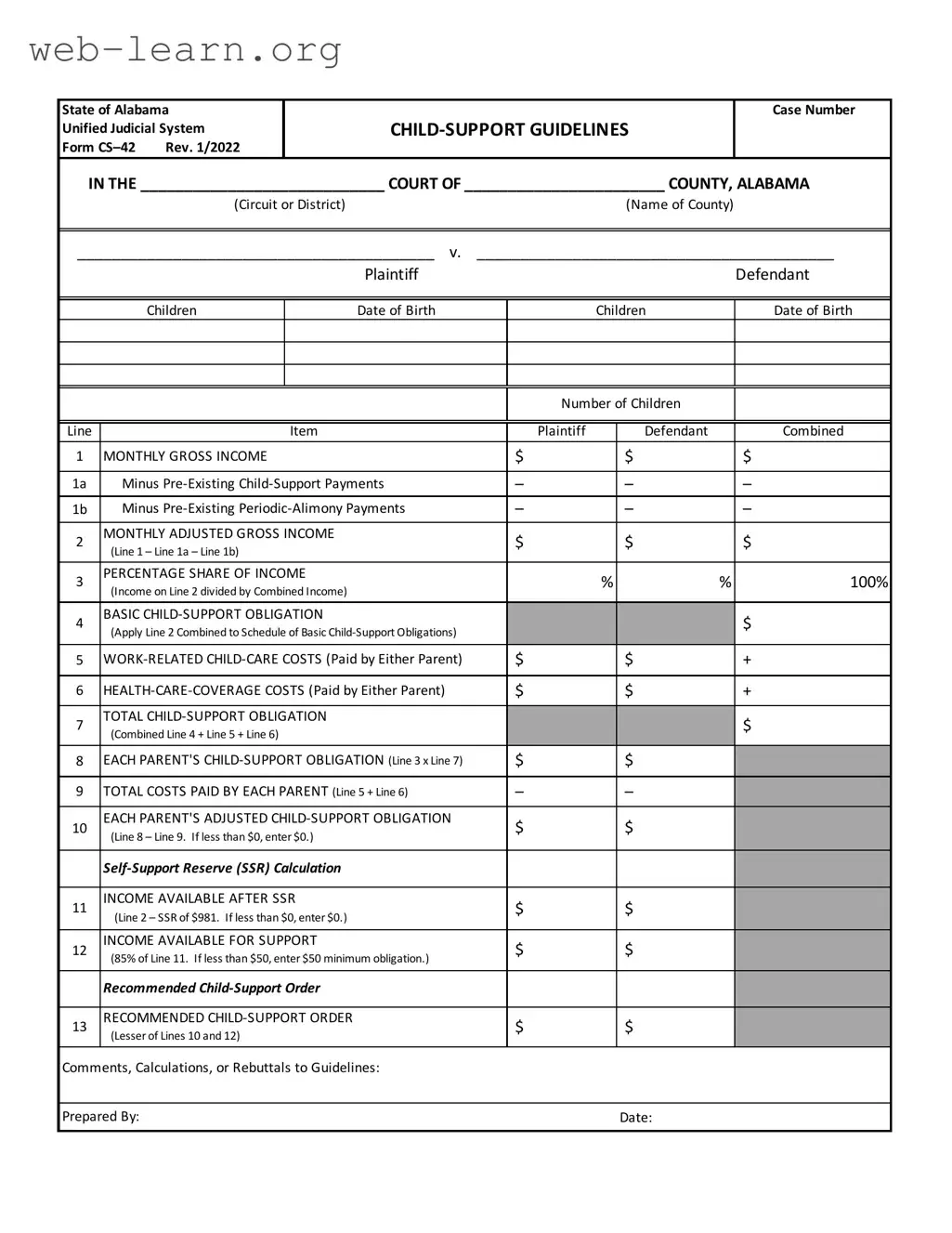
In navigating the complexities of child support in Alabama, the Alabama Child Support Sheet form serves as a crucial tool for both parents and the courts. This form, officially designated as CS-42 and revised in January 2022, is designed to systematically calculate child support obligations based on the financial circumstances of both parents. It begins with an assessment of each parent's monthly gross income, allowing for deductions such as pre-existing child support and alimony payments. The form then calculates the monthly adjusted gross income, which is vital for determining each parent's percentage share of total income. From this point, it establishes a basic child support obligation, taking into account additional costs like work-related child-care expenses and health-care coverage. The comprehensive nature of this form ensures that all relevant financial factors are considered, leading to a more equitable distribution of child support responsibilities. Ultimately, it culminates in a recommended child support order, which reflects the calculated obligations while allowing space for comments or rebuttals. Understanding the nuances of this form can empower parents to advocate effectively for their financial interests while ensuring the well-being of their children.
Sample - Alabama Child Support Sheet Form

Case Number
Date of Birth Date of Birth
Line Plaintiff Defendant Combined
1
$ $ $
1a
1b
2
$ $ $
3
% % 100%
4
$
5
$ $ +
6
$ $ +
7
$
8
$ $
9
10
$ $
11
$ $
12
$ $
13
$ $
Date:
RECOMMENDED CHILD-SUPPORT ORDER
(Lesser of Lines 10 and 12)
Comments, Calculations, or Rebuttals to Guidelines:
Prepared By:
TOTAL COSTS PAID BY EACH PARENT (Line 5 + Line 6)
EACH PARENT'S ADJUSTED CHILD-SUPPORT OBLIGATION
(Line 8 – Line 9. If less than $0, enter $0.)
Self-Support Reserve (SSR) Calculation
INCOME AVAILABLE AFTER SSR
(Line 2 – SSR of $981. If less than $0, enter $0.)
INCOME AVAILABLE FOR SUPPORT
(85% of Line 11. If less than $50, enter $50 minimum obligation.)
Recommended Child-Support Order
EACH PARENT'S CHILD-SUPPORT OBLIGATION
(Line 3 x Line 7)
Number of Children
Item
MONTHLY GROSS INCOME
Minus Pre-Existing Child-Support Payments
Minus Pre-Existing Periodic-Alimony Payments
MONTHLY ADJUSTED GROSS INCOME
(Line 1 – Line 1a – Line 1b)
PERCENTAGE SHARE OF INCOME
(Income on Line 2 divided by Combined Income)
BASIC CHILD-SUPPORT OBLIGATION
(Apply Line 2 Combined to Schedule of Basic Child-Support Obligations)
WORK-RELATED CHILD-CARE COSTS (Paid by Either Parent)
HEALTH-CARE-COVERAGE COSTS (Paid by Either Parent)
TOTAL CHILD-SUPPORT OBLIGATION
(Combined Line 4 + Line 5 + Line 6)
State of Alabama
Unified Judicial System
Form CS–42 Rev. 1/2022
CHILD-SUPPORT GUIDELINES
IN THE ____________________________ COURT OF _______________________ COUNTY, ALABAMA
(Circuit or District) (Name of County)
_________________________________________ v. _________________________________________
Plaintiff Defendant
Children Children

Form Information

Fact Name Description
Governing Law The Alabama Child Support Guidelines are governed by Alabama Code § 30-3-150 et seq.
Form Purpose This form is used to calculate child support obligations in Alabama.
Monthly Gross Income Line 1 captures the monthly gross income of both parents, which is essential for determining support obligations.
Adjusted Gross Income Line 2 reflects the monthly adjusted gross income after subtracting any pre-existing child support and alimony payments.
Percentage Share of Income Line 3 calculates each parent's percentage share of the combined income, which is crucial for equitable support distribution.
Basic Child-Support Obligation Line 4 determines the basic child support obligation based on the combined income and the state's schedule of obligations.
Health Care Coverage Costs Lines 6 and 7 allow for the inclusion of health care costs, which can affect the total child support obligation.
Self-Support Reserve The Self-Support Reserve (SSR) calculation ensures that each parent retains a minimum income for personal living expenses.

Detailed Guide for Filling Out Alabama Child Support Sheet

Completing the Alabama Child Support Sheet form requires careful attention to detail. This form helps in calculating the child support obligations of both parents based on their income and expenses. Follow these steps to ensure accurate completion of the form.

  1. Begin by entering the case number at the top of the form.
  2. Identify the court by filling in the court type (Circuit or District) and the name of the county.
  3. List the names of the plaintiff and defendant in the appropriate fields.
  4. For each child, enter their name and date of birth.
  5. In the section titled Monthly Gross Income, input the gross income for both the plaintiff and defendant.
  6. If applicable, subtract any pre-existing child-support payments from the gross income.
  7. Next, subtract any pre-existing periodic-alimony payments from the gross income.
  8. Calculate the Monthly Adjusted Gross Income by subtracting the amounts from the previous two steps from the total gross income.
  9. Determine the percentage share of income for each parent by dividing each parent's adjusted gross income by the combined income.
  10. Refer to the Schedule of Basic Child-Support Obligations to find the obligation based on the combined income.
  11. Enter any work-related child-care costs paid by either parent.
  12. Input any health-care-coverage costs that either parent pays.
  13. Add the basic child-support obligation, work-related child-care costs, and health-care-coverage costs to find the total child-support obligation.
  14. Calculate each parent's child-support obligation by multiplying their percentage share of income by the total child-support obligation.
  15. List any total costs paid by each parent for child-care and health care.
  16. Determine each parent's adjusted child-support obligation by subtracting the total costs from the child-support obligation. If the result is less than $0, enter $0.
  17. Calculate the income available after the Self-Support Reserve (SSR) by subtracting the SSR amount from each parent's adjusted gross income. If the result is less than $0, enter $0.
  18. Find the income available for support by calculating 85% of the income available after SSR. If this amount is less than $50, enter $50 as the minimum obligation.
  19. Finally, determine the recommended child-support order by taking the lesser of each parent's adjusted child-support obligation and the income available for support.

After completing the form, review all entries for accuracy. Ensure that all calculations are correct and that the form is signed and dated by the preparer. This will help facilitate the next steps in the child support process.

Obtain Answers on Alabama Child Support Sheet

  1. What is the Alabama Child Support Sheet form?

    The Alabama Child Support Sheet form is a standardized document used in Alabama courts to calculate child support obligations. It provides a clear framework for determining how much financial support a parent is required to provide for their children based on their income and other relevant factors.

  2. Who needs to complete the Child Support Sheet?

    Both parents involved in a child support case must complete the Child Support Sheet. This ensures that all financial information is considered when calculating the support obligations. It is essential for establishing a fair and accurate amount that reflects each parent's financial capabilities.

  3. How is monthly gross income determined?

    Monthly gross income includes all sources of income before taxes and deductions. This can include wages, salaries, bonuses, rental income, and any other earnings. It is important to report all income accurately to ensure the calculation reflects the true financial situation of both parents.

  4. What deductions can be made from gross income?

    Two primary deductions can be made from gross income: pre-existing child support payments and pre-existing periodic alimony payments. These deductions help to arrive at a more accurate monthly adjusted gross income, which is crucial for calculating child support obligations.

  5. How is the basic child support obligation calculated?

    The basic child support obligation is determined by applying the combined monthly adjusted gross income of both parents to the Alabama Schedule of Basic Child-Support Obligations. This schedule provides a guideline based on the number of children and the combined income level.

  6. What are work-related child-care costs?

    Work-related child-care costs are expenses incurred by either parent for the care of their children while they are working. These costs can be added to the child support obligation, ensuring that the financial needs of the children are met while both parents are engaged in employment.

  7. How are health-care coverage costs factored into child support?

    Health-care coverage costs paid by either parent for the children are also included in the child support calculation. This ensures that the children's health needs are adequately addressed in the support agreement.

  8. What is the Self-Support Reserve (SSR)?

    The Self-Support Reserve is a minimum amount that each parent must retain for their own living expenses. In Alabama, this amount is set at $981. If a parent's income after this reserve is less than $0, it will be adjusted to $0 to ensure they can meet their basic needs.

  9. What is the recommended child support order?

    The recommended child support order is the lesser amount calculated between each parent's adjusted child-support obligation and the income available for support. This figure represents the amount that the court will typically order each parent to pay for child support, ensuring it is fair and manageable.

  10. Can comments or rebuttals be included on the form?

    Yes, there is space provided on the form for comments, calculations, or rebuttals to the guidelines. This allows parents to present any additional information or concerns that may affect the child support determination.

Common mistakes

Filling out the Alabama Child Support Sheet can be a daunting task, and many individuals make common mistakes that can impact their child support obligations. One prevalent error is failing to accurately report monthly gross income. This figure is crucial, as it forms the foundation for calculating child support. Individuals sometimes overlook additional sources of income, such as bonuses, overtime, or freelance work. Omitting these amounts can lead to an underestimation of support obligations, ultimately affecting the financial well-being of the children involved.

Another frequent mistake involves the miscalculation of adjusted gross income. After determining the monthly gross income, individuals must subtract any pre-existing child support or alimony payments. Errors in this calculation can arise from not accounting for all relevant payments or misplacing figures in the provided lines. It is essential to double-check these calculations to ensure that the adjusted income accurately reflects the financial situation.

Many people also struggle with understanding the percentage share of income. This percentage is derived from dividing each parent's adjusted gross income by the combined income. Misunderstanding this calculation can lead to incorrect assumptions about each parent's financial responsibility. It is vital to ensure that the calculations are clear and precise, as this directly influences the final child support obligation.

In addition, individuals often neglect to include necessary expenses, such as work-related child-care costs and health-care-coverage costs. These costs should be documented accurately, as they contribute to the total child support obligation. Failing to include these figures can result in a lower support amount, which may not adequately cover the children's needs.

Finally, many individuals do not pay sufficient attention to the self-support reserve (SSR) calculation. This reserve is designed to ensure that the paying parent has enough income to support themselves after fulfilling their child support obligations. Ignoring this calculation can lead to an unfair financial burden on one parent. It is crucial to understand and apply the SSR to avoid potential financial distress.

Documents used along the form

When navigating the complexities of child support in Alabama, several forms and documents are essential to ensure that the process is handled correctly. Each of these documents serves a specific purpose and can help clarify responsibilities and rights for all parties involved. Below is a list of commonly used forms alongside the Alabama Child Support Sheet.

  • Child Support Order: This is the official court order that outlines the amount of child support one parent must pay to the other. It is legally binding and must be followed unless modified by the court.
  • Income Withholding Order: This document directs an employer to withhold a specific amount from the paying parent’s paycheck to ensure that child support payments are made consistently and on time.
  • Affidavit of Financial Disclosure: In this form, both parents provide a detailed account of their financial situation. This information helps the court determine the appropriate amount of child support.
  • Child Support Modification Request: If a parent believes that their financial circumstances have changed, this form can be submitted to request a modification of the existing child support order.
  • Parenting Plan: This document outlines the custody arrangement and visitation schedule between parents. While not directly related to child support, it provides context for the child’s living situation and needs.
  • Health Insurance Information Form: This form details the health insurance coverage available for the child, which is often a factor in calculating child support obligations.
  • Child Support Guidelines Worksheet: This worksheet helps parents calculate their expected child support obligations based on their incomes and other financial factors, serving as a preliminary tool before filing official documents.
  • Certificate of Service: This document confirms that all parties involved have received copies of the child support forms and orders, ensuring that everyone is informed and aware of the proceedings.

Understanding these forms can alleviate some of the stress associated with child support matters. Each document plays a vital role in ensuring that child support is calculated fairly and that the needs of the children are prioritized. If you have questions or concerns about these forms, seeking legal advice can provide clarity and guidance tailored to your specific situation.

Similar forms

The Alabama Child Support Sheet form serves a critical function in determining child support obligations. It shares similarities with several other documents used in family law. Below is a list of ten documents that are comparable, along with an explanation of how they relate to the Alabama Child Support Sheet.

  • Child Support Worksheet: This document outlines the income and expenses of both parents to calculate child support obligations. Like the Alabama form, it focuses on monthly income and necessary deductions.
  • Income Statement: This statement provides a detailed account of an individual's income. Both documents require a clear presentation of gross income to determine financial responsibilities.
  • Child Support Guidelines: These guidelines provide a framework for calculating child support based on income levels. Similar to the Alabama form, they use standardized formulas to ensure fairness in support calculations.
  • Financial Affidavit: A financial affidavit discloses all financial information of a parent. It parallels the Alabama Child Support Sheet in its emphasis on transparency regarding income and expenses.
  • Child Support Modification Request: This document is used to request changes in existing child support orders. It often references income changes similar to those outlined in the Alabama form.
  • Parenting Plan: While primarily focused on custody arrangements, a parenting plan often includes financial obligations. Both documents aim to ensure the best interests of the child are met through clear financial support structures.
  • Alimony Worksheet: This worksheet calculates spousal support obligations. It shares a similar structure with the Alabama Child Support Sheet, focusing on income and necessary deductions.
  • Child Support Agreement: This is a formal agreement between parents regarding child support. Like the Alabama form, it includes calculations based on income and expenses to ensure clarity and compliance.
  • Tax Returns: Tax returns provide a comprehensive view of an individual’s financial situation. Both the Alabama Child Support Sheet and tax returns rely on accurate income reporting to determine obligations.
  • Expense Ledger: This document tracks monthly expenses incurred for a child. It complements the Alabama form by detailing costs that may affect child support calculations.

Understanding these documents can help parents navigate the complexities of child support obligations with greater clarity and confidence.

Dos and Don'ts

When filling out the Alabama Child Support Sheet form, attention to detail is essential. This form can significantly impact the financial responsibilities of parents. Here are four important dos and don'ts to consider:

  • Do ensure that all income sources are accurately reported. This includes wages, bonuses, and any other earnings.
  • Do double-check your calculations. Errors in math can lead to incorrect child support obligations.
  • Do provide documentation for any deductions claimed, such as pre-existing child support or alimony payments.
  • Do keep a copy of the completed form for your records. This can be useful for future reference or disputes.
  • Don't leave any sections blank. Incomplete information can delay the process and lead to complications.
  • Don't underestimate your income. Be honest about your financial situation to avoid issues later on.
  • Don't forget to include all children involved. Omitting a child can affect the overall support calculation.
  • Don't ignore deadlines. Timely submission of the form is crucial to ensure compliance with court orders.

By following these guidelines, you can navigate the process more effectively and ensure that the best interests of the children are prioritized.

Misconceptions

Understanding the Alabama Child Support Sheet form is essential for parents navigating child support obligations. However, several misconceptions can lead to confusion. Here are nine common misunderstandings:

  • The form is only for custodial parents. Many believe that only custodial parents need to fill out this form. In reality, both parents must provide their financial information to determine the support obligation fairly.
  • Child support is solely based on income. While income is a significant factor, other elements, such as child care costs and health care expenses, also play a crucial role in calculating the total child support obligation.
  • Previous child support payments are not considered. Some think that prior child support obligations do not affect the current calculation. However, these payments are deducted from gross income to arrive at an adjusted figure.
  • All expenses are automatically included in the calculations. Not all expenses are considered. Only specific costs, such as work-related child care and health care coverage, are included in the child support calculation.
  • Child support obligations never change. Many assume that once a child support amount is set, it remains the same indefinitely. In fact, changes in income or circumstances can warrant a modification of the support order.
  • The form guarantees a specific amount of child support. Some people believe that completing the form will automatically result in a predetermined support amount. The calculations provide a guideline, but the final amount is subject to judicial approval.
  • Only the court can modify child support amounts. While the court has the authority to modify orders, parents can also agree to changes outside of court, provided they document the agreement properly.
  • Health insurance costs are not factored into child support. There is a misconception that health insurance expenses are irrelevant. In fact, these costs can significantly impact the overall child support obligation.
  • The Child Support Sheet is the only document needed. Some believe that submitting this form is sufficient. However, additional documentation may be required to support the financial information provided.

Being informed about these misconceptions can help parents navigate the child support process more effectively and ensure that the best interests of the children are prioritized.

Key takeaways

Filling out the Alabama Child Support Sheet form is an important step in determining child support obligations. Here are some key takeaways to keep in mind:

  • Understand the Purpose: This form helps calculate child support obligations based on both parents' incomes and expenses related to the children.
  • Accurate Income Reporting: Report the monthly gross income for both parents accurately. This is the foundation of the calculations.
  • Adjust for Existing Obligations: Subtract any pre-existing child support or alimony payments from the gross income to find the adjusted gross income.
  • Calculate Percentage Share: Determine each parent's percentage share of the combined income. This is essential for fair distribution of child support obligations.
  • Include Additional Costs: Don’t forget to add work-related child-care and health-care coverage costs, as these contribute to the total child support obligation.
  • Determine Total Obligation: The total child support obligation is the sum of the basic obligation and any additional costs.
  • Adjust for Payments: Calculate each parent's adjusted child support obligation by subtracting any costs they have already paid.
  • Self-Support Reserve: Be aware of the self-support reserve calculation, which ensures that each parent has sufficient income after obligations are met.
  • Final Recommendations: The recommended child support order will be the lesser amount between each parent's adjusted obligation and the income available for support.

Following these steps carefully will help ensure that the child support calculation is fair and accurate for all parties involved.