Homepage Blank Alabama Child Support Income Form
Outline

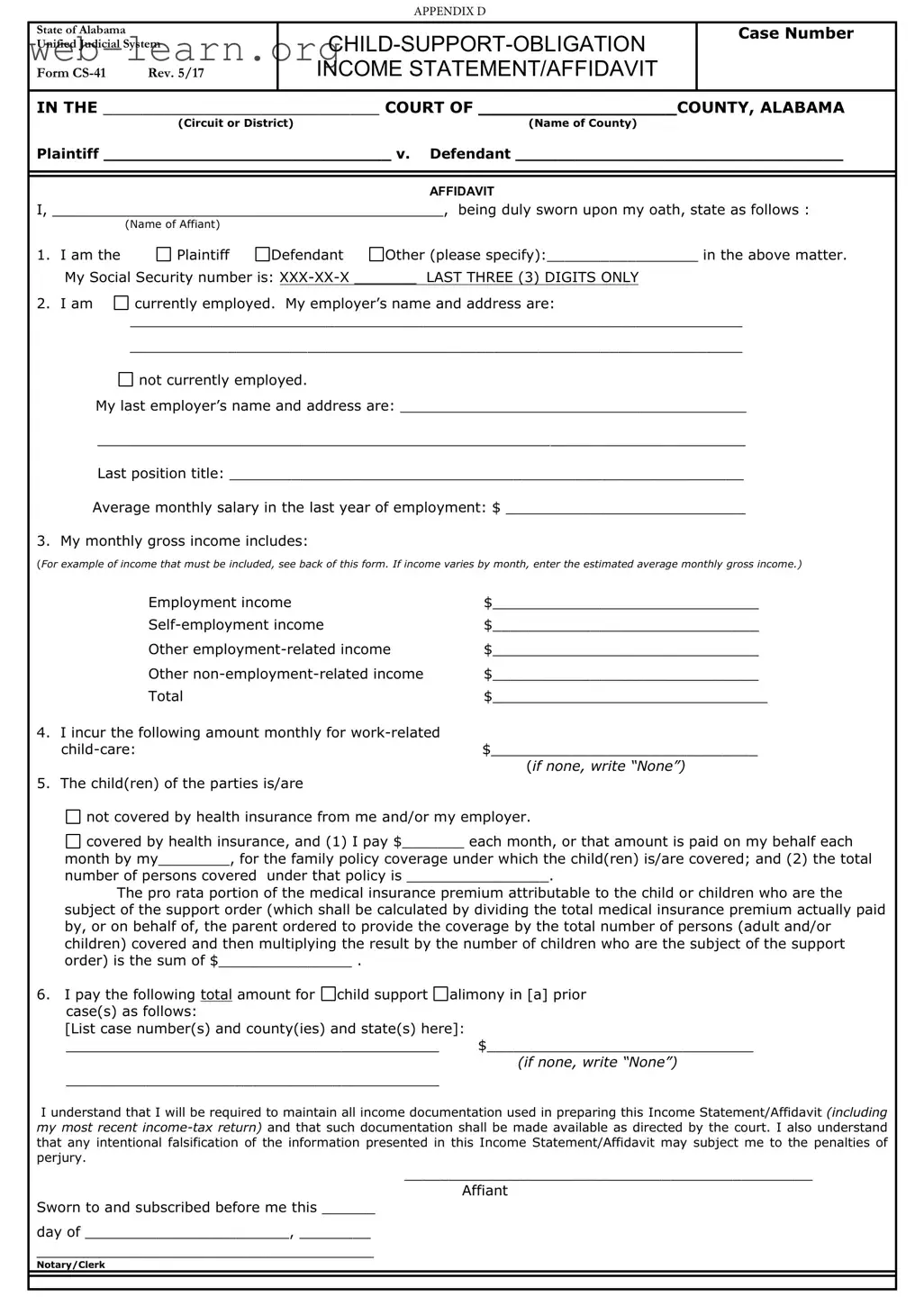
In the state of Alabama, navigating the complexities of child support can be challenging, and the Child Support Income form plays a crucial role in this process. This form, known as the Income Statement/Affidavit (CS-41), is designed to gather essential financial information from parents involved in child support cases. It requires individuals to disclose their employment status, monthly gross income, and any additional sources of income, such as self-employment or other non-employment-related earnings. The form also addresses critical aspects like work-related child-care expenses and health insurance coverage for the child or children involved. By providing a comprehensive overview of a parent’s financial situation, this form helps ensure that child support obligations are determined fairly and equitably. Moreover, it emphasizes the importance of honesty, as any intentional misrepresentation can lead to serious legal consequences. Understanding the details and requirements of the Alabama Child Support Income form is essential for parents seeking to fulfill their responsibilities while ensuring the well-being of their children.


Sample - Alabama Child Support Income Form

State of Alabama
Unified Judicial System
Form CS-41
Rev. 5/17
CHILD-SUPPORT-OBLIGATION
INCOME STATEMENT/AFFIDAVIT
Case Number
IN THE ____________________________ COURT OF __________________COUNTY, ALABAMA
(Circuit or District) (Name of County)
Plaintiff _____________________________ v. Defendant _________________________________
AFFIDAVIT
I, ____________________________________________, being duly sworn upon my oath, state as follows :
(Name of Affiant)
1. I am the
Plaintiff Defendant Other (please specify):_________________ in the above matter.
My Social Security number is: XXX-XX-X _______ LAST THREE (3) DIGITS ONLY
2. I am currently employed. My employer’s name and address are:
_____________________________________________________________________
_____________________________________________________________________
not currently employed.
My last employer’s name and address are: _______________________________________
_________________________________________________________________________
Last position title: __________________________________________________________
Average monthly salary in the last year of employment: $ ___________________________
3. My monthly gross income includes:
(For example of income that must be included, see back of this form. If income varies by month, enter the estimated average monthly gross income.)
Employment income $______________________________
Self-employment income $______________________________
Other employment-related income $______________________________
Other non-employment-related income $______________________________
Total $_______________________________
4. I incur the following amount monthly for work-related
child-care: $______________________________
(if none, write “None”)
5. The child(ren) of the parties is/are
not covered by health insurance from me and/or my employer.
covered by health insurance, and (1) I pay $_______ each month, or that amount is paid on my behalf each
month by my________, for the family policy coverage under which the child(ren) is/are covered; and (2) the total
number of persons covered under that policy is ________________.
The pro rata portion of the medical insurance premium attributable to the child or children who are the
subject of the support order (which shall be calculated by dividing the total medical insurance premium actually paid
by, or on behalf of, the parent ordered to provide the coverage by the total number of persons (adult and/or
children) covered and then multiplying the result by the number of children who are the subject of the support
order) is the sum of $_______________ .
6. I pay the following total amount for
child support alimony in [a] prior
case(s) as follows:
[List case number(s) and county(ies) and state(s) here]:
__________________________________________ $______________________________
(if none, write “None”)
__________________________________________
I understand that I will be required to maintain all income documentation used in preparing this Income Statement/Affidavit (including
my most recent income-tax return) and that such documentation shall be made available as directed by the court. I also understand
that any intentional falsification of the information presented in this Income Statement/Affidavit may subject me to the penalties of
perjury.
______________________________________________
Affiant
Sworn to and subscribed before me this ______
day of _______________________, ________
______________________________________
Notary/Clerk
APPENDIX D
Form CS-41 (Back)
EXAMPLES OF INCOME THAT MUST BE INCLUDED IN YOUR GROSS MONTHLY INCOME
1. Employment Income shall include, but not be limited to, salary, wages, bonuses, commissions, severance
pay, worker’s compensation, pension income, unemployment insurance, disability insurance, and Social
Security benefits.
2. SelfEmployment Income shall include, but not be limited to, income from self-employment, rent, royalties,
proprietorship of a business, or joint ownership of a partnership or closely held corporation. “Gross income”
means gross receipts minus ordinary and necessary expenses required to produce this income.
3. Other EmploymentRelated Income shall include, but not be limited to, the average monthly value of any
expense reimbursements or in-kind payments received in the course of employment that are significant and
reduce personal living expenses, such as a furnished automobile, a clothing allowance, and a housing
allowance.
4. Other Non-Employment-Related Income shall include, but not be limited to, dividends, interest, annuities,
capital gains, gifts, prizes, and pre-existing periodic alimony.
RULE 32, ALABAMA RULES OF JUDICIAL ADMINISTRATION, PROVIDES THE FOLLOWING DEFINITIONS:
Income. For purposes of the guidelines specified in this Rule, income” means the actual gross income of a
parent, if the parent is employed to full capacity, or if the parent is unemployed or underemployed, then it
means the actual gross income the parent has the ability to earn.
Gross Income.
Gross income” includes income from any source, and includes, but is not limited to, income from salaries,
wages, commissions, bonuses, dividends, severance pay, pensions, interest, trust income, annuities, capital
gains, Social Security benefits, workers’ compensation benefits, unemployment-insurance benefits, disability-
insurance benefits, gifts, prizes, and preexisting periodic alimony.
“Gross income” does not include child support received for other children or benefits received from means-
tested public-assistance programs, including, but not limited to, Temporary Assistance for Needy Families,
Supplemental Security Income, food stamps, and general assistance.
Selfemployment Income.
For income from self-employment, rent, royalties, proprietorship of business, or joint ownership of a
partnership or closely held corporation, “gross income” means gross receipts minus ordinary and necessary
expenses required to produce such income, as allowed by the Internal Revenue Service, with the exceptions
noted in Rule 32 (B)(3)(b).
Under those exceptions, “ordinary and necessary expenses” does not include amounts allowable by the
Internal Revenue Service for the accelerated component of depreciation expenses, investment tax credits, or
any other business expenses determined by the court to be inappropriate for determining gross income for
purposes of calculating child support.
Other Income. Expense reimbursements or in-kind payments received by a parent in the course of
employment of self-employment or operation of a business shall be counted as income if they are significant and
reduce personal living expenses.

Form Information

Fact Name Details
Purpose The Alabama Child Support Income Form is used to provide a detailed account of a parent's income for child support calculations.
Affidavit Requirement Parents must sign an affidavit, affirming the accuracy of the information provided under oath.
Income Documentation Affiants are required to maintain and present income documentation, such as tax returns, as directed by the court.
Types of Income The form includes various income types, such as employment income, self-employment income, and other related earnings.
Health Insurance Coverage Parents must disclose whether the child(ren) are covered by health insurance and the associated costs.
Work-Related Child Care Costs The form allows parents to report monthly expenses for work-related child care, which can affect support calculations.
Prior Child Support Obligations Parents must list any existing child support or alimony obligations from prior cases, which may impact current calculations.
Governing Laws The form is governed by Rule 32 of the Alabama Rules of Judicial Administration, which outlines definitions and calculations for income.
Penalties for Falsification Providing false information on the form can lead to penalties, including charges of perjury.
Form Revision Date The current version of the form is CS-41, revised in May 2017, indicating the need for up-to-date compliance.

Detailed Guide for Filling Out Alabama Child Support Income

Completing the Alabama Child Support Income form requires accurate and thorough information about your income and financial obligations. Follow these steps to ensure the form is filled out correctly.

  1. Write the case number at the top of the form.
  2. Indicate the court type (Circuit or District) and the name of the county.
  3. In the Plaintiff and Defendant sections, fill in the names of both parties involved in the case.
  4. In the Affidavit section, write your name as the affiant.
  5. Select your role in the case (Plaintiff, Defendant, or Other) and provide your Social Security number, entering only the last three digits.
  6. State your current employment status by checking the appropriate box and providing your employer's name and address, or the name and address of your last employer if you are not currently employed.
  7. Include your last position title and your average monthly salary from the last year of employment.
  8. List your monthly gross income, breaking it down into categories: employment income, self-employment income, other employment-related income, and other non-employment-related income. Calculate the total.
  9. If applicable, state the monthly amount you incur for work-related child-care. If none, write "None."
  10. Indicate whether the child(ren) is/are covered by health insurance. If covered, provide the monthly premium and the total number of persons covered under the policy. Calculate the pro rata portion of the medical insurance premium for the child(ren).
  11. List any child support or alimony payments you make for prior cases, including case numbers, counties, and states. If none, write "None."
  12. Sign and date the affidavit, acknowledging the requirement to maintain income documentation and the penalties for falsification.
  13. Have the form notarized by a Notary Public or Clerk.

Obtain Answers on Alabama Child Support Income

  1. What is the purpose of the Alabama Child Support Income form?

    The Alabama Child Support Income form, officially known as the Income Statement/Affidavit, is used to provide the court with a clear picture of a parent's financial situation. This form helps determine the appropriate amount of child support that one parent may owe to the other. It collects information about income, employment, and expenses related to child care and health insurance, ensuring that the court has all necessary details to make an informed decision.

  2. What information do I need to provide on the form?

    When filling out the form, you will need to include several key pieces of information:

    • Your employment status and details about your current or last employer.
    • Your gross monthly income, which includes employment income, self-employment income, and any other relevant sources of income.
    • Monthly expenses related to work-related child care, if applicable.
    • Details about health insurance coverage for your child or children, including costs and the number of individuals covered.
    • Any prior child support or alimony obligations you may have.

    It is important to be accurate and thorough, as this information will be used by the court to assess your financial responsibilities.

  3. What types of income should I include?

    The form requires you to report various types of income. This includes:

    • Employment income: Salary, wages, bonuses, and commissions.
    • Self-employment income: Earnings from your own business, including any rent or royalties.
    • Other employment-related income: This can include expense reimbursements or in-kind payments that reduce your living expenses.
    • Other non-employment-related income: Such as dividends, interest, gifts, or periodic alimony.

    By including all relevant income, you ensure that the court has a comprehensive view of your financial situation.

  4. What happens if I provide false information on the form?

    Providing false information on the Alabama Child Support Income form can have serious consequences. If the court finds that you intentionally misrepresented your income or other financial details, you could face penalties for perjury. This could include fines or even jail time. It is crucial to be honest and transparent when completing the form, as the accuracy of the information directly impacts the child support determination.

Common mistakes

Completing the Alabama Child Support Income form can be a straightforward process, but several common mistakes can complicate matters. One frequent error is failing to provide accurate employment information. Individuals often neglect to list their current employer or provide outdated details about previous employment. This omission can lead to discrepancies that may delay the processing of the child support case.

Another mistake involves underreporting income. Some individuals mistakenly believe that only their salary counts as income. However, all sources of income must be included, such as bonuses, commissions, and even self-employment earnings. Omitting these can result in an inaccurate assessment of financial capability.

Inadequate documentation is also a common pitfall. Applicants sometimes fail to maintain necessary income documentation, such as tax returns or pay stubs. The court requires this information to verify the accuracy of the reported income. Without proper documentation, individuals may face challenges in justifying their claims.

Misunderstanding the child care expenses section is another issue. Some people either underestimate or completely ignore the costs associated with work-related child care. This can lead to an inaccurate portrayal of monthly expenses, affecting the overall child support calculation.

Additionally, individuals often overlook health insurance details. It is crucial to specify whether the children are covered by health insurance and to provide accurate premium amounts. Failing to do so may lead to misunderstandings about the financial responsibilities related to medical care.

Furthermore, individuals sometimes neglect to disclose prior child support obligations. Listing any existing support payments is essential for the court to understand the full financial picture. Omitting this information can create complications and may even lead to legal repercussions.

Lastly, some applicants fail to sign the affidavit correctly or do not have it notarized. This step is critical, as an unsigned or improperly notarized form may be deemed invalid, causing delays or requiring resubmission. Ensuring that all sections are completed accurately and that signatures are in place can help streamline the process.

Documents used along the form

When navigating the complexities of child support in Alabama, several forms and documents may accompany the Alabama Child Support Income form to ensure a comprehensive understanding of financial obligations. Here’s a look at some of the essential paperwork that often goes hand-in-hand with the Income Statement/Affidavit.

  • Child Support Order: This document outlines the specific amount of child support that one parent is required to pay to the other. It includes details such as payment frequency and duration.
  • Financial Affidavit: This form provides a detailed account of an individual's financial situation, including income, expenses, assets, and liabilities. It helps the court assess the ability to pay child support.
  • Health Insurance Verification: This document confirms whether a parent has health insurance coverage for the child(ren). It specifies the type of coverage and the monthly premium costs.
  • Income Tax Returns: Recent tax returns are often required to verify income levels. They provide a clear picture of an individual's financial situation over the past year.
  • Pay Stubs: These are regular documents provided by employers that detail an employee's earnings and deductions. They serve as proof of current income.
  • Proof of Child Care Expenses: This form shows any costs incurred for child care, which may be considered when calculating child support obligations.
  • Employment Verification Letter: A letter from an employer confirming an individual's employment status, job title, and salary can help clarify income details for the court.
  • Modification Request: If circumstances change, this document requests a review and potential adjustment of the existing child support order.
  • Affidavit of Service: This document proves that the child support papers were properly served to the other party, ensuring that all legal processes are followed.

Understanding these documents is crucial for anyone involved in a child support case. They not only help clarify financial responsibilities but also ensure that the best interests of the child are prioritized. Keeping organized records and being prepared with the necessary forms can make the process smoother and more efficient.

Similar forms

  • Child Support Guidelines Worksheet - This document outlines the financial obligations of parents regarding child support. Similar to the Alabama Child Support Income form, it requires detailed information about income, expenses, and financial responsibilities to determine the appropriate support amount.
  • Affidavit of Support - Often used in immigration cases, this affidavit requires the sponsor to provide information about their financial situation. Like the income form, it necessitates a declaration of income and assets to ensure the sponsor can support the immigrant.
  • Financial Disclosure Statement - In divorce proceedings, this statement requires parties to disclose their financial situation, including income and expenses. Both documents aim to present a clear picture of financial resources available for support obligations.
  • Income Verification Form - This form is often requested by financial institutions or courts to verify a person’s income. It shares similarities with the Alabama Child Support Income form in that it collects detailed income information for assessment purposes.
  • Child Support Modification Request - When a parent seeks to change their child support obligations, this request includes financial information similar to the income form. It helps the court assess whether a modification is warranted based on current financial circumstances.
  • Tax Return Documentation - Tax returns are often required to substantiate income claims. Like the Alabama Child Support Income form, they provide a comprehensive view of an individual's earnings over a specific period.
  • Employment Verification Letter - This letter, typically provided by an employer, confirms an employee's income and job status. It parallels the income form by providing essential information about a parent’s financial situation.
  • Self-Employment Income Statement - For individuals who are self-employed, this document details income and expenses related to their business. It is similar to the Alabama Child Support Income form in that it requires a breakdown of income sources.
  • Budget Worksheet - This tool helps individuals track their income and expenses. While it serves a different purpose, it shares the goal of providing a comprehensive overview of financial resources, similar to the Alabama Child Support Income form.
  • Proof of Income for Public Assistance - When applying for public assistance, individuals must provide proof of income. This document collects financial information akin to the income form, ensuring eligibility for assistance programs.

Dos and Don'ts

When filling out the Alabama Child Support Income form, there are several important dos and don’ts to keep in mind. Adhering to these guidelines can help ensure that your submission is accurate and complete, ultimately benefiting the process.

  • Do provide your full name and accurate case number at the top of the form.
  • Do clearly indicate your employment status, whether currently employed or not.
  • Do include all sources of income, such as employment income, self-employment income, and any other relevant earnings.
  • Do calculate and report your monthly gross income accurately, using an average if your income varies.
  • Do maintain documentation of your income, including tax returns, to support your claims.
  • Don’t leave any sections of the form blank; if something does not apply, write “None.”
  • Don’t underestimate your income; be honest about all earnings to avoid legal repercussions.
  • Don’t forget to include child care costs if applicable, as these can impact your child support calculations.
  • Don’t falsify any information, as this can lead to severe penalties, including perjury charges.

By following these guidelines, you can navigate the form-filling process with greater ease and confidence. Remember, accuracy and honesty are crucial in ensuring that your child support obligations are fair and just.

Misconceptions

Misconceptions about the Alabama Child Support Income form can lead to confusion for parents navigating child support obligations. Here are nine common misconceptions:

  • The form is only for employed parents. The form is required for both employed and unemployed parents. Unemployed individuals must report their last employment details and any income they may have.
  • Only salary counts as income. The form requires reporting all sources of income, including bonuses, commissions, and self-employment earnings. Even non-traditional income, like rental income or royalties, must be included.
  • Child support payments are not considered income. Child support received for other children is not counted as income. However, it does not affect the income reported for the child support obligation being established.
  • Health insurance costs are irrelevant. Health insurance premiums paid for the child(ren) are relevant and should be included in the income statement. This can affect the overall child support calculation.
  • Only current income matters. The form requires a complete picture of income, including any previous employment and average monthly earnings. Historical income can impact calculations.
  • Documentation is optional. Parents must maintain documentation of all income reported. This includes tax returns and proof of other income sources, as the court may request verification.
  • Falsifying information is not a serious issue. Intentionally providing false information can lead to penalties for perjury. Accuracy is crucial when completing the form.
  • All expenses can be deducted from income. Only ordinary and necessary expenses that meet IRS guidelines can be deducted. Not all business expenses qualify.
  • The form is a one-time requirement. The income statement may need to be updated regularly, especially if there are changes in income or employment status. Regular updates help ensure compliance with child support obligations.

Key takeaways

When filling out the Alabama Child Support Income form, it is essential to understand the requirements and implications of the information provided. Here are key takeaways to consider:

  • Identify Your Role: Clearly state whether you are the Plaintiff, Defendant, or another party in the case.
  • Social Security Number: Only the last three digits of your Social Security number are required for privacy reasons.
  • Employment Status: Indicate whether you are currently employed or not, and provide relevant employer information if applicable.
  • Income Reporting: Include all sources of income, such as employment, self-employment, and any other non-employment-related income.
  • Child-Care Expenses: Report any monthly work-related child-care expenses, or specify if there are none.
  • Health Insurance Coverage: Disclose whether the child(ren) are covered by health insurance and provide details on the costs associated with that coverage.
  • Prior Support Obligations: List any existing child support or alimony obligations from prior cases, if applicable.
  • Documentation Requirement: Keep all income documentation, including tax returns, as the court may request these for verification.
  • Falsification Consequences: Be aware that providing false information can lead to serious legal consequences, including perjury charges.
  • Understanding Income Definitions: Familiarize yourself with what constitutes gross income, including various forms of earnings and benefits.

These points serve as a guide to ensure accurate completion of the form and compliance with Alabama's child support guidelines.