Homepage Blank Alabama C 34 Form
Outline

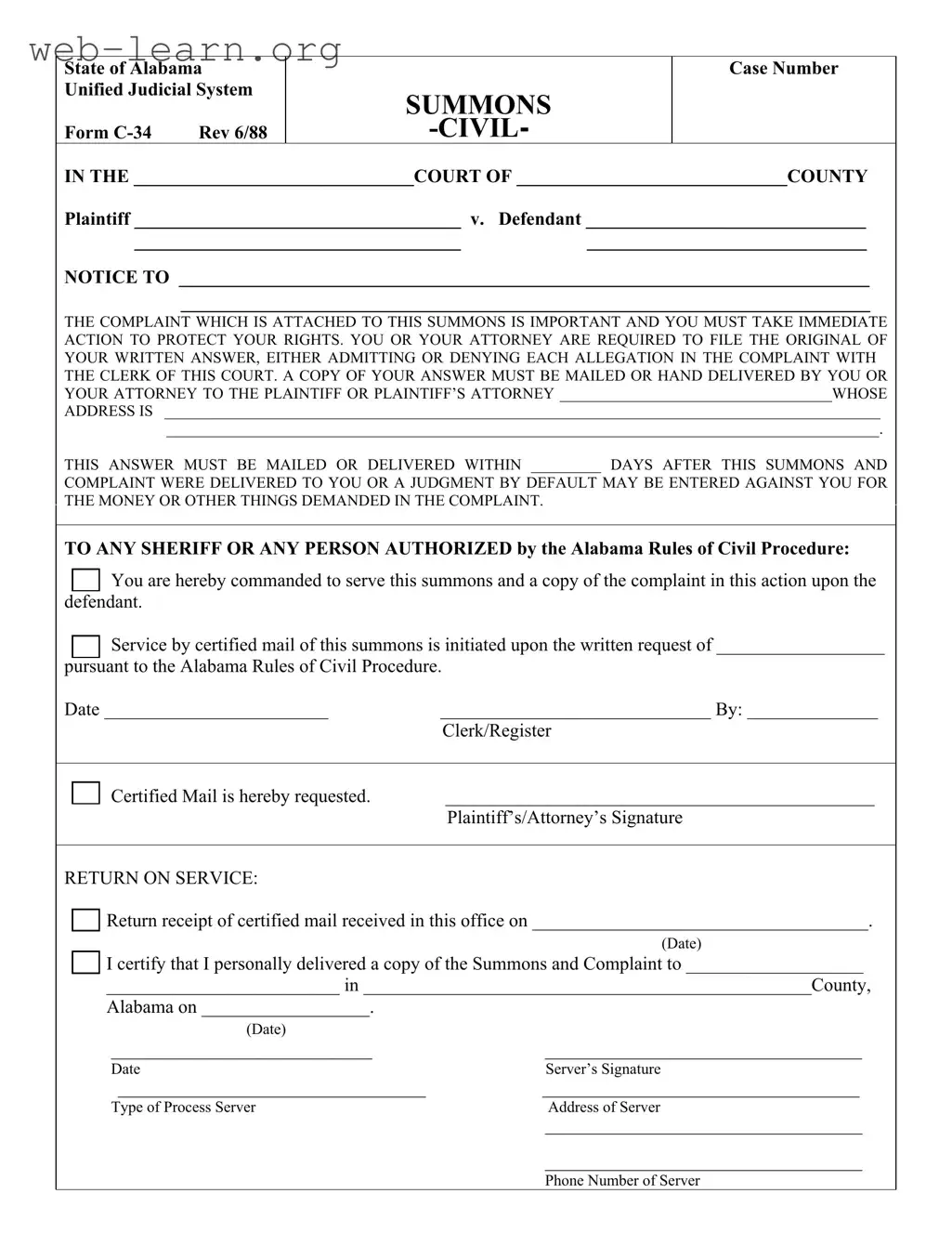
The Alabama C 34 form serves as an essential legal document in civil cases within the state. It is primarily a summons that notifies defendants of a lawsuit filed against them. This form includes vital information such as the case number, the names of the plaintiff and defendant, and instructions for the defendant on how to respond. The complaint attached to the summons outlines the allegations made by the plaintiff, making it crucial for the defendant to take immediate action. A clear deadline is established, requiring the defendant or their attorney to file a written answer within a specified number of days. Failure to respond can result in a default judgment, which may lead to the plaintiff winning the case by default. The form also includes sections for the court clerk's signature and details about service of process, ensuring that the summons is properly delivered. Understanding the Alabama C 34 form is vital for anyone involved in a civil lawsuit, as it lays the groundwork for the legal proceedings that will follow.

Sample - Alabama C 34 Form

State of Alabama
Unified Judicial System
Form C-34 Rev 6/88
SUMMONS
-CIVIL-
Case Number
IN THE ______________________________COURT OF _____________________________COUNTY
Plaintiff ___________________________________ v. Defendant ______________________________
___________________________________ ______________________________
NOTICE TO __________________________________________________________________________
__________________________________________________________________________
THE COMPLAINT WHICH IS ATTACHED TO THIS SUMMONS IS IMPORTANT AND YOU MUST TAKE IMMEDIATE
ACTION TO PROTECT YOUR RIGHTS. YOU OR YOUR ATTORNEY ARE REQUIRED TO FILE THE ORIGINAL OF
YOUR WRITTEN ANSWER, EITHER ADMITTING OR DENYING EACH ALLEGATION IN THE COMPLAINT WITH
THE CLERK OF THIS COURT. A COPY OF YOUR ANSWER MUST BE MAILED OR HAND DELIVERED BY YOU OR
YOUR ATTORNEY TO THE PLAINTIFF OR PLAINTIFF’S ATTORNEY ___________________________________WHOSE
ADDRESS IS ____________________________________________________________________________________________
____________________________________________________________________________________________.
THIS ANSWER MUST BE MAILED OR DELIVERED WITHIN _________ DAYS AFTER THIS SUMMONS AND
COM
PLAI
NT WERE DELIVERED TO YOU OR A JUDGMENT BY DEFAULT MAY BE ENTERED AGAINST YOU FOR
THE MONEY OR OTHER THINGS DEMANDED IN THE COMPLAINT.
TO ANY SHERIFF OR ANY PERSON AUTHORIZED by the Alabama Rules of Civil Procedure:
You are hereby commanded to serve this summons and a copy of the complaint in this action upon the
defendant.
Service by certified mail of this summons is initiated upon the written request of __________________
pursuant to the Alabama Rules of Civil Procedure.
Date ________________________ _____________________________ By: ______________
Clerk/Register
Certified Mail is hereby requested. ______________________________________________
Plaintiff’s/Attorney’s Signature
RETURN ON SERVICE:
Return receipt of certified mail received in this office on ____________________________________.
(Date)
I certify that I personally delivered a copy of the Summons and Complaint to ___________________
_________________________ in ________________________________________________County,
Alabama on __________________.
(Date)
____________________________ __________________________________
Date
Server’s Signature
_________________________________ __________________________________
Type of Process Server Address of Server
__________________________________
__________________________________
Phone Number of Server

Form Information

Fact Name Details
Form Title Alabama Unified Judicial System Form C-34
Purpose This form is a summons used in civil cases to notify the defendant of a lawsuit.
Governing Law Regulated under the Alabama Rules of Civil Procedure.
Filing Requirement The defendant must file a written answer with the court within a specified number of days.
Delivery Method Service can be done by certified mail or personal delivery by an authorized person.
Default Judgment If the defendant fails to respond, a judgment by default may be entered against them.
Signature Requirement The form must be signed by the plaintiff or their attorney.
Return on Service The server must complete a return receipt for proof of service delivery.

Detailed Guide for Filling Out Alabama C 34

Completing the Alabama C 34 form requires careful attention to detail to ensure that all necessary information is accurately provided. After filling out the form, it will be used to initiate legal proceedings, and proper submission is crucial for the process to move forward.

  1. Begin by entering the case number at the top of the form.
  2. In the space provided, write the name of the court where the case is being filed.
  3. Fill in the county name where the court is located.
  4. Next, write the name of the plaintiff in the designated area.
  5. In the section labeled "v.", enter the name of the defendant.
  6. Complete the notice section by detailing the necessary actions the defendant must take.
  7. Indicate the number of days the defendant has to respond after receiving the summons.
  8. For the plaintiff’s or attorney's signature, ensure that the correct name is filled in along with their address.
  9. In the section for the date, write the date the summons is being issued.
  10. Have the clerk or register sign and date the form to validate it.
  11. If certified mail is requested, ensure that the appropriate section is completed.
  12. For the return on service, fill in the date the certified mail was received.
  13. Finally, the server must complete their section, including their name, signature, and contact information.

Obtain Answers on Alabama C 34

  1. What is the Alabama C 34 form?

    The Alabama C 34 form is a legal document known as a Summons for civil cases. It notifies the defendant that a complaint has been filed against them in court. This form is crucial for initiating a civil lawsuit in Alabama.

  2. What information is required on the form?

    The form requires several key pieces of information:

    • The name of the court where the case is filed.
    • The case number.
    • The names of the plaintiff and defendant.
    • The address of the plaintiff or their attorney.
    • The number of days the defendant has to respond to the complaint.
  3. What should the defendant do upon receiving the summons?

    Upon receiving the summons, the defendant must take immediate action. They or their attorney must file a written answer with the court. This answer should either admit or deny the allegations made in the complaint. It is essential to respond within the specified time frame to avoid a default judgment.

  4. What happens if the defendant does not respond?

    If the defendant fails to respond within the designated time, a judgment by default may be entered against them. This means the court could rule in favor of the plaintiff without the defendant's input, potentially resulting in financial or other penalties.

  5. How is the summons served to the defendant?

    The summons can be served by a sheriff or any authorized person. It may also be sent via certified mail upon request. Proper service is crucial, as it ensures the defendant is officially notified of the lawsuit.

  6. What is the role of the process server?

    The process server is responsible for delivering the summons and complaint to the defendant. They must complete a return on service, which documents how and when the summons was served. This ensures that the court has a record of the service.

  7. Can the defendant respond to the complaint verbally?

    No, the defendant must provide a written answer to the complaint. This written response is a formal document that outlines their position regarding the allegations. A verbal response is not sufficient in a court of law.

  8. What should the plaintiff do after filing the summons?

    After filing the summons, the plaintiff should ensure that it is properly served to the defendant. They should also keep track of the response time and be prepared to proceed with the case if the defendant files an answer.

  9. Where can I obtain the Alabama C 34 form?

    The Alabama C 34 form can typically be obtained from the local courthouse or downloaded from the official Alabama Unified Judicial System website. It is important to use the most current version of the form to ensure compliance with legal requirements.

Common mistakes

Filling out the Alabama C 34 form can be a straightforward process, but several common mistakes can lead to complications. One frequent error is neglecting to include the correct case number. This number is essential for the court to track the case, and without it, the form may be considered incomplete.

Another common mistake is failing to accurately identify the court. The form requires the name of the court where the case is being filed, and an incorrect designation can cause delays in processing. Additionally, individuals often overlook the need to specify the county in which the court is located. This information is crucial for jurisdictional purposes.

Many people also make the mistake of not providing complete names for both the plaintiff and the defendant. Incomplete names can lead to confusion and may affect the service of the summons. Furthermore, individuals sometimes forget to include the address of the plaintiff or the plaintiff's attorney. This omission can hinder communication and delivery of important documents.

Another error involves the deadline for filing an answer. The form specifies a timeframe within which the defendant must respond. Failing to fill in this timeframe or misunderstanding it can result in a default judgment against the defendant.

In addition to these issues, some individuals do not sign the form where indicated. A signature is necessary to validate the document, and without it, the form may be rejected. Similarly, neglecting to provide a date on which the form is signed can also lead to problems.

Misunderstanding the service requirements is another common mistake. Individuals may not realize that they must either mail or hand-deliver a copy of the answer to the plaintiff or the plaintiff's attorney. This step is critical to ensure that all parties are informed and can respond appropriately.

Another frequent oversight is the failure to complete the return on service section. This section confirms that the summons and complaint have been delivered to the defendant. Incomplete information here can lead to questions about whether the defendant has been properly served.

Moreover, some individuals may not provide accurate contact information for the process server. This includes the server’s address and phone number, which are necessary for any follow-up that may be required. Missing this information can delay the proceedings.

Lastly, individuals sometimes misinterpret the instructions regarding certified mail. They may not understand when and how to request certified mail service, leading to further complications in the delivery of the summons.

Overall, careful attention to detail is essential when filling out the Alabama C 34 form. By avoiding these common mistakes, individuals can help ensure that their legal proceedings move forward smoothly.

Documents used along the form

When dealing with legal matters, particularly in Alabama, several forms and documents often accompany the Alabama C-34 form, which is essential for initiating a civil lawsuit. Understanding these documents can help ensure that all necessary steps are taken promptly and correctly. Below is a list of commonly used forms that may be relevant.

  • Complaint Form: This document outlines the plaintiff's claims against the defendant. It details the facts of the case, the legal basis for the claims, and the relief sought. The complaint must be filed alongside the summons to initiate the legal process.
  • Answer Form: After receiving the summons and complaint, the defendant must respond with an answer. This document admits or denies the allegations made in the complaint and may include any defenses or counterclaims the defendant wishes to assert.
  • Affidavit of Service: This form serves as proof that the summons and complaint were delivered to the defendant. It details how and when the documents were served, which is crucial for ensuring that the court has jurisdiction over the defendant.
  • Motion to Dismiss: If the defendant believes that the complaint is legally insufficient, they may file a motion to dismiss. This document requests that the court dismiss the case before it goes to trial, based on specific legal grounds.
  • Notice of Appearance: This document is filed by an attorney to formally indicate their representation of a party in the case. It ensures that all parties and the court are aware of who is acting on behalf of the plaintiff or defendant.

Utilizing these forms correctly is vital for navigating the legal landscape effectively. Each document plays a specific role in the process, and timely filing can significantly impact the outcome of a case. Always consult with a legal professional if there are any uncertainties regarding these forms or the procedures involved.

Similar forms

The Alabama C 34 form, which serves as a civil summons, shares similarities with several other legal documents. Each of these documents serves a specific purpose in the legal process, often involving notifications and responses. Below are six documents that are comparable to the Alabama C 34 form:

  • Civil Complaint: This document initiates a lawsuit by outlining the plaintiff's claims against the defendant. It accompanies the summons and provides the necessary context for the allegations.
  • Answer: The answer is the formal response from the defendant. It addresses each allegation made in the complaint, allowing the defendant to admit or deny the claims.
  • Notice of Appearance: This document informs the court and the opposing party that a lawyer is representing a party in the case. It is often filed shortly after receiving the summons.
  • Motion to Dismiss: A defendant may file this document to request the court to dismiss the case. It can be based on various grounds, such as lack of jurisdiction or failure to state a claim.
  • Subpoena: A subpoena is a document that orders an individual to appear in court or produce evidence. It is used to compel testimony or the production of documents relevant to the case.
  • Default Judgment: If the defendant fails to respond to the summons and complaint within the specified time, the plaintiff may request a default judgment. This document formalizes the court's decision in favor of the plaintiff.

Dos and Don'ts

When filling out the Alabama C 34 form, it is essential to follow specific guidelines to ensure accuracy and compliance. Here are nine things you should and shouldn't do:

  • Do read the entire form carefully before starting.
  • Do provide complete and accurate information for both the plaintiff and defendant.
  • Do file your written answer within the specified time frame to avoid default judgment.
  • Do make sure to sign the form where required.
  • Do keep a copy of the completed form for your records.
  • Don't leave any sections blank unless instructed to do so.
  • Don't alter the form or use any additional pages unless necessary.
  • Don't forget to deliver a copy of your answer to the plaintiff or their attorney.
  • Don't ignore the deadlines provided in the summons.

Misconceptions

The Alabama C 34 form, also known as the Summons - Civil, is often misunderstood. Below are ten common misconceptions about this form, along with clarifications.

  1. It is only for court cases involving money. Many believe the form is limited to monetary disputes. However, it can be used in various civil cases, including those seeking non-monetary relief.
  2. Filing an answer is optional. Some think that responding to the summons is not necessary. In reality, failing to file an answer can lead to a default judgment against the defendant.
  3. The complaint is not important. Some individuals underestimate the importance of the attached complaint. It contains critical information about the allegations and the basis for the lawsuit.
  4. Service of the summons can be done by anyone. Many believe that any person can serve the summons. In fact, it must be served by a sheriff or a person authorized under the Alabama Rules of Civil Procedure.
  5. There is no deadline to respond. Some assume they can take their time in responding. However, the form specifies a deadline, typically within 30 days, to avoid default judgment.
  6. Only the defendant must respond. It is a common misconception that only the defendant is required to act. The plaintiff or their attorney must also ensure that a copy of the answer is delivered to them.
  7. Certified mail is the only method of service. While certified mail is an option, the summons can also be served in person. The form allows for multiple methods of service.
  8. The clerk of court will automatically provide legal advice. Many believe that the clerk will guide them through the legal process. Clerks can provide procedural information but cannot offer legal advice.
  9. Once served, the case is automatically lost. Some individuals think that being served means they have already lost the case. This is not true; they have the opportunity to respond and defend themselves.
  10. Only lawyers can file the answer. While it is advisable to have legal representation, individuals can file their own answers if they choose to do so.

Understanding these misconceptions can help individuals navigate the legal process more effectively and protect their rights.

Key takeaways

When filling out and using the Alabama C-34 form, consider the following key takeaways:

  • Understand the Purpose: The Alabama C-34 form serves as a summons for civil cases. It notifies the defendant that legal action has been initiated against them.
  • Timely Response is Crucial: Defendants must file their written answer within the specified number of days. Failing to do so may result in a default judgment against them.
  • Proper Filing: The original written answer must be filed with the court clerk. Ensure that a copy is also sent to the plaintiff or their attorney.
  • Service of Summons: The form must be served to the defendant by a sheriff or an authorized individual. This can also be done via certified mail if requested.
  • Document Everything: Keep a record of when the summons and complaint were delivered. This information is essential for verifying compliance with court requirements.