Homepage Blank Alabama C 25A Form
Outline

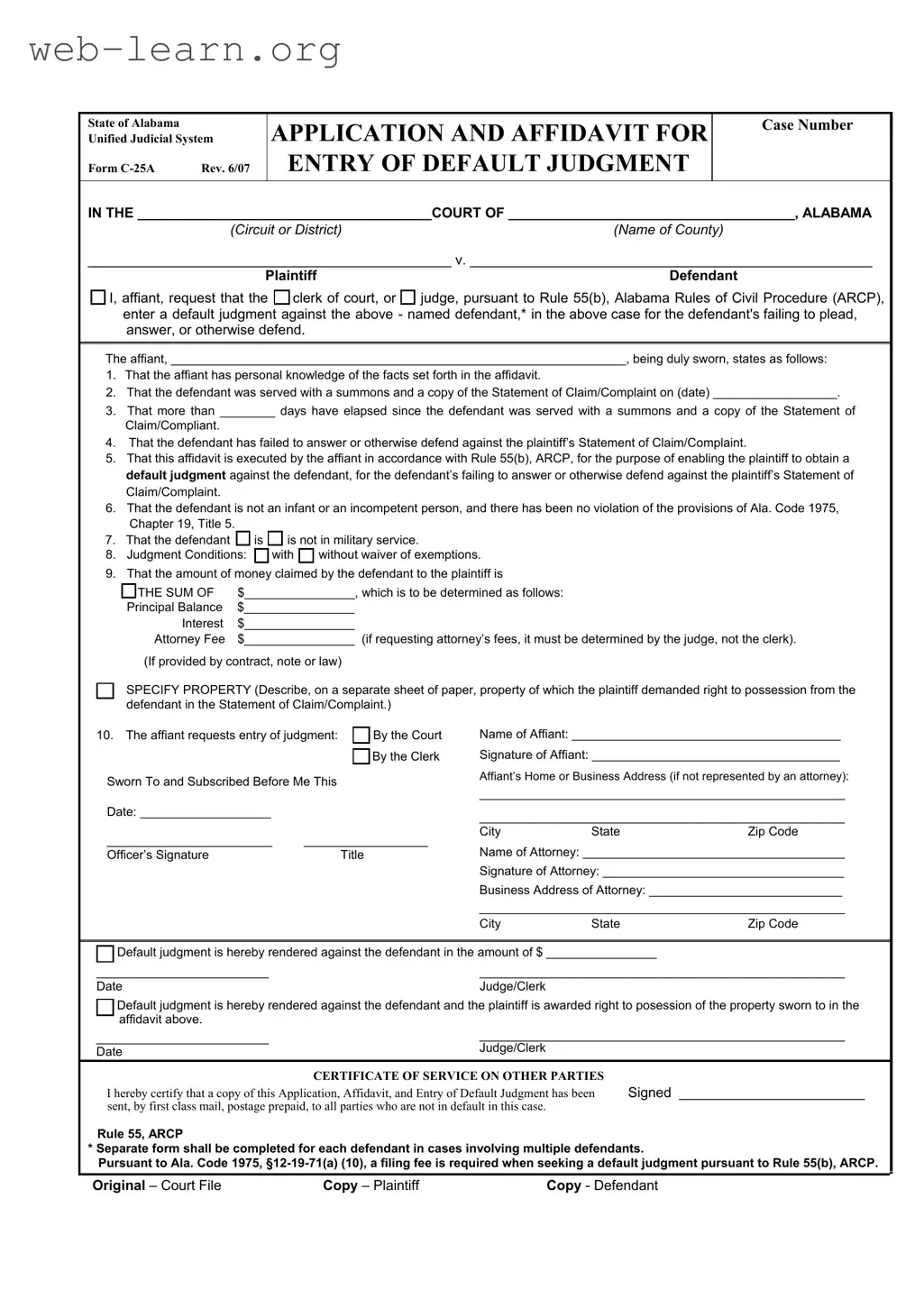
The Alabama C 25A form is a crucial document for those seeking a default judgment in the state’s court system. It serves as both an application and an affidavit, allowing a plaintiff to request the court to enter a judgment against a defendant who has failed to respond to a legal complaint. This form is utilized when a defendant does not plead, answer, or defend themselves within the required timeframe after being served with a summons and a copy of the complaint. The form outlines essential information, including the case number, the names of the parties involved, and the specific court where the case is filed. It also requires the affiant, or the person making the request, to provide details such as the date the defendant was served, the number of days that have passed since then, and whether the defendant is in military service. Additionally, the affiant must confirm that the defendant is not a minor or deemed incompetent. The form includes a section for specifying the amount of money claimed, as well as any property involved in the case. Finally, it concludes with a certification of service, ensuring that all parties are notified of the proceedings. By following the guidelines set forth in this form, plaintiffs can effectively navigate the process of obtaining a default judgment in Alabama.

Sample - Alabama C 25A Form

State of Alabama
Unified Judicial System
Form C-25A Rev. 6/07
APPLICATION AND AFFIDAVIT FOR
ENTRY OF DEFAULT JUDGMENT
Case Number
IN THE ______________________________________COURT OF _____________________________________, ALABAMA
(Circuit or District) (Name of County)
_______________________________________________ v. ____________________________________________________
Plaintiff Defendant
I, affiant, request that the clerk of court, or judge, pursuant to Rule 55(b), Alabama Rules of Civil Procedure (ARCP),
enter a default judgment against the above - named defendant,* in the above case for the defendant's failing to plead,
answer, or otherwise defend.
CERTIFICATE OF SERVICE ON OTHER PARTIES
I hereby certify that a copy of this Application, Affidavit, and Entry of Default Judgment has been Signed ________________________
sent, by first class mail, postage prepaid, to all parties who are not in default in this case.
The affiant, __________________________________________________________________, being duly sworn, states as follows:
1. That the affiant has personal knowledge of the facts set forth in the affidavit.
2. That the defendant was served with a summons and a copy of the Statement of Claim/Complaint on (date) __________________.
3. That more than ________ days have elapsed since the defendant was served with a summons and a copy of the Statement of
Claim/Compliant.
4. That the defendant has failed to answer or otherwise defend against the plaintiff’s Statement of Claim/Complaint.
5. That this affidavit is executed by the affiant in accordance with Rule 55(b), ARCP, for the purpose of enabling the plaintiff to obtain a
default judgment against the defendant, for the defendant’s failing to answer or otherwise defend against the plaintiff’s Statement of
Claim/Complaint.
6. That the defendant is not an infant or an incompetent person, and there has been no violation of the provisions of Ala. Code 1975,
Chapter 19, Title 5.
7. That the defendant is is not in military service.
8. Judgment Conditions: with without waiver of exemptions.
9. That the amount of money claimed by the defendant to the plaintiff is
THE SUM OF $________________, which is to be determined as follows:
Principal Balance $________________
Interest $________________
Attorney Fee $________________ (if requesting attorney’s fees, it must be determined by the judge, not the clerk).
(If provided by contract, note or law)
SPECIFY PROPERTY (Describe, on a separate sheet of paper, property of which the plaintiff demanded right to possession from the
defendant in the Statement of Claim/Complaint.)
10. The affiant requests entry of judgment: By the Court
By the Clerk
Sworn To and Subscribed Before Me This
Date: ___________________
________________________ __________________
Officer’s Signature Title
Name of Affiant: _______________________________________
Signature of Affiant: ____________________________________
Affiant’s Home or Business Address (if not represented by an attorney):
_____________________________________________________
_____________________________________________________
City State Zip Code
Name of Attorney: ______________________________________
Signature of Attorney: ___________________________________
Business Address of Attorney: ____________________________
_____________________________________________________
City State Zip Code
Default judgment is hereby rendered against the defendant in the amount of $ ________________
_________________________
Date
_____________________________________________________
Judge/Clerk
Default judgment is hereby rendered against the defendant and the plaintiff is awarded right to posession of the property sworn to in the
affidavit above.
_________________________
Date
_____________________________________________________
Judge/Clerk
Rule 55, ARCP
* Separate form shall be completed for each defendant in cases involving multiple defendants.
Pursuant to Ala. Code 1975, §12-19-71(a) (10), a filing fee is required when seeking a default judgment pursuant to Rule 55(b), ARCP.
Original – Court File Copy Plaintiff Copy - Defendant

Form Information

Fact Name Fact Description
Form Title The form is officially titled "Application and Affidavit for Entry of Default Judgment" and is designated as Form C-25A.
Governing Laws This form is governed by Rule 55(b) of the Alabama Rules of Civil Procedure (ARCP).
Purpose The primary purpose of this form is to request a default judgment against a defendant who has failed to respond to a legal complaint.
Affiant Requirements The affiant must have personal knowledge of the facts stated in the affidavit to ensure accuracy and validity.
Service of Summons The form requires the affiant to confirm that the defendant was served with a summons and a copy of the complaint.
Timeframe for Response More than a specified number of days must have passed since the defendant was served, indicating their failure to respond.
Judgment Conditions The form allows the affiant to specify whether the judgment should be granted with or without a waiver of exemptions.
Filing Fee A filing fee is required when submitting this form, as mandated by Ala. Code 1975, §12-19-71(a)(10).

Detailed Guide for Filling Out Alabama C 25A

Filling out the Alabama C 25A form is a straightforward process that requires careful attention to detail. After completing the form, it should be submitted to the appropriate court along with any required fees. Ensure all information is accurate to avoid delays in processing.

  1. Obtain the Alabama C 25A form from the Unified Judicial System website or your local courthouse.
  2. Fill in the case number at the top of the form.
  3. Specify the court type (Circuit or District) and the name of the county where the case is filed.
  4. Provide the names of the plaintiff and defendant in the designated fields.
  5. In the section for the affiant, write your name as the person requesting the default judgment.
  6. Indicate the date when the defendant was served with the summons and Statement of Claim/Complaint.
  7. Fill in the number of days that have elapsed since the defendant was served.
  8. Confirm that the defendant has failed to answer or defend against the claim.
  9. State whether the defendant is an infant or incompetent person and if they are in military service.
  10. Choose whether the judgment conditions are with or without waiver of exemptions.
  11. Specify the amount of money claimed from the defendant, breaking it down into principal balance, interest, and attorney fees, if applicable.
  12. If property is involved, describe it on a separate sheet of paper and attach it to the form.
  13. Select whether you request entry of judgment by the court or the clerk.
  14. Sign and date the form in the designated areas for the affiant and include your home or business address.
  15. If represented by an attorney, fill in their name, signature, and business address.
  16. After completing the form, make copies for your records and for the defendant.
  17. File the original form with the court and pay any required filing fees.
  18. Certify that a copy of the application has been sent to all parties not in default.

Obtain Answers on Alabama C 25A

  1. What is the purpose of the Alabama C 25A form?

    The Alabama C 25A form is an application and affidavit used to request a default judgment in civil cases. When a defendant fails to respond to a complaint or summons, the plaintiff can use this form to ask the court to enter a judgment against the defendant. It serves to document the necessary facts and affirmations required by the court under Rule 55(b) of the Alabama Rules of Civil Procedure.

  2. Who can file the Alabama C 25A form?

    The form can be filed by the plaintiff or their attorney. The person filing must have personal knowledge of the facts outlined in the affidavit. This ensures that the information presented is accurate and can be verified.

  3. What information is required on the form?

    The form requires several key pieces of information, including:

    • The names of the plaintiff and defendant.
    • The date the defendant was served with the summons and complaint.
    • The number of days that have passed since service.
    • A declaration that the defendant has not answered or defended against the complaint.
    • Confirmation that the defendant is not an infant or incompetent.
    • Details about any claims for monetary damages or property possession.

  4. What does it mean if a default judgment is entered?

    A default judgment means that the court has ruled in favor of the plaintiff because the defendant did not respond to the legal action. This judgment can include monetary damages, possession of property, or other remedies as requested by the plaintiff.

  5. How long does a defendant have to respond before a default judgment can be requested?

  6. Can a default judgment be contested after it is entered?

    Yes, a default judgment can be contested. The defendant may file a motion to set aside the judgment, usually on grounds such as lack of proper service or a valid reason for their failure to respond. However, this process often requires the defendant to act quickly and provide compelling evidence.

  7. Is there a fee associated with filing the C 25A form?

    Yes, there is a filing fee required when seeking a default judgment using the C 25A form. This fee is mandated by Ala. Code 1975, §12-19-71(a) (10) and must be paid at the time of filing.

  8. What happens if there are multiple defendants?

    If there are multiple defendants in a case, a separate C 25A form must be completed for each defendant. This ensures that the court has the necessary information for each party involved in the action.

  9. What should be included in the judgment conditions section?

    The judgment conditions section allows the affiant to specify whether the judgment is with or without a waiver of exemptions. This is important as it determines whether the defendant's assets may be protected from seizure in the event of a judgment.

  10. How is the amount of the judgment determined?

    The amount of the judgment is based on the claims made by the plaintiff, which may include the principal balance owed, interest, and any attorney fees if applicable. It is crucial that the attorney fees are determined by the judge, not the clerk, as per the requirements of the form.

Common mistakes

Filling out the Alabama C 25A form can be a straightforward process, but many people make common mistakes that can lead to delays or rejections. One significant error is failing to provide accurate information about the defendant. This includes not listing the correct name or failing to specify the right court. Such inaccuracies can result in complications, as the court may not be able to process the default judgment correctly.

Another frequent mistake involves the section regarding the service of summons. Applicants often forget to include the date when the defendant was served with the summons and complaint. This date is crucial because it establishes the timeline for the case. If this information is missing or incorrect, it can lead to questions about whether the defendant had sufficient notice to respond.

Additionally, individuals sometimes overlook the requirement to confirm whether the defendant is in military service. The form specifically asks for this information, and failing to answer can lead to legal issues. If a defendant is in military service, special protections apply, and the court may need to take additional steps before proceeding with a default judgment.

Lastly, many applicants do not properly calculate the amount being claimed. It is essential to break down the total amount into its components, such as principal balance, interest, and attorney fees. Inaccuracies in this section can result in the court rejecting the application or delaying the judgment. Ensuring all calculations are correct and clearly presented is vital for a smooth process.

Documents used along the form

When navigating the legal process in Alabama, particularly in relation to default judgments, several forms and documents may accompany the Alabama C 25A form. Each of these documents serves a specific purpose and helps ensure that the legal proceedings are conducted smoothly and fairly. Below is a list of commonly used forms that you might encounter alongside the C 25A.

  • Summons: This document notifies the defendant that a lawsuit has been filed against them. It provides essential information about the case and instructs the defendant on how to respond.
  • Statement of Claim/Complaint: This form outlines the plaintiff's allegations against the defendant. It details the basis of the lawsuit and the relief sought by the plaintiff.
  • Affidavit of Service: This document serves as proof that the defendant was properly served with the summons and complaint. It includes details about how and when the service was completed.
  • Motion for Default Judgment: This is a formal request submitted to the court asking for a default judgment. It is often filed when the defendant fails to respond within the specified time frame.
  • Notice of Default: This document informs the defendant that they have failed to respond to the lawsuit. It may serve as a reminder of the impending legal consequences.
  • Certificate of Service: This form certifies that all relevant parties have been notified of the proceedings. It is essential for maintaining transparency in the legal process.
  • Judgment Entry Form: This document is used by the court to officially record the judgment rendered in the case. It details the outcome and any awarded amounts.
  • Request for Hearing: If a hearing is necessary to resolve any disputes regarding the default judgment, this form is used to formally request that the court schedule a hearing.
  • Financial Disclosure Statement: In some cases, this document may be required to disclose the financial status of the parties involved, especially when monetary judgments are at stake.
  • Waiver of Service: This form may be used by the defendant to waive their right to be formally served with the summons and complaint, thereby expediting the process.

Understanding these documents and their roles in the legal process can provide clarity and reassurance. Each form plays a crucial part in ensuring that the rights of all parties are respected and that the legal proceedings are conducted fairly. If you find yourself needing to navigate this process, being familiar with these documents can help you feel more prepared and confident.

Similar forms

The Alabama C 25A form, used for applying and affixing an affidavit for entry of default judgment, shares similarities with several other legal documents. Below is a list of eight documents that are comparable in purpose or function:

  • Notice of Default: This document informs a party that they have failed to meet their obligations, similar to how the C 25A addresses a defendant's failure to respond.
  • Motion for Default Judgment: Like the C 25A, this motion requests the court to issue a judgment due to a party's inaction, focusing on the lack of response from the defendant.
  • Affidavit of Service: This affidavit confirms that legal documents were properly served to a party, paralleling the C 25A's requirement to demonstrate that the defendant was served.
  • Complaint: The initial document that outlines the plaintiff's case against the defendant, setting the stage for the C 25A by detailing the issues that led to the default.
  • Judgment Entry: This document officially records the court's decision, much like the C 25A, which seeks to formalize the entry of a default judgment.
  • Application for Default: Similar to the C 25A, this application requests the court to recognize a party's default due to their failure to respond or appear.
  • Order of Possession: This document grants the plaintiff the right to take possession of property, aligning with the C 25A's provision for awarding possession in default cases.
  • Certificate of Service: This document confirms that copies of court documents were sent to involved parties, akin to the C 25A's requirement to certify service on other parties.

Dos and Don'ts

When filling out the Alabama C 25A form, it’s crucial to follow specific guidelines to ensure your application is processed smoothly. Here’s a list of things you should and shouldn’t do:

  • Do double-check that you have the correct case number at the top of the form.
  • Do ensure all names and titles are spelled correctly, including the plaintiff and defendant.
  • Do fill in the date when the defendant was served with the summons and complaint.
  • Do provide accurate details regarding the amount of money being claimed.
  • Do make sure to include your signature and the date at the bottom of the form.
  • Don't leave any sections blank unless specifically instructed to do so.
  • Don't forget to specify whether the defendant is in military service.
  • Don't submit the form without confirming that all required information is included.
  • Don't use legal jargon or unclear terms; keep your language straightforward.
  • Don't forget to include your certificate of service to ensure all parties are notified.

Taking these steps can help avoid delays and complications in your application process. Make sure to act promptly and thoroughly.

Misconceptions

Understanding the Alabama C 25A form is crucial for those navigating the legal process. However, several misconceptions can lead to confusion. Here are four common misconceptions:

  • The C 25A form can be used without prior notification to the defendant. Many believe that a default judgment can be requested without serving the defendant with the necessary documents. In reality, the defendant must be properly served with a summons and a copy of the Statement of Claim/Complaint before filing the C 25A form.
  • A default judgment guarantees the plaintiff will receive the full amount claimed. Some assume that once a default judgment is entered, the plaintiff automatically receives the full amount sought. This is not the case. The court must still determine the appropriate amount, including any interest or attorney fees, before a judgment is finalized.
  • Only attorneys can file the C 25A form. It is a common belief that only licensed attorneys can submit this form. However, individuals can file the C 25A themselves, provided they meet all requirements and understand the process.
  • The C 25A form is only for monetary claims. Some people think this form is exclusively for financial disputes. While it often involves monetary judgments, it can also pertain to cases involving the right to possession of property, depending on the specifics of the claim.

By clarifying these misconceptions, individuals can better prepare themselves for the legal process associated with the Alabama C 25A form.

Key takeaways

  • The Alabama C 25A form is used to request a default judgment when a defendant fails to respond to a lawsuit.

  • This form must be filed in the appropriate court, either Circuit or District, depending on the case.

  • Ensure you have the correct case number and the names of both the plaintiff and defendant filled out accurately.

  • Personal knowledge of the facts is required. The affiant must be able to confirm the details stated in the affidavit.

  • Service of the summons and complaint must be properly documented, including the date of service.

  • It is important to note how many days have passed since the defendant was served. This is crucial for the timing of the request.

  • The affidavit must confirm that the defendant has not answered or defended against the claim.

  • Check whether the defendant is an infant, incompetent, or in military service, as this affects the ability to obtain a default judgment.

  • Specify if the judgment is with or without a waiver of exemptions, as this will impact the amount recoverable.

  • Clearly state the amount being claimed, breaking it down into principal, interest, and attorney fees if applicable.

  • Remember to sign the form and include the date. The signature of a notary public is also necessary for validation.

  • Finally, a certificate of service must be completed, confirming that all parties received a copy of the application and affidavit.