Homepage Blank Alabama C 20 Form
Outline

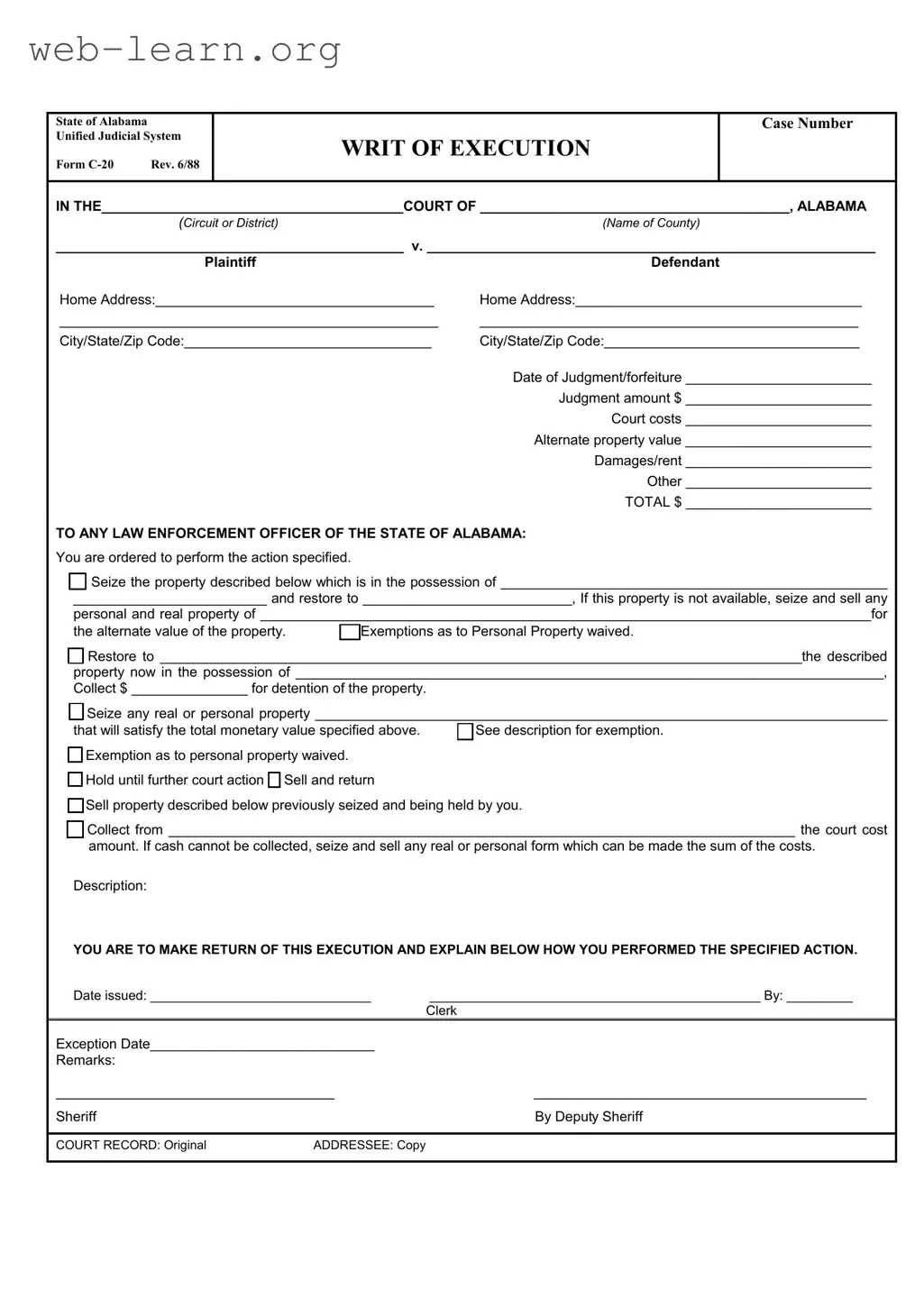
The Alabama C 20 form is an essential legal document used in the state’s judicial system for the execution of court judgments. This form facilitates the collection of debts by allowing a plaintiff to request the seizure of a defendant's property to satisfy a judgment. It includes critical information such as the case number, names of the parties involved, judgment amount, and specific instructions for law enforcement officers. The form outlines the actions that officers must take, whether it involves seizing property, collecting court costs, or selling assets to recover owed amounts. Additionally, it provides a notice of the right to claim exemptions, informing defendants of their legal rights to protect certain personal property from being seized. Understanding the Alabama C 20 form is crucial for both plaintiffs seeking to enforce a judgment and defendants wishing to navigate their rights effectively.


Sample - Alabama C 20 Form

State of Alabama
Unified Judicial System
Form C-20 Rev. 6/88
WRIT OF EXECUTION
Case Number
IN THE_______________________________________COURT OF ________________________________________, ALABAMA
(Circuit or District) (Name of County)
_____________________________________________ v. __________________________________________________________
Plaintiff Defendant
Home Address:____________________________________
_________________________________________________
City/State/Zip Code:________________________________
Home Address:_____________________________________
_________________________________________________
City/State/Zip Code:_________________________________
Date of Judgment/forfeiture ________________________
Judgment amount $ ________________________
Court costs ________________________
Alternate property value ________________________
Damages/rent ________________________
Other ________________________
TOTAL $ ________________________
TO ANY LAW ENFORCEMENT OFFICER OF THE STATE OF ALABAMA:
You are ordered to perform the action specified.
Seize the property described below which is in the possession of __________________________________________________
_________________________ and restore to ___________________________, If this property is not available, seize and sell any
personal and real property of _______________________________________________________________________________for
the alternate value of the property. Exemptions as to Personal Property waived.
Restore to ___________________________________________________________________________________the described
property now in the possession of ____________________________________________________________________________,
Collect $ _______________ for detention of the property.
Seize any real or personal property __________________________________________________________________________
that will satisfy the total monetary value specified above. See description for exemption.
Exemption as to personal property waived.
Hold until further court action Sell and return
Sell property described below previously seized and being held by you.
Collect from _________________________________________________________________________________ the court cost
amount. If cash cannot be collected, seize and sell any real or personal form which can be made the sum of the costs.
Description:
YOU ARE TO MAKE RETURN OF THIS EXECUTION AND EXPLAIN BELOW HOW YOU PERFORMED THE SPECIFIED ACTION.
Date issued: ______________________________ _____________________________________________ By: _________
Clerk
Exception Date_____________________________
Remarks:
_
___________________________________ ___________________________________________
Sheriff By Deputy Sheriff
COURT RECORD: Original ADDRESSEE: Copy
State of Alabama
Unified Judicial System
Form C-20A Rev. 10/86
NOTICE OF RIGHT TO CLAIM EXEMPTIONS
FROM EXECUTION
Case Number
IN THE_______________________________________COURT OF ________________________________________, ALABAMA
(Circuit or District) (Name of County)
_____________________________________________v. __________________________________________________________
Plaintiff Defendant
Home Address:____________________________________
_________________________________________________
City State Zip Code
Telephone Number:___________________________
Home Address:_____________________________________
_________________________________________________
City State Zip Code
Telephone Number:____________________________
The Writ of Execution delivered to you along with this Notice means that certain property belonging to you may be taken
from you and sold to collect a court judgment against you.
However, the law gives you the right, under certain circumstances, to claim your property as “exempt” to keep it from
being sold to collect certain kinds of court judgments. For example, you may be able to claim your “homestead exemption”
to keep your home from being sold, or at least to keep a certain portion of the money from the sale.
You may also be able to keep up to $3,000 in personal property, including motor vehicle and household furniture and
appliances, by claiming this property as exempt.
These examples are for purposes of illustration only. Whether you will be entitled to claim any exemption from the Writ
of Execution, and if so, what property may be exempt, will be determined by the facts in your particular case. IF YOU ARE
UNCERTAIN AS TO YOUR EXEMPTION RIGHTS, YOU SHOULD CONSULT A LAWYER FOR ADVICE. PERSONNEL
IN THE CLERK’S OFFICE CANNOT GIVE YOU LEGAL ADVICE.
TO CLAIM ANY EXEMPTION THAT MAY BE AVAILABLE TO YOU, YOU MUST PREPARE A “CLAIM OF
EXEMPTION" FORM BEFORE YOUR PROPERTY IS SOLD, LISTING ON IT THE PROPERTY TO BE SOLD (OR ANY
PART THEREOF) IN DETAIL THAT YOU CLAIM TO BE EXEMPT. YOU MUST ALSO STATE APPROXIMATELY WHAT
YOU THINK EACH ITEM IS WORTH, AND HOW MUCH (IF ANYTHING) YOU STILL OWE ON EACH SUCH ITEM. YOU
MUST THEN HAVE THE “CLAIM OF EXEMPTION” NOTARIZED AND FILE IT IN THE SHERIFF’S OFFICE. YOU MUST
ALSO FILE A COPY OF THE “CLAIM OF EXEMPTION” WITH THE CLERK OF THE COURT. THE CLERK CANNOT
GIVE YOU LEGAL ADVICE. IT YOU NEED ASSISTANCE, YOU SHOULD SEE A LAWYER.
If you file a Claim of Exemption, the party who has a judgment against you will have approximately ten (10) days from
receipt of a copy thereof to file a “contest” of your Claim of Exemption. If a contest is filed, a court hearing will be scheduled,
and you will be notified of the time and place of the hearing. If the party who has a judgment against you does not file a
contest, the property (or any part thereof) claimed by you as exempt will be released from the execution.
If you do not file a Claim of Exemption, you are deemed to have waived your rights of exemptions, and your property
may be sold or turned over to the party who has a judgment against you to help satisfy a judgment against you.
TO PROTECT YOUR RIGHTS, IT IS IMPORTANT THAT YOU ACT PROMPTLY. IF YOU HAVE ANY QUESTIONS,
YOU SHOULD CONSULT A LAWYER.

Form Information

Fact Name Description
Form Title The Alabama C-20 form is officially titled "Writ of Execution."
Governing Law This form is governed by Alabama Rules of Civil Procedure, specifically Rule 70.
Purpose The form is used to enforce a judgment by allowing the seizure of property to satisfy a court order.
Case Number The form requires a case number to identify the specific legal action related to the judgment.
Judgment Details It includes sections for entering the date of judgment and the amount awarded by the court.
Law Enforcement Role Law enforcement officers are ordered to carry out the specified actions outlined in the writ.
Property Description It requires a description of the property to be seized or sold to satisfy the judgment.
Exemptions The form provides information about exemptions that may apply to certain personal property.
Claim of Exemption Debtors can file a "Claim of Exemption" to protect certain properties from being seized.
Filing Requirements To claim an exemption, a notarized form must be filed with both the Sheriff’s Office and the court clerk.

Detailed Guide for Filling Out Alabama C 20

Filling out the Alabama C-20 form requires attention to detail and accurate information. After completing the form, it will be submitted to the appropriate court and law enforcement for action.

  1. Obtain a copy of the Alabama C-20 form.
  2. Fill in the case number at the top of the form.
  3. Indicate the court name and county where the case is being filed.
  4. Provide the names of the plaintiff and defendant in the designated spaces.
  5. Enter the home addresses for both the plaintiff and defendant, including city, state, and zip code.
  6. Fill in the date of judgment or forfeiture.
  7. Specify the judgment amount, court costs, alternate property value, damages or rent, and any other relevant amounts.
  8. Calculate and write the total amount due at the bottom of the section.
  9. Complete the section that instructs law enforcement on the actions to be taken. Clearly describe the property to be seized and the person in possession of that property.
  10. Indicate whether exemptions to personal property are waived.
  11. Provide details about any real or personal property that may satisfy the total monetary value specified.
  12. Write the date issued and sign the form as the clerk.
  13. Complete the remarks section, if necessary, to provide additional information.
  14. Make copies of the completed form for your records and for the parties involved.

Obtain Answers on Alabama C 20

  1. What is the Alabama C 20 form?

    The Alabama C 20 form is a Writ of Execution used in the state of Alabama. It allows a court to authorize law enforcement to seize property to satisfy a court judgment. This form is crucial for creditors seeking to enforce a judgment against a debtor.

  2. Who can issue a Writ of Execution?

    A Writ of Execution can be issued by a court after a judgment has been made in favor of a plaintiff. The plaintiff must request this writ to collect the judgment amount from the defendant.

  3. What information is required on the C 20 form?

    The C 20 form requires several key details, including:

    • Case number
    • Names of the plaintiff and defendant
    • Home addresses of both parties
    • Date of judgment
    • Judgment amount
    • Details of any property to be seized

  4. What happens after the Writ of Execution is issued?

    Once the Writ of Execution is issued, it is delivered to law enforcement officers. They are then responsible for carrying out the seizure of the specified property or collecting the judgment amount from the debtor.

  5. Can a debtor claim exemptions from the Writ of Execution?

    Yes, a debtor may claim exemptions. Under certain circumstances, they can protect specific property from being seized. Common exemptions include a homestead exemption for a primary residence and exemptions for personal property up to a certain value.

  6. How does a debtor claim an exemption?

    To claim an exemption, the debtor must complete a “Claim of Exemption” form. This form must detail the property they wish to protect, its estimated value, and any outstanding debts on it. The claim must be notarized and filed with both the sheriff's office and the court clerk.

  7. What happens if a Claim of Exemption is contested?

    If the creditor contests the Claim of Exemption, a court hearing will be scheduled. The debtor will be notified of the hearing's time and place, where both parties can present their arguments regarding the exemption.

  8. What if a debtor does not file a Claim of Exemption?

    If a debtor fails to file a Claim of Exemption, they waive their rights to claim exemptions. This means their property may be sold or turned over to satisfy the judgment against them.

  9. Why is it important to act promptly with the C 20 form?

    Timely action is crucial to protect rights. If a debtor believes they have exempt property, they should file their claim as soon as possible. Delays may result in the loss of property that could have been protected.

Common mistakes

Filling out the Alabama C-20 form can be a straightforward process, but many people make common mistakes that can lead to delays or complications. One frequent error is leaving the case number blank. This number is essential for identifying your case and ensuring that the court processes your request correctly. Always double-check that you've filled in this crucial detail before submitting your form.

Another mistake involves incorrectly identifying the court name and county. Each court has specific jurisdictions, and providing the wrong information can result in your writ being dismissed or delayed. Make sure to verify the exact name of the court and the county where your case is being heard.

Many people also overlook the judgment amount section. Failing to accurately enter this figure can create confusion and may lead to complications in the enforcement of the writ. Ensure that you calculate the total amount owed, including any court costs, damages, and other relevant fees.

Providing incomplete or inaccurate addresses for both the plaintiff and defendant is another common error. Clear and complete addresses are necessary for the enforcement of the writ. Double-check that all address fields are filled out accurately to avoid issues during the execution process.

Some individuals forget to sign the form. A signature is required to validate the document and initiate the court's action. Without a signature, the form may be considered invalid, causing further delays.

Another pitfall occurs when people do not include a detailed description of the property to be seized. This section must clearly outline the items in question to avoid misunderstandings. Vague descriptions can lead to disputes over what is being claimed.

Additionally, failing to claim any exemptions can be detrimental. Many individuals do not realize they may have the right to keep certain property from being seized. If you believe you qualify for exemptions, it’s vital to prepare the appropriate documentation, such as a "Claim of Exemption" form, and file it promptly.

Lastly, many people neglect to consult with a lawyer when they have questions. While the clerk's office can assist with procedural matters, they cannot provide legal advice. If you're unsure about any aspect of the form or your rights, seeking legal counsel is a wise step to protect your interests.

Documents used along the form

The Alabama C-20 form is a crucial document in the execution of court judgments, but it is often accompanied by other important forms and documents. Each of these documents plays a specific role in the legal process, ensuring that the rights of both plaintiffs and defendants are respected. Below is a list of additional forms that are frequently used alongside the Alabama C-20 form.

  • Alabama C-20A: Notice of Right to Claim Exemptions from Execution - This form informs defendants of their rights to claim certain exemptions from the execution of a judgment. It details the types of property that may be protected from seizure, such as a homestead or personal property up to a specified value.
  • Claim of Exemption Form - This document allows defendants to formally claim that certain property should be exempt from execution. It requires a detailed list of the property, its estimated value, and any outstanding debts associated with it. The form must be notarized and filed with both the sheriff’s office and the court clerk.
  • Notice of Sale - If property is to be sold to satisfy a judgment, this notice informs the parties involved of the time and place of the sale. It serves to ensure transparency and provides an opportunity for interested parties to attend the sale.
  • Return of Execution - After the execution process has been completed, this form is filed by the sheriff or executing officer. It details how the execution was carried out and the results, including any property seized or sold.
  • Motion to Contest Exemption - If a defendant files a Claim of Exemption, the plaintiff may contest it. This motion outlines the reasons for contesting the exemption and requests a court hearing to resolve the matter.
  • Judgment Satisfaction Form - Once a judgment has been satisfied, this form serves as official documentation that the debt has been paid. It releases the defendant from further obligations related to that judgment.

Understanding these accompanying documents is essential for anyone involved in the legal process regarding judgments and executions in Alabama. Each form serves a distinct purpose, contributing to a fair and organized judicial system. Engaging with these documents properly can help protect rights and ensure compliance with the law.

Similar forms

The Alabama C 20 form, which is a Writ of Execution, shares similarities with several other legal documents. Here are seven documents that are comparable to the Alabama C 20 form, along with explanations of their similarities:

  • Writ of Garnishment: Like the C 20 form, a Writ of Garnishment allows a creditor to collect a debt by seizing funds directly from a third party, such as a bank or employer, rather than taking property directly from the debtor.
  • Writ of Possession: This document is used to regain possession of property. Similar to the C 20 form, it authorizes law enforcement to remove a tenant or occupant from a property following a court judgment.
  • Judgment Lien: A Judgment Lien attaches to a debtor’s property, much like the C 20 form allows for the seizure of property to satisfy a judgment. Both documents serve to secure a creditor’s claim against the debtor’s assets.
  • Claim of Exemption: This document is filed by a debtor to protect certain assets from being seized. It is related to the C 20 form as it outlines the rights of a debtor to claim exemptions from execution actions.
  • Notice of Default: A Notice of Default informs a borrower of their failure to meet loan obligations. Similar to the C 20 form, it initiates legal proceedings to recover debts owed, often leading to further legal actions.
  • Affidavit of Service: This document confirms that legal papers have been delivered to a party. It is similar to the C 20 form in that both require proper documentation of actions taken to enforce court orders.
  • Execution Sale Notice: This notice is issued to inform interested parties about the sale of seized property. Like the C 20 form, it facilitates the process of collecting debts through the sale of assets.

Dos and Don'ts

When filling out the Alabama C-20 form, it is essential to be careful and thorough. Here are ten important things to keep in mind.

  • Do ensure all personal information is accurate, including names and addresses.
  • Do double-check the case number for accuracy.
  • Do fill in the date of judgment clearly.
  • Do specify the total judgment amount correctly.
  • Do include any court costs and additional damages.
  • Don't leave any sections blank; incomplete forms may cause delays.
  • Don't use unclear language when describing property; be as specific as possible.
  • Don't forget to sign and date the form before submission.
  • Don't ignore the instructions regarding exemptions; they are crucial for your rights.
  • Don't hesitate to seek legal advice if you have questions or uncertainties.

Taking these steps will help ensure that your form is filled out correctly and that your rights are protected.

Misconceptions

Misconceptions about the Alabama C 20 Form

  • Misconception 1: The C 20 form can be filled out by anyone.
  • This form is specifically designed for use by law enforcement officers and court officials. Individuals cannot fill it out for their own use.

  • Misconception 2: Filing the C 20 form guarantees the seizure of property.
  • Filing the form does not automatically result in property seizure. The court must first issue a judgment that allows for execution.

  • Misconception 3: All personal property can be seized without exception.
  • There are exemptions that protect certain types of personal property from being seized. Understanding these exemptions is crucial for individuals facing a writ of execution.

  • Misconception 4: You have unlimited time to claim exemptions after receiving the C 20 form.
  • There is a limited timeframe to file a Claim of Exemption. Acting promptly is essential to protect your rights.

  • Misconception 5: Legal advice can be obtained from court personnel regarding the C 20 form.
  • Court personnel, including those in the clerk’s office, cannot provide legal advice. Consulting a lawyer is necessary for guidance on how to proceed.

Key takeaways

Filling out and using the Alabama C-20 form is an important process that requires attention to detail. Here are some key takeaways to keep in mind:

  • The Alabama C-20 form is a legal document used to initiate a writ of execution, allowing the seizure of property to satisfy a court judgment.
  • Ensure that you fill in the case number and the names of both the plaintiff and defendant accurately to avoid delays.
  • Be specific when detailing the property to be seized. Include descriptions and any relevant information to help law enforcement identify the items.
  • Understand your exemption rights. Certain properties may be exempt from seizure, such as a homestead or specific personal property up to a certain value.
  • If you believe your property is exempt, you must file a Claim of Exemption form before the property is sold, detailing the items and their estimated values.
  • Act promptly. If you do not file a Claim of Exemption, you may lose your rights, and your property could be sold to satisfy the judgment.

Being informed and proactive can help protect your rights during this process. If you have questions or need assistance, it is advisable to consult a legal professional.