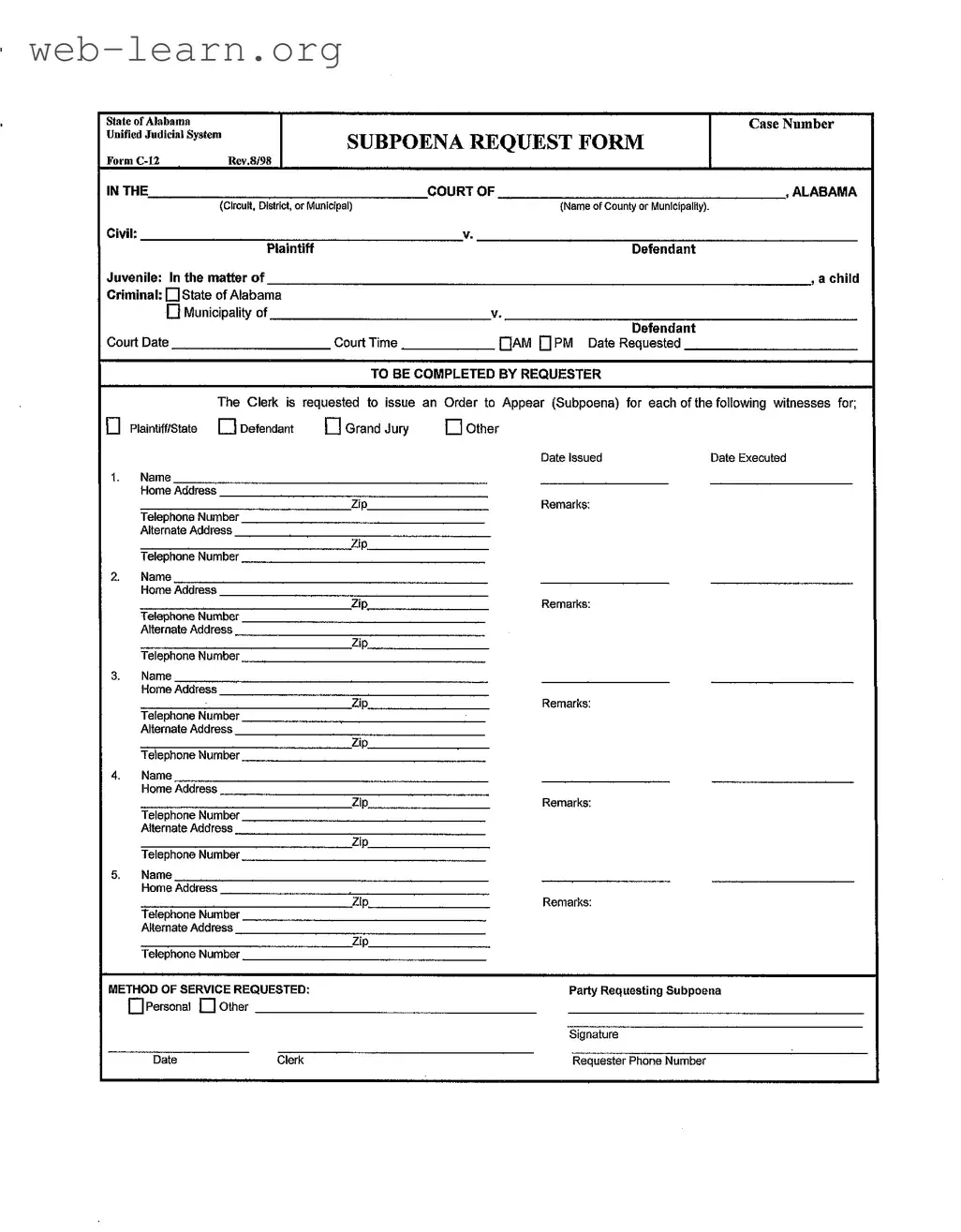
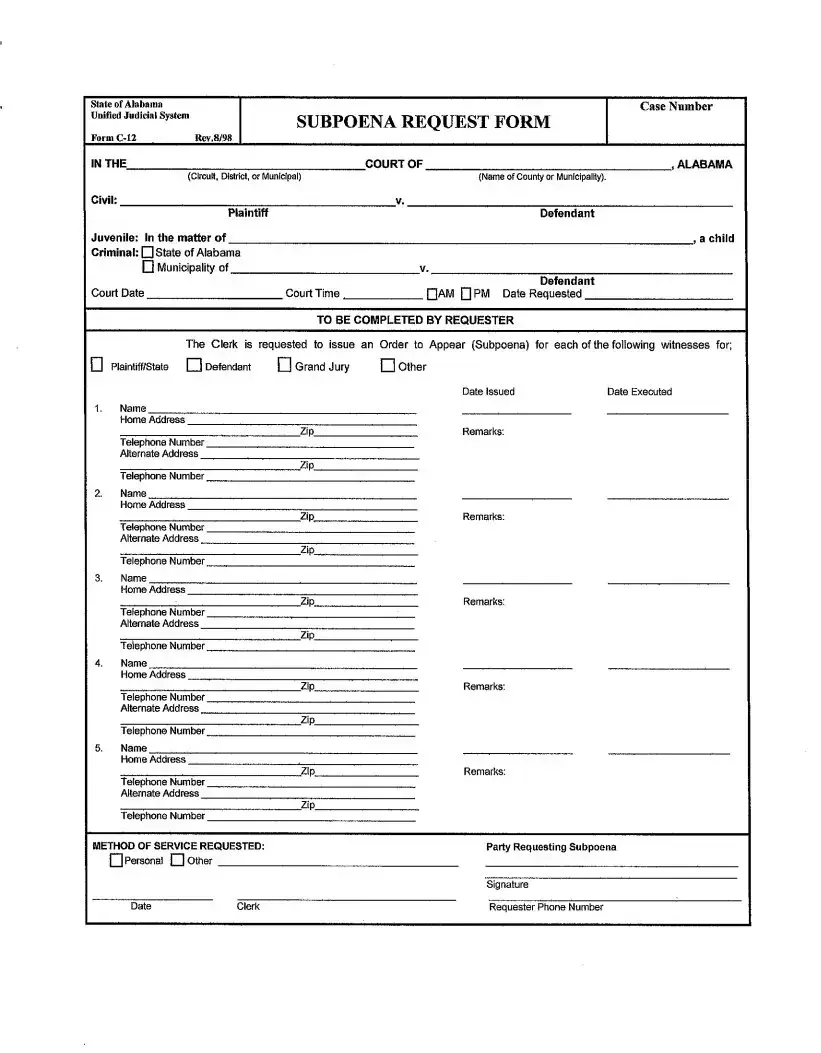
The Alabama C 12 form serves as a crucial tool in the judicial process, specifically designed for requesting subpoenas in civil, criminal, and juvenile cases. This form is utilized by individuals or parties involved in legal proceedings who seek to compel witnesses to appear in court. The document requires detailed information about each witness, including their name, home address, and contact information. Additionally, it allows the requester to specify the method of service for the subpoena, whether it be personal delivery or another method. The form also includes sections for remarks and alternate addresses, ensuring that the court has all necessary information to facilitate the subpoena's issuance. By providing a structured format, the Alabama C 12 form streamlines the process of obtaining a court order to appear, thereby enhancing the efficiency of legal proceedings in Alabama.
| Fact Name | Description |
|---|---|
| Form Title | Alabama C-12 Subpoena Request Form |
| Governing Law | Alabama Rules of Civil Procedure, Rule 45 |
| Form Purpose | This form is used to request the issuance of a subpoena for witnesses in civil, criminal, or juvenile cases. |
| Submission Requirements | The requester must provide the names, addresses, and contact information for each witness. |
| Date Fields | Requesters must fill in the date the subpoena is issued and the date it is executed. |
| Method of Service | The form allows the requester to specify the method of service, such as personal delivery. |
| Requester Information | The form requires the requester’s signature and contact information for follow-up. |
| Version | The current version of the form is Rev. 8/98. |
Filling out the Alabama C 12 form involves providing specific information about the case and the witnesses you wish to subpoena. After completing the form, it will be submitted to the Clerk of Court for processing. Below are the steps to fill out the form correctly.
What is the Alabama C-12 form?
The Alabama C-12 form is a subpoena request form used within the Unified Judicial System of Alabama. It allows a party involved in a civil, criminal, or juvenile case to request the issuance of a subpoena, compelling witnesses to appear in court. This form ensures that all necessary details about the witnesses are collected, such as their names, addresses, and the nature of their testimony.
Who can request a subpoena using the C-12 form?
Any party involved in a legal case, whether as a plaintiff or defendant, can request a subpoena using the C-12 form. This includes individuals, attorneys, or representatives of the state. It is important to ensure that the request is made in connection with a specific case number and court to maintain proper legal protocol.
What information is required on the form?
The C-12 form requires several pieces of information:
How is the subpoena served?
The form allows the requester to specify the method of service. Typically, subpoenas can be served personally, meaning that a process server or law enforcement officer delivers the subpoena directly to the witness. Alternatively, other methods may be permissible depending on the circumstances and the court's rules.
What happens after the C-12 form is submitted?
Once the C-12 form is completed and submitted to the court clerk, the clerk will review the request. If everything is in order, the clerk will issue the subpoena, which will then need to be served to the witnesses listed on the form. It’s crucial for the requesting party to ensure that the subpoenas are served in a timely manner to allow witnesses to prepare for their court appearance.
Can a subpoena be contested?
Yes, a subpoena can be contested. If a witness believes that the subpoena is unreasonable, overly broad, or seeks privileged information, they may file a motion to quash the subpoena in court. This legal action seeks to invalidate the subpoena, and the court will then decide whether to uphold or dismiss the request based on the arguments presented.
When filling out the Alabama C-12 form, many individuals make common mistakes that can lead to delays or issues in processing their subpoena requests. Understanding these pitfalls can help ensure a smoother experience.
One frequent error is neglecting to provide complete names and addresses for all witnesses. Each witness's information must be accurate and thorough. Missing or incorrect details can hinder the ability of law enforcement or court officials to serve the subpoena properly. Double-checking this information before submission can save time and prevent complications.
Another mistake occurs when individuals fail to specify the correct court type. The form requires clarity on whether the case is being handled in Circuit, District, or Municipal Court. Choosing the wrong designation can lead to confusion and misdirected requests, which can ultimately delay proceedings.
People often overlook the importance of including a valid case number. This number is crucial for the court to identify the specific case associated with the subpoena. Without it, the request may be misplaced or rejected, causing unnecessary frustration for the requester.
Additionally, not indicating the method of service can create issues. The form provides options for personal service or other methods. Failing to select a preferred method can lead to delays in serving the subpoena, as the clerk may not know how to proceed without this information.
Lastly, some individuals forget to sign the form or provide their contact information. A signature is essential for the request to be valid. Furthermore, including a phone number ensures that the court can reach the requester if there are any questions or issues with the form.
The Alabama C-12 form is a crucial document for requesting subpoenas in civil, criminal, or juvenile cases. Several other forms and documents often accompany it to ensure proper legal procedures are followed. Below is a list of these documents, each with a brief description.
Using these forms in conjunction with the Alabama C-12 ensures that the legal process runs smoothly and that all parties fulfill their obligations. Proper documentation is key to achieving a fair and just outcome in legal proceedings.
The Alabama C 12 form is a subpoena request form used in various legal proceedings. It shares similarities with several other legal documents. Here’s a list of nine documents that are comparable to the C 12 form, along with a brief explanation of how they are similar:
When filling out the Alabama C-12 form, it's important to follow specific guidelines to ensure accuracy and compliance. Here are eight things to keep in mind:
By adhering to these guidelines, you can help ensure that your subpoena request is processed smoothly and efficiently.
Misconceptions about the Alabama C 12 form can lead to confusion and errors in legal proceedings. Here are five common misconceptions, along with clarifications:
This form is used in both civil and criminal cases. It serves as a subpoena request form, allowing parties to summon witnesses in various types of legal matters.
All sections of the form must be completed, including the names and addresses of witnesses. Incomplete forms may result in delays or denials of the subpoena.
Submitting the form does not ensure that witnesses will comply with the subpoena. If a witness fails to appear, additional legal actions may be necessary to enforce compliance.
Choosing a method of service is essential. The requester must indicate how they want the subpoena delivered, whether personally or through another method, to ensure proper legal procedures are followed.
A signature from the party requesting the subpoena is required. This confirms the request and holds the requester accountable for the information provided on the form.
The Alabama C-12 form is used to request a subpoena for witnesses in civil, criminal, or juvenile cases.
Ensure you fill out the case number and the court's name correctly at the top of the form.
List each witness's name, home address, telephone number, and any alternate address in the designated sections.
Provide remarks for each witness if there are specific details or instructions related to them.
Select the method of service you prefer, such as personal service or another method.
Include your contact information as the requester, including your phone number.
Sign the form to confirm that you are officially requesting the subpoena.
Submit the completed form to the court clerk for processing.