Homepage ↝ Blank Alabama 9501 Form
Outline

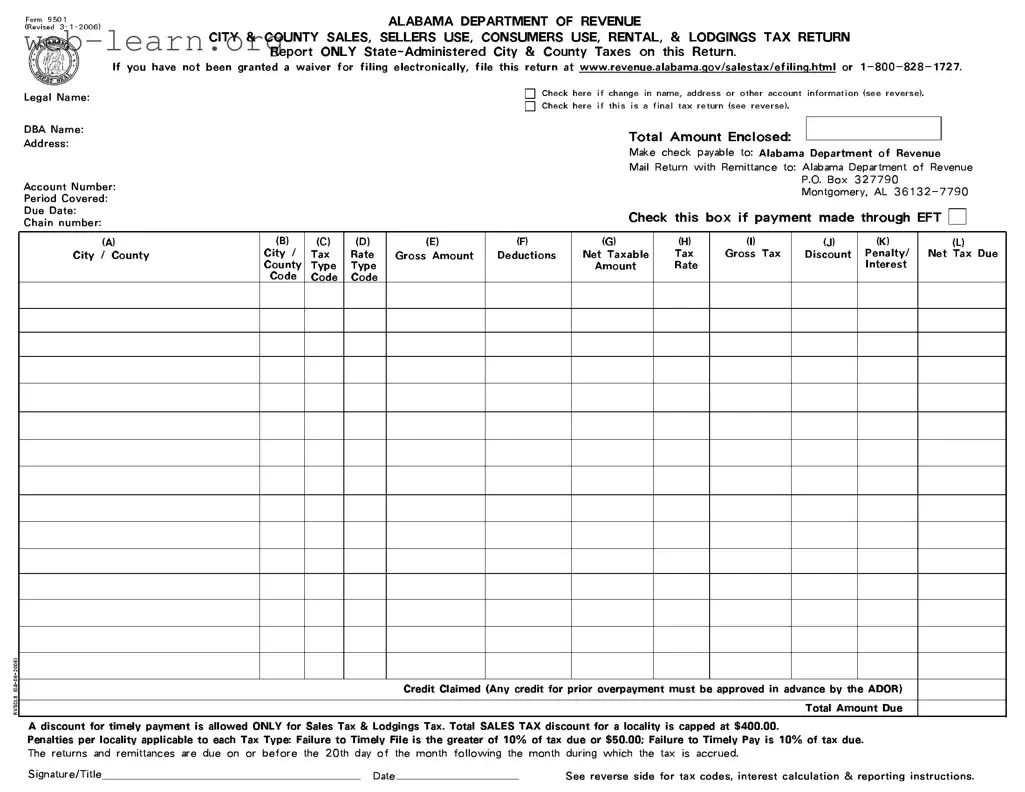
The Alabama 9501 form is a critical document for businesses operating within the state, specifically designed for reporting various local taxes, including city and county sales, sellers use, consumers use, rental, and lodgings taxes. This form requires the legal name and any "doing business as" (DBA) names, along with the business's address and account number. It is essential to indicate the period covered by the return and the due date for submission. A business must also specify if there has been a change in account information or if this is a final tax return. Each tax type has specific codes and rates that must be accurately filled out, reflecting gross amounts, deductions, and net taxable amounts. The form outlines the penalties for late filing and payment, emphasizing the importance of timely submissions. Additionally, businesses can claim discounts for timely payments under certain conditions, while also needing to account for any prior overpayments as credits. Ultimately, the Alabama 9501 form serves as a comprehensive tool for ensuring compliance with state tax regulations, requiring careful attention to detail and adherence to deadlines.
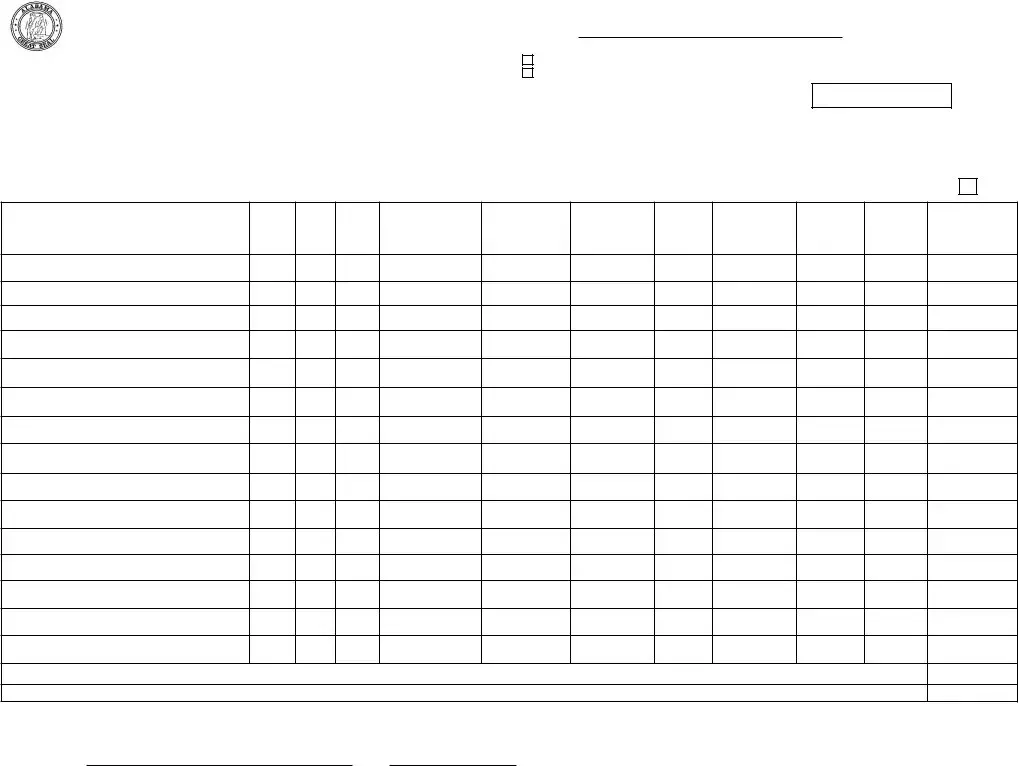
Sample - Alabama 9501 Form

RVSCL8 (04-06-2006)
Date
Signature/Title
Total Amount Due
Credit Claimed (Any credit for prior overpayment must be approved in advance by the ADOR)
Penalty/
Interest
Deductions
City /
County
Code
City / County
Tax
Type
Code
Gross Amount
(A)
Address:
DBA Name:
Legal Name:
Check here if change in name, address or other account information (see reverse).
Form 9501
ALABAMA DEPARTMENT OF REVENUE
CITY & COUNTY SALES, SELLERS USE, CONSUMERS USE, RENTAL, & LODGINGS TAX RETURN
Report ONLY State-Administered City & County Taxes on this Return.
If you have not been granted a waiver for filing electronically, file this return at www.revenue.alabama.gov/salestax/efiling.html or 1-800-828-1727.
Check here if this is a final tax return (see reverse).
Chain number:
Due Date:
Period Covered:
Account Number:
Total Amount Enclosed:
Make check payable to:
Mail Return with Remittance to: Alabama Department of Revenue
P.O. Box 327790
Montgomery, AL 36132-7790
Alabama Department of Revenue
Rate
Type
Code
Net Taxable
Amount
Tax
Rate
Gross Tax
Discount
Net Tax Due
(B)
(C) (D) (E)
(F) (G) (H) (I)
(J)
(K)
(L)
A discount for timely payment is allowed ONLY for Sales Tax & Lodgings Tax. Total SALES TAX discount for a locality is capped at $400.00.
Penalties per locality applicable to each Tax Type: Failure to Timely File is the greater of 10% of tax due or $50.00; Failure to Timely Pay is 10% of tax due.
The returns and remittances are due on or before the 20th day of the month following the month during which the tax is accrued.
(Revised 3-1-2006)
See reverse side for tax codes, interest calculation & reporting instructions.
Check this box if payment made through EFT
RVSCL9 (03-15-2006)
Mail this Return with Remittance to: Alabama Department of Revenue, Sales & Use Tax Section, P.O. Box 327790, Montgomery, AL 36132-7790
Please indicate nature of change:
REPORT ONLY STATE-ADMINISTERED CITY AND COUNTY TAXES ON THIS RETURN.
Change of Name and/or Address:
Name
Address
City/County/State/Zip
Phone No.
Date Business Closed/Sold
If Business Sold, Sold to
Address
City/State/Zip
This is a final return.
For change in location, check one of the following:
business location,
mailing address,
business location & mailing address,
ownership,
name only (same owners)
inside corporate limits,
inside police jurisdiction,
outside corporate limits and police jurisdiction
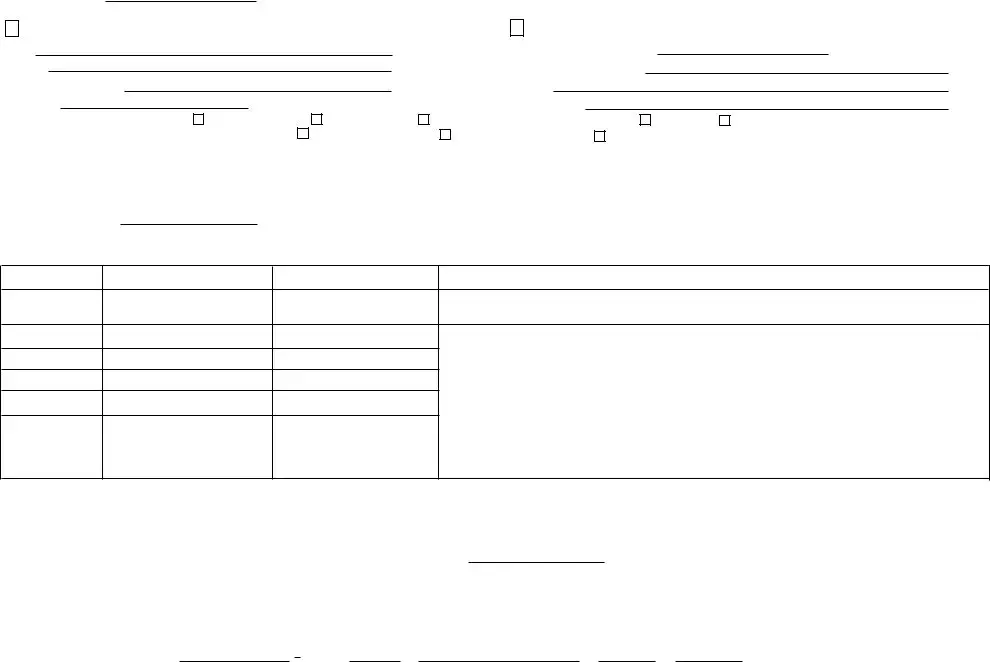
9501 CITY/COUNTY TAX RETURN FILING INSTRUCTIONS:
Column:
Column (C)
(A)
Enter the city or county name. If the transaction occurs outside the city limits but within the police jurisdiction, write "PJ" following the
city
name.
(B)
Enter the unique four digit City/County Code assigned to each city and county. City codes begin with a 9; county codes begin with a 7. See the Local Tax Rate Schedule,
or our web site (www.revenue.alabama.gov), or call the ADOR at 334-242-1490 for these codes.
(C)
Enter the appropriate Tax Type Code. (See below)
(E)
Enter the gross sales, purchases, rental receipts, or lodgings receipts for the corresponding Tax Type/Rate Type. This includes the following: cash and credit amounts;
nontaxable and taxable amounts; cost of property purchased at wholesale withdrawn for use; collections during month on credit sales previously claimed as deductions.
(D)
Enter the appropriate Rate Type Code. (See below)
Column (D)
(F)
Enter allowable deductions. This includes nontaxable amounts reported in Column E.
(G)
Net Taxable Sales is the result of Gross Amount in Column E less Deductions in Column F.
(H)
Enter the appropriate tax rate. See the Local Tax Rate Schedule, our web site (www.revenue.alabama.gov), or call the ADOR 334-242-1490 for these local tax rates.
(I) Gross Tax is the result of multiplying the tax rate in Column H by the Net Taxable Amount in Column G.
(J)
Enter the allowable discount for timely payment of gross tax shown due in Column I. Note that discount is allowed ONLY on sales tax and lodgings tax, and is 5% of the
first $100 of gross tax due shown in Column I, plus 2% on gross tax over $100. Total SALES TAX discount for a city or county is capped at $400 per month.
(K)
If return is filed and/or paid late, enter the appropriate penalties. Failure to Timely File Penalty is the greater of 10% of gross tax due (col. I) or $50.00, & is applicable
to each Tax Type for each locality; Failure to Timely Pay Penalty is 10% of gross tax due (col. I).
If payment of tax due is made late, enter the appropriate interest. See our web site for the interest rates or call ADOR at 334-242-1490.
Interest calculation example: Annual Interest Rate
:
365 = daily rate x Number of days payment late x Gross Tax = Interest Due.
Total Amount Due:
Enter the sum of all amounts shown due in the Net Tax Due column L less any Credit Claimed. Enclose your check for this amount. Make your check
payable to Alabama Department of Revenue.
(L)
Net Tax Due is the sum of Gross Tax (column I), less allowable discount (column J), or plus applicable penalty and interest (column K).
C
redit Claimed:
You may take a credit for prior overpayments. Any credit for prior overpayment must be approved in advance by the ADOR. Contact the ADOR to verify that
a credit has been established for your tax account prior to claiming a credit on this line.
Tax Type
Code
Description of
Tax Type Codes
Rate Type Codes for
Tax Type
Description of Rate Type Codes
CU
LL
RT
CONSUMERS USE TAX A, F, G, M
A = AUTOMOTIVE
LODGINGS TAX
RENTAL TAX
ST
SU
A, G, L
SALES TAX
SELLERS USE TAX
G
A, F, G, M, V, W
A, F, G, M
F = FARM MACHINES & EQUIPMENT
G = GENERAL (Includes AMUSEMENT -- If the Amusement Rate differs from
the General Rate, enter the appropriate Tax Rate in Col. H, and the city/
county code in Col. B designated for that locality's amusement tax)
L = LINEN
M = MANUFACTURING MACHINES & ATTACHMENTS
V = VENDING
W = AUTOMOTIVE WITHDRAWAL FEE (FOR AUTOMOBILE DEALERS ONLY)

Form Information

Fact Name Description
Form Number The Alabama 9501 form is used for reporting state-administered city and county taxes.
Governing Law This form is governed by the Alabama Code Title 40, Chapter 23, which outlines sales and use tax regulations.
Filing Frequency Returns and remittances are due on or before the 20th day of the month following the month in which the tax is accrued.
Penalties Late filing incurs a penalty of the greater of 10% of the tax due or $50. Late payment incurs a 10% penalty on the tax due.
Discounts A discount for timely payment is allowed only for sales tax and lodgings tax, capped at $400 per locality.
Change Notification Taxpayers must check a box if there is a change in name, address, or other account information.
Payment Instructions Checks must be made payable to the Alabama Department of Revenue and mailed to P.O. Box 327790, Montgomery, AL 36132-7790.
Credit Claimed Taxpayers may claim a credit for prior overpayments, but it must be approved in advance by the Alabama Department of Revenue.

Detailed Guide for Filling Out Alabama 9501

Completing the Alabama 9501 form requires careful attention to detail. This form must be filled out accurately to ensure compliance with state tax regulations. Follow these steps to complete the form correctly.

  1. Legal Name: Enter your business's legal name in the designated field.
  2. DBA Name: If applicable, provide your "Doing Business As" name.
  3. Address: Fill in your business address, including city, county, state, and zip code.
  4. Account Number: Input your assigned account number.
  5. Period Covered: Specify the tax period for which you are reporting.
  6. Due Date: Enter the due date for this tax return.
  7. Chain Number: If applicable, include the chain number.
  8. City/County Total Amount Enclosed: State the total amount you are sending with this return.
  9. Payment Method: Check the box if payment is made through EFT.
  10. City/County Code: Enter the unique four-digit code for your city or county.
  11. Tax Type Code: Select the appropriate tax type code from the provided list.
  12. Rate Type Code: Choose the correct rate type code based on the tax type.
  13. Gross Amount: Fill in the total gross sales, purchases, or receipts for the reporting period.
  14. Deductions: List any allowable deductions from the gross amount.
  15. Net Taxable Amount: Calculate the net taxable amount by subtracting deductions from the gross amount.
  16. Tax Rate: Enter the applicable tax rate for your locality.
  17. Gross Tax: Calculate the gross tax by multiplying the net taxable amount by the tax rate.
  18. Discount: If applicable, enter the discount for timely payment.
  19. Penalty/Interest: Include any penalties or interest if the return is filed or paid late.
  20. Net Tax Due: Calculate the net tax due by summing the gross tax and any penalties or interest, then subtracting the discount.
  21. Credit Claimed: If applicable, indicate any credits for prior overpayments that have been approved by the ADOR.
  22. Total Amount Due: Provide the total amount due, factoring in any credits claimed.
  23. Signature/Title: Sign and date the form, indicating your title.

After completing the form, ensure that all information is accurate before mailing it along with your payment to the Alabama Department of Revenue. Timely submission is essential to avoid penalties.

Obtain Answers on Alabama 9501

  1. What is the Alabama 9501 form?

    The Alabama 9501 form is a tax return used to report state-administered city and county sales, sellers use, consumers use, rental, and lodgings taxes. It is essential for businesses operating in Alabama to file this form accurately to ensure compliance with state tax regulations.

  2. Who needs to file the Alabama 9501 form?

    If you operate a business that collects sales tax or any of the other taxes mentioned, you must file the Alabama 9501 form. This includes businesses engaged in retail sales, rental services, and lodging services. Even if you have no tax due for a specific period, you may still need to file a return.

  3. When is the Alabama 9501 form due?

    The form is due on or before the 20th day of the month following the month during which the tax is accrued. For example, if you collected taxes in January, your return must be filed by February 20th. Timely filing helps avoid penalties.

  4. What happens if I miss the deadline?

    Missing the deadline can result in penalties. The penalty for failing to file on time is the greater of 10% of the tax due or $50. Additionally, if you fail to pay the tax due on time, a 10% penalty will apply. Interest may also accrue on late payments, so it’s best to file and pay on time.

  5. How do I make a payment?

    You can make a payment by enclosing a check with your completed Alabama 9501 form. Make the check payable to the Alabama Department of Revenue. Alternatively, if you prefer electronic payments, you can indicate that payment was made through EFT (Electronic Funds Transfer) by checking the appropriate box on the form.

Common mistakes

Filling out the Alabama 9501 form can be a straightforward process, but there are common mistakes that individuals often make. Awareness of these errors can help ensure the accuracy of the return and avoid unnecessary penalties.

One frequent mistake is failing to update the Legal Name or DBA Name when there has been a change. If a business has undergone a name change, it is crucial to reflect this on the form. Neglecting to do so may lead to confusion and potential issues with the Alabama Department of Revenue.

Another common error is not checking the box for a change in name, address, or account information. This is important because it informs the department of any updates that could affect the processing of the return. If this box is left unchecked, the return may be processed with outdated information.

Inaccurate reporting of the Account Number is also a mistake that can delay processing. Each account has a unique identifier, and entering the wrong number can lead to complications. Always double-check this information before submission.

Additionally, many individuals overlook the importance of entering the correct City/County Code. Each city and county has a specific code that must be used. If the wrong code is entered, it can affect the tax calculations and lead to incorrect tax liabilities.

Another area where mistakes frequently occur is in the calculation of Gross Amount and Deductions. It is essential to accurately report all sales, purchases, and deductions. Errors in these figures can lead to incorrect tax due amounts and potential penalties.

Failing to account for applicable penalties and interest is another oversight. If a return is filed late, penalties apply. Understanding these penalties and accurately calculating them is vital to avoid unexpected charges.

Lastly, individuals often forget to sign and date the form. This step is crucial as an unsigned form may be deemed invalid. Taking the time to ensure all sections are complete and accurate can save time and prevent complications in the future.

Documents used along the form

The Alabama 9501 form is a critical document for reporting state-administered city and county taxes. Various other forms and documents accompany it to ensure compliance with tax regulations. Below is a list of documents that are often used in conjunction with the Alabama 9501 form, each serving a specific purpose.

  • Alabama Business Privilege License Application: This application is required for businesses operating within Alabama to obtain a privilege license, allowing them to conduct business legally.
  • Sales Tax Exemption Certificate: Businesses use this certificate to claim exemption from sales tax on purchases made for resale or specific exempt purposes.
  • Form ST-1 (Sales Tax Return): This return is filed by businesses to report and remit sales tax collected from customers, separate from the city and county taxes reported on Form 9501.
  • Form ST-3 (Sales Tax Exemption Certificate): This form is issued to buyers to document sales tax exemptions for certain purchases, such as for resale or specific nonprofit activities.
  • Form ST-4 (Sales Tax Exemption Certificate for Nonprofit Organizations): Nonprofit organizations use this form to claim exemption from sales tax on purchases made for their charitable purposes.
  • Form 941 (Employer's Quarterly Federal Tax Return): Employers file this form to report income taxes withheld from employee wages and their share of Social Security and Medicare taxes.
  • Form W-9 (Request for Taxpayer Identification Number): This form is used by businesses to request the Taxpayer Identification Number (TIN) of a vendor or contractor for tax reporting purposes.
  • Form 1099-MISC (Miscellaneous Income): This form is issued to report payments made to independent contractors or other non-employee service providers, which may be relevant for tax purposes.
  • Local Tax Rate Schedule: This document provides the applicable tax rates for various cities and counties in Alabama, essential for accurate tax reporting on Form 9501.
  • Tax Payment Receipt: This receipt serves as proof of payment for taxes submitted to the Alabama Department of Revenue, useful for record-keeping and audits.

These documents collectively assist in maintaining compliance with Alabama tax regulations. Understanding their purpose and how they relate to the Alabama 9501 form is essential for effective tax management.

Similar forms

The Alabama 9501 form is similar to several other tax-related documents. Each serves a specific purpose in reporting and remitting taxes. Here are eight documents that share similarities with the Alabama 9501 form:

  • IRS Form 1040: This is the standard individual income tax return form used by U.S. taxpayers. Like the Alabama 9501, it requires personal information, income reporting, and tax calculations.
  • IRS Form 941: This form is used to report payroll taxes withheld from employees. Both forms require accurate reporting of amounts due and have specific deadlines for submission.
  • IRS Form 1120: Corporations use this form to report income, gains, losses, and deductions. Similar to the Alabama 9501, it includes sections for reporting specific types of taxes owed.
  • State Sales Tax Return: Many states have their own sales tax return forms. These documents, like the Alabama 9501, require reporting of gross sales, deductions, and net taxable amounts.
  • Form W-2: Employers use this form to report wages paid to employees and taxes withheld. Both forms require precise calculations and reporting of tax obligations.
  • Form 1099: This form is used to report various types of income other than wages. Similar to the Alabama 9501, it requires clear documentation of amounts paid and tax withheld.
  • State Income Tax Return: Similar to the Alabama 9501, state income tax returns require individuals to report their income and calculate taxes owed based on state-specific regulations.
  • Form 990: Nonprofit organizations use this form to report their financial information. Like the Alabama 9501, it includes sections for detailing revenue and expenses, as well as tax obligations.

Dos and Don'ts

When filling out the Alabama 9501 form, it is essential to follow specific guidelines to ensure accuracy and compliance. Here are six important dos and don'ts to consider:

  • Do provide your legal name and DBA name accurately to avoid any discrepancies.
  • Do check the appropriate boxes for changes in name, address, or if this is a final tax return.
  • Do ensure you enter the correct city or county code, as this is crucial for tax calculations.
  • Do calculate the gross tax accurately by multiplying the net taxable amount by the correct tax rate.
  • Don't forget to include any allowable deductions, as this can affect your net taxable amount.
  • Don't submit your form late, as penalties for late filing and payment can significantly increase your total tax due.

Misconceptions

Here are 10 misconceptions about the Alabama 9501 form, along with clarifications:

  1. Only businesses need to file the Alabama 9501 form. Individuals who engage in taxable activities may also need to file this form.
  2. The form is only for sales tax. It covers various taxes, including sellers use tax, consumers use tax, rental tax, and lodgings tax.
  3. Filing late incurs the same penalty regardless of the tax type. Different tax types have specific penalties, which may vary by locality.
  4. Discounts for timely payment apply to all taxes. Discounts are only available for sales tax and lodgings tax.
  5. Tax codes are not necessary for filing. Accurate tax and rate type codes are essential for proper reporting.
  6. The due date is flexible. Returns and payments are strictly due by the 20th of the month following the tax accrual.
  7. All deductions are automatically accepted. Only allowable deductions, as specified, should be reported.
  8. You can claim credits without prior approval. Any credit for prior overpayment must be pre-approved by the Alabama Department of Revenue (ADOR).
  9. Payment can be made through any method. Payments must be made by check or electronic funds transfer (EFT) as specified.
  10. The form does not require a signature. A signature is mandatory to validate the return.

Key takeaways

Here are some key takeaways for filling out and using the Alabama 9501 form:

  • Report Only State-Administered Taxes: Ensure that you only report city and county taxes that are administered by the state on this form.
  • Timely Submission: The form and payment are due on or before the 20th day of the month following the month in which the tax was accrued.
  • Account Information: Check the box if there is a change in your name, address, or other account information. This helps keep your records accurate.
  • Discounts and Penalties: A discount for timely payment is available for sales and lodgings tax, capped at $400. Be aware of penalties for late filing and payment.
  • Accurate Tax Codes: Use the correct city/county code and tax type code as specified. This ensures proper processing of your return.
  • Credit for Overpayments: You can claim a credit for prior overpayments, but it must be approved in advance by the Alabama Department of Revenue.