Homepage Blank Alabama 40Es Form
Outline

The Alabama 40ES form plays a crucial role for individuals and corporations in managing their estimated tax obligations. This form is designed for those who expect to owe at least $500 in taxes after accounting for withholding and credits. It allows taxpayers to estimate their income, deductions, and tax liabilities for the year. Key components include sections for reporting adjusted gross income, deductions, and federal income tax liability. The form also outlines the tax rates applicable based on filing status, helping taxpayers calculate their estimated tax. Moreover, it provides a record for tracking payments made throughout the year, ensuring that individuals can maintain accurate documentation for their financial records. For those who derive a significant portion of their income from farming, there are special provisions that allow for different payment schedules. Understanding the Alabama 40ES form is essential for effective tax planning and compliance, making it an important tool in the financial toolkit of Alabama residents.
Sample - Alabama 40Es Form

1
1
2
3
4
5
6
9
10
11
8a
8b
8c
4
5
6
7
2
3
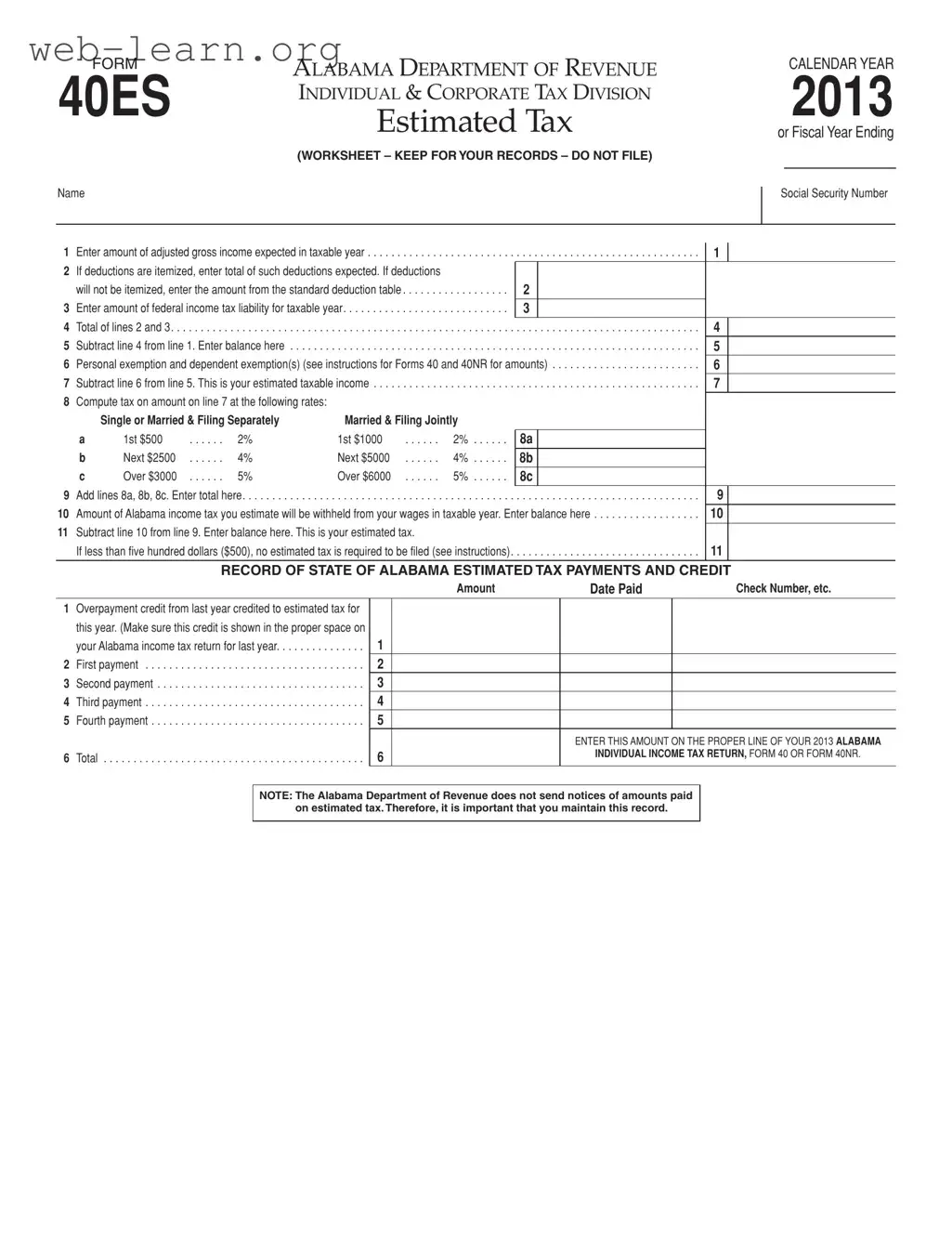
RECORD OF STATE OF ALABAMA ESTIMATED TAX PAYMENTS AND CREDIT
Amount
Date Paid
Check Number, etc.
NOTE: The Alabama Department of Revenue does not send notices of amounts paid
on estimated tax. Therefore, it is important that you maintain this record.
ENTER THIS AMOUNT ON THE PROPER LINE OF YOUR 2013 ALABAMA
INDIVIDUAL INCOME TAX RETURN, FORM 40 OR FORM 40NR.
Name Social Security Number
1 Overpayment credit from last year credited to estimated tax for
this year. (Make sure this credit is shown in the proper space on
your Alabama income tax return for last year. ..............
2 First payment .....................................
3 Second payment ...................................
4 Third payment .....................................
5 Fourth payment ....................................
6 Total ............................................
1 Enter amount of adjusted gross income expected in taxable year ........................................................
2 If deductions are itemized, enter total of such deductions expected. If deductions
will not be itemized, enter the amount from the standard deduction table ..................
3 Enter amount of federal income tax liability for taxable year............................
4 Total of lines 2 and 3.........................................................................................
5 Subtract line 4 from line 1. Enter balance here .....................................................................
6 Personal exemption and dependent exemption(s) (see instructions for Forms 40 and 40NR for amounts) .........................
7 Subtract line 6 from line 5. This is your estimated taxable income .......................................................
8 Compute tax on amount on line 7 at the following rates:
Single or Married & Filing Separately Married & Filing Jointly
a 1st $500 . . . . . . 2% 1st $1000 . . . . . . 2% ......
b Next $2500 . . . . . . 4% Next $5000 . . . . . . 4% ......
c Over $3000 . . . . . . 5% Over $6000 . . . . . . 5% ......
9 Add lines 8a, 8b, 8c. Enter total here.............................................................................
10 Amount of Alabama income tax you estimate will be withheld from your wages in taxable year. Enter balance here ..................
11 Subtract line 10 from line 9. Enter balance here. This is your estimated tax.
If less than five hundred dollars ($500), no estimated tax is required to be filed (see instructions)................................
FORM
40ES
CALENDAR YEAR
2013
or Fiscal Year Ending
ALABAMA DEPARTMENT OF REVENUE
INDIVIDUAL & CORPORATE TAX DIVISION
Estimated Tax
(WORKSHEET – KEEP FOR YOUR RECORDS – DO NOT FILE)
Who Must Pay Estimated Tax
If you owe additional tax for 2012, you may have to pay esti-
mated tax for 2013.
You can use the following general rule as a guide during the
year to see if you will have enough withholding, or if you should in-
crease your withholding or make estimated tax payments.
General Rule. In most cases, you must pay estimated tax for
2013 if both of the following apply.
1. You expect to owe at least $500 in tax for 2013, after sub-
tracting your withholding and credits.
2. You expect your withholding plus your credits to be less than
the smaller of:
a. 90% of the tax to be shown on your 2013 tax return, or
b. 100% of the tax shown on the your 2012 tax return. Your
2012 tax return must cover all 12 months.
Special Rule for Higher Income Taxpayers
If your Alabama AGI for 2012 was more than $150,000
($75,000 if your filing status for 2013 is Married Filing a Separate
Return) substitute 110% for 100% in (2b) under General Rule,
above.
When and Where to File Estimated Tax
Your estimated tax must be filed on or before April 15, 2013, or
on such later dates as specified under “Farmers.It should be
mailed to the Alabama Department of Revenue, Individual Esti-
mates, P.O. Box 327485, Montgomery, AL 36132-7485.
Payment of Estimated Tax
Your estimated tax may be paid in full or in equal installments
on or before April 15, 2013, June 15, 2013, September 15, 2013
and January 15, 2014. If the 15th falls on a Saturday, Sunday, or
State holiday, the due date will then be considered the following
business day. Checks or money orders should be made payable
to the Alabama Department of Revenue.
Changes In Tax
Even though your situation on April 15 is such that you are not
required to file estimated tax at that time, your expected tax may
change so that you will be required to file estimated tax later. In
such case, the time for filing is as follows: June 15, if the change
occurs after April 1 and before June 2; September 15, if the change
occurs after June 1 and before September 2; January 15, if the
change occurs after September 1. If, after you have filed a voucher,
you find that your estimated tax is substantially increased or de-
creased as the result of a change in your tax, you should file an
amended voucher on or before the next filing date June 15, 2013,
September 15, 2013, January 15, 2014.
Farmers
If at least 2/3 of your estimated gross income for the taxable
year is derived from farming, you may pay estimated tax at any
time on or before January 15, 2014 instead of April 15, 2013. If
you wait until January 15, 2014, you must pay the entire balance
of the estimated tax. However, if farmers file their final tax return
on or before March 2, 2013, and pay the total tax at that time, they
need not file estimated tax.
Fiscal Year
If you file your income tax return on a fiscal year basis, you will
substitute for the dates specified in the above instructions the
months corresponding thereto.
Penalties for Underpayment
Penalties are provided for underpaying the Alabama income tax
by at least $500.00.
Form 40ES Instructions
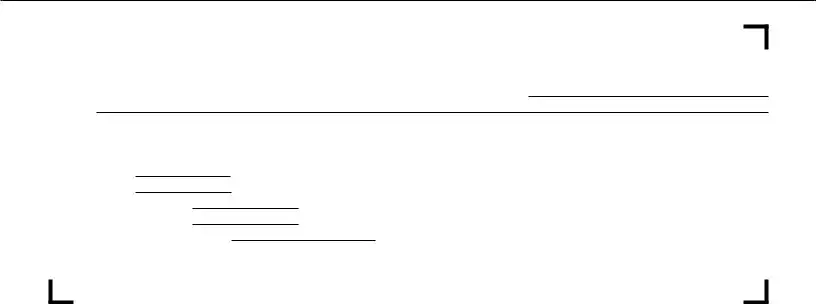
DETACH ALONG THIS LINE AND MAIL VOUCHER WITH YOUR FULL PAYMENT
40ES 2013
PRIMARY TAXPAYER’S SPOUSE’S LAST
FIRST NAME FIRST NAME NAME
MAILING
ADDRESS
DAYTIME
CITY STATE ZIP TELEPHONE NUMBER
CHECK IF FISCAL YEAR
Beginning Date:
Ending Date:
Primary Taxpayer SSN:
Spouse SSN:
Amount Paid With Voucher: $
Alabama Department of Revenue
Estimated Income Tax Payment Voucher
MAIL TO: Alabama Department of Revenue, Individual Estimates,
P.O. Box 327485, Montgomery, AL 36132-7485
ADOR
Instructions
1. Be sure you are using a form for the proper year.
Do not use this form to file for any calendar year
other than the year printed in bold type on the
face of the form. Individuals who file on fiscal year
basis (other than calendar year ending Dec. 31)
should show beginning and ending dates of fiscal
year in spaces provided on Form 40ES and each
payment voucher.
2. Enter your social security number in space pro-
vided. If joint voucher, enter spouse’s number on
the line after yours.
3. Enter your first name, middle initial, and last
name. If joint estimated tax, show first name and
middle initial of both spouses. (Example: John T.
and Mary A. Doe).
4. The amount to be shown on Amount Paid With
Voucher line is determined by (a) the date you
meet the requirements for filing a estimated tax,
(b) the amount of credit, if any, for overpayment
from last year or income taxes withheld. Any
overpayment credit may be applied to your earli-
est installment or divided equally among all the
installments for the year. See the following
schedule:
Requirements Met Required Amt. Due With
After & Before Filing Date Voucher
1-1-2013 4-2-2013 4-15-2013 1/4 of line 1
4-1-2013 6-2-2013 6-15-2013 1/3 of line 1
6-1-2013 9-2-2013 9-15-2013 1/2 of line 1
9-1-2013 1-1-2014 1-15-2014 All of line 1
MAIL TO: Alabama Department of Revenue
Individual Estimates
P.O. Box 327485
Montgomery, AL 36132-7485
DETACH ALONG THIS LINE AND MAIL VOUCHER WITH YOUR FULL PAYMENT
40ES 2013
PRIMARY TAXPAYER’S SPOUSE’S LAST
FIRST NAME FIRST NAME NAME
MAILING
ADDRESS
DAYTIME
CITY STATE ZIP TELEPHONE NUMBER
CHECK IF FISCAL YEAR
Beginning Date:
Ending Date:
Primary Taxpayer SSN:
Spouse SSN:
Amount Paid With Voucher: $
Alabama Department of Revenue
Estimated Income Tax Payment Voucher
MAIL TO: Alabama Department of Revenue, Individual Estimates,
P.O. Box 327485, Montgomery, AL 36132-7485
ADOR
Instructions
1. Be sure you are using a form for the proper year.
Do not use this form to file for any calendar year
other than the year printed in bold type on the
face of the form. Individuals who file on fiscal year
basis (other than calendar year ending Dec. 31)
should show beginning and ending dates of fiscal
year in spaces provided on Form 40ES and each
payment voucher.
2. Enter your social security number in space pro-
vided. If joint voucher, enter spouse’s number on
the line after yours.
3. Enter your first name, middle initial, and last
name. If joint estimated tax, show first name and
middle initial of both spouses. (Example: John T.
and Mary A. Doe).
4. The amount to be shown on Amount Paid With
Voucher line is determined by (a) the date you
meet the requirements for filing a estimated tax,
(b) the amount of credit, if any, for overpayment
from last year or income taxes withheld. Any
overpayment credit may be applied to your earli-
est installment or divided equally among all the
installments for the year. See the following
schedule:
Requirements Met Required Amt. Due With
After & Before Filing Date Voucher
1-1-2013 4-2-2013 4-15-2013 1/4 of line 1
4-1-2013 6-2-2013 6-15-2013 1/3 of line 1
6-1-2013 9-2-2013 9-15-2013 1/2 of line 1
9-1-2013 1-1-2014 1-15-2014 All of line 1
MAIL TO: Alabama Department of Revenue
Individual Estimates
P.O. Box 327485
Montgomery, AL 36132-7485
DETACH ALONG THIS LINE AND MAIL VOUCHER WITH YOUR FULL PAYMENT
40ES 2013
PRIMARY TAXPAYER’S SPOUSE’S LAST
FIRST NAME FIRST NAME NAME
MAILING
ADDRESS
DAYTIME
CITY STATE ZIP TELEPHONE NUMBER
CHECK IF FISCAL YEAR
Beginning Date:
Ending Date:
Primary Taxpayer SSN:
Spouse SSN:
Amount Paid With Voucher: $
Alabama Department of Revenue
Estimated Income Tax Payment Voucher
MAIL TO: Alabama Department of Revenue, Individual Estimates,
P.O. Box 327485, Montgomery, AL 36132-7485
ADOR
Instructions
1. Be sure you are using a form for the proper year.
Do not use this form to file for any calendar year
other than the year printed in bold type on the
face of the form. Individuals who file on fiscal year
basis (other than calendar year ending Dec. 31)
should show beginning and ending dates of fiscal
year in spaces provided on Form 40ES and each
payment voucher.
2. Enter your social security number in space pro-
vided. If joint voucher, enter spouse’s number on
the line after yours.
3. Enter your first name, middle initial, and last
name. If joint estimated tax, show first name and
middle initial of both spouses. (Example: John T.
and Mary A. Doe).
4. The amount to be shown on Amount Paid With
Voucher line is determined by (a) the date you
meet the requirements for filing a estimated tax,
(b) the amount of credit, if any, for overpayment
from last year or income taxes withheld. Any
overpayment credit may be applied to your earli-
est installment or divided equally among all the
installments for the year. See the following
schedule:
Requirements Met Required Amt. Due With
After & Before Filing Date Voucher
1-1-2013 4-2-2013 4-15-2013 1/4 of line 1
4-1-2013 6-2-2013 6-15-2013 1/3 of line 1
6-1-2013 9-2-2013 9-15-2013 1/2 of line 1
9-1-2013 1-1-2014 1-15-2014 All of line 1
MAIL TO: Alabama Department of Revenue
Individual Estimates
P.O. Box 327485
Montgomery, AL 36132-7485
DETACH ALONG THIS LINE AND MAIL VOUCHER WITH YOUR FULL PAYMENT
40ES 2013
PRIMARY TAXPAYER’S SPOUSE’S LAST
FIRST NAME FIRST NAME NAME
MAILING
ADDRESS
DAYTIME
CITY STATE ZIP TELEPHONE NUMBER
CHECK IF FISCAL YEAR
Beginning Date:
Ending Date:
Primary Taxpayer SSN:
Spouse SSN:
Amount Paid With Voucher: $
Alabama Department of Revenue
Estimated Income Tax Payment Voucher
MAIL TO: Alabama Department of Revenue, Individual Estimates,
P.O. Box 327485, Montgomery, AL 36132-7485
ADOR
Instructions
1. Be sure you are using a form for the proper year.
Do not use this form to file for any calendar year
other than the year printed in bold type on the
face of the form. Individuals who file on fiscal year
basis (other than calendar year ending Dec. 31)
should show beginning and ending dates of fiscal
year in spaces provided on Form 40ES and each
payment voucher.
2. Enter your social security number in space pro-
vided. If joint voucher, enter spouse’s number on
the line after yours.
3. Enter your first name, middle initial, and last
name. If joint estimated tax, show first name and
middle initial of both spouses. (Example: John T.
and Mary A. Doe).
4. The amount to be shown on Amount Paid With
Voucher line is determined by (a) the date you
meet the requirements for filing a estimated tax,
(b) the amount of credit, if any, for overpayment
from last year or income taxes withheld. Any
overpayment credit may be applied to your earli-
est installment or divided equally among all the
installments for the year. See the following
schedule:
Requirements Met Required Amt. Due With
After & Before Filing Date Voucher
1-1-2013 4-2-2013 4-15-2013 1/4 of line 1
4-1-2013 6-2-2013 6-15-2013 1/3 of line 1
6-1-2013 9-2-2013 9-15-2013 1/2 of line 1
9-1-2013 1-1-2014 1-15-2014 All of line 1
MAIL TO: Alabama Department of Revenue
Individual Estimates
P.O. Box 327485
Montgomery, AL 36132-7485

Form Information

Fact Name Description
Purpose The Alabama 40ES form is used for estimating individual and corporate income tax payments.
Governing Law This form is governed by the Alabama Code Title 40, Chapter 18.
Who Must Use It
Filing Deadline The estimated tax must be filed by April 15 of the taxable year.
Payment Schedule Payments can be made in full or in four equal installments due on April 15, June 15, September 15, and January 15.
Record Keeping Taxpayers should keep a record of estimated tax payments, as the Alabama Department of Revenue does not send notices.
Penalties Penalties may apply for underpayment of estimated tax if the amount is less than $500.
Special Rules Higher income taxpayers may have different requirements based on their adjusted gross income from the previous year.

Detailed Guide for Filling Out Alabama 40Es

Filling out the Alabama 40ES form is an important step in estimating your tax obligations for the year. Completing this form accurately ensures that you meet your tax responsibilities and helps you avoid penalties. Here’s a straightforward guide to help you fill out the form step by step.

  1. Obtain the Alabama 40ES form for the correct year. Make sure it is the version for the year you are filing.
  2. Enter your social security number in the designated space. If filing jointly, include your spouse’s number as well.
  3. Fill in your name (first name, middle initial, and last name). If filing jointly, include both names.
  4. Provide your mailing address, including city, state, and ZIP code.
  5. In line 1, estimate your adjusted gross income for the taxable year and enter that amount.
  6. If you are itemizing deductions, enter the total of those deductions in line 2. If not, use the amount from the standard deduction table.
  7. Enter your estimated federal income tax liability for the year in line 3.
  8. Add the amounts from lines 2 and 3, and write the total in line 4.
  9. Subtract the total in line 4 from the amount in line 1. Enter the result in line 5.
  10. Calculate your personal and dependent exemptions and enter that amount in line 6.
  11. Subtract line 6 from line 5 and write the result in line 7. This is your estimated taxable income.
  12. Compute your tax based on the rates provided in lines 8a, 8b, and 8c. Enter the total in line 9.
  13. Estimate the amount of Alabama income tax you expect will be withheld from your wages in line 10.
  14. Subtract line 10 from line 9 and enter the result in line 11. This is your estimated tax.
  15. Record any estimated tax payments made on the designated lines provided at the bottom of the form.
  16. Finally, make sure to mail the completed form to the Alabama Department of Revenue at the address specified.

After you’ve filled out the form, keep a copy for your records. It’s essential to maintain accurate records of your estimated tax payments and any credits. This will help you when it’s time to file your annual tax return and ensure that you are compliant with Alabama tax regulations.

Obtain Answers on Alabama 40Es

  1. What is the Alabama 40ES form?

    The Alabama 40ES form is a worksheet used to calculate estimated tax payments for individuals and corporations in Alabama. It helps taxpayers determine how much tax they expect to owe for the year, taking into account their adjusted gross income, deductions, and any taxes already withheld from wages. This form is not submitted to the state but should be kept for personal records.

  2. Who needs to file the Alabama 40ES form?

    Individuals and businesses must file the Alabama 40ES form if they expect to owe at least $500 in tax for the year after accounting for withholding and credits. It is especially relevant for those who did not have enough tax withheld in the previous year or who have had changes in income that may affect their tax liability.

  3. When is the deadline for filing estimated tax payments?

    Estimated tax payments are due on specific dates throughout the year. For the 2013 tax year, payments must be made by April 15, June 15, September 15, and January 15 of the following year. If any of these dates fall on a weekend or holiday, the deadline is extended to the next business day.

  4. How do I calculate my estimated tax using the Alabama 40ES form?

    To calculate your estimated tax, start by entering your expected adjusted gross income for the year. Subtract your expected deductions and federal tax liability to find your estimated taxable income. Then, apply the appropriate tax rates to determine your estimated tax. If your total estimated tax is less than $500, you are not required to file estimated tax payments.

  5. What happens if I don’t pay enough estimated tax?

    If you underpay your estimated tax and owe at least $500, you may face penalties. The Alabama Department of Revenue imposes penalties for underpayment, which can add to your overall tax liability. It is essential to monitor your income and tax situation throughout the year to avoid underpayment penalties.

  6. Can I make changes to my estimated tax payments after filing?

    Yes, you can adjust your estimated tax payments if your financial situation changes. If you find that your estimated tax has significantly increased or decreased, it is advisable to file an amended voucher before the next payment due date. This helps ensure that you are accurately reflecting your tax liability and avoiding any penalties.

Common mistakes

Filling out the Alabama 40ES form can be straightforward, but many make common mistakes that could lead to issues down the line. One significant error is failing to use the correct year’s form. Each year has specific tax regulations and rates. Using an outdated form can result in incorrect calculations and potential penalties. Always ensure you are working with the form designated for the year you are filing.

Another frequent mistake involves entering the Social Security Number (SSN) incorrectly. The form requires the primary taxpayer's SSN and, if applicable, the spouse's SSN. Omitting digits or transposing numbers can lead to delays in processing and complications with your tax records. Double-check the SSN before submitting the form to avoid these issues.

People often miscalculate their expected adjusted gross income. Line 1 of the form asks for this amount, and underestimating or overestimating can skew your entire tax picture. Accurate projections are crucial. Take time to review your financial situation and consult previous tax returns if necessary.

Additionally, many fail to account for all deductions. On line 2, you must enter the total of itemized deductions or the standard deduction. Neglecting to include all eligible deductions can lead to a higher taxable income than necessary. Carefully review the deduction options available to you to ensure you maximize your tax benefits.

Finally, some individuals overlook the payment deadlines. The estimated tax must be filed on or before April 15, with subsequent payments due on specific dates throughout the year. Missing these deadlines can result in penalties and interest on unpaid amounts. Keep a calendar and set reminders to stay on track with your estimated tax payments.

Documents used along the form

The Alabama 40ES form is essential for individuals and corporations in Alabama who need to estimate their tax payments. When preparing your tax documents, you may also need several other forms to ensure compliance with state tax regulations. Below is a list of forms that are often used alongside the Alabama 40ES form.

  • Form 40: This is the standard individual income tax return form for Alabama residents. It is used to report income, claim deductions, and calculate the total tax owed for the year.
  • Form 40NR: This form is for non-residents of Alabama who earn income in the state. It allows non-residents to report their income and calculate their tax liability.
  • Form 40V: This is the payment voucher for individuals who owe tax when filing their Alabama income tax return. It is used to submit payments along with the tax return.
  • Form 1040: This is the federal income tax return form used by individuals to report their income and calculate federal taxes. Information from this form is often needed for state tax calculations.
  • Form W-2: This form reports an employee's annual wages and the amount of taxes withheld. It is crucial for accurately completing both federal and state tax returns.
  • Form 1099: This form is used to report various types of income other than wages, salaries, and tips. Freelancers and independent contractors often receive this form, which impacts their tax filings.
  • Form 4868: This is the application for an automatic extension of time to file a federal tax return. While not specific to Alabama, it may be relevant for those needing extra time to file their federal return.
  • Form 8453: This form is used to authenticate an electronically filed tax return. It may be required when submitting certain forms electronically, including state returns.

Gathering these forms will help streamline the tax preparation process. Each form serves a specific purpose, and understanding their roles can ensure accurate reporting and compliance with Alabama tax laws.

Similar forms

The Alabama 40ES form is an important document for individuals and corporations who need to estimate their tax payments. It shares similarities with several other tax-related documents. Here’s a breakdown of ten forms that are comparable to the Alabama 40ES form:

  • IRS Form 1040-ES: This is the estimated tax form used for federal income tax purposes. Like the Alabama 40ES, it allows taxpayers to calculate and pay estimated taxes based on expected income, deductions, and credits.
  • IRS Form 1040: The standard individual income tax return form. While the 1040 is used for reporting actual income and taxes owed, it also requires information that is similar to what is estimated on the 40ES.
  • IRS Form 1120-W: This form is used by corporations to calculate estimated tax payments. Similar to the Alabama 40ES, it helps businesses project their tax liabilities for the year.
  • California Form 540-ES: This is California's estimated tax form, which functions much like the Alabama 40ES. It helps residents estimate their state income tax based on projected earnings.
  • New York Form IT-2105: This form is for estimated personal income tax payments in New York. It shares the same purpose as the Alabama 40ES, assisting taxpayers in managing their state tax obligations.
  • Florida Form DR-501: This form is used for estimating sales and use tax. While it serves a different tax type, it similarly helps taxpayers calculate expected liabilities.
  • Texas Franchise Tax Report: This report is required for businesses in Texas and includes estimated tax calculations. Like the Alabama 40ES, it helps ensure compliance with state tax obligations.
  • IRS Form 8862: This form is used to claim the Earned Income Credit after disallowance. It requires similar income and deduction information, making it comparable in terms of data collection.
  • IRS Form 8863: This form is for education credits and requires similar calculations related to income and tax liability, akin to the information needed for the Alabama 40ES.
  • IRS Schedule C: Used by sole proprietors to report income and expenses. While it’s not an estimated tax form, it requires similar financial information that can impact estimated tax calculations.

Dos and Don'ts

When filling out the Alabama 40ES form, there are several important dos and don'ts to keep in mind. Following these guidelines can help ensure that your estimated tax payment is processed smoothly and accurately.

  • Do use the correct form for the appropriate tax year. Make sure it matches the year printed on the form.
  • Don't forget to enter your social security number in the designated space. If filing jointly, include your spouse's number as well.
  • Do provide your full name, including your middle initial, as it appears on your tax documents. If filing jointly, include both names.
  • Don't underestimate your expected income. Be realistic about your adjusted gross income to avoid underpayment penalties.
  • Do calculate your estimated tax carefully, considering all deductions and credits you may qualify for.
  • Don't ignore the deadlines. Submit your estimated tax payment by the due dates to avoid penalties.
  • Do keep a record of your payments. This documentation is essential for your tax return and for future reference.

By following these simple guidelines, you can navigate the process of filling out the Alabama 40ES form with confidence and clarity.

Misconceptions

  • Misconception 1: The Alabama 40ES form is only for individuals.
  • This form is applicable to both individuals and corporations. Anyone who expects to owe taxes should consider filing it, regardless of their entity type.

  • Misconception 2: You can file the 40ES form at any time during the year.
  • The form has specific due dates. For most taxpayers, it must be filed by April 15, with subsequent payments due on June 15, September 15, and January 15 of the following year.

  • Misconception 3: If you don’t owe taxes, you don’t need to worry about the 40ES form.
  • Even if you don’t owe taxes for the previous year, you may still need to file if you expect to owe at least $500 in the current year after subtracting your withholding and credits.

  • Misconception 4: You don’t need to keep records of your estimated tax payments.
  • It’s essential to maintain a record of your estimated tax payments. The Alabama Department of Revenue does not send notices of amounts paid, so keeping track is your responsibility.

  • Misconception 5: You can use the 40ES form for any tax year.
  • The 40ES form is year-specific. Make sure you are using the correct form for the tax year you are filing for, as indicated on the form itself.

  • Misconception 6: Estimated tax payments are optional.
  • For those who meet the criteria, estimated tax payments are not optional. If you expect to owe a certain amount, you are required to make these payments to avoid penalties.

Key takeaways

Here are key takeaways about filling out and using the Alabama 40ES form:

  • Understand the Purpose: The Alabama 40ES form is used to estimate your state income tax for the year.
  • Eligibility: You must file this form if you expect to owe at least $500 in tax after subtracting your withholding and credits.
  • Filing Deadlines: Submit your estimated tax by April 15, or on specified later dates for farmers.
  • Payment Options: You can pay your estimated tax in full or in four equal installments throughout the year.
  • Record Keeping: Maintain a record of your estimated tax payments, as the Alabama Department of Revenue does not send payment notices.
  • Adjustments: If your income changes during the year, you may need to adjust your estimated tax and file an amended voucher.
  • Use the Correct Year: Ensure you are using the form for the correct tax year, as specified on the form.
  • Social Security Numbers: Include your Social Security number and your spouse’s number if filing jointly.
  • Overpayment Credits: You can apply any overpayment credit from the previous year to your estimated tax payments.