Homepage Blank Alabama 390 Form
Outline

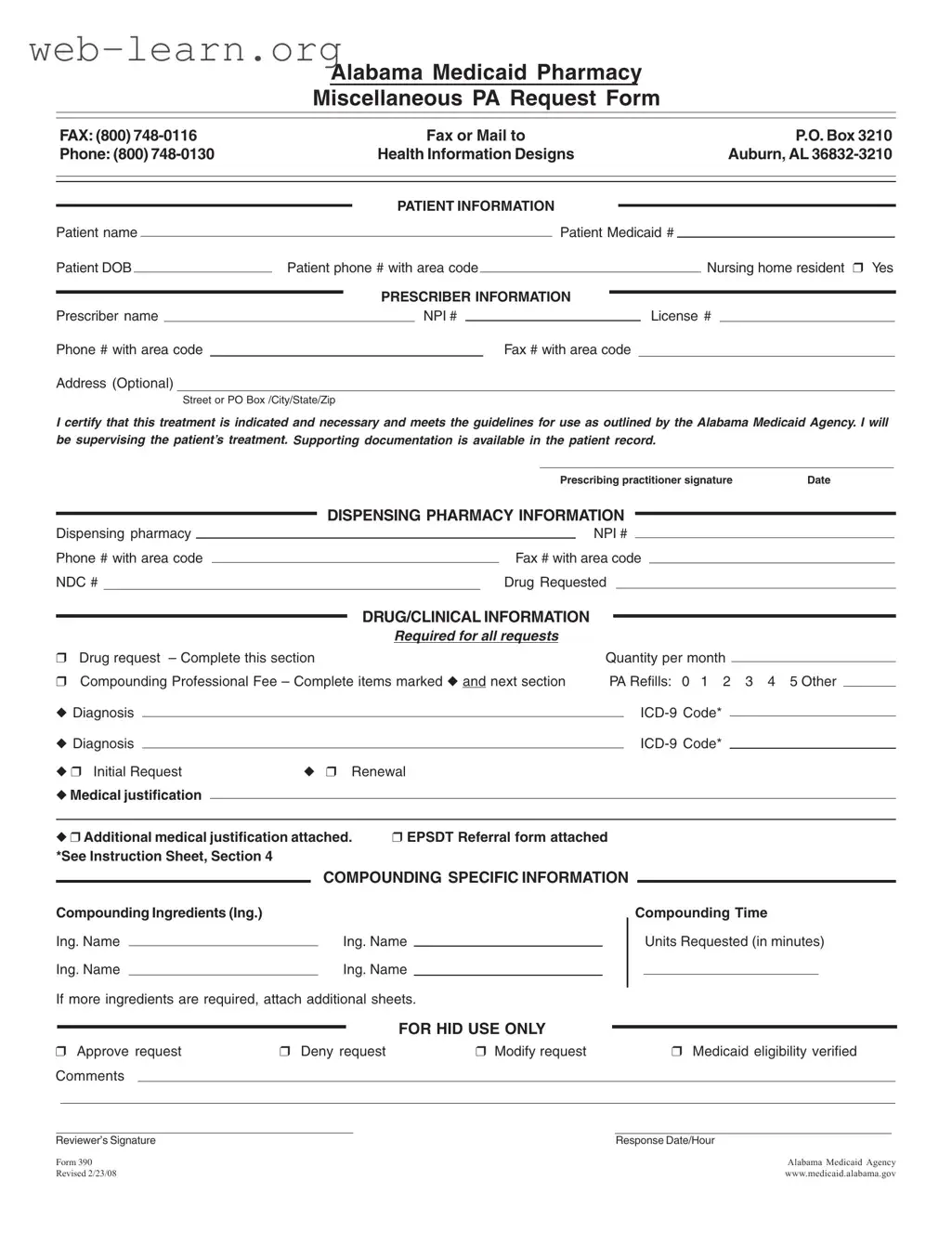
The Alabama 390 form is a crucial document for healthcare providers seeking prior authorization for pharmacy services under the Alabama Medicaid program. This form is specifically designed to streamline the process of requesting medication that may not be readily available or requires special approval. It captures essential patient information, including the patient's name, Medicaid number, and date of birth, ensuring that the request is tied to the correct individual. Additionally, the form requires details from the prescriber, such as their name, license number, and contact information, affirming their commitment to the patient's treatment. The Alabama 390 form also includes sections for the dispensing pharmacy and the specific drug being requested, along with any necessary clinical information and justifications for the request. By providing a clear structure for documenting the rationale behind medication needs, this form helps facilitate timely access to necessary treatments while adhering to Medicaid guidelines. With an emphasis on thorough documentation, the form promotes accountability and ensures that both patients and providers can navigate the complexities of Medicaid pharmacy services with confidence.

Sample - Alabama 390 Form

Alabama Medicaid Pharmacy
Miscellaneous PA Request Form
FAX: (800) 748-0116 Fax or Mail to P.O. Box 3210
Phone: (800) 748-0130 Health Information Designs Auburn, AL 36832-3210
DISPENSING PHARMACY INFORMATION
Dispensing pharmacy NPI #
Phone # with area code Fax # with area code
NDC # Drug Requested
DRUG/CLINICAL INFORMATION
Required for all requests
Drug request – Complete this section Quantity per month
Compounding Professional Fee – Complete items marked
and next section PA Refills: 0 1 2 3 4 5 Other
Diagnosis ICD-9 Code*
Initial Request Renewal
Medical justification
Additional medical justification attached. EPSDT Referral form attached
*See Instruction Sheet, Section 4
FOR HID USE ONLY
Approve request Deny request Modify request Medicaid eligibility verified
Comments
Reviewer’s Signature Response Date/Hour
Form 390 Alabama Medicaid Agency
Revised 2/23/08 www.medicaid.alabama.gov
COMPOUNDING SPECIFIC INFORMATION
Compounding Ingredients (Ing.) Compounding Time
Ing. Name Ing. Name Units Requested (in minutes)
Ing. Name Ing. Name
If more ingredients are required, attach additional sheets.
Street or PO Box /City/State/Zip
PATIENT INFORMATION
Patient name Patient Medicaid #
Patient DOB Patient phone # with area code Nursing home resident Ye s
PRESCRIBER INFORMATION
Prescriber name NPI # License #
Phone # with area code Fax # with area code
Address (Optional)
I certify that this treatment is indicated and necessary and meets the guidelines for use as outlined by the Alabama Medicaid Agency. I will
be supervising the patient’s treatment.
Supporting documentation is available in the patient record.
Prescribing practitioner signature Date

Form Information

Fact Name Description
Form Purpose The Alabama 390 form is used to request prior authorization for medications under the Alabama Medicaid program.
Governing Law This form is governed by the Alabama Medicaid Agency regulations, which outline the procedures for medication approval.
Patient Information Essential details about the patient must be provided, including name, Medicaid number, date of birth, and phone number.
Prescriber Requirements The prescriber must include their name, NPI number, and contact information, certifying the necessity of the treatment.
Compounding Information If the request involves compounding, specific ingredients and time units must be detailed on the form.
Submission Methods The completed form can be submitted via fax or mail to the Alabama Medicaid Agency's designated address.

Detailed Guide for Filling Out Alabama 390

Filling out the Alabama 390 form requires careful attention to detail to ensure that all necessary information is provided. The form is essential for submitting requests related to Medicaid pharmacy services. Below are the steps to complete the form accurately.

  1. Begin with the PATIENT INFORMATION section. Enter the patient's name, Medicaid number, date of birth, and phone number, including the area code. Indicate if the patient is a nursing home resident by checking the appropriate box.
  2. Proceed to the PRESCRIBER INFORMATION section. Fill in the prescriber's name, NPI number, license number, phone number with area code, and fax number with area code. An address is optional but can be provided if desired.
  3. In the same section, the prescriber must certify the treatment by signing and dating the form.
  4. Next, complete the DISPENSING PHARMACY INFORMATION section. Include the dispensing pharmacy's name and phone number with area code. Enter the NDC number, NPI number, and fax number with area code. Specify the drug requested.
  5. Move on to the DRUG/CLINICAL INFORMATION section. Mark whether it is a drug request or a compounding professional fee request. If applicable, provide the quantity per month and the number of refills. Include the diagnosis ICD-9 codes and indicate if it is an initial request or a renewal. Attach any required medical justification or EPSDT referral form.
  6. If the request involves compounding, fill out the COMPOUNDING SPECIFIC INFORMATION section. List the names of the compounding ingredients. If more ingredients are needed, attach additional sheets. Specify the compounding time requested in minutes.
  7. Review the completed form for accuracy and ensure all required fields are filled out.
  8. Submit the form via fax to (800) 748-0116 or mail it to P.O. Box 3210, Auburn, AL 36832-3210. You can also contact Health Information Designs at (800) 748-0130 if you have questions.

Obtain Answers on Alabama 390

  1. What is the Alabama 390 form?

    The Alabama 390 form is a request form used for obtaining prior authorization for pharmacy services under Alabama Medicaid. It is specifically designed for miscellaneous pharmacy requests that require approval before medication can be dispensed.

  2. Who should fill out the Alabama 390 form?

    The form should be completed by the prescribing healthcare provider. This includes doctors, nurse practitioners, or any licensed prescriber who is responsible for the patient's treatment.

  3. What information is required on the form?

    Essential information includes:

    • Patient's name, Medicaid number, date of birth, and phone number
    • Prescriber's name, NPI number, license number, and contact details
    • Dispensing pharmacy's information
    • Details about the drug requested, including quantity and diagnosis codes
  4. How do I submit the Alabama 390 form?

    You can submit the form by faxing it to (800) 748-0116 or mailing it to the address provided on the form: P.O. Box 3210, Auburn, AL 36832-3210.

  5. What happens after I submit the form?

    After submission, the Alabama Medicaid Agency will review the request. They may approve, deny, or modify the request based on the information provided. You will receive a response indicating the outcome of your request.

  6. Is there a specific timeframe for approval?

    The timeframe for approval can vary. However, it is advisable to submit the form as early as possible to avoid delays in treatment. Generally, a response is provided within a reasonable period after submission.

  7. What if my request is denied?

    If your request is denied, you will receive a notification explaining the reasons for the denial. You may have the option to appeal the decision or provide additional information to support your request.

  8. Can I attach additional documentation?

    Yes, you can attach additional medical justification or other relevant documents to support your request. Make sure to indicate on the form that you have attached extra documentation.

  9. What is the purpose of the compounding section?

    The compounding section is for requests involving customized medications that require specific ingredients. You must list the ingredients and the time required for compounding in this section.

  10. Where can I find more information about the Alabama 390 form?

    For more details, you can visit the Alabama Medicaid Agency's website at www.medicaid.alabama.gov. This site provides comprehensive information about the form and the prior authorization process.

Common mistakes

Filling out the Alabama 390 form can be a straightforward process, but many individuals make common mistakes that can delay approval or lead to denials. One significant error is failing to provide complete patient information. Omitting essential details such as the patient's Medicaid number or date of birth can result in processing delays. Each section of the form is crucial, and incomplete submissions can lead to unnecessary back-and-forth communication with the Medicaid agency.

Another frequent mistake is neglecting to include the prescriber’s information accurately. The prescriber’s name, NPI number, and contact details must be filled out correctly. If any of this information is incorrect or missing, it can hinder the approval process. The prescriber’s signature is also vital; without it, the request may be deemed invalid.

Many applicants also overlook the importance of providing proper drug and clinical information. This section requires specific details about the drug requested, including the NDC number and the quantity needed. Failing to specify the correct drug or not providing adequate medical justification can lead to a denial. Furthermore, the diagnosis codes must be accurate, as they are used to determine the medical necessity of the request.

Compounding requests present additional challenges. Applicants often forget to list all required compounding ingredients or fail to specify the compounding time units requested. Incomplete information in this section can lead to misunderstandings and delays in processing. It is essential to double-check that all ingredients are listed and that the time required for compounding is clearly stated.

Lastly, many individuals do not attach the necessary supporting documentation. If additional medical justification or EPSDT referral forms are required, they must be included with the submission. Failing to provide this documentation can result in a denial or a request for further information, prolonging the process. Thoroughly reviewing the form and ensuring all sections are complete can significantly improve the chances of approval.

Documents used along the form

The Alabama 390 form is a crucial document used for requesting prior authorization for certain pharmacy services under Medicaid. However, there are several other forms and documents that often accompany the Alabama 390 form to ensure a smooth and efficient processing of requests. Below is a list of these documents, each serving a specific purpose in the Medicaid process.

  • EPSDT Referral Form: This form is used to refer patients for additional services under the Early and Periodic Screening, Diagnostic, and Treatment (EPSDT) program. It ensures that children receive comprehensive healthcare services as mandated by Medicaid.
  • Medical Justification Letter: This letter provides detailed explanations and supporting evidence for the requested treatment or medication. It helps clarify why the prescribed service is necessary for the patient’s health and wellbeing.
  • ICD-9 Code Documentation: This document includes the International Classification of Diseases codes that correspond to the patient's diagnosis. Accurate coding is essential for processing claims and ensuring that the treatment aligns with Medicaid guidelines.
  • Prescription Order: A formal prescription from the healthcare provider that details the medication, dosage, and duration of treatment. This document is vital for pharmacies to dispense the medication correctly.
  • Patient Information Release Form: This form allows healthcare providers to share the patient's medical information with the pharmacy or other involved parties. It is important for maintaining compliance with privacy regulations while facilitating necessary communication.

Understanding these documents and their roles can help streamline the prior authorization process for Medicaid services. By ensuring that all necessary paperwork is completed and submitted, patients can receive timely access to the medications and treatments they need.

Similar forms

The Alabama 390 form is a request form used for pharmacy prior authorization in the Medicaid system. Several other documents serve similar purposes in healthcare and insurance. Here are seven documents that share similarities with the Alabama 390 form:

  • Medicaid Prior Authorization Request Form: Like the Alabama 390, this form is used to request approval for specific medical treatments or medications under Medicaid. Both require patient and prescriber information.
  • Medicare Part D Prior Authorization Form: This document is used to obtain authorization for certain drugs under Medicare. It also includes details about the patient and the prescribed medication, similar to the Alabama 390.
  • Commercial Insurance Prior Authorization Form: Insurers often require this form to approve coverage for specific treatments or medications. It shares the same goal of ensuring that prescribed treatments are necessary.
  • Compounding Pharmacy Authorization Form: This form is specifically for requesting compounded medications. It includes similar sections for drug details and patient information, like the Alabama 390.
  • Request for Medical Necessity Documentation: This document is used to justify the need for certain treatments. It requires similar information about the patient’s diagnosis and treatment plan.
  • Durable Medical Equipment (DME) Prior Authorization Form: This form is used to request approval for DME. It also requires patient details and justification for the equipment, mirroring the Alabama 390's structure.
  • Pharmacy Benefit Manager (PBM) Prior Authorization Form: Used by PBMs to assess medication requests, this form also collects patient and prescriber information, akin to the Alabama 390.

Dos and Don'ts

When filling out the Alabama 390 form, it is essential to ensure accuracy and completeness. The following list outlines important actions to take and avoid during this process.

  • Do provide complete patient information, including name, Medicaid number, and date of birth.
  • Do ensure that the prescriber’s information is accurate, including their NPI number and contact details.
  • Do include all necessary documentation to support the request, such as medical justification and any required referral forms.
  • Do double-check the drug requested and the quantity to avoid any errors in the request.
  • Don't leave any sections of the form blank; incomplete forms can lead to delays or denials.
  • Don't forget to sign and date the form to confirm the information provided is accurate and necessary.
  • Don't use abbreviations or unclear language that could lead to misunderstandings about the request.
  • Don't submit the form without verifying that all required fields are filled out correctly.

Misconceptions

Understanding the Alabama 390 form is crucial for both healthcare providers and patients. However, several misconceptions can lead to confusion. Here are nine common misconceptions about the form:

  1. The Alabama 390 form is only for nursing home residents. This form can be used for any Medicaid patient requiring prior authorization for pharmacy services, not just those in nursing homes.
  2. Only doctors can submit the Alabama 390 form. While physicians typically submit the form, other licensed prescribers, such as nurse practitioners and physician assistants, can also complete it.
  3. The form is only for new medication requests. The Alabama 390 form can be used for both initial requests and renewals of existing medications.
  4. All fields on the form must be completed. While it's important to provide as much information as possible, some sections, like the optional address for the prescriber, may be left blank.
  5. Submitting the form guarantees approval. Approval is not guaranteed. The request will be reviewed, and a determination will be made based on Medicaid guidelines.
  6. The Alabama 390 form is only for prescription medications. It can also be used for compounding requests, which may involve multiple ingredients and specific instructions.
  7. Once submitted, the request cannot be modified. If additional information is needed, the prescriber may be contacted for clarification or further documentation.
  8. There is no need for supporting documentation. Supporting documentation is often required to justify the medical necessity of the requested treatment.
  9. Faxing the form is the only submission method. In addition to faxing, the form can also be mailed to the specified address, providing flexibility for prescribers.

Being aware of these misconceptions can help streamline the process and ensure that patients receive the necessary medications in a timely manner.

Key takeaways

When utilizing the Alabama 390 form, it is essential to ensure that the process is clear and efficient. Here are ten key takeaways to consider:

  • Patient Information: Accurately fill in the patient's name, Medicaid number, date of birth, and phone number. This information is crucial for identifying the individual.
  • Nursing Home Resident: Indicate whether the patient resides in a nursing home, as this may affect the approval process.
  • Prescriber Information: Provide complete details about the prescriber, including their name, NPI number, and contact information. This helps verify the legitimacy of the request.
  • Certification: The prescriber must certify that the treatment is necessary and meets Medicaid guidelines. This statement is a vital part of the form.
  • Dispensing Pharmacy: Include the name and contact details of the pharmacy that will dispense the medication. This ensures proper communication regarding the request.
  • Drug Requested: Clearly specify the drug being requested and the quantity needed per month. This information is essential for processing the request.
  • Diagnosis Codes: Include the appropriate ICD-9 codes for the patient's diagnosis. These codes provide context for the medical necessity of the request.
  • Compounding Information: If the request involves compounding, list all necessary ingredients and the time units required for preparation.
  • Medical Justification: Provide a detailed medical justification for the request. If additional documentation is available, indicate that it is attached.
  • Follow-Up: After submission, keep track of the request status. Communication with the Alabama Medicaid Agency may be necessary to address any issues or provide further information.

By following these guidelines, individuals can navigate the process of filling out and using the Alabama 390 form more effectively, ultimately ensuring that patients receive the necessary medications in a timely manner.