Homepage Blank Alabama 362 Form
Outline

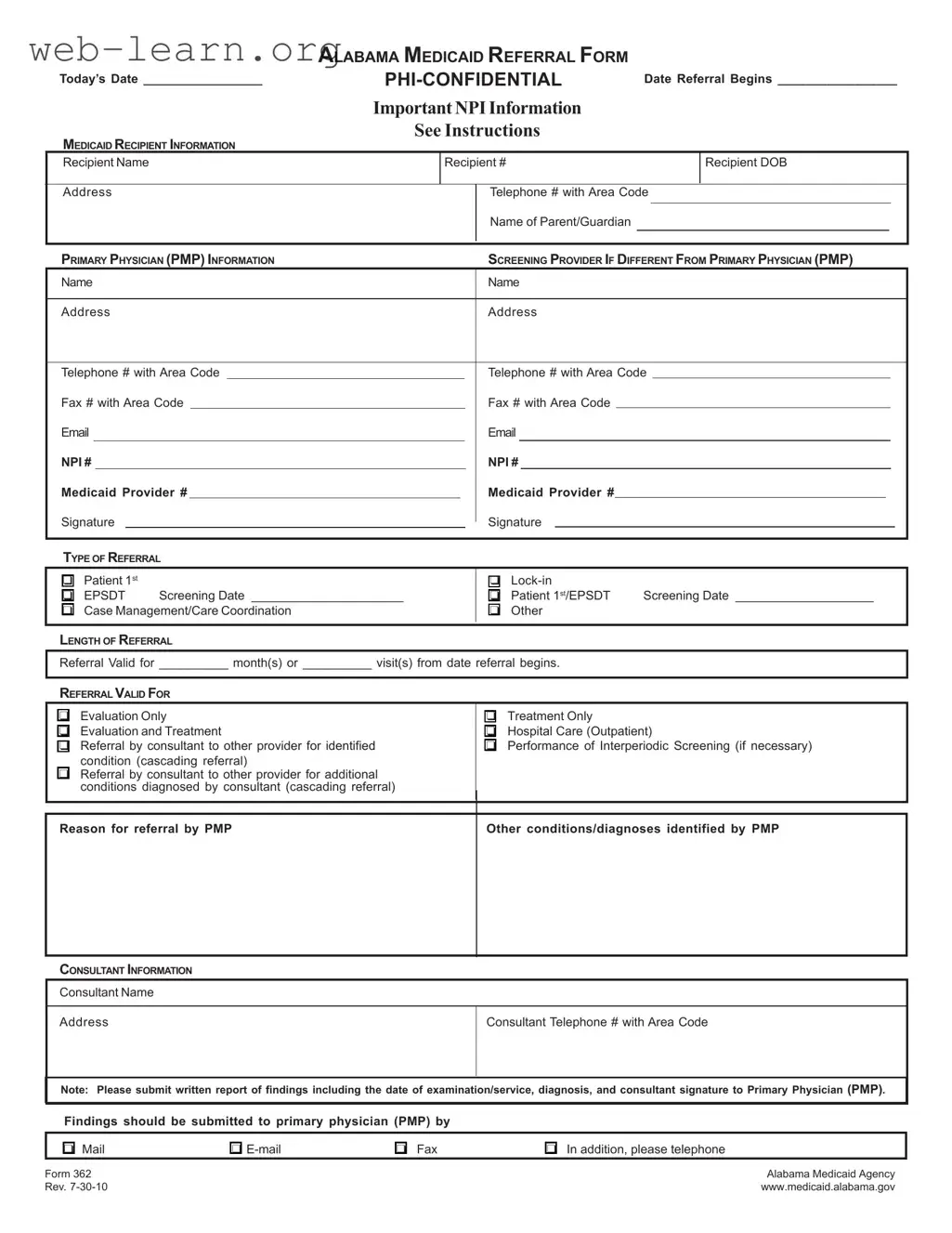
The Alabama 362 form serves as a crucial document in the Medicaid referral process, ensuring that recipients receive the appropriate care they need. This form captures essential details about the Medicaid recipient, including their name, date of birth, and contact information, along with the necessary identifiers like the recipient number. It also gathers information about the primary physician and any other screening providers involved in the patient's care. The form outlines the type of referral being made, whether it is for evaluation, treatment, or case management, and specifies the duration of the referral. Additionally, it provides space for the consultant's information, ensuring that communication between healthcare providers remains streamlined. By requiring signatures from both the primary physician and the consultant, the form emphasizes accountability and collaboration in patient care. Understanding how to correctly fill out and utilize the Alabama 362 form is essential for both healthcare providers and patients navigating the Medicaid system.
Sample - Alabama 362 Form

PRIMARY PHYSICIAN (PMP) INFORMATION SCREENING PROVIDER IF DIFFERENT FROM PRIMARY PHYSICIAN (PMP)
Name Name
Address Address
Telephone # with Area Code Telephone # with Area Code
Fax # with Area Code Fax # with Area Code
Email Email
NPI # NPI #
Medicaid Provider # Medicaid Provider #
Signature Signature
Findings should be submitted to primary physician (PMP) by
Mail E-mail Fax In addition, please telephone
REFERRAL VALID FOR
Evaluation Only Treatment Only
Evaluation and Treatment Hospital Care (Outpatient)
Referral by consultant to other provider for identified Performance of Interperiodic Screening (if necessary)
condition (cascading referral)
Referral by consultant to other provider for additional
conditions diagnosed by consultant (cascading referral)
ALABAMA MEDICAID REFERRAL FORM
PHI-CONFIDENTIAL
LENGTH OF REFERRAL
Referral Valid for __________ month(s) or __________ visit(s) from date referral begins.
Reason for referral by PMP Other conditions/diagnoses identified by PMP
CONSULTANT INFORMATION
Consultant Name
Address Consultant Telephone # with Area Code
Form 362 Alabama Medicaid Agency
Rev. 7-30-10 www.medicaid.alabama.gov
MEDICAID RECIPIENT INFORMATION
Recipient Name Recipient # Recipient DOB
Address Telephone # with Area Code
Name of Parent/Guardian
Note: Please submit written report of findings including the date of examination/service, diagnosis, and consultant signature to Primary Physician (PMP).
TYPE OF REFERRAL
Patient 1
st
Lock-in
EPSDT Screening Date ______________________ Patient 1
st
/EPSDT Screening Date ____________________
Case Management/Care Coordination Other
Important NPI Information
See Instructions
Today’s Date _________________ Date Referral Begins _________________

Form Information

Fact Name Details
Form Purpose The Alabama 362 form is used for Medicaid referrals, facilitating communication between healthcare providers.
Governing Law This form is governed by Alabama Medicaid regulations and policies.
Confidentiality PHI (Protected Health Information) is marked as confidential on the form, ensuring patient privacy.
Recipient Information Essential details such as the recipient's name, Medicaid number, and date of birth must be provided.
Primary Physician Information Information about the primary physician, including their NPI and Medicaid provider number, is required.
Type of Referral Referrals can be categorized as Patient 1st, EPSDT Screening, or Case Management, among others.
Length of Referral The form allows providers to specify the duration of the referral, either by months or visits.
Consultant Information Details about the consultant, including name and contact information, must be included for follow-up.
Submission Instructions Providers are instructed to submit findings to the primary physician via mail, email, or fax.

Detailed Guide for Filling Out Alabama 362

Filling out the Alabama 362 form is an important step in the referral process for Medicaid recipients. Once you complete the form, it will need to be submitted to the appropriate parties for processing. Follow these steps to ensure that you fill out the form correctly.

  1. Enter Today's Date: Write the current date at the top of the form.
  2. Fill in Recipient Information: Include the recipient's name, Medicaid number, date of birth, address, telephone number, and the name of the parent or guardian, if applicable.
  3. Provide Primary Physician Information: Write the name, address, telephone number, fax number, email, NPI number, and Medicaid provider number of the primary physician.
  4. Screening Provider Information: If different from the primary physician, fill in the same details for the screening provider.
  5. Select Type of Referral: Check the appropriate box for the type of referral, such as Patient 1st, Lock-in, or EPSDT Screening.
  6. Specify Length of Referral: Indicate how long the referral is valid by filling in the number of months or visits from the start date.
  7. Indicate Referral Validity: Check the appropriate box for what the referral is valid for, such as evaluation only or treatment only.
  8. Provide Consultant Information: Fill in the consultant's name, address, and telephone number.
  9. Signature: Ensure that the primary physician signs the form to validate it.
  10. Submit Findings: Remember to submit a written report of findings to the primary physician, including the date of examination, diagnosis, and consultant signature.

After completing these steps, review the form for any errors before submission. Ensure that all required information is filled out clearly to avoid delays in processing. Once everything is checked, send the form to the appropriate Medicaid office or provider as needed.

Obtain Answers on Alabama 362

  1. What is the Alabama 362 form?

    The Alabama 362 form, also known as the Alabama Medicaid Referral Form, is a document used to refer Medicaid recipients for various medical services. It captures essential information about the patient, their primary physician, and any consultants involved in the patient's care. This form ensures that all necessary details are communicated effectively between healthcare providers.

  2. Who needs to fill out the Alabama 362 form?

    The form is typically completed by the primary physician (PMP) of the Medicaid recipient. This physician is responsible for initiating the referral process. Additionally, if there is a screening provider different from the primary physician, they may also need to provide their information on the form.

  3. What information is required on the form?

    The Alabama 362 form requires several key pieces of information, including:

    • Recipient's name, date of birth, and Medicaid number
    • Address and contact information
    • Primary physician's details, including their NPI and Medicaid provider numbers
    • Type of referral and duration
    • Consultant information if applicable
  4. What types of referrals can be made using this form?

    The Alabama 362 form allows for various types of referrals, including:

    • Patient first referrals
    • EPSDT screenings
    • Case management or care coordination
    • Cascading referrals for evaluation and treatment
    • Hospital care referrals
  5. How long is a referral valid?

    The length of the referral is specified on the form. It can be valid for a certain number of months or a specific number of visits, starting from the date the referral begins. It is important to clearly indicate this duration to avoid any confusion regarding the referral's validity.

  6. What should be done after the consultation?

    After the consultation, the consultant is required to submit a written report of their findings. This report should include the date of examination, diagnosis, and the consultant's signature. The findings must be sent to the primary physician, either by mail, email, fax, or another agreed-upon method.

  7. Can the form be used for multiple conditions?

    Yes, the Alabama 362 form can accommodate referrals for multiple conditions. If a consultant identifies additional conditions during their evaluation, these can be documented on the form under the appropriate sections. This allows for comprehensive care coordination.

  8. Where can I find more information about the form?

    Additional details about the Alabama 362 form can be found on the Alabama Medicaid Agency's official website. This resource provides guidance on completing the form and offers updates on any changes to the referral process.

  9. What happens if the form is not filled out correctly?

    If the Alabama 362 form is not completed accurately, it may lead to delays in care or complications with Medicaid billing. It is essential to ensure that all information is correct and complete before submission. Inaccuracies can hinder the referral process and affect the recipient's access to necessary services.

Common mistakes

Filling out the Alabama 362 form can be straightforward, but mistakes can lead to delays in processing or even denial of services. One common error is failing to include the Medicaid Recipient Information completely. This section requires accurate details such as the recipient's name, number, date of birth, address, and telephone number. Omitting any of this information can result in significant delays.

Another frequent mistake is not providing the correct Primary Physician (PMP) Information. The form requires the name, address, and contact details of the primary physician. If this information is incorrect or missing, it may hinder communication between providers and affect the recipient's care.

Many individuals also overlook the importance of specifying the Type of Referral. This section has multiple options, and selecting the wrong one can lead to confusion about the purpose of the referral. It is essential to carefully review the options and choose the one that accurately reflects the situation.

Additionally, some people fail to indicate the Length of Referral properly. This section asks for either the number of months or visits for which the referral is valid. Not providing this information can result in the referral being deemed invalid.

When it comes to the Consultant Information, errors often occur. This includes providing incorrect contact details for the consultant. If the consultant's name, address, or phone number is wrong, it can complicate the process of obtaining necessary evaluations or treatments.

Another mistake is neglecting to sign the form. The Signature section is critical, and failing to sign can lead to the form being rejected outright. It is essential to ensure that all required signatures are present before submission.

Some individuals also forget to specify the Reason for Referral. This detail is crucial for the receiving provider to understand the context of the referral. Without a clear reason, the referral may not be processed as intended.

In addition, many people do not submit the required written report of findings from the consultant. This report is necessary for the primary physician to understand the outcomes of the consultation. Failing to include this report can delay further treatment.

Lastly, using outdated or incorrect versions of the form can lead to complications. Always ensure that the most current version of the Alabama 362 form is being used to avoid any issues with compliance or processing.

Documents used along the form

The Alabama 362 form is a crucial document used for Medicaid referrals in Alabama. It captures essential information about the recipient, the primary physician, and the details of the referral. Alongside this form, several other documents are often utilized to ensure a smooth referral process. Below is a list of these commonly used forms and documents.

  • Alabama Medicaid Application: This document is required for individuals seeking to enroll in the Alabama Medicaid program. It gathers personal information, income details, and other relevant data to determine eligibility.
  • Medicaid Recipient Identification Card: Issued to eligible Medicaid recipients, this card contains vital information such as the recipient's name, Medicaid number, and coverage details. It must be presented when accessing healthcare services.
  • Prior Authorization Request Form: This form is submitted by healthcare providers to obtain approval from Medicaid before certain services or procedures are performed. It ensures that the requested service is medically necessary and covered by Medicaid.
  • Care Coordination Plan: This document outlines the strategies and services required to meet the healthcare needs of a Medicaid recipient. It includes goals, interventions, and the roles of various healthcare providers involved in the recipient's care.
  • Consultation Report: After a specialist evaluates a patient, this report details the findings, diagnoses, and recommendations. It is sent to the primary physician and is essential for continuity of care.
  • Patient Consent Form: This form is necessary for obtaining permission from the patient or their guardian to share medical information with other providers. It ensures compliance with privacy regulations and facilitates communication among healthcare professionals.

Each of these documents plays a significant role in the Medicaid referral process. Together, they help ensure that recipients receive the appropriate care while maintaining compliance with regulations. Understanding these forms can simplify interactions with the healthcare system and enhance the overall experience for both providers and patients.

Similar forms

The Alabama 362 form serves as a crucial document for Medicaid referrals in the state of Alabama. It is not unique in its function; several other forms fulfill similar roles in healthcare and insurance contexts. Below are five documents that share similarities with the Alabama 362 form:

  • CMS-1500 Form: This form is used for billing Medicare and Medicaid. Like the Alabama 362, it collects essential patient and provider information, ensuring that claims are processed correctly. Both forms require details about the patient’s diagnosis and the services provided.
  • Referral Authorization Form: Often used by health insurance companies, this form requires healthcare providers to obtain authorization before referring patients to specialists. Similar to the Alabama 362, it includes patient information and the reason for the referral, helping to streamline the process and ensure that care is coordinated.
  • Patient Intake Form: This document is completed by patients upon their first visit to a healthcare provider. It gathers personal information, medical history, and insurance details, akin to the Alabama 362’s collection of recipient information. Both forms aim to create a comprehensive overview of the patient’s health status and needs.
  • Care Coordination Plan: Used in managing patient care, this plan outlines the services a patient will receive and the providers involved. Similar to the Alabama 362, it emphasizes collaboration among healthcare providers and includes details about referrals and follow-up care.
  • Authorization for Release of Medical Information: This form allows healthcare providers to share patient information with other entities. Like the Alabama 362, it ensures compliance with privacy regulations while facilitating communication between providers, which is essential for effective patient care.

Dos and Don'ts

When filling out the Alabama 362 form, it's essential to follow specific guidelines to ensure your submission is accurate and complete. Here’s a list of things you should and shouldn’t do:

  • Do provide all required information, including the recipient's name, date of birth, and address.
  • Do ensure that the NPI and Medicaid Provider numbers are accurate for both the primary physician and the consultant.
  • Do clearly indicate the type of referral and the length of the referral period.
  • Do sign the form where indicated to validate the referral.
  • Don't leave any sections blank; incomplete forms may be rejected or delayed.
  • Don't forget to submit any required written reports from the consultant to the primary physician.

By following these tips, you can help ensure a smoother process when using the Alabama 362 form.

Misconceptions

Understanding the Alabama 362 form is essential for both healthcare providers and patients. However, several misconceptions can lead to confusion. Here’s a look at nine common misunderstandings about this important document:

  • It is only for new patients. Many believe the form is only necessary for new patients. In reality, it can be used for existing patients who require referrals for additional services.
  • Only primary care physicians can complete it. While primary care physicians often fill out the form, specialists can also initiate referrals when appropriate.
  • It covers unlimited visits. Some think that once the form is submitted, there are no limits on visits. The referral is valid for a specific number of visits or a set duration, as indicated on the form.
  • All referrals require a consultant. Not every referral needs to involve a consultant. Referrals can be made for evaluations or treatments directly from the primary physician without additional specialists.
  • It is not necessary to document the reason for referral. In fact, providing a clear reason for the referral is crucial. This helps ensure that the patient receives appropriate care and follow-up.
  • The form is only for Medicaid recipients. Although primarily used for Medicaid patients, the referral process can also apply to other insurance plans, depending on the provider's policies.
  • Once submitted, the form cannot be changed. Changes can be made to the referral details if necessary. It is important to communicate any updates to the involved parties promptly.
  • It is a one-time requirement. Some assume that once the form is submitted, no further documentation is needed. However, ongoing evaluations may require additional referrals or updates.
  • Faxing is the only way to submit the form. While faxing is an option, the form can also be submitted via email or mail, offering flexibility in how it is sent to the appropriate provider.

By clarifying these misconceptions, both healthcare providers and patients can navigate the referral process more effectively. Understanding the Alabama 362 form helps ensure that necessary care is accessed without unnecessary delays.

Key takeaways

When filling out the Alabama 362 form, it's essential to keep a few key points in mind. Here are some important takeaways:

  • Confidentiality is crucial. This form contains personal health information, so handle it with care.
  • Make sure to fill in the date referral begins accurately. This will help in tracking the referral's validity.
  • Provide complete Medicaid recipient information. This includes the recipient's name, number, date of birth, address, and contact details.
  • Identify the primary physician and any other screening providers clearly. Include their contact information and NPI numbers.
  • Choose the correct type of referral. Options include Patient 1st, EPSDT Screening, and Case Management.
  • Specify the length of referral. Indicate whether it is valid for a certain number of months or visits.
  • Indicate the scope of the referral. This can be for evaluation only, treatment, or cascading referrals.
  • Provide accurate consultant information. Include the consultant's name, address, and contact number.
  • Remember to submit a written report of findings to the primary physician. This should include the date of service and diagnosis.

By following these guidelines, you can ensure that the Alabama 362 form is completed correctly and efficiently, facilitating the necessary medical referrals.