Homepage Blank Agreement Nonparent Relative Caregiver Form
Outline

The Agreement Nonparent Relative Caregiver form serves as a crucial legal document designed to facilitate the care and welfare of a child when a parent is unable to provide direct supervision. This form, compliant with Chapter 34 of the Texas Family Code, allows a parent to designate a relative or voluntary caregiver—such as a grandparent, aunt, uncle, or adult sibling—to make important decisions regarding the child's health, education, and welfare. By completing this form, parents grant authority to the designated caregiver to handle a variety of responsibilities, including authorizing medical treatment, enrolling the child in educational programs, and even applying for public benefits. It is essential for both the parent and the caregiver to understand their obligations under this agreement, which includes a requirement to inform each other of any changes in contact information. Additionally, the form outlines specific limitations, such as the prohibition against authorizing an abortion or administering emergency contraception without further legal consent. This document not only protects the rights of the child but also ensures that the parent retains ultimate authority and can revoke the agreement at any time. As such, it is imperative for all parties involved to carefully read and comprehend the associated warnings and disclosures before signing, as this agreement carries significant legal implications.


Sample - Agreement Nonparent Relative Caregiver Form

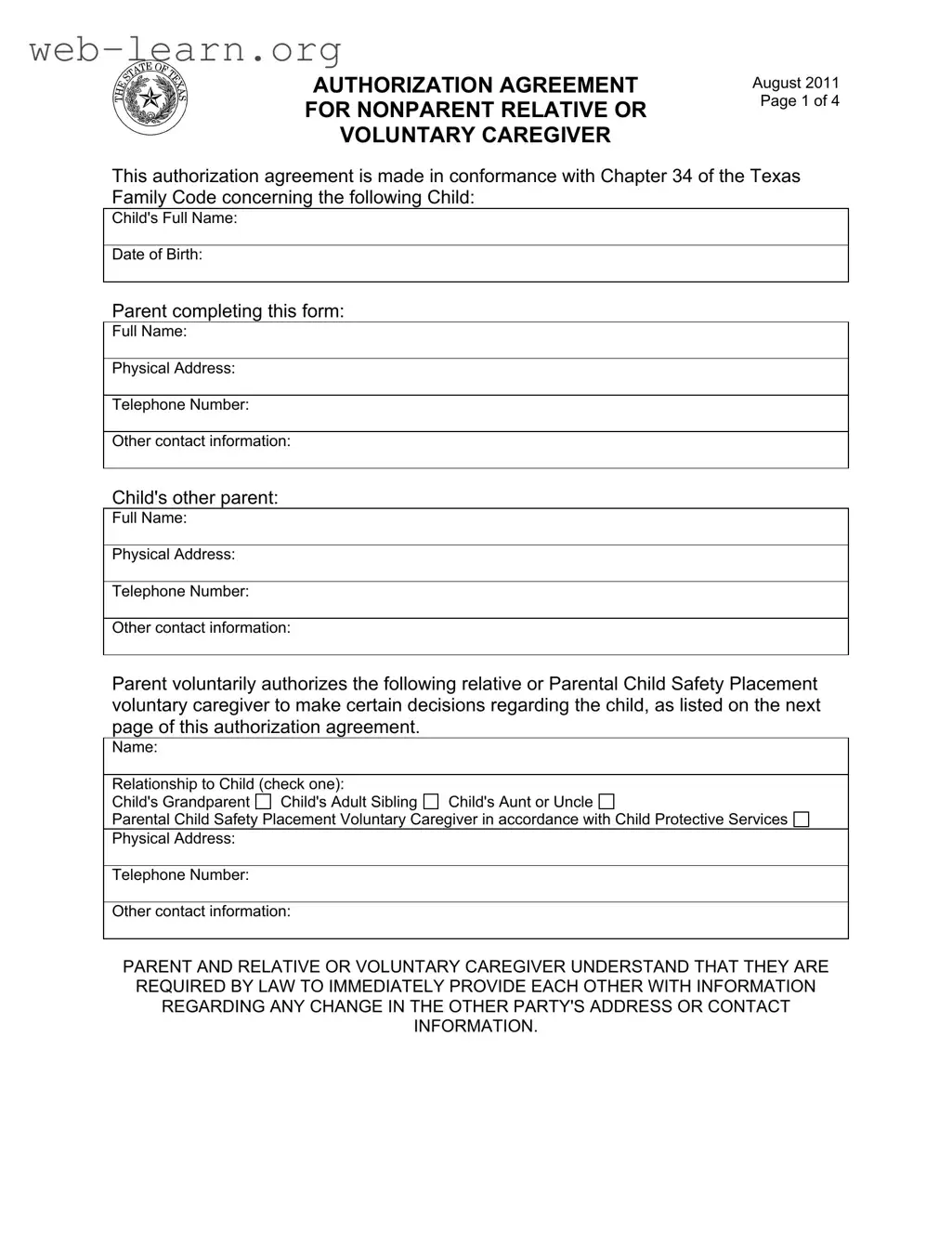
AUTHORIZATION AGREEMENT
FOR NONPARENT RELATIVE OR
VOLUNTARY CAREGIVER
August 2011
Page 1 of 4
This authorization agreement is made in conformance with Chapter 34 of the Texas
Family Code concerning the following Child:
Child's Full Name:
Date of Birth:
Parent completing this form:
Full Name:
Physical Address:
Telephone Number:
Other contact information:
Child's other parent:
Full Name:
Physical Address:
Telephone Number:
Other contact information:
Parent voluntarily authorizes the following relative or Parental Child Safety Placement
voluntary caregiver to make certain decisions regarding the child, as listed on the next
page of this authorization agreement.
Name:
Relationship to Child (check one):
Child's Grandparent
Child's Adult Sibling Child's Aunt or Uncle
Parental Child Safety Placement Voluntary Caregiver in accordance with Child Protective Services
Physical Address:
Telephone Number:
Other contact information:
PARENT AND RELATIVE OR VOLUNTARY CAREGIVER UNDERSTAND THAT THEY ARE
REQUIRED BY LAW TO IMMEDIATELY PROVIDE EACH OTHER WITH INFORMATION
REGARDING ANY CHANGE IN THE OTHER PARTY'S ADDRESS OR CONTACT
INFORMATION.
AUTHORIZATION AGREEMENT
FOR NONPARENT RELATIVE OR
VOLUNTARY CAREGIVER
August 2011
Page 2 of 4
Parent authorizes the above named relative or voluntary caregiver to perform the following acts in
regard to the child and the relative or voluntary caregiver assumes the responsibility of
performing these functions:
(1) To authorize medical, dental, psychological, surgical treatment, and immunization of the child,
including executing any consents or authorizations for the release of information as required by law
relating to the treatment or immunization;
(2) To obtain and maintain health insurance coverage for the child and automobile insurance coverage
for the child, if appropriate;
(3) To enroll the child in a day-care program or public or private preschool, primary or secondary school;
(4) To authorize the child to participate in age-appropriate extracurricular, civic, social, or recreational
activities, including athletic activities;
(5) To authorize the child to obtain a learner's permit, driver's license, or state-issued identification card;
(6) To authorize employment of the child; and
(7) To apply for and receive public benefits on behalf of the child.
(8) This authorization agreement does not confer on the relative or voluntary caregiver of the child the
right to authorize the performance of an abortion on the child or the administration of emergency
contraception to the child
To the best of the parent's and the relative's or voluntary caregiver's knowledge (check if applicable):
This child is not the subject of a current (pre-existing) valid authorization agreement, and no
parent, guardian, custodian, licensed child-placing agency or other agency makes any claim to
actual physical possession or care, custody or control of the child that is inconsistent with this
authorization agreement.
To the best of the parent's and the relative's or voluntary caregiver's knowledge (choose one from below):
THERE IS NO COURT INVOLVEMENT WITH THIS CHILD
All of the following statements must apply:
There is no court order or pending suit affecting the parent-child relationship concerning the child.
There is no pending litigation in any court concerning custody, possession, or placement of the
child or access to or visitation with the child.
The court does not have continuing jurisdiction concerning the child.
THIS CHILD HAS BEEN THE SUBJECT OF A COURT ACTION
The court with continuing jurisdiction concerning the child has given written approval for the execution of
the authorization agreement accompanied by the following information:
The county in which the court is located;
The number of the court; and
The cause number in which the order was issued or the litigation is pending.
Please staple a copy of the court's order to this agreement.
AUTHORIZATION AGREEMENT
FOR NONPARENT RELATIVE OR
VOLUNTARY CAREGIVER
August 2011
Page 3 of 4
WARNINGS AND DISCLOSURES
This authorization agreement is an important legal document. The parent and the relative or voluntary
caregiver must read all of the warnings and disclosures before signing this authorization agreement.
The parent and relative are not required to consult an attorney but are advised to do so.
A parent's rights as a parent may be adversely affected by placing or leaving the parent's child with
another person.
This authorization agreement does not confer on the relative or voluntary caregiver the rights of a
managing or possessory conservator or legal guardian.
A parent who is a party to this authorization agreement may terminate the authorization agreement and
resume custody, possession, care, and control of the child on demand and at any time the parent may
request the return of the child.
Failure by the relative or voluntary caregiver to return the child to the parent immediately on request may
have criminal and civil consequences.
Under other applicable law, the relative or voluntary caregiver may be liable for certain expenses relating
to the child in the relative's or voluntary caregiver's care, but the parent still retains the parental obligation
to support the child.
In certain circumstances, this authorization agreement may not be entered into without written permission
of the court. Examples of when court permission must be granted include when a court has entered a
previous order granting custody or establishing a child support obligation.
This authorization agreement may be terminated by certain court orders affecting the child.
This authorization agreement does not supersede, invalidate, or terminate any prior authorization
agreement regarding the child.
This authorization agreement is void if a prior authorization agreement regarding the child is in effect and
has not expired or been terminated.
MAILING REQUIREMENTS:
When both parents do not sign the parent authorization agreement, a copy of the agreement MUST be
mailed to the non-signing parent, unless that parent is deceased or has had his or her parental rights
terminated. This authorization agreement is void unless:
1. The parties mail a copy of this agreement to a non-signing parent not later than the 10th day
after the date the authorization agreement is signed, by certified or international registered
mail, as applicable, return receipt requested.
2. If the parties do not receive a response from the non-signing parent before the 20th day after the
date the copy of the agreement is mailed, the parties must mail a second copy of the agreement
by first class mail or international first class mail, as applicable, to the parent not later than
the 45th day after the date the authorization agreement is signed.
EXCEPTION TO MAILING REQUIREMENTS:
If a parent who did not sign the authorization agreement does not have court-ordered possession of
or access to the child who is the subject of the agreement, the parent who is a party to the
agreement does not have to mail a copy of the agreement to the non-signing parent if either of the
following circumstances applies:
1. A protective order has been issued against the non-signing parent as provided under Chapter
85 of the Texas Family Code or under a similar law of another state for committing an act of
family violence (as defined by Section 71.004 of the Texas Family Code) against the parent
AUTHORIZATION AGREEMENT
FOR NONPARENT RELATIVE OR
VOLUNTARY CAREGIVER
August 2011
Page 4 of 4
who signed the agreement or any child of the parent who signed the agreement; or
2. The non-signing parent has been convicted of any of the following criminal offenses against
the parent who signed the agreement or any child of the parent who signed the agreement:
o any offense under Title 5 of the Texas Penal Code (including murder, homicide,
kidnapping, assault and sexual assault); or
o any other criminal offense in Texas or any other state if the offense involves a violent act
or prohibited sexual conduct.
This authorization agreement (select one of the following two):
Expires on this date: OR
Is valid until revoked in writing by either party
In addition, check here if you want the agreement to continue in effect after your death or during any
period of incapacity.
Execution of a subsequent authorization agreement does not by itself supersede, invalidate, or terminate
a prior authorization agreement.
By signing below, parent and the relative or voluntary caregiver acknowledge that they have each read
this authorization agreement carefully, are entering into the authorization agreement voluntarily, and have
read and understand all of the Warnings and Disclosures included in this authorization agreement.
_____________________________________
PARENT
Printed name:
SUBSCRIBED AND ACKNOWLEDGED BEFORE ME on this ____ day of _________________, 20____.
_____________________________________
Notary Public in and for the State of TEXAS
_____________________________________
PARENT**
Printed name:
SUBSCRIBED AND ACKNOWLEDGED BEFORE ME on this ____ day of _________________, 20____.
_____________________________________
Notary Public in and for the State of TEXAS
_____________________________________
RELATIVE OR VOLUNTARY CAREGIVER
Printed name:
SUBSCRIBED AND ACKNOWLEDGED BEFORE ME on this ____ day of _________________, 20____.
_____________________________________
Notary Public in and for the State of TEXAS

Form Information

Fact Name Details
Governing Law This form is governed by Chapter 34 of the Texas Family Code.
Purpose The form allows a parent to authorize a nonparent relative or voluntary caregiver to make specific decisions regarding the child's welfare.
Decision-Making Authority The caregiver can authorize medical treatment, enroll the child in school, and apply for public benefits, among other responsibilities.
Mailing Requirements If both parents do not sign, a copy must be mailed to the non-signing parent within ten days, unless exceptions apply.
Termination of Agreement The authorization can be revoked by the parent at any time, and certain court orders may also terminate the agreement.

Detailed Guide for Filling Out Agreement Nonparent Relative Caregiver

After filling out the Agreement Nonparent Relative Caregiver form, the next steps involve ensuring that all parties understand the terms and conditions outlined in the document. It is important to keep copies for your records and to follow any mailing requirements if both parents do not sign the agreement.

  1. Begin by entering the child's full name and date of birth at the top of the form.
  2. Fill in the parent’s full name, physical address, telephone number, and any other contact information.
  3. Provide the full name, physical address, telephone number, and other contact information for the child’s other parent.
  4. Identify the relative or voluntary caregiver by entering their name and relationship to the child. Check the appropriate box to indicate the relationship.
  5. Enter the physical address, telephone number, and other contact information for the relative or voluntary caregiver.
  6. Check the box confirming whether the child is the subject of a current valid authorization agreement.
  7. Select one option regarding court involvement with the child, and complete the necessary details if applicable.
  8. Read the warnings and disclosures section carefully to understand the implications of the agreement.
  9. Choose whether the agreement will expire on a specific date or remain valid until revoked in writing. Indicate if you want it to continue after death or during incapacity.
  10. All parties must sign the form, and their signatures must be notarized. Ensure that the notary public completes the required sections.
  11. If both parents do not sign the agreement, mail a copy to the non-signing parent as specified in the mailing requirements.

Obtain Answers on Agreement Nonparent Relative Caregiver

  1. What is the Agreement Nonparent Relative Caregiver form?

    This form is a legal document that allows a parent to authorize a relative or voluntary caregiver to make specific decisions regarding their child. It is designed to comply with Texas Family Code and outlines the responsibilities and rights of both the parent and the caregiver.

  2. What decisions can the authorized caregiver make?

    The caregiver can make several important decisions, including:

    • Authorize medical and dental treatment for the child.
    • Obtain health insurance coverage.
    • Enroll the child in educational programs.
    • Allow participation in extracurricular activities.
    • Authorize the child to get a learner's permit or driver's license.
    • Apply for public benefits on behalf of the child.

    However, the caregiver cannot authorize an abortion or emergency contraception for the child.

  3. What happens if there is a change in contact information?

    Both the parent and the caregiver must inform each other immediately of any changes to their address or contact information. This requirement is essential to maintain clear communication and ensure the child's well-being.

  4. Can the parent terminate the agreement?

    Yes, the parent can terminate the authorization agreement at any time and regain custody of the child. If the parent requests the return of the child, the caregiver must comply immediately. Failure to do so may lead to legal consequences.

  5. What are the mailing requirements for the agreement?

    If both parents do not sign the agreement, the parent who signed must mail a copy to the non-signing parent within ten days. If there is no response within twenty days, a second copy must be sent by first-class mail. There are exceptions to this requirement, particularly if there are issues of safety or previous court orders.

Common mistakes

Filling out the Agreement Nonparent Relative Caregiver form can be a straightforward process, but many people make mistakes that can lead to complications. One common error is failing to provide complete information about the child. This includes the child's full name and date of birth. Missing this information can delay the authorization process or cause it to be rejected altogether.

Another mistake is not updating contact information. Both the parent and the caregiver must inform each other about any changes in their addresses or phone numbers. If one party fails to do this, it can lead to misunderstandings and may even affect the legal standing of the agreement.

Some individuals overlook the importance of checking the correct relationship to the child. The form requires you to specify if the caregiver is a grandparent, sibling, aunt, uncle, or a voluntary caregiver. Incorrectly selecting this option can create confusion and may invalidate the agreement.

Additionally, not addressing court involvement properly is a significant mistake. If there is any court action related to the child, this must be disclosed. Failing to provide this information can have serious legal implications and may undermine the entire agreement.

Lastly, people often forget to sign and date the form correctly. All parties involved must acknowledge their understanding of the agreement. Without proper signatures and dates, the document may not hold up in court, leading to complications in the future.

Documents used along the form

The Agreement Nonparent Relative Caregiver form serves as a critical document in establishing the rights and responsibilities of nonparent caregivers. However, it is often accompanied by various other forms and documents that help clarify the legal relationship and ensure the welfare of the child involved. Below is a list of nine such documents, each playing a unique role in this process.

  • Parental Consent Form: This document provides explicit permission from the biological parents for a nonparent relative caregiver to make decisions on behalf of the child. It outlines the scope of authority granted to the caregiver.
  • Child Custody Agreement: This legal document outlines the custody arrangements for the child, detailing who has the right to make decisions regarding the child's upbringing and care, including living arrangements and visitation rights.
  • Medical Authorization Form: This form allows the caregiver to make medical decisions on behalf of the child, including authorizing treatment and accessing medical records. It ensures that the caregiver can act swiftly in emergencies.
  • School Enrollment Form: This document is necessary for enrolling the child in educational institutions. It typically requires information about the child's previous schooling, immunization records, and any special educational needs.
  • Emergency Contact Form: This form lists individuals who can be contacted in case of an emergency involving the child. It is crucial for ensuring that caregivers have immediate access to necessary contacts.
  • Health Insurance Authorization: This document allows the caregiver to enroll the child in health insurance plans, ensuring that the child has access to necessary medical care and coverage.
  • Background Check Authorization: This form grants permission for a background check on the caregiver. It is often required by agencies or institutions to ensure the safety and well-being of the child.
  • Child Support Agreement: This document outlines any financial responsibilities regarding the child's care. It may involve contributions from the biological parents or other guardians to support the child's needs.
  • Notarized Affidavit: This is a sworn statement that may be required to verify the authenticity of the documents involved in the caregiving arrangement. It adds an additional layer of legal validation to the agreement.

These documents collectively contribute to a comprehensive understanding of the caregiving arrangement. They help protect the rights of the child, the caregiver, and the biological parents while ensuring that all parties are informed and accountable. Proper completion and understanding of these forms can significantly impact the stability and security of the child's environment.

Similar forms

  • Power of Attorney for Minor Child: This document allows a parent to designate another individual to make decisions on behalf of their child. Similar to the Agreement Nonparent Relative Caregiver form, it grants authority for medical, educational, and other important decisions.
  • Temporary Guardianship Agreement: This agreement appoints a temporary guardian for a child. Like the caregiver agreement, it outlines the responsibilities and rights of the guardian, ensuring the child's needs are met during the parent's absence.
  • Child Custody Agreement: This document establishes the living arrangements and decision-making responsibilities for a child after parents separate. It shares similarities with the caregiver agreement in terms of defining roles and responsibilities for the child's care.
  • Caregiver Authorization Affidavit: This form allows a relative or friend to take care of a child temporarily. It is similar to the Agreement Nonparent Relative Caregiver form in that it provides the caregiver with the authority to make decisions regarding the child's welfare.
  • Parental Consent Form: This document is used to give consent for specific activities, such as medical treatment or school enrollment. Like the caregiver agreement, it ensures that the caregiver has the authority to act in the child's best interest.
  • Foster Care Placement Agreement: This agreement is used when a child is placed in foster care. It shares common elements with the caregiver agreement, as it outlines the responsibilities of the foster parent in caring for the child.
  • Emergency Care Plan: This document provides instructions for the care of a child in case of an emergency. It is similar to the caregiver agreement in that it ensures the child’s needs are addressed promptly by the designated caregiver.

Dos and Don'ts

When filling out the Agreement Nonparent Relative Caregiver form, careful attention to detail is essential. Below is a list of ten important dos and don'ts to guide you through the process.

  • Do provide accurate and complete information for the child and parents, including full names and contact details.
  • Do check the appropriate relationship to the child, ensuring it aligns with the options provided.
  • Do read all warnings and disclosures thoroughly before signing the agreement.
  • Do ensure both parents sign the agreement if both are available, to avoid complications.
  • Do mail a copy of the agreement to the non-signing parent within the specified timeframe if required.
  • Don't leave any sections blank; every part of the form must be filled out completely.
  • Don't forget to include the necessary court information if there has been prior court involvement with the child.
  • Don't overlook the importance of notarization; signatures must be acknowledged by a notary public.
  • Don't assume that previous agreements are automatically void; check for any existing authorizations that may affect the current one.
  • Don't ignore the implications of the agreement; understand that it may affect parental rights and responsibilities.

Misconceptions

Understanding the Agreement Nonparent Relative Caregiver form can be crucial for families navigating caregiving arrangements. However, several misconceptions can lead to confusion. Here are eight common misunderstandings:

  • This form grants full legal custody to the caregiver. Many believe that signing this form transfers custody rights. In reality, it only allows the caregiver to make specific decisions regarding the child.
  • All relatives can automatically become caregivers. Not every family member qualifies. The form specifically identifies eligible relatives, such as grandparents, aunts, uncles, or adult siblings.
  • The form is permanent. Some think that once the form is signed, it cannot be changed. In fact, parents can revoke the agreement at any time, resuming full control over their child.
  • There is no need to notify the other parent. A common myth is that only one parent’s signature is necessary. The law requires that the non-signing parent be notified, unless certain exceptions apply.
  • This form allows the caregiver to authorize an abortion. Many mistakenly believe caregivers have the authority to make such decisions. The form explicitly states that this right is not conferred.
  • Consulting a lawyer is not important. Some individuals think legal advice is unnecessary. However, consulting a lawyer is highly recommended to understand the implications of the agreement fully.
  • The form can be signed without any court involvement. While many cases do not require court approval, certain situations do. If there is a prior court order regarding custody, the court's permission is necessary.
  • Mailing requirements can be ignored. Some believe that if both parents sign, there are no mailing obligations. However, the law mandates that a copy must be sent to the non-signing parent in specific situations.

Clarifying these misconceptions can help families make informed decisions regarding the care and wellbeing of their children. Always consider seeking professional guidance when navigating legal documents.

Key takeaways

Key Takeaways for Filling Out and Using the Agreement Nonparent Relative Caregiver Form:

  • The form must be completed accurately, including the child's full name, date of birth, and the parent's information.
  • Only specific relatives or voluntary caregivers can be authorized, such as grandparents, adult siblings, aunts, uncles, or designated caregivers.
  • Both the parent and the caregiver must provide updated contact information to each other immediately if it changes.
  • The authorization allows the caregiver to make important decisions regarding the child, including medical treatment and educational enrollment.
  • It is crucial to understand that this agreement does not grant the caregiver the rights of a legal guardian or conservator.
  • If both parents do not sign, the agreement must be mailed to the non-signing parent within a specified timeframe to remain valid.