Homepage Blank Additional Insured Form
Outline

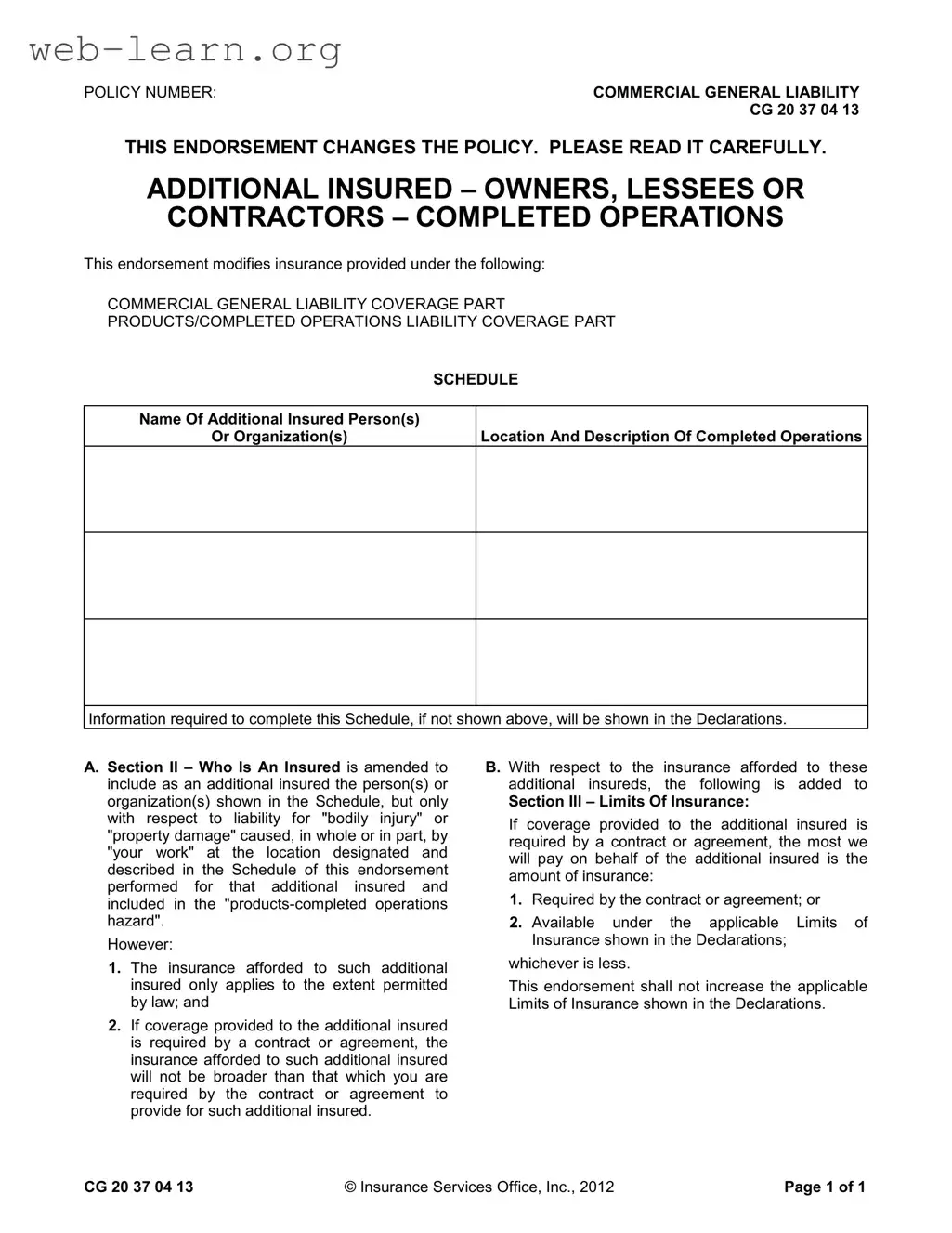
The Additional Insured form, specifically the Commercial General Liability CG 20 37 04 13 endorsement, plays a crucial role in defining the coverage landscape for businesses and contractors. This endorsement modifies the existing insurance policy, extending coverage to additional parties, typically owners, lessees, or contractors, for completed operations. It is essential to understand that this form includes specific details such as the names of additional insured persons or organizations and the location and description of the completed operations. The form clearly outlines that the insurance applies to liability for bodily injury or property damage arising from the work performed for these additional insured parties, but only to the extent permitted by law. Importantly, if the coverage is mandated by a contract, the insurance provided will not exceed the limits required by that contract or the amounts available under the policy's declarations. This ensures that while additional insureds receive necessary protection, the coverage remains aligned with the contractual obligations of the primary insured. Understanding these nuances can help businesses navigate their insurance needs effectively.

Sample - Additional Insured Form

POLICY NUMBER:
COMMERCIAL GENERAL LIABILITY
CG 20 37 04 13
THIS ENDORSEMENT CHANGES THE POLICY. PLEASE READ IT CAREFULLY.
CG 20 37 04 13
© Insurance Services Office, Inc., 2012
Page 1 of 1
ADDITIONAL INSURED OWNERS, LESSEES OR
CONTRACTORS COMPLETED OPERATIONS
This endorsement modifies insurance provided under the following:
COMMERCIAL GENERAL LIABILITY COVERAGE PART
PRODUCTS/COMPLETED OPERATIONS LIABILITY COVERAGE PART
SCHEDULE
Name Of Additional Insured Person(s)
Or Organization(s)
Location And Description Of Completed Operations
Information required to complete this Schedule, if not shown above, will be shown in the Declarations.
A. Section II Who Is An Insured is amended to
include as an additional insured the person(s) or
organization(s) shown in the Schedule, but only
with respect to liability for "bodily injury" or
"property damage" caused, in whole or in part, by
"your work" at the location designated and
described in the Schedule of this endorsement
performed for that additional insured and
included in the "products-completed operations
hazard".
However:
1. The insurance afforded to such additional
insured only applies to the extent permitted
by law; and
2. If coverage provided to the additional insured
is required by a contract or agreement, the
insurance afforded to such additional insured
will not be broader than that which you are
required by the contract or agreement to
provide for such additional insured.
B. With respect to the insurance afforded to these
additional insureds, the following is added to
Section III Limits Of Insurance:
If coverage provided to the additional insured is
required by a contract or agreement, the most we
will pay on behalf of the additional insured is the
amount of insurance:
1. Required by the contract or agreement; or
2. Available under the applicable Limits of
Insurance shown in the Declarations;
whichever is less.
This endorsement shall not increase the applicable
Limits of Insurance shown in the Declarations.

Form Information

Fact Name Description Governing Law
Policy Number This endorsement is identified by the policy number CG 20 37 04 13. Varies by state
Coverage Type The endorsement modifies coverage under the Commercial General Liability policy. Varies by state
Additional Insured It includes owners, lessees, or contractors as additional insureds. Varies by state
Scope of Coverage Coverage is limited to liability for bodily injury or property damage caused by the insured's work. Varies by state
Location Requirement The endorsement specifies the location and description of completed operations. Varies by state
Contractual Limitations If required by contract, the coverage cannot exceed what is stipulated in that contract. Varies by state
Limits of Insurance The maximum amount payable is the lesser of the contract limit or the policy limit. Varies by state
Modification of Insured Section II of the policy is amended to include additional insureds. Varies by state
Insurance Services Office This endorsement is published by the Insurance Services Office, Inc. Varies by state
Effective Date The form was issued on April 13, 2013. Varies by state

Detailed Guide for Filling Out Additional Insured

Filling out the Additional Insured form is a straightforward process that requires attention to detail. This form is essential for ensuring that specific individuals or organizations are covered under your insurance policy for certain liabilities. Follow the steps below to complete the form accurately.

  1. Obtain the Form: Start by getting a copy of the Additional Insured form. You can usually find it through your insurance provider or online.
  2. Enter the Policy Number: Locate the section labeled "POLICY NUMBER" and write your commercial general liability policy number. This number is critical for identifying your specific coverage.
  3. Fill in the Name of Additional Insured: In the section titled "Name Of Additional Insured Person(s) Or Organization(s)," provide the full name of the individual or organization that you wish to add as an additional insured.
  4. Describe the Location and Operations: In the "Location And Description Of Completed Operations" section, clearly describe where the work was completed and provide details about the operations involved. Be specific to avoid confusion.
  5. Review the Information: Carefully check all entries to ensure accuracy. Mistakes can lead to coverage issues down the line.
  6. Sign and Date the Form: Once you are satisfied with the information provided, sign and date the form to confirm its validity.
  7. Submit the Form: Finally, send the completed form to your insurance provider. Keep a copy for your records.

Once you have filled out and submitted the form, your insurance provider will process it. They may reach out if they need any additional information or clarification. It’s always a good idea to follow up to ensure everything is in order.

Obtain Answers on Additional Insured

  1. What is the purpose of the Additional Insured form?

    The Additional Insured form is designed to extend liability coverage to other parties, such as owners, lessees, or contractors, who may be held responsible for injuries or damages related to your work. This endorsement ensures that these additional insured parties are protected under your Commercial General Liability policy, specifically for completed operations.

  2. Who qualifies as an additional insured?

    Individuals or organizations listed in the Schedule of the endorsement qualify as additional insureds. This typically includes clients, project owners, or contractors that you are working for. Their coverage is limited to liability arising from your work, specifically at the location described in the endorsement.

  3. What types of incidents are covered under the Additional Insured endorsement?

    The endorsement covers liability for "bodily injury" or "property damage" that occurs as a result of your work. This includes incidents that happen during the completed operations phase of a project. However, the coverage is only valid to the extent permitted by law and is subject to the specific terms of your contract with the additional insured.

  4. Are there any limitations to the coverage provided?

    Yes, there are limitations. The coverage provided to the additional insured cannot exceed what is required by your contract with them. Additionally, it will not be broader than the coverage you are obligated to provide. This means that if your contract specifies a certain level of coverage, that will be the maximum available to the additional insured.

  5. How does the limit of insurance work for additional insureds?

    The limit of insurance for additional insureds is determined by the lesser of two amounts: the coverage required by the contract or the limits available under your policy. This means that if your policy has a cap on coverage, the additional insured will only receive the amount specified in the contract or the policy limit, whichever is lower.

  6. Can the Additional Insured endorsement increase my policy limits?

    No, the endorsement does not increase the overall limits of your insurance policy. The limits of insurance stated in the Declarations remain unchanged. Therefore, it is essential to ensure that your policy limits are adequate to cover both your needs and those of any additional insured parties.

  7. How should I complete the Additional Insured form?

    To complete the form, you need to provide the names of the additional insured individuals or organizations and a description of the completed operations. If this information is not included in the form itself, it will typically be found in the Declarations of your policy. Ensure that all details are accurate to avoid any coverage issues in the future.

Common mistakes

When filling out the Additional Insured form, individuals often make several common mistakes that can lead to complications later on. One frequent error is failing to accurately identify the name of the additional insured. It is crucial to ensure that the name matches exactly with the legal entity or person to avoid any issues with coverage.

Another mistake is not providing a clear description of the completed operations. This section should detail the specific work being done for the additional insured. Vague descriptions can lead to misunderstandings about what is covered, potentially leaving parties exposed to liability.

Some people neglect to check the policy number and ensure it corresponds with the correct coverage. This oversight can result in the additional insured not being properly covered under the intended policy, which may cause significant problems if a claim arises.

In addition, individuals sometimes overlook the importance of understanding the limits of insurance specified in the form. It is essential to note that the coverage provided to the additional insured cannot exceed what is stipulated in the contract or agreement. Misinterpreting this can lead to inadequate protection.

Lastly, failing to consider the legal requirements for additional insured status can create issues. The insurance provided must comply with applicable laws, and not adhering to these can result in gaps in coverage. Each of these mistakes can have serious implications, so careful attention to detail is necessary when completing the form.

Documents used along the form

The Additional Insured form is a crucial document in the realm of liability insurance. However, it often works in tandem with other forms and documents. Understanding these documents can help ensure comprehensive coverage and compliance with contractual obligations. Below is a list of related documents that are frequently used alongside the Additional Insured form.

  • Certificate of Insurance (COI): This document provides proof of insurance coverage. It outlines the types of coverage, policy limits, and the insured party's details. A COI is often requested by clients or partners to verify that insurance is in place.
  • Contractual Agreement: This is a formal document outlining the terms of the relationship between parties. It often specifies the insurance requirements, including the need for additional insured status, and helps define responsibilities and liabilities.
  • Waiver of Subrogation: This document prevents an insurance company from pursuing a claim against a third party after paying a loss. It is often included in contracts to protect parties from potential lawsuits arising from insurance claims.
  • Endorsement Forms: These are modifications to an insurance policy that change the coverage terms. They can add or restrict coverage and are essential for tailoring policies to specific needs.
  • General Liability Policy: This is the primary insurance policy that covers a wide range of liabilities. It is the foundation upon which the Additional Insured endorsement is built, offering protection against claims of bodily injury and property damage.
  • Indemnity Agreement: This document outlines the obligation of one party to compensate another for certain damages or losses. It is often used to clarify responsibilities and protect against potential liabilities.
  • Loss Run Report: This report provides a history of claims made against an insurance policy. It can be useful for assessing risk and determining the insurability of a party.
  • Policy Declarations Page: This page summarizes the key details of an insurance policy, including coverage limits and insured parties. It serves as a quick reference for understanding the scope of coverage.
  • Claims Notification Form: This form is used to report incidents or claims to an insurance company. Timely notification is crucial for ensuring that coverage is applied appropriately.
  • Additional Insured Endorsement (specific to other parties): Similar to the standard Additional Insured form, this endorsement can be tailored for specific entities, detailing their unique coverage needs and limitations.

Being familiar with these documents can significantly enhance your understanding of insurance coverage and risk management. It is vital to ensure that all necessary forms are in place to protect your interests and fulfill contractual obligations effectively.

Similar forms

  • Certificate of Insurance: This document provides proof of insurance coverage. Like the Additional Insured form, it identifies the insured parties and details the types of coverage in place. It serves as verification for third parties that insurance is active and meets specified requirements.
  • Waiver of Subrogation: This document prevents the insurer from pursuing a third party for recovery after a claim. Similar to the Additional Insured form, it modifies standard insurance terms to protect specific parties involved in a contract, ensuring that one party cannot seek reimbursement from another.
  • Indemnity Agreement: This agreement outlines one party's responsibility to compensate another for certain damages or losses. Both the Indemnity Agreement and the Additional Insured form serve to allocate risk between parties, ensuring that one party is protected against claims arising from the actions of another.
  • Additional Insured Endorsement: This is a broader category that includes various forms granting additional insured status. Like the Additional Insured form, it extends coverage to third parties, protecting them from liabilities associated with the primary insured’s operations.
  • Contractual Liability Coverage: This coverage protects against liabilities assumed under a contract. Similar to the Additional Insured form, it modifies insurance terms to ensure that liabilities arising from contractual obligations are covered, thus safeguarding the interests of all parties involved.

Dos and Don'ts

When filling out the Additional Insured form, it's important to follow certain guidelines to ensure accuracy and compliance. Here are four things you should and shouldn't do:

  • Do provide the correct policy number to avoid any confusion.
  • Don't leave any sections blank; incomplete forms can lead to processing delays.
  • Do clearly list the name of the additional insured person(s) or organization(s) as specified in the requirements.
  • Don't assume that verbal agreements will suffice; all necessary information must be documented on the form.

Misconceptions

Understanding the Additional Insured form is crucial for businesses and contractors. However, several misconceptions can lead to confusion. Here are six common misconceptions:

  • 1. Additional Insured Status Provides Full Coverage: Many believe that being named as an additional insured means they have full coverage under the policy. In reality, the coverage is limited and only applies to specific liabilities.
  • 2. It Covers All Operations: Some think that the additional insured status covers all operations of the primary insured. However, it only applies to the completed operations specified in the endorsement.
  • 3. Coverage is Automatic: There is a misconception that coverage is automatic for anyone listed as an additional insured. Coverage only applies if it is required by a contract or agreement.
  • 4. It Increases Policy Limits: Many assume that adding an additional insured increases the limits of the policy. This is not true; the limits remain as stated in the declarations.
  • 5. It Covers Non-Contractual Liabilities: Some believe that the additional insured endorsement covers non-contractual liabilities. In fact, it only applies to liabilities arising from the specific work performed for the additional insured.
  • 6. All Additional Insureds Have the Same Coverage: There is a belief that all additional insureds receive the same level of coverage. Coverage can vary based on the terms of the contract or agreement that requires the additional insured status.

Clarifying these misconceptions can help businesses better navigate their insurance needs and responsibilities.

Key takeaways

When filling out and using the Additional Insured form, there are several important considerations to keep in mind. Below are key takeaways that can guide you through the process:

  • Understand the Purpose: The Additional Insured form is designed to extend coverage to other parties, such as owners, lessees, or contractors, for specific liabilities related to your work.
  • Complete the Schedule: Ensure that you accurately fill in the names of the additional insured parties and provide a clear description of the completed operations.
  • Know the Limitations: The coverage for additional insureds is limited to the extent permitted by law and cannot exceed what is required by any applicable contract.
  • Review Coverage Scope: The insurance will only cover "bodily injury" or "property damage" caused by your work at the designated location described in the Schedule.
  • Contractual Obligations: If coverage is mandated by a contract, the insurance provided will not be broader than what the contract specifies.
  • Limits of Insurance: The maximum amount payable on behalf of the additional insured will be the lesser of the contract requirement or the available limits of insurance.
  • Consult Declarations: Always refer to the Declarations page for specific limits and conditions that apply to your policy, as the endorsement does not increase these limits.

By keeping these points in mind, you can effectively navigate the complexities of the Additional Insured form and ensure that all parties are adequately protected.