Homepage Blank 96 Idaho Form
Outline

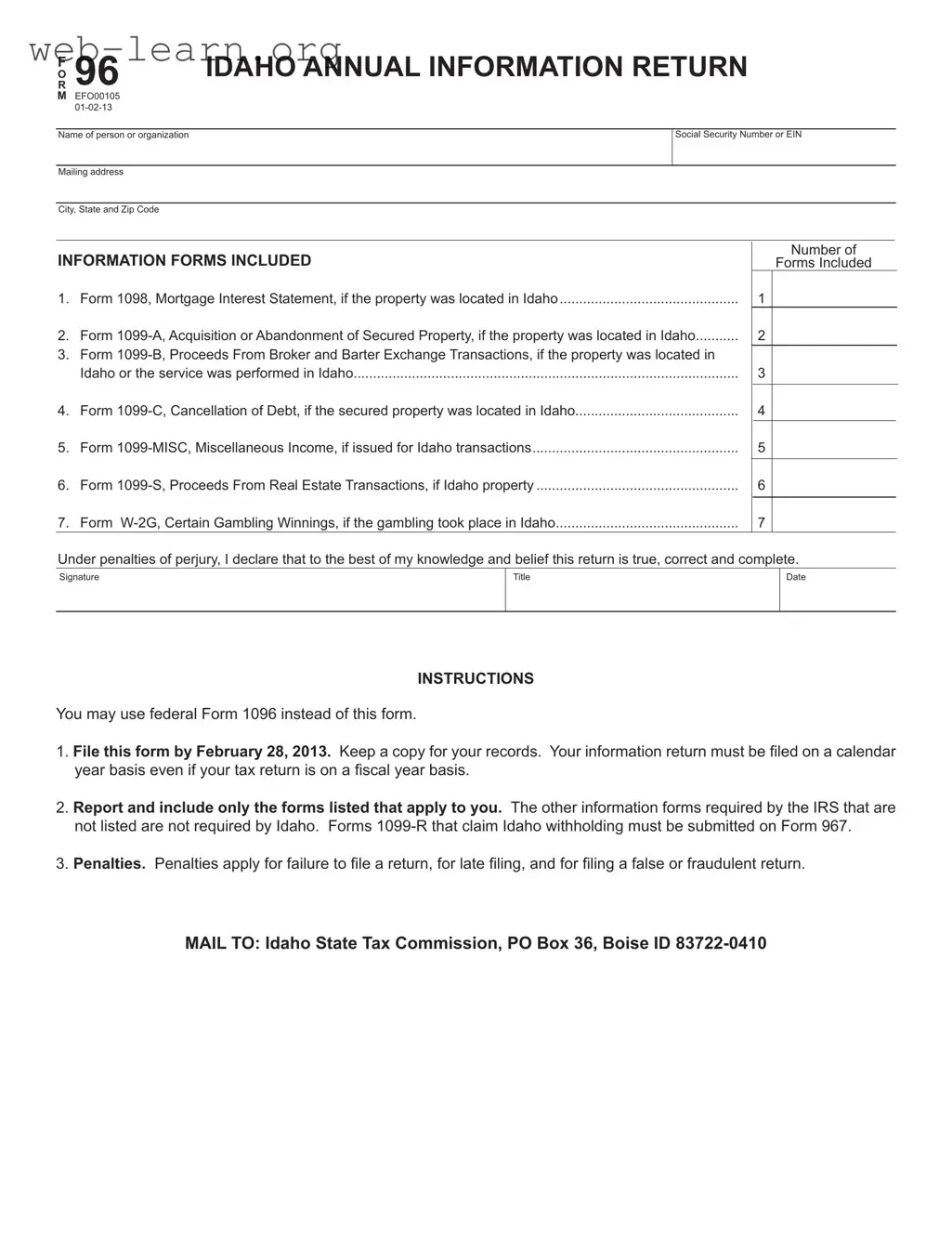
The 96 Idaho form is an essential document for anyone who has engaged in specific financial activities within the state. This form serves as an annual information return, gathering crucial data related to various transactions that occurred throughout the year. It includes several key information forms, such as Form 1098 for mortgage interest, Form 1099-A for acquisition or abandonment of secured property, and Form 1099-B for proceeds from broker transactions, all tailored for Idaho-related activities. Additionally, it covers forms for cancellation of debt, miscellaneous income, real estate transactions, and even certain gambling winnings, ensuring comprehensive reporting for taxpayers. Completing this form accurately is vital, as it helps maintain compliance with Idaho tax regulations. It's important to file it by the designated deadline, which typically falls on February 28, and to keep a copy for your records. Remember, the information reported must align with the forms listed; any other IRS forms not mentioned are not required by Idaho. Failing to file on time or submitting incorrect information can lead to penalties, so diligence is key.
Sample - 96 Idaho Form

INSTRUCTIONS
You may use federal Form 1096 instead of this form.
1. File this form by February 28, 2013.

2. Report and include only the forms listed that apply to you. The other information forms required by the IRS that are
not listed are not required by Idaho. Forms 1099-R that claim Idaho withholding must be submitted on Form 967.
3. Penalties.
MAIL TO: Idaho State Tax Commission, PO Box 36, Boise ID 83722-0410
INFORMATION FORMS INCLUDED
  .............................................. 1
  ........... 2
 
Idaho or the service was performed in Idaho ................................................................................................... 3
 .......................................... 4
  ..................................................... 5
  .................................................... 6
  ............................................... 7

Number of
Forms Included
Title
Signature

IDAHO ANNUAL INFORMATION RETURN
96

01-02-13
F
O
R
M

Name of person or organization



Form Information

Fact Name Details
Form Purpose The 96 Idaho form is an Annual Information Return used to report various types of income related to Idaho transactions.
Included Forms This form includes several information forms such as 1098, 1099-A, 1099-B, 1099-C, 1099-MISC, 1099-S, and W-2G, specifically for transactions or properties located in Idaho.
Filing Deadline The completed form must be filed by February 28, 2013. It's essential to adhere to this deadline to avoid penalties.
Governing Law The form is governed by Idaho state tax laws, which dictate the requirements for reporting income generated in the state.
Penalties for Non-Compliance Failure to file the form, late filing, or submitting false information can result in penalties. It's crucial to ensure accuracy and timeliness when filing.

Detailed Guide for Filling Out 96 Idaho

Completing the 96 Idaho form is an important step in fulfilling your tax obligations. This form requires specific information about various financial transactions that took place within Idaho. Following the steps carefully will ensure that you provide all necessary details accurately.

  1. Begin by entering the name of the person or organization at the top of the form.
  2. Next, provide the Social Security Number or Employer Identification Number (EIN) in the designated space.
  3. Fill in your mailing address, including the city, state, and zip code.
  4. In the section labeled INFORMATION FORMS INCLUDED, check the boxes next to each applicable form that you are including with your submission. These may include:
    • Form 1098, Mortgage Interest Statement
    • Form 1099-A, Acquisition or Abandonment of Secured Property
    • Form 1099-B, Proceeds From Broker and Barter Exchange Transactions
    • Form 1099-C, Cancellation of Debt
    • Form 1099-MISC, Miscellaneous Income
    • Form 1099-S, Proceeds From Real Estate Transactions
    • Form W-2G, Certain Gambling Winnings
  5. Indicate the number of forms included by selecting the appropriate number from 1 to 7.
  6. Read the declaration statement carefully. By signing, you confirm that the information provided is true and complete to the best of your knowledge.
  7. Sign the form and include your title and the date of signing.
  8. Make a copy of the completed form for your records.
  9. Mail the form to the Idaho State Tax Commission at the following address: PO Box 36, Boise ID 83722-0410. Ensure that it is sent by the filing deadline of February 28, 2013.

After submitting the form, it is advisable to keep track of any correspondence from the Idaho State Tax Commission. This will help ensure that you remain informed about your tax status and any further requirements that may arise.

Obtain Answers on 96 Idaho

  1. What is the 96 Idaho form?

    The 96 Idaho form is an annual information return that individuals and organizations must file with the Idaho State Tax Commission. It is primarily used to report various types of income and financial transactions that occurred within the state of Idaho during the calendar year.

  2. Who needs to file the 96 Idaho form?

    Any person or organization that has issued certain information forms related to Idaho transactions must file the 96 Idaho form. This includes those who have issued forms such as 1098, 1099, or W-2G for activities that took place in Idaho.

  3. What forms should be included with the 96 Idaho form?

    The following forms should be included if applicable:

    • Form 1098: Mortgage Interest Statement
    • Form 1099-A: Acquisition or Abandonment of Secured Property
    • Form 1099-B: Proceeds From Broker and Barter Exchange Transactions
    • Form 1099-C: Cancellation of Debt
    • Form 1099-MISC: Miscellaneous Income
    • Form 1099-S: Proceeds From Real Estate Transactions
    • Form W-2G: Certain Gambling Winnings
  4. When is the 96 Idaho form due?

    The form must be filed by February 28 of the year following the calendar year for which the information is being reported. For example, for transactions occurring in 2012, the form was due by February 28, 2013.

  5. Can I use federal Form 1096 instead of the 96 Idaho form?

    Yes, you may use federal Form 1096 in place of the 96 Idaho form. However, it is essential to ensure that all necessary information is reported accurately and completely, as required by Idaho law.

  6. What happens if I fail to file the 96 Idaho form?

    Failure to file the 96 Idaho form can result in penalties. These penalties may apply for late filing, not filing at all, or for filing a false or fraudulent return. It is crucial to adhere to the filing requirements to avoid these consequences.

  7. Where should I mail the 96 Idaho form?

    The completed form should be mailed to the following address:

    Idaho State Tax Commission
    PO Box 36
    Boise, ID 83722-0410

  8. Do I need to keep a copy of the 96 Idaho form?

    Yes, it is advisable to keep a copy of the filed 96 Idaho form for your records. This can be useful for future reference or in case of any inquiries from the tax authorities.

  9. Is the 96 Idaho form based on a calendar year or fiscal year?

    The 96 Idaho form must be filed on a calendar year basis, even if your tax return is filed on a fiscal year basis. This means that all transactions reported should pertain to the calendar year.

  10. What should I do if I need assistance with the 96 Idaho form?

    If you require assistance, consider consulting a tax professional or contacting the Idaho State Tax Commission directly. They can provide guidance and answer any specific questions you may have regarding the form and its requirements.

Common mistakes

Filling out the 96 Idaho form can be a straightforward process, but many individuals make common mistakes that can lead to complications. One significant error is failing to include all necessary forms. The 96 Idaho form requires specific information forms, such as the 1098 and 1099 series, depending on the transactions conducted in Idaho. Omitting any applicable forms can result in penalties and delays in processing.

Another frequent mistake involves incorrect identification information. Individuals often miswrite their Social Security Number or Employer Identification Number (EIN). This error can cause confusion and lead to issues with the tax authorities. It is crucial to double-check this information before submitting the form.

People also tend to overlook the mailing address section. Providing an incomplete or incorrect mailing address can delay the receipt of important correspondence from the Idaho State Tax Commission. Always ensure that the address is accurate and up to date.

Not keeping a copy of the submitted form is another common oversight. It is essential to retain a copy for personal records. This can be helpful in case there are any questions or issues regarding the submission in the future.

Additionally, some individuals misunderstand the filing deadline. The form must be filed by February 28 of the tax year. Missing this deadline can result in penalties. It is important to mark the date on your calendar and plan accordingly.

Another mistake is failing to report information on a calendar year basis. Even if your tax return operates on a fiscal year, the information return must align with the calendar year. This discrepancy can lead to further complications with your tax filings.

People sometimes confuse the requirements of Idaho with those of the IRS. The 96 Idaho form specifies that only the listed forms need to be included. Other IRS forms that are not mentioned do not need to be submitted to Idaho. Misunderstanding this can lead to unnecessary paperwork and confusion.

Finally, individuals may underestimate the importance of accuracy in their declarations. The form includes a declaration stating that the information provided is true, correct, and complete. Filing a false or fraudulent return can result in severe penalties. Always take the time to ensure that all information is accurate before signing and submitting the form.

Documents used along the form

The 96 Idaho Annual Information Return is a crucial document for reporting various types of income and transactions in Idaho. When filing this form, individuals and organizations may also need to submit additional forms that provide detailed information about specific financial activities. Below is a list of related forms that are often used in conjunction with the 96 Idaho form.

  • Form 1098: This form is used to report mortgage interest paid on a property located in Idaho. It provides details about the borrower and the amount of interest paid during the tax year.
  • Form 1099-A: This form reports the acquisition or abandonment of secured property in Idaho. It is essential for taxpayers who have gone through foreclosure or similar situations.
  • Form 1099-B: Used for reporting proceeds from broker and barter exchange transactions, this form applies if the transactions occurred in Idaho or services were performed there.
  • Form 1099-C: This form is issued when a debt has been canceled. If the secured property was located in Idaho, it is necessary to report the cancellation of that debt.
  • Form 1099-MISC: This form is for reporting miscellaneous income, such as payments made for services or rent. It is applicable for transactions conducted in Idaho.

Understanding these additional forms can help ensure compliance with Idaho tax regulations. Each form serves a specific purpose and must be accurately completed and submitted as part of the overall tax reporting process.

Similar forms

The 96 Idaho Annual Information Return is a specific document used for reporting various types of income and transactions related to property in Idaho. Here are five documents that are similar to the 96 Idaho form, along with explanations of how they relate to it:

  • Form 1098, Mortgage Interest Statement: This form is used to report mortgage interest paid by individuals. Like the 96 Idaho form, it is specifically relevant for property located in Idaho and is crucial for taxpayers to accurately report deductions.
  • Form 1099-A, Acquisition or Abandonment of Secured Property: This form reports the acquisition or abandonment of property. It shares similarities with the 96 Idaho form by focusing on property transactions in Idaho, providing essential information for tax reporting.
  • Form 1099-B, Proceeds From Broker and Barter Exchange Transactions: This document reports proceeds from sales or exchanges. It is similar to the 96 Idaho form in that it addresses income generated from transactions, especially those conducted in Idaho.
  • Form 1099-C, Cancellation of Debt: This form is used when a debt is canceled or forgiven. It parallels the 96 Idaho form by being relevant for taxpayers in Idaho who may need to report this cancellation as income.
  • Form 1099-MISC, Miscellaneous Income: This form reports various types of income not covered by other forms. It is similar to the 96 Idaho form in that it captures income related to Idaho transactions, ensuring comprehensive reporting for state tax purposes.

Dos and Don'ts

When filling out the 96 Idaho form, attention to detail is crucial. Here are six essential dos and don'ts to keep in mind:

  • Do ensure that you include all necessary forms listed in the instructions. This includes forms like 1098, 1099-A, and 1099-S, among others.
  • Do file the form by the deadline of February 28, 2013. Timeliness can prevent penalties.
  • Do keep a copy of the completed form for your records. This can be important for future reference.
  • Do verify that the information you provide is accurate. Double-check names, Social Security Numbers, and other details.
  • Don't include any forms that are not specifically listed in the instructions. Only submit what applies to your situation.
  • Don't forget to sign the form. A missing signature can lead to complications with your submission.

By following these guidelines, you can navigate the process more smoothly and minimize the risk of errors. Remember, accuracy and compliance are key when dealing with tax forms.

Misconceptions

Understanding the 96 Idaho form can be challenging. Here are nine common misconceptions about this form, along with clarifications.

  • All tax forms must be submitted with the 96 Idaho form. Many believe that all IRS forms need to accompany the 96 Idaho form. However, only specific forms listed in the instructions are required.
  • Filing deadlines are flexible. Some think that the filing deadline can be adjusted. In reality, the 96 Idaho form must be filed by February 28, 2013, without exceptions.
  • Any year can be used for reporting. It is a misconception that taxpayers can choose any reporting year. The information return must be filed on a calendar year basis.
  • Only residents of Idaho need to file. Many assume that only Idaho residents are required to submit the form. In fact, anyone with property or transactions in Idaho must file.
  • All forms listed must be included. Some believe that all listed forms must be submitted. Only the forms that apply to the taxpayer's situation need to be included.
  • Penalties are not enforced strictly. There is a misconception that penalties for late filing or inaccuracies are rarely enforced. In truth, penalties apply for failure to file, late filing, and filing false returns.
  • Federal Form 1096 cannot be used. Some think that using federal Form 1096 is not permitted. However, the instructions clearly state that it can be used instead of the 96 Idaho form.
  • All income types are reported on the same form. It is commonly believed that all types of income can be reported on the 96 Idaho form. However, forms like 1099-R require submission on Form 967 instead.
  • Mailing address is optional. Some taxpayers may think that providing a mailing address is not essential. This is incorrect; a mailing address is necessary for proper processing.

Key takeaways

Here are some key takeaways about filling out and using the 96 Idaho form:

  • Identify the Correct Information: Ensure you include only the forms listed on the 96 Idaho form that apply to your situation.
  • Deadline Awareness: File the form by February 28, 2013. This is crucial for compliance.
  • Record Keeping: Always keep a copy of the completed form for your records.
  • Calendar Year Reporting: Your information return must be based on the calendar year, regardless of your tax return's fiscal year.
  • Penalties for Non-Compliance: Be aware that penalties may apply for late filing, failure to file, or submitting false information.
  • Mailing Address: Send the completed form to the Idaho State Tax Commission at the specified address.
  • Alternative Filing: You may use federal Form 1096 instead of the 96 Idaho form if you prefer.