Homepage Blank 90 Day Notice To Move Out Form
Outline

The 90 Day Notice To Move Out form serves as an essential document for landlords and tenants in California, outlining the necessary steps and requirements for terminating a tenancy. This notice informs occupants that their lease will end ninety days after it is served, requiring them to vacate the premises peacefully by that date. It emphasizes the importance of compliance, as failure to move out may lead to legal action, which can adversely impact the tenant's credit. Additionally, the form reminds tenants of their ongoing obligation to pay rent until the termination date. A key feature of this notice is the right it grants tenants to request an initial inspection of their unit, allowing them to be present and receive an itemized list of potential deductions from their security deposit. This inspection must occur no earlier than two weeks before the tenancy ends. The document also includes a proof of service section, detailing how the notice was delivered to ensure proper notification. Overall, the 90 Day Notice To Move Out form is a critical tool for facilitating a smooth transition for both landlords and tenants.
Sample - 90 Day Notice To Move Out Form

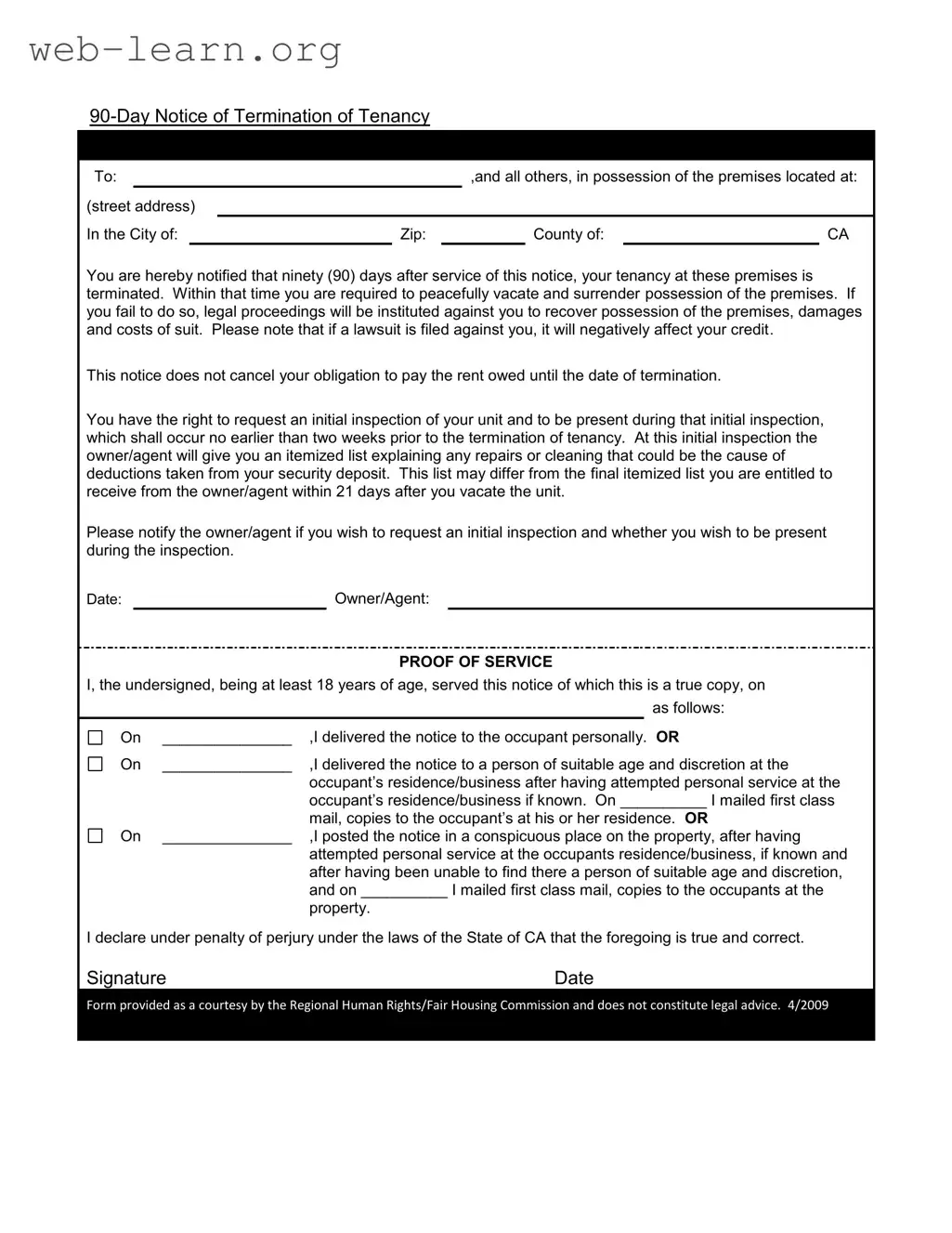
90-Day Notice of Termination of Tenancy
To:
,and all others, in possession of the premises located at:
(street address)
In the City of:
County of:
CA
You are hereby notified that ninety (90) days after service of this notice, your tenancy at these premises is
terminated. Within that time you are required to peacefully vacate and surrender possession of the premises. If
you fail to do so, legal proceedings will be instituted against you to recover possession of the premises, damages
and costs of suit. Please note that if a lawsuit is filed against you, it will negatively affect your credit.
This notice does not cancel your obligation to pay the rent owed until the date of termination.
You have the right to request an initial inspection of your unit and to be present during that initial inspection,
which shall occur no earlier than two weeks prior to the termination of tenancy. At this initial inspection the
owner/agent will give you an itemized list explaining any repairs or cleaning that could be the cause of
deductions taken from your security deposit. This list may differ from the final itemized list you are entitled to
receive from the owner/agent within 21 days after you vacate the unit.
Please notify the owner/agent if you wish to request an initial inspection and whether you wish to be present
during the inspection.
Date:
Owner/Agent:
PROOF OF SERVICE
I, the undersigned, being at least 18 years of age, served this notice of which this is a true copy, on
as follows:
On
_______________
,I delivered the notice to the occupant personally. OR
On
_______________
,I delivered the notice to a person of suitable age and discretion at the
occupant’s residence/business after having attempted personal service at the
occupant’s residence/business if known. On __________ I mailed first class
mail, copies to the occupant’s at his or her residence. OR
On
_______________
,I posted the notice in a conspicuous place on the property, after having
attempted personal service at the occupants residence/business, if known and
after having been unable to find there a person of suitable age and discretion,
and on __________ I mailed first class mail, copies to the occupants at the
property.
I declare under penalty of perjury under the laws of the State of CA that the foregoing is true and correct.
Signature
Date
Form provided as a courtesy by the Regional Human Rights/Fair Housing Commission and does not constitute legal advice. 4/2009

Form Information

Fact Name Description
Notice Period The 90-Day Notice To Move Out form provides a notice period of 90 days, allowing tenants time to vacate the premises before their tenancy is officially terminated.
Initial Inspection Rights Tenants have the right to request an initial inspection of their unit. This inspection can occur no earlier than two weeks before the termination date and allows tenants to be present during the inspection.
Legal Consequences If a tenant fails to vacate the premises after the notice period, legal proceedings may be initiated to recover possession, which can adversely affect their credit.
Governing Law This form is governed by California law, specifically under the California Civil Code Section 1946.1, which outlines the rules for terminating a tenancy with a 90-day notice.

Detailed Guide for Filling Out 90 Day Notice To Move Out

Completing the 90 Day Notice To Move Out form requires careful attention to detail. After filling out the form, it should be served to the tenant to officially notify them of the termination of their tenancy. Follow the steps below to ensure the form is filled out correctly.

  1. Fill in the recipient's details: In the first line, write "To:" followed by the name of the tenant and any others in possession of the premises.
  2. Provide the property address: Enter the street address of the rental property in the designated space.
  3. Specify the city and zip code: Fill in the city name and the zip code for the property location.
  4. Indicate the county: Write the name of the county where the property is located.
  5. Date the notice: Enter the date you are filling out the notice. This date is important as it starts the 90-day countdown.
  6. Identify the owner or agent: Write the name of the owner or the agent responsible for the property.
  7. Complete the proof of service section: Indicate how the notice was served by checking the appropriate box and providing the required details, including dates.
  8. Sign and date the form: The person serving the notice must sign and date the form to validate it.

Obtain Answers on 90 Day Notice To Move Out

  1. What is the purpose of the 90-Day Notice To Move Out form?

    The 90-Day Notice To Move Out form serves as a formal notification to tenants that their lease will be terminated in 90 days. It informs them of their obligation to vacate the premises and outlines the consequences of failing to do so.

  2. Who can issue a 90-Day Notice To Move Out?

    The notice can be issued by the property owner or their authorized agent. It must be delivered to all individuals in possession of the property to ensure that everyone is informed of the termination of tenancy.

  3. How is the 90-Day Notice To Move Out served?

    The notice can be served in several ways:

    • Delivered personally to the tenant.
    • Left with a person of suitable age and discretion at the tenant's residence.
    • Posted in a conspicuous place on the property if personal service is not possible.
    • Mailed via first-class mail to the tenant’s address.
  4. What happens if I do not vacate the premises by the deadline?

    If you do not vacate the property by the end of the 90-day period, the landlord may initiate legal proceedings to recover possession. This could lead to eviction and may negatively impact your credit score.

  5. Can I request an initial inspection of my unit?

    Yes, you have the right to request an initial inspection of your unit. This inspection can occur no earlier than two weeks before your tenancy ends. During this inspection, you can receive an itemized list of potential deductions from your security deposit.

  6. What should I do if I want to be present during the initial inspection?

    If you wish to be present during the initial inspection, you must notify the owner or agent in advance. This ensures that arrangements can be made for your attendance.

  7. Will I receive a final itemized list of deductions from my security deposit?

    Yes, after you vacate the unit, you will receive a final itemized list of any deductions from your security deposit within 21 days. This list may differ from the initial inspection list.

  8. Does the notice cancel my obligation to pay rent?

    No, the notice does not cancel your obligation to pay rent. You are still required to pay rent until the termination date specified in the notice.

  9. What are the consequences of not complying with the notice?

    Failure to comply with the notice may lead to legal action, including eviction. Additionally, any resulting lawsuit could negatively affect your credit rating.

  10. Is the 90-Day Notice To Move Out form legal advice?

    No, the form is provided as a courtesy and does not constitute legal advice. It is advisable to consult with a legal professional for specific questions or concerns related to your situation.

Common mistakes

Filling out the 90-Day Notice to Move Out form can seem straightforward, but many people make common mistakes that can complicate the process. One frequent error is failing to provide complete and accurate information. When listing the address of the premises, it is crucial to include the full street address, city, zip code, and county. Omitting any of these details can lead to confusion and may even invalidate the notice.

Another mistake is not properly notifying all parties involved. The notice should be addressed to all individuals in possession of the premises. If there are multiple tenants or roommates, ensure that their names are included. This step helps to prevent disputes later on and ensures that everyone is aware of the termination of the tenancy.

Additionally, people often overlook the importance of the proof of service section. It is essential to document how and when the notice was delivered. Whether it was handed directly to the occupant, left with someone of suitable age, or mailed, this information must be accurately filled out. Neglecting to complete this section can lead to complications if legal proceedings become necessary.

Lastly, many individuals forget to sign and date the form. A signature is not just a formality; it serves as verification that the notice was issued by the appropriate party. Without a signature, the notice may be considered incomplete. Taking the time to carefully review and ensure all sections are filled out correctly can save a lot of trouble in the long run.

Documents used along the form

When preparing to vacate a rental property, several important documents accompany the 90-Day Notice to Move Out form. Each of these documents plays a crucial role in ensuring that both tenants and landlords understand their rights and responsibilities. Below is a list of commonly used forms and documents that may be relevant during this process.

  • Initial Inspection Request: This document allows tenants to formally request an initial inspection of their rental unit. It provides an opportunity to identify any potential deductions from the security deposit before vacating.
  • Security Deposit Return Request: After moving out, tenants can use this form to request the return of their security deposit. It typically includes information about the forwarding address and any deductions that may be disputed.
  • Move-Out Checklist: This checklist serves as a guide for tenants to ensure they leave the property in good condition. It often includes tasks such as cleaning, repairing damages, and removing personal belongings.
  • Notice of Intent to Vacate: This document may be submitted prior to the 90-Day Notice to formally inform the landlord of the tenant’s intention to vacate the property. It helps establish a timeline for both parties.
  • Lease Agreement: The original lease outlines the terms of tenancy, including rent obligations and responsibilities for property maintenance. It is essential for both parties to refer to this document during the move-out process.
  • Proof of Service Document: This document serves as evidence that the 90-Day Notice to Move Out was delivered to the tenant. It includes details of how and when the notice was served, which is important for legal compliance.

Understanding these documents can significantly ease the transition out of a rental property. Each serves a specific purpose and helps ensure that both tenants and landlords are clear on their obligations and rights during the moving process. Being well-informed can lead to a smoother experience for everyone involved.

Similar forms

  • 30-Day Notice to Terminate Tenancy: This document provides a shorter notice period for tenants to vacate the premises, typically used for month-to-month leases. It similarly informs tenants that their tenancy will end, but with a 30-day timeframe instead of 90 days.
  • 60-Day Notice to Terminate Tenancy: Like the 90-Day Notice, this document is used to terminate a tenancy but requires a 60-day notice period. It serves the same purpose of notifying tenants to vacate the property.
  • Notice to Pay Rent or Quit: This notice is issued when a tenant fails to pay rent. It demands payment within a specified timeframe, similar to how the 90-Day Notice informs tenants of their obligation to vacate.
  • Notice of Lease Violation: This document is issued when a tenant violates lease terms. It outlines the violation and provides a timeframe for correction, akin to the notice period in the 90-Day Notice.
  • Notice of Intent to Enter: This notice informs tenants of an upcoming entry into the rental unit by the landlord. While it serves a different purpose, it also communicates important information regarding the tenant's living situation.
  • Eviction Notice: This document formally begins the eviction process for tenants who do not comply with rental agreements. It shares the goal of informing tenants of their need to vacate, similar to the 90-Day Notice.
  • Security Deposit Itemization Notice: This notice provides tenants with an itemized list of deductions from their security deposit. It parallels the 90-Day Notice in that both documents address tenant rights and responsibilities at the end of a tenancy.
  • Notice of Rent Increase: This notice informs tenants of an upcoming increase in rent. While it does not terminate tenancy, it similarly communicates significant changes in the rental agreement that require tenant awareness.

Dos and Don'ts

When filling out the 90-Day Notice To Move Out form, it’s important to ensure that the process goes smoothly. Here are some key things to do and avoid:

  • Do provide the correct address of the premises. Ensure that every detail is accurate to avoid confusion.
  • Do clearly state the date of the notice. This date starts the 90-day countdown for your tenancy termination.
  • Do request an initial inspection of your unit. This gives you a chance to address any issues before moving out.
  • Do keep a copy of the notice for your records. This serves as proof of your notification.
  • Don't forget to sign and date the form. An unsigned notice may be deemed invalid.
  • Don't ignore the requirement to pay rent until the termination date. Your obligation to pay rent continues until you vacate.
  • Don't delay in notifying the owner/agent about your request for an inspection. Prompt communication is key.

Misconceptions

  • Misconception 1: The 90-Day Notice automatically ends the tenancy.

    Many believe that simply receiving the 90-Day Notice means they can stay until the end of the 90 days without any obligations. In reality, while the notice does give you time to vacate, it does not cancel your responsibility to pay rent until the termination date.

  • Misconception 2: You can ignore the notice if you plan to fight it.

    Some tenants think that they can disregard the notice if they intend to contest it. However, ignoring the notice can lead to legal action against you, including eviction proceedings. It's important to respond appropriately and seek legal advice if needed.

  • Misconception 3: You do not have the right to an inspection before moving out.

    Another common belief is that tenants cannot request an initial inspection of their unit. In fact, you do have the right to request this inspection, and it can help clarify any potential deductions from your security deposit.

  • Misconception 4: The notice is not legally binding.

    Some may think that the notice is just a formality and lacks legal weight. This is incorrect. The 90-Day Notice is a formal legal document that, if not adhered to, can result in serious consequences, including eviction and damage to your credit.

  • Misconception 5: You will receive the same itemized list for security deposit deductions.

    Many tenants assume that the itemized list provided during the initial inspection will be the same as the final list they receive after moving out. However, the initial list may differ from the final one, which you will receive within 21 days of vacating the unit. Understanding this can help you prepare for any potential deductions.

Key takeaways

  • Understand the timeline: The 90-Day Notice To Move Out gives tenants 90 days to vacate the premises after receiving the notice.
  • Legal implications: Failure to vacate can lead to legal action, which may result in eviction and affect your credit score.
  • Rent obligations: Tenants must continue to pay rent until the termination date, even after receiving the notice.
  • Inspection rights: Tenants have the right to request an initial inspection of their unit, which can help clarify any potential deductions from the security deposit.
  • Timing of inspections: The initial inspection can occur no earlier than two weeks before the tenancy ends.
  • Itemized lists: An itemized list of any necessary repairs or cleaning will be provided during the inspection and again after vacating the unit.
  • Notification process: Tenants should inform the owner or agent if they wish to request an initial inspection and their preference to be present.
  • Proof of service: The form includes a section for proof of service, which details how and when the notice was delivered.
  • Seek assistance: While this form is a standard procedure, it is advisable to seek legal guidance if there are any uncertainties regarding the process.