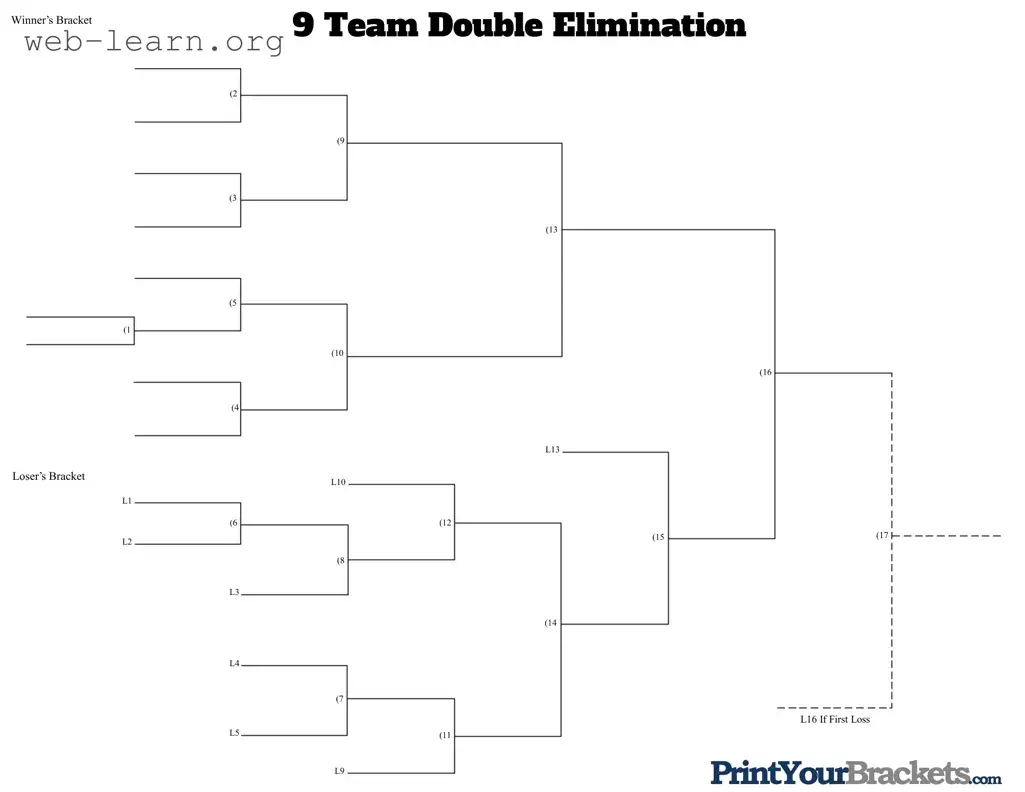
The 9 Team Double Elimination Bracket form is a structured approach to organizing tournaments where teams have the opportunity to compete even after a loss. This format ensures that each team must lose twice before being eliminated from the competition, allowing for a more forgiving and exciting experience. The bracket consists of two main sections: the Winner's Bracket and the Loser's Bracket. In the Winner's Bracket, teams advance through a series of matches, with the winners progressing toward the championship. Conversely, the Loser's Bracket provides a second chance for teams that have lost, giving them the opportunity to fight their way back into contention. This dual-path system creates a dynamic tournament atmosphere, where each match can significantly impact the overall standings. The layout includes matchups that are designed to facilitate a fair competition, and the progression through the brackets is clearly delineated, ensuring that participants and spectators can easily follow the tournament's flow. With a total of nine teams, the bracket is tailored to maintain excitement while providing a logical structure for determining the ultimate champion.

| Fact Name | Description |
|---|---|
| Structure | A 9-team double elimination bracket allows teams to lose once before being eliminated from the tournament. |
| Winner's Bracket | Teams that win their matches progress through the winner's bracket, aiming for the championship match. |
| Loser's Bracket | Teams that lose in the winner's bracket move to the loser's bracket, where they have a chance to stay in the competition. |
| Match Progression | The bracket includes multiple rounds, with each round determining which teams advance and which are eliminated. |
| State-Specific Forms | Some states may have specific regulations governing tournament brackets, including rules for fair play and scheduling. |
| Governing Laws | In states like California, tournaments must comply with local sports regulations to ensure safety and fairness. |
| Final Match | The final match is typically between the last remaining team from the winner's bracket and the last team standing in the loser's bracket. |
After filling out the 9 Team Double Elimination Bracket form, the next steps involve organizing the teams and scheduling the matches based on the bracket structure. This ensures that each team has a clear path through the tournament.
What is a 9 Team Double Elimination Bracket?
A 9 Team Double Elimination Bracket is a tournament structure that allows teams to lose once and still have a chance to win the overall competition. This format ensures that each team has at least two opportunities to compete before being eliminated from the tournament.
How does the bracket work?
The bracket consists of two main sections: the Winner’s Bracket and the Loser’s Bracket. Teams that win their matches continue in the Winner’s Bracket, while teams that lose drop down to the Loser’s Bracket. If a team loses in the Loser’s Bracket, they are eliminated from the tournament.
What happens if a team loses?
If a team loses a match, they move to the Loser’s Bracket. This gives them another chance to compete. However, if they lose again while in the Loser’s Bracket, they will be eliminated from the tournament.
How many matches will each team play?
Each team can play a minimum of one match and a maximum of three matches, depending on their performance. If a team wins all their matches, they will remain in the Winner’s Bracket. If they lose once, they will compete in the Loser’s Bracket.
How are teams seeded in the bracket?
Teams are typically seeded based on their previous performance or rankings. The seeding determines the matchups in the first round of the tournament. Higher-seeded teams usually face lower-seeded teams to ensure a fair competition.
Can teams be placed in the Loser’s Bracket after the first round?
Yes, teams that lose their matches in the Winner’s Bracket during any round will be placed in the Loser’s Bracket. This allows them to continue competing for a chance to win the tournament.
What is the final match format?
The final match is typically between the last remaining team in the Winner’s Bracket and the last remaining team in the Loser’s Bracket. The team from the Winner’s Bracket has an advantage, as they only need to win one match to claim the championship, while the Loser’s Bracket team must win two consecutive matches.
How do I fill out the bracket form?
To fill out the bracket form, enter the names of the teams in the designated slots. Start with the first round in the Winner’s Bracket. As matches are played, record the winners and move them forward in the bracket while placing the losing teams in the Loser’s Bracket.
Is there a specific timeline for the tournament?
Yes, it is important to establish a timeline for the tournament. This includes scheduling match dates and ensuring that all teams are aware of when they need to compete. Timely communication is crucial to the smooth operation of the tournament.
Where can I find more information about tournament rules?
For additional information regarding tournament rules, it is best to consult the organizing body or the official tournament guidelines. They will provide detailed information on match rules, scoring, and any other relevant regulations.
When filling out the 9 Team Double Elimination Bracket form, many people overlook the importance of accurately placing team names in the correct slots. Each team must be assigned to a specific position in the bracket to ensure that the tournament flows smoothly. If a team is placed incorrectly, it can lead to confusion and disrupt the entire competition. Make sure to double-check that each team is listed in its designated area, especially in the Winner's and Loser's brackets.
Another common mistake is failing to track wins and losses properly. In a double elimination format, a team is eliminated only after losing two matches. Some individuals may forget to update the bracket after each game, which can result in incorrect matchups in subsequent rounds. Keeping a clear record of each team's performance is essential. Use a pen or a digital tool to mark wins and losses as they happen to maintain accuracy throughout the tournament.
People often misinterpret the bracket structure itself. The 9 Team Double Elimination Bracket has specific paths for both winners and losers. It's crucial to understand how teams progress through the brackets after winning or losing. Failing to follow the correct progression can lead to mismatches and confusion about which teams are still in contention. Familiarize yourself with the bracket layout and the rules governing each section before filling it out.
Lastly, many individuals neglect to confirm the tournament rules before completing the form. Different tournaments may have unique regulations regarding match formats, time limits, or even the number of games played. Not adhering to these rules can result in disputes or disqualifications. Always review the tournament guidelines to ensure that your bracket reflects the agreed-upon rules and structure.
When organizing a tournament using a 9 Team Double Elimination Bracket, several additional forms and documents can enhance the experience for both organizers and participants. These documents help streamline the tournament process, ensure clear communication, and maintain accurate records. Below is a list of commonly used forms that can accompany the bracket.
Utilizing these forms alongside the 9 Team Double Elimination Bracket can significantly enhance the organization and execution of the tournament. Each document plays a crucial role in ensuring that everything runs smoothly, making the event enjoyable for everyone involved.
When filling out the 9 Team Double Elimination Bracket form, attention to detail is crucial. Here are some important dos and don'ts to keep in mind.
Double elimination tournaments can be a bit confusing, especially with a 9 team bracket. Here are seven common misconceptions about this format that can help clarify how it works.
Understanding these misconceptions can make following a 9 team double elimination bracket much easier. Remember, the excitement of the tournament lies in the unexpected twists and turns!
When utilizing the 9 Team Double Elimination Bracket form, there are several essential aspects to consider for effective use. Below are key takeaways that can guide you through the process: