Homepage Blank 801 Texas Form
Outline

The 801 Texas form, officially titled the Application for Reinstatement and Request to Set Aside Tax Forfeiture, serves as a critical tool for entities seeking to restore their legal standing after a forfeiture or revocation due to tax issues. This form is specifically designed to comply with the statutory requirements outlined in the Texas Tax Code, ensuring that entities can navigate the reinstatement process effectively. To initiate reinstatement, entities must first file all outstanding reports and settle any associated tax liabilities, including penalties and interest. Notably, this form is not applicable for entities that have been voluntarily terminated or revoked for reasons unrelated to tax forfeiture. The reinstatement request can be submitted at any time after forfeiture, provided the entity would have continued to exist otherwise. Authorized individuals, such as shareholders or officers at the time of forfeiture, are permitted to submit this application. Additionally, maintaining accurate registered agent and office information is essential, as this form cannot be used to update such details. As part of the application process, a tax clearance letter from the Texas Comptroller is required, confirming that all franchise tax obligations have been met. Understanding these key aspects of the 801 Texas form is vital for any entity aiming to reinstate its status and continue its operations legally.


Sample - 801 Texas Form

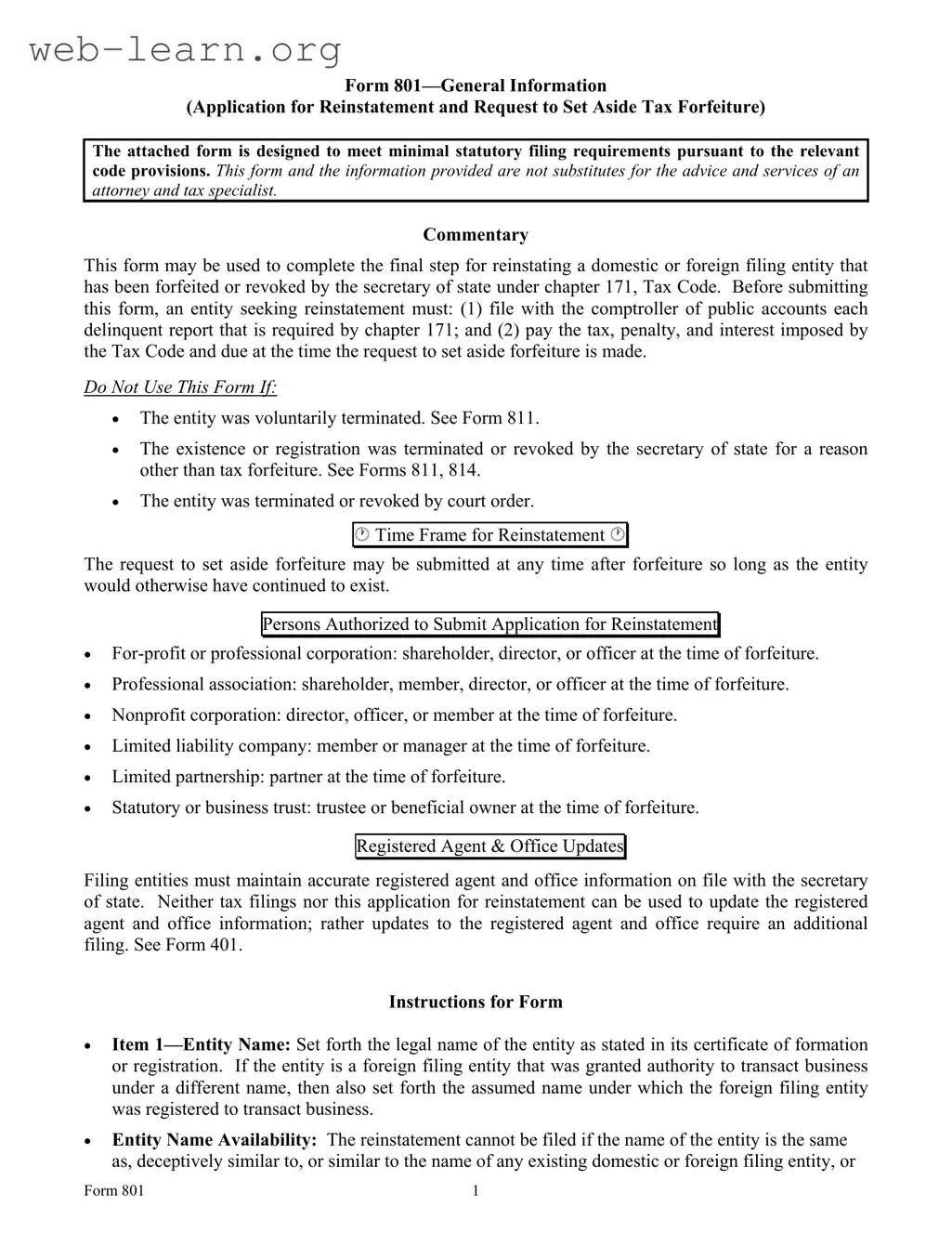
Form 801—General Information
(Application for Reinstatement and Request to Set Aside Tax Forfeiture)
The attached form is designed to meet minimal statutory filing requirements pursuant to the relevant
code provisions. This form and the information provided are not substitutes for the advice and services of an
attorney and tax specialist.
Commentary
This form may be used to complete the final step for reinstating a domestic or foreign filing entity that
has been forfeited or revoked by the secretary of state under chapter 171, Tax Code. Before submitting
this form, an entity seeking reinstatement must: (1) file with the comptroller of public accounts each
delinquent report that is required by chapter 171; and (2) pay the tax, penalty, and interest imposed by
the Tax Code and due at the time the request to set aside forfeiture is made.
Do Not Use This Form If:
The entity was voluntarily terminated. See Form 811.
The existence or registration was terminated or revoked by the secretary of state for a reason
other than tax forfeiture. See Forms 811, 814.
The entity was terminated or revoked by court order.
Time Frame for Reinstatement
The request to set aside forfeiture may be submitted at any time after forfeiture so long as the entity
would otherwise have continued to exist.
Persons Authorized to Submit Application for Reinstatement
For-profit or professional corporation: shareholder, director, or officer at the time of forfeiture.
Professional association: shareholder, member, director, or officer at the time of forfeiture.
Nonprofit corporation: director, officer, or member at the time of forfeiture.
Limited liability company: member or manager at the time of forfeiture.
Limited partnership: partner at the time of forfeiture.
Statutory or business trust: trustee or beneficial owner at the time of forfeiture.
Registered Agent & Office Updates
Filing entities must maintain accurate registered agent and office information on file with the secretary
of state. Neither tax filings nor this application for reinstatement can be used to update the registered
agent and office information; rather updates to the registered agent and office require an additional
filing. See Form 401.
Instructions for Form
Item 1—Entity Name: Set forth the legal name of the entity as stated in its certificate of formation
or registration. If the entity is a foreign filing entity that was granted authority to transact business
under a different name, then also set forth the assumed name under which the foreign filing entity
was registered to transact business.
Entity Name Availability: The reinstatement cannot be filed if the name of the entity is the same
as, deceptively similar to, or similar to the name of any existing domestic or foreign filing entity, or
Form 801
1
any name reservation or registration filed with the secretary of state. The administrative rules
adopted for determining entity name availability (Texas Administrative Code, title 1, part 4, chapter
79,
subchapter C) may be viewed at http://www.sos.state.tx.us/tac/index.shtml.
If the entity name is no longer available, the application for reinstatement must be accompanied by a
letter of consent or an amendment to the entity’s formation document or registration, as applicable.
Item 2—Secretary of State File Number: It is recommended that the file number assigned by the
secretary of state be provided to facilitate processing and ensure that the correct entity is reinstated.
Item 3—Date of Forfeiture/Revocation: Provide the date of the forfeiture or revocation. If unsure,
verification of the date may be obtained by calling the secretary of state at (512) 463-5555, by
dialing 7-1-1 for relay services, or by sending an e-mail to
Item 4—Certified Statements: Although an application for reinstatement need not be notarized, by
signing the application for reinstatement, a person certifies to the statements contained in item 4 of
the application. Prior to signing, please read the statements on this form carefully. In addition to the
penalties imposed by law for the submission of a false or fraudulent document, a person commits an
offense under section 171.363 of the Tax Code if the person is an employee, officer, or agent of a
taxable entity and the person knowingly enters or provides false information on any report, return, or
other document filed by the taxable entity under the provisions of chapter 171, including an
application for reinstatement. An offense under section 171.363 is a felony of the third degree.
Tax Clearance: A certificate of reinstatement must be accompanied by a tax clearance letter from
the Texas Comptroller of Public Accounts stating that the entity has satisfied all franchise tax
liabilities and may be reinstated.
Contact the Comptroller for assistance in complying with franchise tax filing requirements and
obtaining the necessary tax clearance letter. The Comptroller may be contacted by e-mail at
[email protected] or by calling (800) 252-1381 or (512) 463-4600.
Execution: The application must be signed by a person who is authorized to apply for and request a
reinstatement of the forfeited entity. (See “Persons Authorized to Apply” on page 1 of these
instructions.)
Payment and Delivery Instructions: The filing fee for an application for reinstatement is $75,
unless the entity is a nonprofit corporation. There is no fee for filing the reinstatement of a nonprofit
corporation following a tax forfeiture. Fees may be paid by personal checks, money orders,
LegalEase debit cards, or American Express, Discover, MasterCard, and Visa credit cards. Checks
or money orders must be payable through a U.S. bank or financial institution and made payable to
the secretary of state. Fees paid by credit card are subject to a statutorily authorized convenience fee
of 2.7 percent of the total fees.
Applicable fees for any additional filing that may be required as a condition for reinstatement (such as
an amendment to change the entity’s name) must be submitted together with the appropriate filing.
Submit the completed form in duplicate along with the filing fee. The form may be mailed to P.O.
Box 13697, Austin, Texas 78711-3697; faxed to (512) 463-5709; or delivered to the James Earl
Rudder Office Building, 1019 Brazos, Austin, Texas 78701. If a document is transmitted by fax,
credit card information must accompany the transmission (Form 807). On filing the document, the
secretary of state will return the appropriate evidence of filing to the submitter together with a file-
stamped copy of the document, if a duplicate copy was provided as instructed.
Revised 05/11
Form 801
2
This space reserved for office use.
Form 801
(Revised 05/11)
Submit in duplicate to:
Secretary of State
P.O. Box 13697
Austin, TX 78711-3697
512 463-5555
FAX: 512 463-5709
Filing Fee: See instructions
Application for Reinstatement
And Request to Set Aside
Tax Forfeiture
1. The entity name is:
The entity is a foreign entity that was required to obtain its registration under a name that differs from
the legal name stated above. The name under which the entity is registered is:
2. The file number issued to the entity by the secretary of state is:
3. The entity was forfeited or revoked under the provisions of the Tax Code on:
mm/dd/yyyy
4. The undersigned requests that the forfeiture or revocation of the entity be set aside, and certifies
that:
a. The entity has filed each delinquent report that is required by chapter 171 of the Tax Code and has
made payment for the tax, penalty, and interest imposed and that is due at the time of this application
as evidenced by the attached tax clearance letter; and
b. On the date of forfeiture or revocation, the undersigned person was:
an officer, director or shareholder of the above-named for-profit or professional corporation; or
an officer, director, shareholder or member of the above-named professional association; or
an officer, director, or member of the above-named nonprofit corporation; or
a member or manager of the above-named limited liability company; or
a partner of the above-named limited partnership; or
a trustee or beneficial owner of the above-named statutory or business trust.
Additional Required Documentation or Filings
Comptroller of Public Accounts Tax Clearance Letter
Letter of Consent or Amendment to Certificate of Formation or Registration (Required when entity name
is no longer available.)
Execution
The undersigned declares under penalty of perjury, and the penalties imposed by law for the
submission of a materially false or fraudulent instrument, that the undersigned is authorized to make
this request; that the statements contained herein are true and correct, and that tax clearance was not
obtained by providing false or fraudulent information.
Date:
BY:
Signature of authorized person (see instructions)
Printed or typed name of authorized person
Form 801
3

Form Information

Fact Name Details
Form Purpose This form is used for the application for reinstatement and request to set aside tax forfeiture for both domestic and foreign entities.
Governing Law The form is governed by Chapter 171 of the Texas Tax Code.
Eligibility Criteria Entities must have been forfeited or revoked due to tax issues, not voluntary termination or court orders.
Authorized Submitters Shareholders, directors, officers, or members at the time of forfeiture can submit the application.
Tax Clearance Requirement A tax clearance letter from the Texas Comptroller is mandatory to confirm all franchise tax liabilities are satisfied.
Filing Fee The fee for reinstatement is $75, except for nonprofit corporations, which have no fee.
Submission Methods Forms can be mailed, faxed, or delivered in person to the Secretary of State's office.
Time Frame for Reinstatement Requests can be submitted anytime after forfeiture, provided the entity could still exist.

Detailed Guide for Filling Out 801 Texas

Filling out the 801 Texas form is a crucial step for entities seeking reinstatement after a tax forfeiture. This process requires careful attention to detail and adherence to specific guidelines. Below are the steps to successfully complete the form.

  1. Enter the Entity Name: Write the legal name of the entity as it appears in its certificate of formation or registration. If applicable, include the assumed name for foreign entities.
  2. Provide Secretary of State File Number: Include the file number assigned to the entity by the secretary of state to facilitate processing.
  3. Specify Date of Forfeiture/Revocation: Fill in the date when the forfeiture or revocation occurred. If unsure, contact the secretary of state for verification.
  4. Certify Statements: Read the statements in item 4 carefully. By signing the application, certify that the entity has filed all required delinquent reports and paid the necessary taxes, penalties, and interest.
  5. Obtain Tax Clearance Letter: Acquire a tax clearance letter from the Texas Comptroller of Public Accounts confirming that all franchise tax liabilities have been satisfied.
  6. Execution: Ensure that the application is signed by an authorized individual, as outlined in the instructions.
  7. Prepare Payment: Include the filing fee of $75, unless the entity is a nonprofit corporation, which has no fee. Payment can be made via check, money order, or credit card.
  8. Submit the Form: Send the completed form in duplicate, along with the payment, to the appropriate address: P.O. Box 13697, Austin, Texas 78711-3697. Alternatively, you may fax it or deliver it in person.

Obtain Answers on 801 Texas

  1. What is Form 801?

    Form 801 is the application used for reinstating a domestic or foreign entity that has been forfeited or revoked due to tax issues. It allows the entity to request that the forfeiture be set aside, enabling it to continue its business operations.

  2. Who can submit Form 801?

    Only certain individuals are authorized to submit this form. These include:

    • For-profit or professional corporation: Shareholder, director, or officer at the time of forfeiture.
    • Professional association: Shareholder, member, director, or officer at the time of forfeiture.
    • Nonprofit corporation: Director, officer, or member at the time of forfeiture.
    • Limited liability company: Member or manager at the time of forfeiture.
    • Limited partnership: Partner at the time of forfeiture.
    • Statutory or business trust: Trustee or beneficial owner at the time of forfeiture.
  3. What are the filing requirements before submitting Form 801?

    Before submitting Form 801, the entity must:

    • File all delinquent reports required by Chapter 171 of the Tax Code.
    • Pay any taxes, penalties, and interest due at the time of the request.
  4. When can I submit Form 801?

    You can submit the request to set aside forfeiture at any time after the forfeiture, as long as the entity would otherwise still exist.

  5. What should I include in Form 801?

    Form 801 requires several pieces of information, including:

    • The legal name of the entity.
    • The Secretary of State file number.
    • The date of forfeiture or revocation.
    • A tax clearance letter from the Texas Comptroller of Public Accounts.
  6. Can I use Form 801 if my entity was voluntarily terminated?

    No, Form 801 should not be used if the entity was voluntarily terminated. In that case, Form 811 should be used instead.

  7. What is a tax clearance letter?

    A tax clearance letter is a document from the Texas Comptroller of Public Accounts. It states that the entity has satisfied all franchise tax obligations and is eligible for reinstatement.

  8. What is the filing fee for Form 801?

    The filing fee for an application for reinstatement is $75. However, there is no fee for nonprofit corporations filing for reinstatement after a tax forfeiture.

  9. How do I submit Form 801?

    You can submit Form 801 in several ways:

    • By mail to P.O. Box 13697, Austin, Texas 78711-3697.
    • By fax to (512) 463-5709.
    • In person at the James Earl Rudder Office Building, 1019 Brazos, Austin, Texas 78701.
  10. What happens after I submit Form 801?

    Once the document is filed, the Secretary of State will return evidence of filing along with a file-stamped copy of the document if a duplicate was provided.

Common mistakes

Filling out the Texas Form 801 can be a straightforward process, but many people make common mistakes that can delay their application for reinstatement. One significant error is failing to provide the correct entity name. It's essential to use the legal name as it appears in the certificate of formation or registration. If the entity is foreign and registered under a different name, that name must also be included. Omitting this information can lead to processing delays.

Another frequent mistake is not including the Secretary of State file number. This number helps the state identify the entity quickly. Without it, the application may not be processed efficiently. If you're unsure of the number, it’s advisable to verify it before submitting the form.

Many applicants also overlook the date of forfeiture or revocation. This date is crucial for the application and must be accurate. If you're uncertain about the date, you can easily confirm it by contacting the Secretary of State's office. Failing to provide the correct date can lead to complications in reinstatement.

Signing the application without reading the certified statements can have serious repercussions. By signing, you certify that all information is accurate, and any false statements can lead to criminal charges. It’s vital to take a moment to review these statements carefully before you sign.

Another common error is neglecting to obtain a tax clearance letter from the Texas Comptroller of Public Accounts. This letter confirms that all franchise tax liabilities have been satisfied. Without it, the application cannot be processed. Make sure to reach out to the Comptroller’s office to ensure you have this document ready when submitting your form.

Some individuals mistakenly think that submitting the Form 801 will automatically update their registered agent and office information. However, this is not the case. Updates require a separate filing. Be sure to check that your registered agent information is current before submitting the reinstatement application.

Lastly, many applicants forget to include the filing fee. The fee is $75 for most entities, while nonprofit corporations do not have a fee. Ensure that you have the correct payment method ready, as this is necessary for processing your application. Double-check that all required documents and fees are included in your submission to avoid delays.

By being mindful of these common mistakes, you can improve your chances of a smooth reinstatement process. Always take the time to review your application thoroughly before submission.

Documents used along the form

The Form 801 is a critical document for entities seeking reinstatement after a tax forfeiture in Texas. Alongside this form, several other documents may be necessary to ensure compliance with state regulations. Below is a list of commonly used forms that accompany the Form 801, along with brief descriptions of each.

  • Form 401: This form is used to update the registered agent and office information for a filing entity. It is essential for maintaining accurate records with the Secretary of State, as the Form 801 does not serve this purpose.
  • Tax Clearance Letter: Issued by the Texas Comptroller of Public Accounts, this letter confirms that the entity has settled all franchise tax liabilities. It is a mandatory attachment when submitting the Form 801.
  • Letter of Consent: If the entity name is no longer available for reinstatement, this letter is required. It provides consent from the entity that holds the similar name, allowing the reinstatement process to continue.
  • Amendment to Certificate of Formation or Registration: This document is necessary when the entity name is not available. It amends the entity's formation document to reflect a new name, ensuring compliance with naming regulations.

Understanding these forms and their purposes can streamline the reinstatement process and help avoid unnecessary delays. Proper preparation and submission of all required documents are essential for a successful outcome.

Similar forms

  • Form 811—Application for Voluntary Termination: This form is used when an entity chooses to voluntarily end its existence. Unlike Form 801, which is for reinstatement after forfeiture, Form 811 allows entities to formally dissolve without tax-related issues.
  • Form 814—Application for Revocation: This document is for entities that have been revoked for reasons other than tax forfeiture. Form 814 differs from Form 801 as it does not address reinstatement but rather formalizes the revocation process.
  • Form 401—Certificate of Formation: This form is used to create a new entity or amend an existing one. While Form 801 deals with reinstating a forfeited entity, Form 401 is focused on establishing or modifying the legal status of a business.
  • Form 807—Credit Card Payment Form: This form is used for submitting payment via credit card for various filings, including Form 801. It is essential for processing payments but does not contain information about reinstatement itself.
  • Franchise Tax Report: Entities must file this report to comply with Texas tax laws. Before using Form 801, all delinquent reports must be filed, linking it directly to the tax obligations outlined in the Franchise Tax Report.
  • Tax Clearance Letter: This document confirms that an entity has settled all franchise tax liabilities. It is a prerequisite for submitting Form 801, ensuring that tax obligations are met before seeking reinstatement.

Dos and Don'ts

When filling out the Texas Form 801, it’s essential to follow specific guidelines to ensure your application is processed smoothly. Here’s a list of things you should and shouldn’t do:

  • Do provide the legal name of the entity exactly as it appears in its certificate of formation.
  • Do include the Secretary of State file number to help with processing.
  • Do ensure that all delinquent reports and taxes have been filed and paid before submitting the form.
  • Do read and understand the certified statements in the application before signing.
  • Do attach a tax clearance letter from the Texas Comptroller of Public Accounts.
  • Do submit the completed form in duplicate to the Secretary of State.
  • Do pay the required filing fee, unless you are a nonprofit corporation.
  • Don't use this form if the entity was voluntarily terminated.
  • Don't submit the application if the entity was revoked for reasons other than tax forfeiture.
  • Don't forget to verify the date of forfeiture if you're unsure.
  • Don't attempt to update registered agent or office information using this form.
  • Don't provide false information, as this can lead to serious legal penalties.
  • Don't forget to sign the application; it must be signed by an authorized person.
  • Don't submit payment by a method not accepted, such as personal checks from non-U.S. banks.

Misconceptions

  • Misconception 1: The 801 Texas form can be used for any type of entity reinstatement.
  • This form is specifically for reinstating entities that have been forfeited or revoked due to tax issues. It cannot be used if the entity was voluntarily terminated or revoked for other reasons.

  • Misconception 2: Filing the 801 form automatically reinstates the entity.
  • Submitting the form does not guarantee reinstatement. The entity must have filed all required delinquent reports and paid any outstanding taxes, penalties, and interest.

  • Misconception 3: There is no need to contact the Texas Comptroller before filing.
  • It is important to obtain a tax clearance letter from the Texas Comptroller, confirming that all franchise tax liabilities are satisfied before submitting the form.

  • Misconception 4: The entity name must be the same as before forfeiture.
  • If the original name is no longer available, the application must include a letter of consent or an amendment to the entity’s formation documents.

  • Misconception 5: The 801 form must be notarized.
  • While notarization is not required, the person signing the form certifies the accuracy of the information provided, which carries legal consequences for false statements.

  • Misconception 6: Any authorized person can submit the application.
  • Only specific individuals, such as shareholders, directors, or officers at the time of forfeiture, are authorized to submit the application for reinstatement.

  • Misconception 7: The reinstatement fee is the same for all entities.
  • The filing fee is $75 for most entities, but nonprofit corporations do not have to pay a fee for reinstatement following a tax forfeiture.

  • Misconception 8: The 801 form can be used to update registered agent information.
  • This form does not serve to update registered agent or office information. Separate filings are required for those updates.

  • Misconception 9: There is no time limit for submitting the 801 form after forfeiture.
  • The request to set aside forfeiture can be submitted at any time, but the entity must have continued to exist otherwise.

Key takeaways

Key Takeaways for Using Form 801 in Texas:

  • This form is for reinstating a business entity that has been forfeited or revoked due to tax issues.
  • Before using Form 801, ensure all delinquent reports are filed and taxes, penalties, and interest are paid.
  • Do not use this form if the entity was voluntarily terminated or revoked for reasons other than tax forfeiture.
  • The request for reinstatement can be made anytime after forfeiture, as long as the entity would still exist.
  • Only authorized individuals, such as shareholders or directors at the time of forfeiture, can submit the application.
  • Keep registered agent and office information updated separately; this form does not serve that purpose.
  • Provide the entity's legal name as stated in its formation documents and ensure name availability.
  • A tax clearance letter from the Texas Comptroller is necessary to confirm all franchise tax obligations are met.
  • Filing fees are $75 for most entities; nonprofits are exempt from this fee. Payment can be made via check, money order, or credit card.