Homepage Blank 51A125 Kentucky Form
Outline

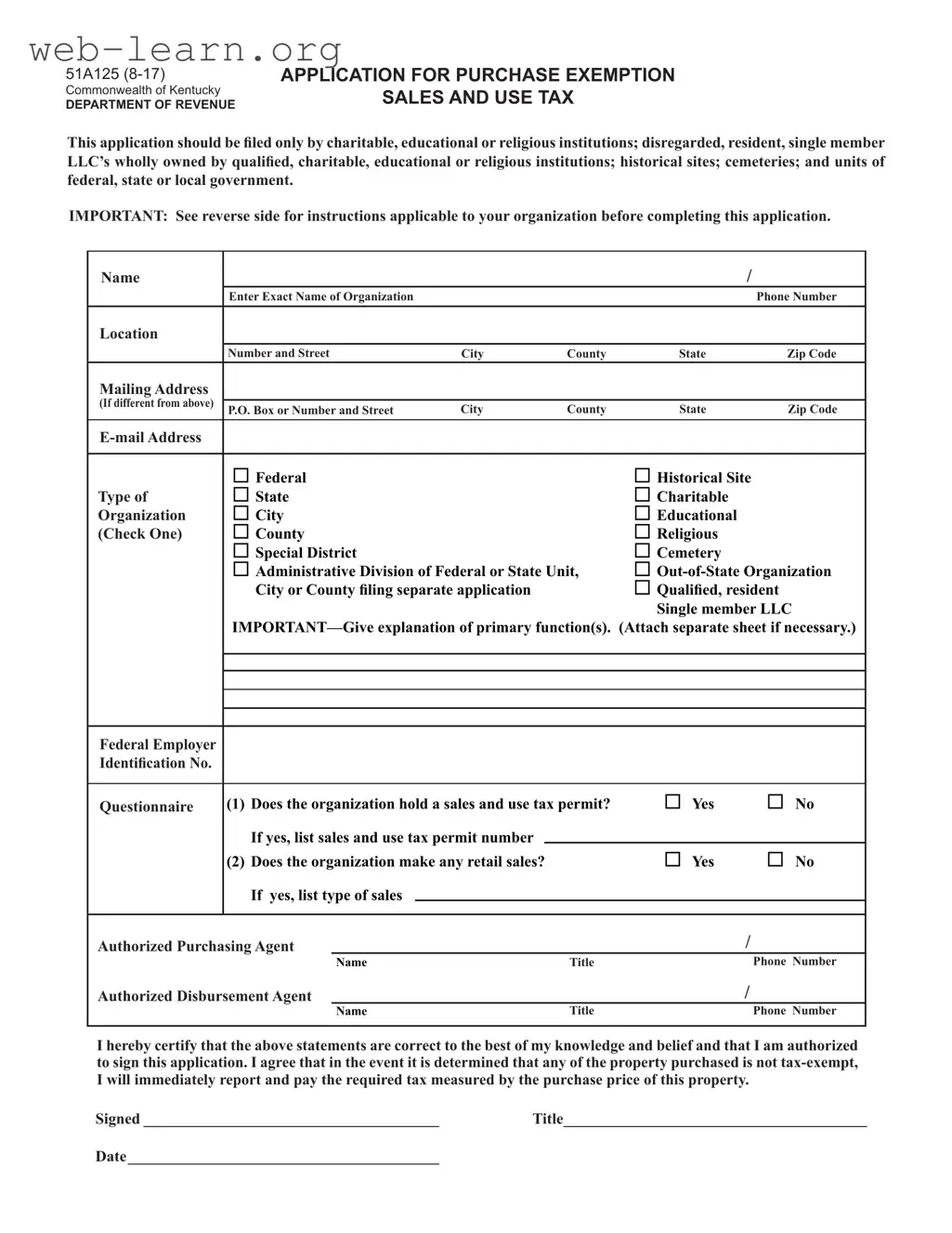
The 51A125 Kentucky form serves as an application for purchase exemption from sales and use tax, specifically designed for various organizations. Eligible applicants include charitable, educational, and religious institutions, along with historical sites, cemeteries, and certain government units. This form requires detailed information about the organization, such as its name, address, and type of entity. Additionally, it includes a questionnaire to determine the organization's sales tax permit status and whether it engages in retail sales. Supporting documents must accompany the application, such as articles of incorporation and IRS exemption letters, depending on the type of organization. Upon approval, organizations can make tax-exempt purchases related to their functions, although they must remain compliant with reporting requirements. Clear instructions are provided to ensure that applicants understand the necessary steps and documentation needed for a successful submission.

Sample - 51A125 Kentucky Form

51A125 (8-17)
Commonwealth of Kentucky
DEPARTMENT OF REVENUE
APPLICATION FOR PURCHASE EXEMPTION
SALES AND USE TAX
This application should be led only by charitable, educational or religious institutions; disregarded, resident, single member
LLC’s wholly owned by qualied, charitable, educational or religious institutions; historical sites; cemeteries; and units of
federal, state or local government.
IMPORTANT: See reverse side for instructions applicable to your organization before completing this application.
Signed ______________________________________ Title _______________________________________
Date ________________________________________
I hereby certify that the above statements are correct to the best of my knowledge and belief and that I am authorized
to sign this application. I agree that in the event it is determined that any of the property purchased is not tax-exempt,
I will immediately report and pay the required tax measured by the purchase price of this property.
Federal Historical Site
State Charitable
City Educational
County Religious
Special District Cemetery
Administrative Division of Federal or State Unit, Out-of-State Organization
City or County ling separate application Qualied, resident
Single member LLC
IMPORTANT—Give explanation of primary function(s). (Attach separate sheet if necessary.)
(1) Does the organization hold a sales and use tax permit? Yes No
If yes, list sales and use tax permit number
(2) Does the organization make any retail sales? Yes No
If yes, list type of sales



 

Enter Exact Name of Organization Phone Number
Name
Location
Mailing Address
(If different from above)
E-mail Address
Type of
Organization
(Check One)
Federal Employer
Identication No.
Questionnaire
Authorized Purchasing Agent
Authorized Disbursement Agent
/
Zip Code
P.O. Box or Number and Street
City County State
Zip Code
Number and Street
City County State
/
/
Name
Name
Title
Title
Phone Number
Phone Number
SPECIAL INSTRUCTIONS
Charitable, Educational and Religious Institutions and Qualied, Resident Single Member LLC’s
(1) A copy of the Articles of Incorporation;
(2) detailed schedule of receipts and disbursements must be attached to this application.
(3) The letter from the Internal Revenue Service which determines that your organization is exempt from income taxation under
Section 501(C)(3) of the Internal Revenue Code must be attached to this application.
Historical Sites
(1) AcopyoftheletterfromtheKentuckyHeritageCommissionconrmingyourlistingintheNationalRegistermustbe
attached to this application.
(2) Admission charges to historical sites qualifying for exemption are not subject to sales tax. However, historical sites are liable
for tax on any other retail sales such as meals, arts and crafts, souvenirs, etc.
Units of Federal, State or Local Government
(1) Unitsoflocalgovernmentincludecities,countiesandallspecialdistrictsasdenedinKRS65.005.
(2) SpecialdistrictsmustattachacopyoftheregistrationledwiththecountyclerkasrequiredbyKRS65.005.
(3) Eachadministrativedivisionwithinafederalorstateunit,cityorcountywhichperformsaspecicfunctionandmakes
purchasesinitsownnameisrequiredtoleaseparateapplication.
Cemeteries
(1) A copy of the Articles of Incorporation and a detailed schedule of receipts and disbursements must be attached to this
application.
(2) Attach a copy of the ruling which grants the organization an exemption from property tax.
IF YOUR APPLICATION IS APPROVED
(1) You will be permitted to make purchases of tangible personal property, digital property or services without payment of sales
and use tax to the supplier. However, purchases of any items not to be used within the exempt function of the organization
are taxable.
(2) A letter of authorization will be mailed to you which will contain an exemption number and instructions for properly claiming
the exemption on purchases.
(3) If the organization makes taxable sales and is not an educational or charitable institution, a sales and use tax permit is
required.
OUT–OF–STATE ORGANIZATION
In addition to the above, you must submit a copy of the exemption letter or authorization to show proof of exemption from sales
tax in your state.
IMPORTANT: TheDepartmentofRevenuemustbenotiedpromptlyofanychangeinthename,addressornatureoftheorganization
from the information submitted in this application. Please refer to the purchase exemption number issued to the
organization when corresponding with the Department.
Mail completed application to the Kentucky Department of Revenue, Division of Sales and Use Tax, P.O.
Box 181, Station 67, Frankfort, Kentucky, 40602–0181.

Form Information

Fact Name Description
Purpose The 51A125 form is an application for purchase exemption from sales and use tax, intended for specific organizations like charitable, educational, or religious institutions.
Eligibility Eligible applicants include charitable organizations, educational institutions, historical sites, cemeteries, and units of government, as well as certain single-member LLCs.
Required Attachments Applicants must attach relevant documents, such as Articles of Incorporation and IRS exemption letters, depending on their organization type.
Governing Law This form is governed by Kentucky Revised Statutes (KRS) 65.005 and other applicable laws regarding sales and use tax exemptions.

Detailed Guide for Filling Out 51A125 Kentucky

Filling out the 51A125 Kentucky form requires careful attention to detail. After completing the application, it will be submitted to the Kentucky Department of Revenue for processing. It is important to ensure that all required documentation is included to avoid delays in approval.

  1. Begin by entering the exact name of your organization in the designated field.
  2. Provide the phone number for your organization.
  3. Fill in the location address including the street number, city, county, state, and zip code.
  4. If applicable, enter a mailing address that differs from the location address, including P.O. Box or street number, city, county, state, and zip code.
  5. Input the email address for your organization.
  6. Select the type of organization by checking the appropriate box (e.g., Charitable, Educational, Religious, etc.).
  7. Provide a brief explanation of the primary functions of your organization. If necessary, attach a separate sheet.
  8. Enter the Federal Employer Identification Number (EIN) for your organization.
  9. Complete the questionnaire regarding sales and use tax permits and retail sales, providing details as needed.
  10. List the Authorized Purchasing Agent and their contact information.
  11. List the Authorized Disbursement Agent and their contact information.
  12. Sign and date the application, ensuring that the title of the signer is included.
  13. Attach any required documents based on your organization type, such as Articles of Incorporation, IRS exemption letters, or other relevant paperwork.
  14. Mail the completed application to the Kentucky Department of Revenue, Division of Sales and Use Tax, at the specified address.

Obtain Answers on 51A125 Kentucky

  1. What is the purpose of the 51A125 Kentucky form?

    The 51A125 form is an application for purchase exemption from sales and use tax in Kentucky. It is specifically designed for charitable, educational, and religious institutions, as well as certain other organizations like historical sites and cemeteries. By filing this form, eligible entities can obtain an exemption that allows them to purchase tangible personal property, digital property, or services without paying sales tax.

  2. Who is eligible to file the 51A125 form?

    Eligibility for the 51A125 form includes:

    • Charitable organizations
    • Educational institutions
    • Religious institutions
    • Historical sites
    • Cemeteries
    • Units of federal, state, or local government
    • Disregarded, resident, single-member LLCs wholly owned by qualified organizations

    Each of these entities must meet specific requirements outlined in the form instructions to qualify for the exemption.

  3. What documents are required to accompany the application?

    When submitting the 51A125 form, certain documents must be attached depending on the type of organization:

    • For charitable, educational, and religious institutions: Articles of Incorporation, a detailed schedule of receipts and disbursements, and IRS exemption letter under Section 501(C)(3).
    • For historical sites: A letter from the Kentucky Heritage Commission confirming listing in the National Register.
    • For cemeteries: Articles of Incorporation and a ruling granting property tax exemption.
    • For units of government: Registration copy filed with the county clerk for special districts.
  4. What happens after the application is approved?

    Upon approval of the 51A125 application, the organization will receive a letter of authorization containing an exemption number. This allows the organization to make tax-exempt purchases related to their exempt functions. However, it is important to note that any purchases made outside of these functions will still be subject to sales tax.

  5. How should changes to the organization’s information be handled?

    If there are any changes to the organization’s name, address, or nature, it is crucial to notify the Kentucky Department of Revenue promptly. Maintaining accurate information ensures that the organization can continue to benefit from its tax-exempt status without complications.

Common mistakes

Filling out the 51A125 Kentucky form can be straightforward, but many people make common mistakes that can lead to delays or denials. One frequent error is not providing the exact name of the organization. It’s crucial to match the name exactly as it appears in official documents. Any discrepancies can raise questions and complicate the approval process.

Another mistake is failing to include the correct contact information. This includes phone numbers and email addresses. If the Department of Revenue needs to reach out for clarification, having accurate contact details is essential. Double-checking this information can save time and prevent misunderstandings.

Many applicants also overlook the requirement to attach necessary documents. For instance, charitable organizations must include a copy of their Articles of Incorporation and a letter from the IRS confirming their tax-exempt status. Failing to provide these documents will result in an incomplete application, which can lead to rejection.

Additionally, some individuals mistakenly answer the questionnaire inaccurately. For example, if the organization does hold a sales and use tax permit, this must be clearly indicated. Misleading answers can not only delay the process but may also lead to legal complications down the line.

Lastly, applicants often forget to sign and date the form. This might seem minor, but without a signature, the application is not valid. Ensure that the person authorized to sign the application does so, as this confirms the accuracy of the information provided.

Documents used along the form

The 51A125 form is essential for organizations seeking exemption from sales and use tax in Kentucky. Along with this form, several other documents may be necessary to support the application process. Each of these documents serves a specific purpose and helps ensure that the application is complete and compliant with state regulations. Below is a list of commonly used forms and documents that often accompany the 51A125 form.

  • Articles of Incorporation: This document outlines the formation of the organization, including its name, purpose, and structure. It is crucial for establishing the legal status of charitable, educational, and religious institutions.
  • IRS Exemption Letter: This letter confirms that the organization is recognized as tax-exempt under Section 501(c)(3) of the Internal Revenue Code. It is essential for proving eligibility for sales tax exemption.
  • Schedule of Receipts and Disbursements: A detailed financial statement that lists all income and expenses. This document provides transparency and helps demonstrate the organization’s financial activities.
  • Kentucky Heritage Commission Letter: For historical sites, this letter verifies the site’s listing in the National Register. It is necessary to confirm eligibility for sales tax exemption related to admission charges.
  • Registration Copy for Special Districts: Special districts must provide a copy of their registration filed with the county clerk. This document is needed to comply with state regulations regarding local government units.
  • Property Tax Exemption Ruling: Cemeteries must attach a copy of the ruling that grants them an exemption from property tax. This document supports their claim for sales tax exemption.
  • Sales and Use Tax Permit: If the organization engages in taxable sales, a permit is required. This document allows the organization to collect sales tax on retail sales made.
  • Proof of Exemption from Out-of-State Organization: Out-of-state organizations must submit documentation showing proof of exemption from sales tax in their home state. This supports their application for exemption in Kentucky.

Each of these documents plays a vital role in the application process for sales and use tax exemption in Kentucky. Ensuring that all necessary paperwork is accurately completed and submitted will help facilitate a smoother approval process. Proper documentation not only strengthens the application but also demonstrates the organization’s commitment to compliance with state laws.

Similar forms

The 51A125 Kentucky form is an application for purchase exemption from sales and use tax, specifically designed for certain organizations. Several other documents serve similar purposes in different contexts. Here are four documents that share similarities with the 51A125 form:

  • IRS Form 1023: This is the application for recognition of exemption under Section 501(c)(3) of the Internal Revenue Code. Like the 51A125, it is used by charitable organizations to establish their tax-exempt status. Both forms require detailed information about the organization's purpose and activities.
  • State Sales Tax Exemption Certificate: Many states provide a sales tax exemption certificate for qualifying organizations. This document, similar to the 51A125, allows eligible entities to make tax-exempt purchases. Both forms require proof of the organization's exempt status and often necessitate additional documentation.
  • Form ST-5 (Sales Tax Exempt Certificate): This form is used in various states, including Kentucky, to claim exemption from sales tax on purchases made by exempt organizations. Much like the 51A125, it requires the organization to provide information about its tax-exempt status and intended use of the purchased items.
  • Form 990: This is an annual information return that most tax-exempt organizations must file with the IRS. While its primary purpose is different from the 51A125, both documents aim to ensure compliance with tax laws and provide transparency about the organization’s activities and financial status.

Dos and Don'ts

When filling out the 51A125 Kentucky form, it's important to follow specific guidelines to ensure a smooth application process. Here are five things you should and shouldn't do:

  • Do read the instructions on the reverse side of the form carefully before starting.
  • Do provide the exact name of your organization as it appears in official documents.
  • Do include all required attachments, such as Articles of Incorporation and IRS exemption letters.
  • Do ensure that all contact information is accurate and up-to-date.
  • Do sign and date the application to certify the information provided.
  • Don't leave any sections blank; fill out all applicable fields to avoid delays.
  • Don't submit the application without double-checking for errors or missing information.
  • Don't forget to notify the Department of Revenue about any changes to your organization’s information.
  • Don't assume that previous applications or approvals apply to this form; each application is evaluated independently.
  • Don't ignore the specific requirements for your type of organization, as they may vary.

Misconceptions

There are several misconceptions surrounding the 51A125 Kentucky form. Understanding these can help clarify the process for organizations seeking tax exemptions. Here is a list of nine common misconceptions:

  1. Only large organizations can apply. Many believe that only large charitable or educational institutions are eligible. In reality, smaller organizations and single-member LLCs can also apply.
  2. All purchases are tax-exempt. Some think that once they receive the exemption, all purchases are tax-exempt. However, only purchases related to the organization's exempt functions are exempt.
  3. Historical sites are completely exempt from sales tax. It is a common belief that historical sites do not pay any sales tax. They are liable for tax on retail sales like meals and souvenirs.
  4. Only non-profit organizations can apply. Many assume that only non-profits qualify. However, certain government units and LLCs owned by qualifying organizations can also apply.
  5. The application is straightforward and does not require supporting documents. Some applicants think they can submit the form alone. In fact, detailed supporting documents are often required.
  6. Once approved, the exemption lasts indefinitely. There is a misconception that once an organization receives exemption status, it lasts forever. Changes in the organization’s status must be reported to the Department of Revenue.
  7. All types of sales are exempt. Some believe that all sales made by the organization are exempt. This is not true, as taxable sales require a sales and use tax permit.
  8. Out-of-state organizations cannot apply. There is a belief that only in-state organizations can use this form. Out-of-state organizations can apply if they provide proof of exemption from their own state.
  9. Filing the application guarantees approval. Many think that submitting the application ensures they will receive tax-exempt status. Approval is not guaranteed and depends on meeting specific criteria.

Understanding these misconceptions can help organizations navigate the application process more effectively and ensure compliance with state regulations.

Key takeaways

  • Eligibility: The 51A125 form is specifically for charitable, educational, or religious institutions, as well as certain LLCs and government units. Ensure your organization qualifies before applying.
  • Required Information: Fill out the form completely. Include the exact name of your organization, contact details, and the type of organization. Missing information can delay the process.
  • Attachments: Depending on your organization type, specific documents are required. For example, charitable organizations must include Articles of Incorporation and IRS exemption letters.
  • Tax Exemption: If approved, your organization can make tax-exempt purchases. However, any items not used for exempt purposes will still be subject to sales tax.
  • Notification of Changes: Keep the Department of Revenue informed of any changes to your organization's name, address, or purpose. This ensures your exemption status remains valid.
  • Submission Process: Mail the completed application to the Kentucky Department of Revenue. Ensure all required documents are included to avoid delays in processing.