Homepage Blank 5080 Michigan Form
Outline

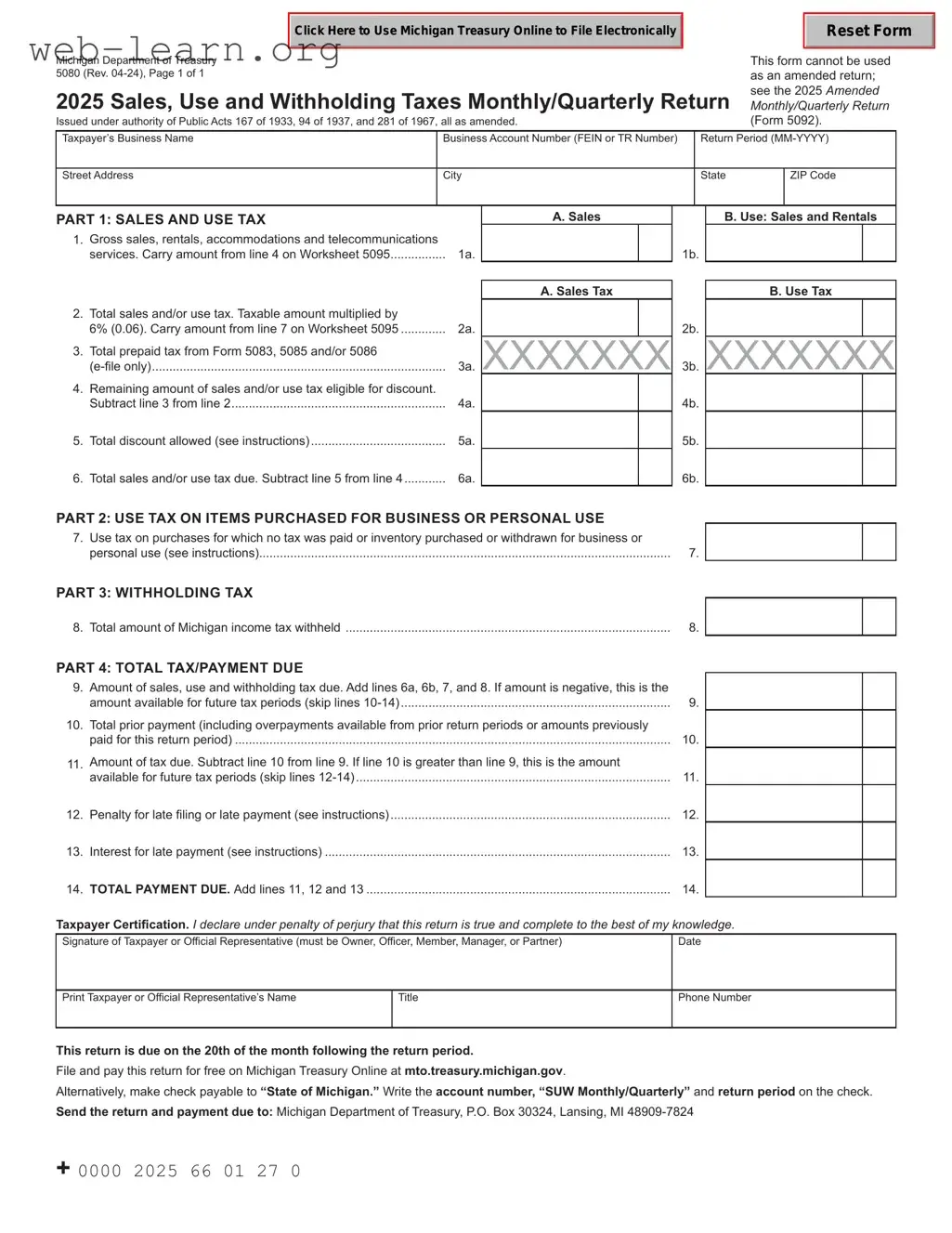
The Michigan Department of Treasury Form 5080 serves as a crucial tool for businesses in the state, enabling them to report and remit sales, use, and withholding taxes on a monthly or quarterly basis. This form is specifically designed for taxpayers to accurately declare their gross sales, rentals, and services, ensuring compliance with state tax laws. It includes several key sections, beginning with the calculation of total sales and use tax, where businesses must multiply their taxable sales by the state's 6% tax rate. Taxpayers are also required to report any pre-paid taxes from previous forms and calculate any applicable discounts based on their filing frequency. Additionally, the form addresses use tax on items purchased for business or personal use, as well as withholding tax on employee wages. The final section consolidates the total tax due, allowing taxpayers to determine any overpayments or penalties incurred due to late filings. Understanding the components of Form 5080 is essential for businesses to maintain compliance and avoid potential penalties associated with tax deficiencies.

Sample - 5080 Michigan Form

Michigan Department of Treasury
This form cannot be used
5080 (Rev. 04-24), Page 1 of 1
as an amended return;
see the 2025 Amended
2025 Sales, Use and Withholding Taxes Monthly/Quarterly Return
Monthly/Quarterly Return
Issued under authority of Public Acts 167 of 1933, 94 of 1937, and 281 of 1967, all as amended.
(Form 5092).
Taxpayer’s Business Name Business Account Number (FEIN or TR Number) Return Period (MM-YYYY)
Street Address City State ZIP Code
PART 1: SALES AND USE TAX
A. Sales B. Use: Sales and Rentals
1.
Gross sales, rentals, accommodations and telecommunications
services. Carry amount from line 4 on Worksheet 5095................ 1a. 1b.
2. Total sales and/or use tax. Taxable amount multiplied by
6% (0.06). Carry amount from line 7 on Worksheet 5095 ............. 2a.
A. Sales Tax
XXXXXXX
2b.
3. Total prepaid tax from Form 5083, 5085 and/or 5086
(e-le only)..................................................................................... 3a. 3b.
4. Remaining amount of sales and/or use tax eligible for discount.
Subtract line 3 from line 2.............................................................. 4a. 4b.
5. Total discount allowed (see instructions)....................................... 5a. 5b.
6. Total sales and/or use tax due. Subtract line 5 from line 4............ 6a. 6b.
PART 2: USE TAX ON ITEMS PURCHASED FOR BUSINESS OR PERSONAL USE
7. Use tax on purchases for which no tax was paid or inventory purchased or withdrawn for business or
personal use (see instructions)....................................................................................................................... 7.
PART 3: WITHHOLDING TAX
8. Total amount of Michigan income tax withheld .............................................................................................. 8.
B. Use Tax
XXXXXXX
PART 4: TOTAL TAX/PAYMENT DUE
9. Amount of sales, use and withholding tax due. Add lines 6a, 6b, 7, and 8. If amount is negative, this is the
amount available for future tax periods (skip lines 10-14)..............................................................................
10. Total prior payment (including overpayments available from prior return periods or amounts previously
paid for this return period) ..............................................................................................................................
11.
Amount of tax due. Subtract line 10 from line 9. If line 10 is greater than line 9, this is the amount
available for future tax periods (skip lines 12-14)...........................................................................................
9.
10.
11.
12. Penalty for late ling or late payment (see instructions)................................................................................. 12.
13. Interest for late payment (see instructions) .................................................................................................... 13.
14. TOTAL PAYMENT DUE. Add lines 11, 12 and 13 ........................................................................................ 14.
Taxpayer Certication. I declare under penalty of perjury that this return is true and complete to the best of my knowledge.
Signature of Taxpayer or O󰀩cial Representative (must be Owner, O󰀩cer, Member, Manager, or Partner) Date
Print Taxpayer or O󰀩cial Representative’s Name Title Phone Number
This return is due on the 20th of the month following the return period.
File and pay this return for free on Michigan Treasury Online at mto.treasury.michigan.gov.
Alternatively, make check payable to “State of Michigan.” Write the account number, “SUW Monthly/Quarterly” and return period on the check.
Send the return and payment due to: Michigan Department of Treasury, P.O. Box 30324, Lansing, MI 48909-7824
+ 0000 2025 66 01 27 0
Reset Form
Click Here to Use Michigan Treasury Online to File Electronically
2025 Form 5080, Page 2
Instructions for 2025 Sales, Use and Withholding
Taxes Monthly/Quarterly Return (Form 5080)
Form 5080 is available for submission electronically
using Michigan Treasury Online (MTO) at
mto.treasury.michigan.gov or by using approved tax
preparation software.
NOTE: The address field on this form is required to
be completed but will not be used to replace an existing
valid address for the purpose of correspondence or
refunds. Update address and other registration information
using MTO or mail a completed Notice of Change or
Discontinuance (Form 163).
IMPORTANT: This is a return for sales tax, use tax
and/or withholding tax. If the taxpayer inserts a zero on
or leaves blank any line reporting sales tax, use tax or
withholding tax, the taxpayer is certifying that no tax
is owed for that tax type. Only enter figures for taxes
the business is registered and/or liable for. If it is
determined that tax is owed the taxpayer will be liable for
the deficiency as well as penalty and interest. Complete
the Sales, Use and Withholding Taxes Monthly/Quarterly
and Amended Monthly/Quarterly Worksheet
(Form 5095, hereafter referred to as Worksheet 5095)
prior to completing this form.
PART 1: SALES AND USE TAX
Line 1a: Enter the amount from Worksheet 5095, line 4A.
Line 1b: Enter the amount from Worksheet 5095, line 4B.
Line 2a: Total Sales Tax. Negative figures are not allowed.
Enter the amount from Worksheet 5095, line 7A. Gross sales
minus allowable deductions, multiplied by 6%
Line 2b: Total Use Tax. Negative figures not allowed. Enter
the amount from Worksheet 5095, line 7B. Total receipts
from sales, rentals, and services, minus allowable deductions,
multiplied by 6%.
Line 5: Total Discount Allowed for Timely Filing and
Payment. Discounts apply only to 2/3 (0.6667) of the sales
and/or use tax collected at the 6 percent tax rate. See below
to calculate the discount:
Monthly Filer
If the tax is less than $9, calculate the discount by
multiplying the tax by 2/3 (.6667).
If tax is $9 to $1,200 and paid by the 12th, or $9 to $1,800
and paid by the 20th, then enter $6.
If the tax is more than $1,200 and paid by the 12th,
calculate discount using this formula:
(Tax x .6667 x .0075). The maximum discount is $20,000
for the tax period.
If the tax is more than $1,800 and paid by the 20th,
calculate discount using this formula:
(Tax x .6667 x .005). The maximum discount is $15,000
for the tax period.
Quarterly Filer
If the tax is less than $27, calculate the discount by
multiplying the tax by 2/3 (.6667).
If tax is $27 to $3,600 and paid by the 12th, or $27 to
$5,400 and paid by the 20th, then enter $18.
If the tax is more than $3,600 and paid by the 12th,
calculate discount using this formula:
(Tax x .6667 x .0075). The maximum discount is $20,000
for the tax period.
If the tax is more than $5,400 and paid by the 20th,
calculate discount using this formula:
(Tax x .6667 x .005). The maximum discount is $15,000
for the tax period.
Accelerated Filer
If the tax is paid by the 20th, calculate discount using this
formula: (Tax x .6667 x .005). No maximum discount
applies.
Credit Schedules
E-file only credit schedules (Form 5083, 5085 and/or
5086) include specific discount calculations. See
respective schedule form instructions for more
information. If filing a credit schedule with a monthly/
quarterly return, calculate the allowable discount on sales
tax separate from the sales tax discount calculated on the
credit schedule. Sum both sales tax discount amounts and
enter on line 5 of this form.
PART 2: USE TAX ON ITEMS PURCHASED FOR
BUSINESS OR PERSONAL USE
Line 7: Enter the amount from Worksheet 5095, line 9. To
determine use tax due from purchases and withdrawals,
multiply the applicable tax base by 6%.
PART 3: WITHHOLDING TAX
Line 8: Enter the total Michigan income tax withheld for the
tax period.
PART 4: TOTAL TAX/PAYMENT DUE
Line 9: If amount is negative, this is the amount available for
future tax periods (skip lines 10-14).
Line 10: Enter any payments submitted for this period prior
to filing the return or any overpayment from prior periods.
Liability minus prior/over payments for this period must be
greater than or equal to zero.
Line 14: Total Payment Due. Add lines 11, 12 and 13.
Submit payments electronically on MTO, or make check
payable to the “State of Michigan” and remit with your
return. Write the account number, “SUW Monthly/
Quarterlyand the return period on the check. Do not pay
if the amount due is less than $1.
2025 Form 5080, Page 3
HOW TO COMPUTE PENALTY AND INTEREST
If the return is filed late with tax due, include penalty and
interest with the payment. Penalty is 5% of the tax due and
increases by an additional 5% per month or fraction thereof,
after the second month, to a maximum of 25%. Interest is
charged daily using the average prime rate, plus 1 percent.
Visit www.michigan.gov/taxes for current interest rate
information or help in calculating late payment penalties.
Tax Assistance
For assistance, call 517-636-6925. Assistance is available
using TTY through the Michigan Relay Center by calling
711.

Form Information

Fact Name Details
Form Title Michigan Department of Treasury 5080 (07-14) 2015 Sales, Use and Withholding Taxes Monthly/Quarterly Return
Governing Laws Issued under authority of Public Acts 167 of 1933 and 94 of 1937, as amended.
Usage Limitation This form cannot be used as an amended return; refer to Form 5092 for amendments.
Tax Types Applicable for Sales Tax, Use Tax, and Withholding Tax.
Discount Eligibility Discounts apply to 2/3 of the sales and/or use tax collected at the 6% rate.
Filing Frequency Taxpayers can file monthly, quarterly, or as accelerated filers based on their tax liability.
Penalty for Late Filing 5% penalty on the tax due, increasing by 5% per month, up to a maximum of 25%.
Interest on Late Payments Interest is charged daily at the average prime rate plus 1 percent.
Payment Instructions Make checks payable to “State of Michigan” and include your account number.

Detailed Guide for Filling Out 5080 Michigan

Filling out the Michigan Department of Treasury 5080 form requires careful attention to detail. This form is essential for reporting sales, use, and withholding taxes. After completing the form, ensure that you sign it and submit it along with any payment due to the Michigan Department of Treasury.

  1. Gather Required Information: Collect your business name, business account number (FEIN or TR Number), and the return period ending date (MM-YYYY).
  2. Complete Part 1: Sales and Use Tax:
    • Line 1a: Enter total gross sales for the tax period, including all sales of tangible personal property.
    • Line 1b: Report use tax from purchases and rentals, including out-of-state sales and rental receipts.
    • Line 2: Calculate total sales and/or use tax by multiplying taxable sales by 6% (0.06).
    • Line 3: Enter any pre-paid tax from Forms 5083, 5085, or 5086.
    • Line 4: Subtract line 3 from line 2 to find the remaining amount of sales and use tax eligible for discount.
    • Line 5: Calculate total allowable discounts based on the applicable discount rate.
    • Line 6: Subtract line 5 from line 4 to determine total sales and use tax due.
  3. Complete Part 2: Use Tax on Items Purchased for Business or Personal Use: Enter the total amount of use tax from purchases and withdrawals from inventory by multiplying the taxable amount by 6% (0.06).
  4. Complete Part 3: Withholding Tax: Enter the total amount of Michigan income tax withheld for the tax period.
  5. Complete Part 4: Total Tax/Payment Due:
    • Line 9: Add lines 6a, 6b, 7, and 8 to find the total tax due. If negative, skip lines 10-14.
    • Line 10: Enter any overpayment from a prior return period.
    • Line 11: Subtract line 10 from line 9 to determine the amount of tax due.
    • Lines 12 and 13: Enter any penalty and interest paid with this return for late filing.
    • Line 14: Add lines 11, 12, and 13 to find the total payment due.
  6. Taxpayer Certification: Sign the form, print your name, title, and date to certify that the return is complete and accurate.
  7. Submit the Form: Make your check payable to “State of Michigan,” include your account number, and mail the return along with any payment to the Michigan Department of Treasury at the specified address.

Obtain Answers on 5080 Michigan

  1. What is the purpose of the 5080 Michigan form?

    The 5080 Michigan form is used to report sales, use, and withholding taxes to the Michigan Department of Treasury. Businesses must file this form monthly or quarterly, depending on their tax obligations. It consolidates various tax types into a single return, making it easier for taxpayers to manage their tax responsibilities.

  2. Who needs to file the 5080 form?

    Any business operating in Michigan that collects sales tax, use tax, or withholding tax is required to file the 5080 form. This includes retailers, service providers, and any entities that withhold income tax from employees. If a business has no tax liability for a specific period, they must still submit the form, indicating zero for the relevant lines.

  3. How do I calculate the sales and use tax due?

    To calculate the sales and use tax due, follow these steps:

    • Determine your gross sales, rentals, and services for the period.
    • Multiply the total taxable amount by the sales tax rate of 6% (0.06).
    • Subtract any pre-paid tax from prior forms, if applicable.
    • Calculate any allowable discounts based on your filing frequency.
    • Finally, subtract the discounts from the total sales and use tax to find the amount due.
  4. What if I filed my return late?

    If you file your return late, you will incur a penalty and interest on the amount due. The penalty starts at 5% of the tax due and increases by an additional 5% for each month or fraction thereof after the second month, capping at 25%. Interest is calculated daily based on the average prime rate plus 1%. It’s important to pay these amounts along with your tax liability to avoid further penalties.

  5. Where do I send my completed 5080 form?

    Once you have completed the 5080 form, send it along with any payment due to the following address:

    Michigan Department of Treasury
    P.O. Box 30324
    Lansing, MI 48909-7824

    Ensure that you include your business account number on your check to facilitate proper processing.

Common mistakes

Filling out the Michigan Department of Treasury Form 5080 can be a complex task. One common mistake is failing to report all gross sales accurately. Taxpayers often overlook including all types of sales, such as rentals or services, which can lead to an underreporting of tax liability. This error can result in significant penalties and interest if the state later determines that taxes were owed. It is crucial to ensure that every source of revenue is accounted for to avoid complications.

Another frequent mistake involves incorrectly calculating the sales and use tax due. Taxpayers sometimes misinterpret the instructions related to the multiplication of taxable sales by the applicable tax rate of 6%. Errors in calculation can lead to either overpayment or underpayment, both of which can have financial repercussions. Careful attention to detail is essential when performing these calculations to ensure compliance with tax obligations.

In addition, many individuals fail to take advantage of allowable discounts due to a lack of understanding of the discount structure. The form outlines specific criteria for discounts based on filing frequency, yet some taxpayers either do not apply the discount or miscalculate it. This oversight can result in paying more tax than necessary. Understanding the discount eligibility and calculation methods can help taxpayers minimize their tax burden.

Lastly, neglecting to sign and date the form is a common oversight. The certification section requires the taxpayer's signature, affirming that the information provided is accurate. Submitting an unsigned form can lead to delays in processing and potential penalties. It is vital to review the entire form before submission to ensure all required signatures are included, thereby avoiding unnecessary complications.

Documents used along the form

When filing the Michigan Department of Treasury 5080 form, there are several other forms and documents that may be necessary. These documents can help ensure that your tax obligations are met accurately and efficiently. Below is a list of these forms along with a brief description of each.

  • Form 5092: This is the Amended Monthly/Quarterly Return. Use this form if you need to make changes to a previously filed 5080 form. It allows you to correct errors or update information.
  • Form 5083: This form is used for Prepaid Sales Tax. If you have prepaid sales tax from previous transactions, you can report it here to offset your current tax liability.
  • Form 5085: Similar to Form 5083, this form is for reporting Prepaid Use Tax. It helps you manage prepaid use tax credits against your current obligations.
  • Form 5086: This is another form for Prepaid Use Tax, specifically for electronic filings. It allows for efficient reporting of prepaid taxes in a digital format.
  • Form 5018: This form is used for the Sales and Use Tax Exemption Certificate. If you are purchasing items that qualify for tax exemption, this certificate will support your claim.
  • Form 5089: This is the Sales Tax Refund Request form. If you believe you have overpaid sales tax, you can use this form to request a refund from the state.
  • Form 5172: This form is for the Withholding Tax Annual Reconciliation. At the end of the year, it summarizes all withholding tax amounts that were reported throughout the year.

Using these forms in conjunction with the 5080 can help you navigate your tax responsibilities more effectively. It is important to ensure that all information is accurate and submitted on time to avoid penalties or issues with your tax filings.

Similar forms

  • Form 5092 - Amended Monthly/Quarterly Return: This form is used to correct errors made on the original Form 5080. If a taxpayer realizes they made a mistake after submitting their return, they would use Form 5092 to amend the information, ensuring accurate reporting of sales, use, and withholding taxes.
  • Form 5083 - Prepaid Sales Tax Return: Similar to Form 5080, this document is specifically for reporting prepaid sales tax. Businesses that collect sales tax in advance for future sales must use Form 5083 to report and remit these amounts to the state.
  • Form 5085 - Sales Tax Return for Out-of-State Retailers: Out-of-state retailers who have sales in Michigan use this form to report their sales tax. Like Form 5080, it requires detailed reporting of sales but is tailored for those who do not have a physical presence in Michigan.
  • Form 5086 - Use Tax Return: This form is dedicated to reporting use tax on items purchased for business or personal use. It is similar to Form 5080 in that it calculates tax based on purchases, but it focuses solely on use tax rather than sales and withholding taxes.
  • Form 1040 - Individual Income Tax Return: While primarily for personal income tax, this form requires individuals to report income and any taxes withheld, similar to how Form 5080 requires businesses to report sales, use, and withholding taxes. Both forms aim to ensure accurate tax reporting.
  • Form 941 - Employer's Quarterly Federal Tax Return: This federal form is used to report income taxes, Social Security tax, and Medicare tax withheld from employee wages. Like Form 5080, it serves as a summary of tax obligations for a specific period, ensuring compliance with tax laws.

Dos and Don'ts

Filling out the Michigan Department of Treasury 5080 form can seem daunting, but understanding the do's and don'ts can make the process smoother. Here’s a helpful list to guide you through.

  • Do double-check your business name and account number to ensure accuracy.
  • Do complete all relevant sections for sales, use, and withholding taxes.
  • Do calculate your total sales and use tax carefully, ensuring you multiply by the correct rate.
  • Do keep records of all sales, rentals, and services for your reference.
  • Do submit your form and payment by the due date to avoid penalties.
  • Don’t leave any lines blank unless you are certifying that no tax is owed.
  • Don’t forget to sign and date the form; an unsigned form may be considered invalid.
  • Don’t mix personal and business expenses when reporting your taxes.
  • Don’t ignore the instructions for calculating any discounts; they can save you money.
  • Don’t overlook the need to include any penalties or interest if applicable.

By following these guidelines, you can help ensure that your submission is accurate and complete. Taking the time to understand the requirements will ultimately save you from potential issues down the road.

Misconceptions

There are several misconceptions about the Michigan Department of Treasury 5080 form. Understanding these can help ensure accurate tax reporting and compliance.

  • The 5080 form is only for sales tax. This form covers sales tax, use tax, and withholding tax. It is essential to report all applicable taxes.
  • You can use the 5080 form to amend a previous return. This is incorrect. For amendments, you must use the Amended Monthly/Quarterly Return (Form 5092).
  • Zero entries mean no tax is owed. While entering zero certifies that no tax is owed, it is crucial to ensure this is accurate. Incorrect entries can lead to penalties.
  • All discounts are automatically applied. Discounts are not automatically applied. Taxpayers must calculate and enter the total allowable discounts manually.
  • Negative amounts are acceptable on the form. Negative figures are not allowed on the 5080 form. All amounts must be reported as positive.
  • Only businesses need to file this form. Individuals who have withheld taxes or owe use tax from personal purchases also need to file.
  • Filing late has no consequences if you pay the tax due. Late filings incur penalties and interest, which can accumulate quickly.
  • You can submit the form electronically without prior registration. Ensure you are registered for e-filing before attempting to submit electronically.
  • Payment can be made to any address. Payments must be sent to the specified address: Michigan Department of Treasury, P.O. Box 30324, Lansing, MI 48909-7824.

Key takeaways

When completing the 5080 Michigan form, understanding the details is crucial for accurate reporting and compliance. Here are key takeaways to consider:

  • Purpose of the Form: The 5080 form is designed for reporting Sales Tax, Use Tax, and Withholding Tax.
  • Business Information: Ensure that you accurately fill in your business name, account number, and return period ending date.
  • Gross Sales Reporting: Report total gross sales, rentals, and services accurately on Line 1a and 1b to reflect your business activity.
  • Discount Eligibility: Calculate allowable discounts based on your filing frequency and ensure to apply them correctly to reduce your tax liability.
  • Negative Figures: Be aware that negative figures are not allowed on Lines 2a and 2b; ensure all amounts are positive.
  • Use Tax Calculation: For purchases made for business or personal use, calculate the use tax by multiplying the total amount by 6% (0.06).
  • Withholding Tax Reporting: Accurately report the total Michigan income tax withheld on Line 8 to avoid discrepancies.
  • Payment Due: Sum all applicable taxes due on Line 9, and if the amount is negative, skip the subsequent lines related to payment.
  • Overpayments: If you have overpayments from prior periods, only report the amount needed to settle your current liability.
  • Penalties and Interest: Be aware of penalties for late filing, which can accumulate quickly. Calculate interest based on the average prime rate plus one percent.

By following these guidelines, you can ensure that your completion of the 5080 Michigan form is accurate and compliant with state regulations. This diligence can prevent potential penalties and streamline your tax reporting process.