Homepage Blank 5020 California Form
Outline

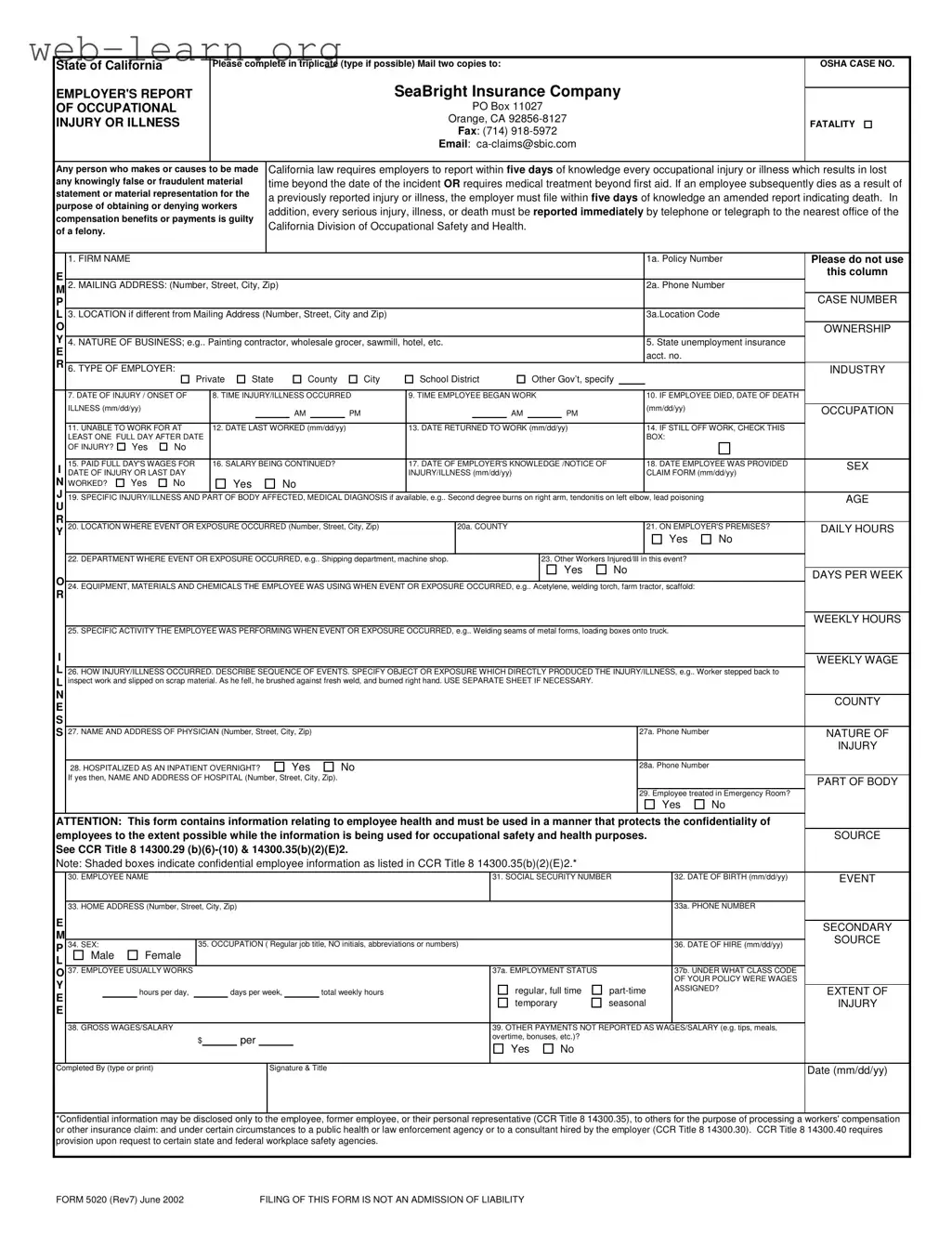
The 5020 California form is a critical document for employers reporting occupational injuries or illnesses. This form must be completed in triplicate and submitted to SeaBright Insurance Company within five days of the employer's knowledge of an incident that results in lost work time or requires medical treatment beyond first aid. It serves as an official record that not only tracks injuries but also ensures compliance with state regulations. Employers must provide detailed information, including the nature of the injury, the circumstances surrounding it, and the employee's work status. If an employee dies due to a reported injury, an amended report is required within five days. Additionally, serious injuries must be reported immediately to the California Division of Occupational Safety and Health. The form captures essential details such as the employee's personal information, the specifics of the injury, and the employer's knowledge of the incident. By adhering to these reporting requirements, employers help maintain workplace safety and ensure that employees receive the necessary care and benefits.

Sample - 5020 California Form

FORM 5020 (Rev7) June 2002 FILING OF THIS FORM IS NOT AN ADMISSION OF LIABILITY
Please complete in triplicate (type if possible) Mail two copies to:
OSHA CASE NO.
State of California
EMPLOYER'S REPORT
OF OCCUPATIONAL
INJURY OR ILLNESS
SeaBright Insurance Company
PO Box 11027
Orange, CA 92856-8127
Fax: (714) 918-5972
Email: ca-claims@sbic.com
FATALITY
Any person who makes or causes to be made
any knowingly false or fraudulent material
statement or material representation for the
purpose of obtaining or denying workers
compensation benefits or payments is guilty
of a felony.
California law requires employers to report within five days of knowledge every occupational injury or illness which results in lost
time beyond the date of the incident OR requires medical treatment beyond first aid. If an employee subsequently dies as a result of
a previously reported injury or illness, the employer must file within five days of knowledge an amended report indicating death. In
addition, every serious injury, illness, or death must be reported immediately by telephone or telegraph to the nearest office of the
California Division of Occupational Safety and Health.
1. FIRM NAME
1a. Policy Number
Please do not use
this column
2. MAILING ADDRESS: (Number, Street, City, Zip)
2a. Phone Number
CASE NUMBER
3. LOCATION if different from Mailing Address (Number, Street, City and Zip)
3a.Location Code
4. NATURE OF BUSINESS; e.g.. Painting contractor, wholesale grocer, sawmill, hotel, etc.
5. State unemployment insurance
acct. no.
OWNERSHIP
E
M
P
L
O
Y
E
R
6. TYPE OF EMPLOYER:
Private State County City School District Other Gov’t, specify
INDUSTRY
7. DATE OF INJURY / ONSET OF
ILLNESS (mm/dd/yy)
8. TIME INJURY/ILLNESS OCCURRED
AM
PM
9. TIME EMPLOYEE BEGAN WORK
AM
PM
10. IF EMPLOYEE DIED, DATE OF DEATH
(mm/dd/yy)
11. UNABLE TO WORK FOR AT
LEAST ONE FULL DAY AFTER DATE
OF INJURY?
Yes No
12. DATE LAST WORKED (mm/dd/yy)
13. DATE RETURNED TO WORK (mm/dd/yy)
14. IF STILL OFF WORK, CHECK THIS
BOX:
OCCUPATION
15. PAID FULL DAY'S WAGES FOR
DATE OF INJURY OR LAST DAY
WORKED?
Yes No
16. SALARY BEING CONTINUED?
Yes No
17. DATE OF EMPLOYER'S KNOWLEDGE /NOTICE OF
INJURY/ILLNESS (mm/dd/yy)
18. DATE EMPLOYEE WAS PROVIDED
CLAIM FORM (mm/dd/yy)
SEX
19. SPECIFIC INJURY/ILLNESS AND PART OF BODY AFFECTED, MEDICAL DIAGNOSIS if available, e.g.. Second degree burns on right arm, tendonitis on left elbow, lead poisoning
AGE
20. LOCATION WHERE EVENT OR EXPOSURE OCCURRED (Number, Street, City, Zip)
20a. COUNTY
21. ON EMPLOYER'S PREMISES?
Yes No
DAILY HOURS
22. DEPARTMENT WHERE EVENT OR EXPOSURE OCCURRED, e.g.. Shipping department, machine shop.
23. Other Workers Injured/Ill in this event?
Yes No
DAYS PER WEEK
24. EQUIPMENT, MATERIALS AND CHEMICALS THE EMPLOYEE WAS USING WHEN EVENT OR EXPOSURE OCCURRED, e.g.. Acetylene, welding torch, farm tractor, scaffold:
WEEKLY HOURS
25. SPECIFIC ACTIVITY THE EMPLOYEE WAS PERFORMING WHEN EVENT OR EXPOSURE OCCURRED, e.g.. Welding seams of metal forms, loading boxes onto truck.
WEEKLY WAGE
26. HOW INJURY/ILLNESS OCCURRED. DESCRIBE SEQUENCE OF EVENTS. SPECIFY OBJECT OR EXPOSURE WHICH DIRECTLY PRODUCED THE INJURY/ILLNESS, e.g.. Worker stepped back to
inspect work and slipped on scrap material. As he fell, he brushed against fresh weld, and burned right hand. USE SEPARATE SHEET IF NECESSARY.
COUNTY
27. NAME AND ADDRESS OF PHYSICIAN (Number, Street, City, Zip)
27a. Phone Number
NATURE OF
INJURY
28a. Phone Number
I
N
J
U
R
Y
O
R
I
L
L
N
E
S
S
28. HOSPITALIZED AS AN INPATIENT OVERNIGHT? Yes No
If yes then, NAME AND ADDRESS OF HOSPITAL (Number, Street, City, Zip).
29. Employee treated in Emergency Room?
Yes No
PART OF BODY
ATTENTION: This form contains information relating to employee health and must be used in a manner that protects the confidentiality of
employees to the extent possible while the information is being used for occupational safety and health purposes.
See CCR Title 8 14300.29 (b)(6)-(10) & 14300.35(b)(2)(E)2.
Note: Shaded boxes indicate confidential employee information as listed in CCR Title 8 14300.35(b)(2)(E)2.*
SOURCE
30. EMPLOYEE NAME
31. SOCIAL SECURITY NUMBER
32. DATE OF BIRTH (mm/dd/yy)
EVENT
33. HOME ADDRESS (Number, Street, City, Zip)
33a. PHONE NUMBER
34. SEX:
Male Female
35. OCCUPATION ( Regular job title, NO initials, abbreviations or numbers)
36. DATE OF HIRE (mm/dd/yy)
SECONDARY
SOURCE
37. EMPLOYEE USUALLY WORKS
hours per day,
days per week,
total weekly hours
37a. EMPLOYMENT STATUS
regular, full time
part-time
temporary
seasonal
37b. UNDER WHAT CLASS CODE
OF YOUR POLICY WERE WAGES
ASSIGNED?
E
M
P
L
O
Y
E
E
38. GROSS WAGES/SALARY
$
per
39. OTHER PAYMENTS NOT REPORTED AS WAGES/SALARY (e.g. tips, meals,
overtime, bonuses, etc.)?
Yes No
EXTENT OF
INJURY
Completed By (type or print) Signature & Title
Date (mm/dd/yy)
*Confidential information may be disclosed only to the employee, former employee, or their personal representative (CCR Title 8 14300.35), to others for the purpose of processing a workers' compensation
or other insurance claim: and under certain circumstances to a public health or law enforcement agency or to a consultant hired by the employer (CCR Title 8 14300.30). CCR Title 8 14300.40 requires
provision upon request to certain state and federal workplace safety agencies.

Form Information

Fact Name Description
Purpose The 5020 California form is used by employers to report occupational injuries or illnesses.
Submission Requirements Employers must complete the form in triplicate and send two copies to SeaBright Insurance Company.
Reporting Timeframe California law mandates that injuries resulting in lost time or requiring medical treatment be reported within five days of knowledge.
Amended Reports If an employee dies from a previously reported injury, an amended report must be filed within five days of knowledge of the death.
Immediate Reporting Serious injuries or deaths must be reported immediately to the California Division of Occupational Safety and Health.
Confidentiality The form contains confidential employee information and must be handled accordingly to protect privacy.
Legal Consequences Filing false information on the form is a felony under California law.
Governing Laws This form is governed by California Code of Regulations (CCR) Title 8, Sections 14300.29 and 14300.35.

Detailed Guide for Filling Out 5020 California

Completing the 5020 California form is an important step for employers when reporting occupational injuries or illnesses. This process ensures that necessary information is documented and submitted to the appropriate parties. After filling out the form, you will need to mail two copies to SeaBright Insurance Company and keep one for your records. Below are the steps to help you fill out the form accurately.

  1. Firm Name: Enter the name of your business.
  2. Policy Number: Provide your insurance policy number, but do not use the "E" column.
  3. Mailing Address: Fill in the complete mailing address, including street, city, and zip code.
  4. Phone Number: Include the phone number for your business.
  5. Location: If different from the mailing address, provide the location where the injury occurred.
  6. Ownership Type: Indicate the type of ownership (e.g., Private, State, County, etc.).
  7. Nature of Business: Describe your business type (e.g., painting contractor, hotel, etc.).
  8. Date of Injury/Onset of Illness: Enter the date the injury or illness occurred (mm/dd/yy).
  9. Time Injury/Illness Occurred: Specify the time of the incident (AM/PM).
  10. Time Employee Began Work: Indicate the time the employee started their shift (AM/PM).
  11. Date of Death: If applicable, enter the date of death related to the injury (mm/dd/yy).
  12. Unable to Work For: State how many days the employee is unable to work.
  13. Date Last Worked: Provide the last date the employee worked (mm/dd/yy).
  14. Date Returned to Work: If applicable, enter the date the employee returned to work (mm/dd/yy).
  15. Still Off Work: Check "Yes" or "No" to indicate if the employee is still off work.
  16. Paid Full Day's Wages: Indicate if the employee was paid a full day's wages for the day of the injury.
  17. Salary Being Continued: Check "Yes" or "No" regarding whether the employee's salary is being continued.
  18. Date of Employer's Knowledge: Enter the date you became aware of the injury or illness (mm/dd/yy).
  19. Date Employee Provided Claim Form: Fill in the date the employee received the claim form (mm/dd/yy).
  20. Specific Injury/Illness: Describe the injury or illness and the affected body part.
  21. Location of Event: Provide the address where the injury or exposure occurred.
  22. County: Indicate the county where the event took place.
  23. On Employer's Premises: Check "Yes" or "No" to indicate if the event occurred on your premises.
  24. Department: Specify the department where the event occurred.
  25. Other Workers Injured: Check "Yes" or "No" to indicate if other workers were affected.
  26. Equipment, Materials, and Chemicals: List any items the employee was using at the time of the incident.
  27. Specific Activity: Describe the activity the employee was performing when the event occurred.
  28. How Injury/Illness Occurred: Provide a detailed description of the sequence of events leading to the injury.
  29. Name and Address of Physician: Enter the physician's name and contact information.
  30. Hospitalized Overnight: Indicate if the employee was hospitalized overnight.
  31. Employee Treated in Emergency Room: Check "Yes" or "No" based on whether the employee received emergency treatment.
  32. Employee Name: Fill in the employee's full name.
  33. Social Security Number: Provide the employee's social security number.
  34. Date of Birth: Enter the employee's date of birth (mm/dd/yy).
  35. Home Address: Fill in the employee's home address.
  36. Phone Number: Provide the employee's phone number.
  37. Sex: Indicate the employee's gender (Male or Female).
  38. Occupation: Enter the employee's job title without using abbreviations.
  39. Date of Hire: Specify the employee's hire date (mm/dd/yy).
  40. Hours Worked: Indicate the employee's usual hours worked per day and week.
  41. Employment Status: Check the appropriate status (regular, full-time, part-time, etc.).
  42. Class Code: Provide the class code under which the employee's wages were assigned.
  43. Gross Wages/Salary: Enter the employee's gross wages or salary.
  44. Other Payments: Indicate if there are other payments not reported as wages.
  45. Completed By: Type or print the name of the person filling out the form, along with their signature and title.
  46. Date: Enter the date the form was completed (mm/dd/yy).

Obtain Answers on 5020 California

  1. What is the purpose of the 5020 California form?

    The 5020 California form is designed for employers to report occupational injuries or illnesses that occur in the workplace. This includes incidents that result in lost time beyond the date of the incident or require medical treatment beyond first aid. The form must be completed in triplicate and submitted to the designated insurance company.

  2. Who is required to fill out the 5020 form?

    Employers in California are required to complete the 5020 form whenever an employee experiences a work-related injury or illness that meets the reporting criteria. This includes private employers, state agencies, and various governmental entities.

  3. What information must be provided on the form?

    The form requires several pieces of information, including:

    • Employer's name and policy number
    • Details of the injury or illness, including date, time, and nature of the incident
    • Employee information, such as name, social security number, and occupation
    • Medical details, if applicable, such as the name of the treating physician and whether the employee was hospitalized

  4. When must the 5020 form be submitted?

    The form must be submitted within five days of the employer's knowledge of the injury or illness. If the employee dies as a result of the incident, an amended report must be filed within five days of that knowledge.

  5. How should the form be submitted?

    Employers must complete the form in triplicate. Two copies should be mailed to SeaBright Insurance Company at the specified address. Additionally, employers can also send the form via fax or email as provided on the form.

  6. What happens if false information is provided on the form?

    Providing false or fraudulent information on the 5020 form is considered a felony under California law. This applies to anyone who knowingly makes false statements to obtain or deny workers' compensation benefits.

  7. Is there any confidential information on the form?

    Yes, the form contains confidential employee information, such as social security numbers and medical details. Employers must handle this information with care and ensure it is used only for occupational safety and health purposes.

  8. What should an employer do if multiple employees are injured in the same incident?

    If more than one employee is injured, the employer must report each injury individually on separate forms. This ensures that all incidents are documented accurately and appropriately for workers' compensation purposes.

Common mistakes

Filling out the 5020 California form accurately is crucial for ensuring that occupational injuries or illnesses are reported correctly. However, many people make mistakes that can lead to delays or complications in processing claims. One common error is failing to provide complete information in the FIRM NAME and MAILING ADDRESS sections. Omitting details such as the complete address or policy number can create confusion and hinder communication with the insurance company.

Another frequent mistake involves the DATE OF INJURY and TIME INJURY/ILLNESS OCCURRED fields. It’s vital to enter the correct dates and times, as inaccuracies can affect the validity of the report. If the date of injury is not clearly documented, it may lead to disputes regarding the claim. Additionally, ensure that the time is noted in the correct format, as this can also complicate matters.

People often overlook the importance of detailing the SPECIFIC INJURY/ILLNESS AND PART OF BODY AFFECTED. Providing vague descriptions can lead to misunderstandings about the nature of the injury. It is essential to be as specific as possible, including medical diagnoses if available. This information is critical for both the employer’s records and the insurance company’s assessment of the claim.

Lastly, failing to indicate whether the employee was hospitalized or treated in an emergency room is a significant oversight. The HOSPITALIZED AS AN INPATIENT OVERNIGHT? and Employee treated in Emergency Room? questions must be answered accurately. This information helps the insurance company understand the severity of the injury and can impact the claim’s outcome. Ensuring that all sections of the form are completed with accurate and detailed information is essential for a smooth claims process.

Documents used along the form

The 5020 California form is a critical document for employers reporting occupational injuries or illnesses. In addition to this form, several other documents are often required or beneficial in the claims process. Below is a list of these documents, each serving a specific purpose in ensuring compliance and facilitating communication between employers, employees, and insurance companies.

  • Workers' Compensation Claim Form (DWC 1): This form is used by employees to formally initiate a claim for workers' compensation benefits. It outlines the nature of the injury and the circumstances surrounding it. The employee must complete this form and submit it to their employer, who then forwards it to the insurance carrier.
  • Employer's Report of Injury (Form 5021): This form serves as a supplementary report that employers must submit to their workers' compensation insurance carrier. It provides detailed information about the incident, including witness statements and any immediate actions taken following the injury.
  • Medical Authorization Form: This document allows the employer or insurance company to obtain medical records related to the employee's injury or illness. It ensures that the necessary medical information is accessible for processing the claim while maintaining confidentiality.
  • Return-to-Work Form: After an employee has been injured, this form is used to confirm their ability to return to work. It is typically completed by a medical professional and outlines any work restrictions or accommodations needed for the employee's safe reintegration into the workplace.

Understanding these additional forms and their purposes can streamline the claims process and ensure compliance with California's workers' compensation regulations. Proper documentation is essential for both employers and employees to navigate the complexities of occupational injury reporting and claims management effectively.

Similar forms

  • Form 300: Log of Work-Related Injuries and Illnesses - This document is used by employers to record all work-related injuries and illnesses. Similar to the 5020 form, it requires detailed information about the incident, including the nature of the injury and the affected body part.
  • Form 301: Injury and Illness Incident Report - This form provides a more detailed account of a specific incident. Like the 5020 form, it captures information about the employee, the circumstances of the injury, and the medical treatment received.
  • Form 8220: Employer's Report of Injury - This document serves a similar purpose to the 5020 form by reporting occupational injuries. It includes details about the injury, the employee's work status, and the employer's response.
  • Form DWC-1: Employee's Claim for Workers' Compensation Benefits - This form is completed by employees to initiate a workers' compensation claim. It shares similarities with the 5020 form in that it addresses the injury and the medical treatment required.
  • Form 5021: Employer's Report of Occupational Injury or Illness (Supplemental) - This supplemental form is used to provide additional information about an injury or illness already reported. It aligns with the 5020 form by emphasizing the need for timely and accurate reporting of workplace incidents.

Dos and Don'ts

When filling out the 5020 California form, it is essential to follow certain guidelines to ensure accuracy and compliance. Below is a list of things to do and avoid.

  • Do complete the form in triplicate, ensuring all copies are filled out accurately.
  • Do provide clear and concise information about the injury or illness, including specific details.
  • Do ensure that all required fields are filled in completely to avoid delays.
  • Do submit the form within five days of knowledge of the injury or illness.
  • Do keep a copy of the completed form for your records.
  • Don't leave any required fields blank; this can lead to processing issues.
  • Don't provide false or misleading information, as this is illegal and can have serious consequences.
  • Don't forget to report any serious injuries or deaths immediately by phone or telegraph.
  • Don't use abbreviations or initials for job titles; full titles are required.
  • Don't submit the form without reviewing it for accuracy and completeness.

Misconceptions

Understanding the 5020 California form is essential for employers. However, several misconceptions can lead to confusion. Here are seven common misunderstandings:

  • Filing the form is optional. Many believe that submitting the 5020 form is not mandatory. In reality, California law requires employers to report any occupational injury or illness that results in lost time or requires medical treatment beyond first aid.
  • Only serious injuries need to be reported. Some think that only severe injuries must be documented. However, any injury or illness that meets the reporting criteria must be reported, regardless of its severity.
  • Filing the form admits liability. There is a misconception that submitting the form implies the employer is admitting fault. This is not true; filing the form is simply a legal requirement and does not affect liability.
  • The form can be submitted at any time. Many believe they can take their time to file the form. In fact, employers must report injuries within five days of becoming aware of them.
  • Only physical injuries need to be reported. Some assume that only physical injuries are relevant. However, any occupational illness, including mental health issues, must also be reported.
  • All injuries require the same information. There is a belief that every injury requires the same level of detail. In reality, the specifics needed can vary based on the nature of the injury or illness.
  • Employers can ignore minor injuries. Some employers think they can overlook minor injuries. However, if an injury results in lost time or requires medical treatment, it must be reported.

Being aware of these misconceptions can help ensure compliance and protect both employers and employees. Properly understanding the requirements of the 5020 form is crucial for maintaining workplace safety and meeting legal obligations.

Key takeaways

Filling out and using the 5020 California form is crucial for employers reporting occupational injuries or illnesses. Here are some key takeaways to keep in mind:

  • Timely Reporting: Employers must report any occupational injury or illness that results in lost time or requires medical treatment beyond first aid within five days of learning about the incident.
  • Amended Reports: If an employee dies due to a previously reported injury, an amended report must be filed within five days of knowledge of the death.
  • Immediate Notification: Serious injuries, illnesses, or fatalities must be reported immediately by phone or telegraph to the California Division of Occupational Safety and Health.
  • Accurate Information: Ensure all sections of the form are filled out accurately, including employee details, nature of the injury, and specifics about the incident.
  • Confidentiality Matters: Handle the form with care, as it contains confidential employee information that must be protected.

By following these guidelines, employers can ensure compliance with California law and contribute to a safer workplace.