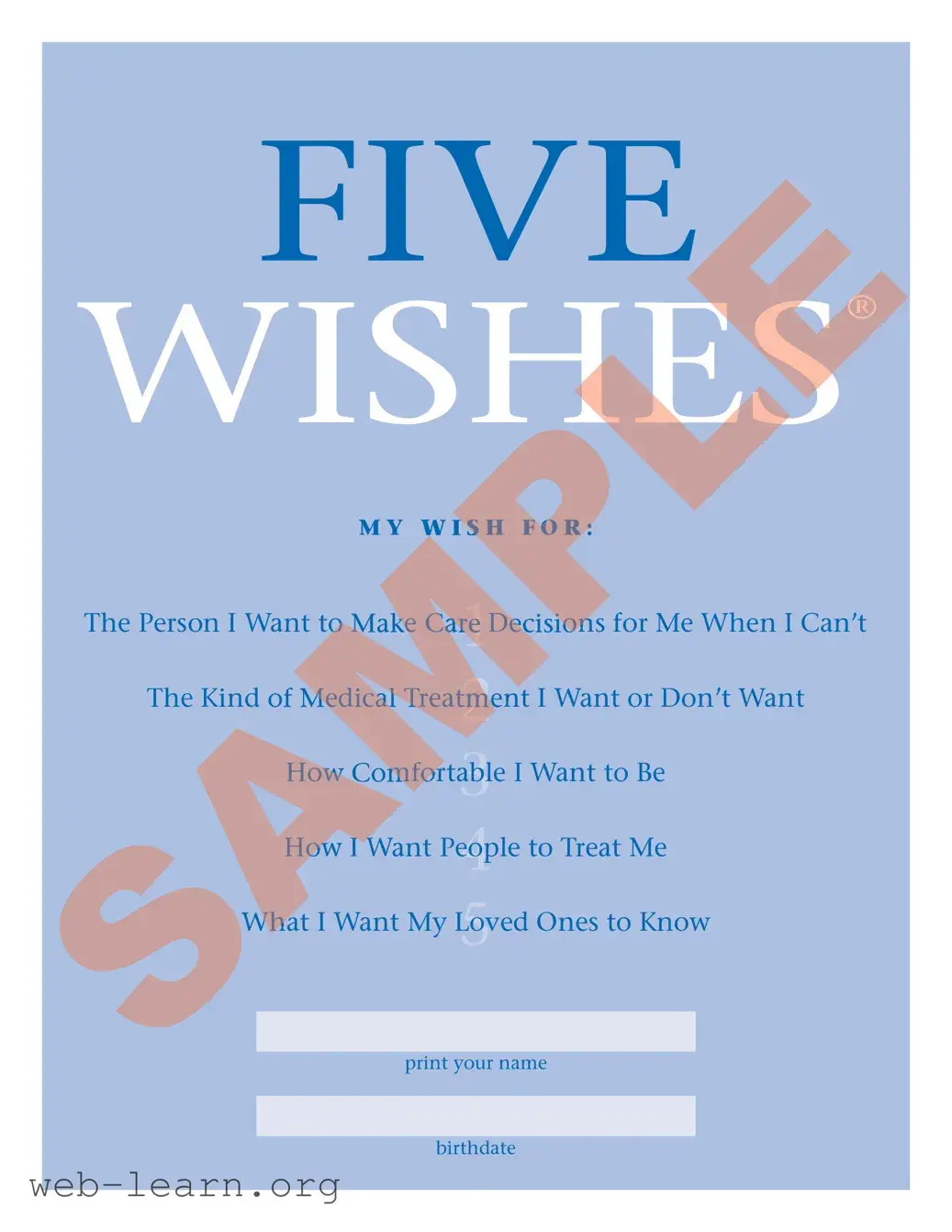
Homepage Blank 5 Wishes Document Form
Contents

When faced with serious health decisions, many people find comfort in expressing their wishes ahead of time. The Five Wishes document facilitates this process, allowing individuals to voice not only their medical preferences but also their emotional and spiritual needs. With this easy-to-complete form, you designate a trusted person to make healthcare decisions on your behalf if you become unable to do so yourself. Additionally, it empowers you to specify the kind of medical treatment you desire or wish to avoid, as well as how comfortable you want to feel during treatment. This document encourages open conversations with loved ones about your desires, alleviating the burden of making difficult choices in stressful situations. Notably, Five Wishes has gained recognition as the first living will that encompasses personal care in conjunction with medical directives. Developed with insights from legal experts and healthcare professionals, it serves as a resource for people aged 18 and older, regardless of their marital status or family structure. It is currently valid in numerous states, offering guidance on how individuals can communicate their preferences effectively to family, caregivers, and medical providers.


Sample - 5 Wishes Document Form

1
1
2
3
4
5
MY WISH FOR:
The Person I Want to Make Care Decisions for Me When I Can’t
The Kind of Medical Treatment I Want or Don’t Want
How Comfortable I Want to Be
How I Want People to Treat Me
What I Want My Loved Ones to Know
Print Your Name
Birthdate
2
T
here are many things in life that are out of our hands. This Five Wishes
document gives you a way to control something very important — how
you are treated if you get seriously ill. It is an easy-to-complete form that
lets you say exactly what you want. Once it is filled out and properly signed,
it is valid under the laws of most states.
Five Wishes is the first living will (also called an advance directive) that talks about your personal,
emotional, and spiritual needs as well as your medical wishes. It lets you choose the person you want
to make health care decisions for you if you are not able to make them for yourself. Five Wishes lets
you say exactly how you wish to be treated if you get seriously ill. It was written with the help of the
nation’s leading experts in end-of-life care. It’s also easy to use. All you have to do is check a box,
circle a direction, or write a few sentences.
What Is Five Wishes?
It lets you talk with your family, friends and
doctor about how you want to be treated if
you become seriously ill.
Your family members will not have to guess
what you want. It protects them
if you become seriously ill, because
they won’t have to make hard choices
without knowing your wishes.
You can know what your mom, dad,
spouse, or friend wants. You can be there
for them when they need you most. You will
understand what they really want.
How Five Wishes Can Help You And Your Family
How Five Wishes Began
For 12 years, Jim Towey worked closely with Mother Teresa, and, for one year, he lived in a hospice
she ran in Washington, DC. Inspired by this first-hand experience, Mr. Towey sought a way for
patients and their families to plan ahead and to cope with serious illness. The result is Five Wishes and
the response to it has been overwhelming. It has been featured on CNN and NBC’s Today Show and
in the pages of Time and Money magazines. Newspapers have called Five Wishes the first “living will
with a heart and soul.” Today, Five Wishes is available in 30 languages.
3
Five Wishes was created with help from the American Bar Association’s Commission on Law and
Aging. If you live in the District of Columbia or most states you can use Five Wishes and have
the peace of mind to know that it substantially meets your state’s requirements under the law.
If you live in one of four states (Kansas, New Hampshire, Ohio, or Texas) you can still use Five
Wishes but may need to take an extra step. Find out more at FiveWishes.org/states.
You may already have a living will or a durable power of attorney for health care. If you want to use
Five Wishes instead, all you need to do is fill out and sign a new Five Wishes as directed. As soon as
you sign it, it takes away any advance directive you had before. To make sure the right form is used,
please do the following:
Five Wishes is for anyone 18 or older — married, single, parents, adult children, and friends. More
than 40 million people of all ages have already used it. Because it works so well, lawyers, doctors,
hospitals and hospices, faith communities, employers, and retiree groups are handing out this
document.
People who use Five Wishes find that it helps them express all that they want and provides a helpful
guide to family members, friends, care givers and doctors. Most doctors and health care professionals
know they need to listen to your wishes no matter how you express them.
Who Should Use Five Wishes
Five Wishes In My State
How Do I Change To Five Wishes?
Destroy all copies of your old living will or
durable power of attorney for healthcare.
Or you can write “revoked” in large letters
across the copy you have. Tell your lawyer
if he or she helped prepare those old forms
for you.
Tell your Health Care Agent, family
members, and doctor that you have filled out
a new Five Wishes. Make sure they know
about your new wishes.
4
I
f I am no longer able to make my own health care
decisions, this form names the person I choose to
make these choices for me. This person will be my
Health Care Agent (or other term that may be used in
my state, such as proxy, representative, or surrogate).
This person will make my health care choices if both
of these things happen:
My attending or treating doctor finds I am no
longer able to make health care choices, AND
Another health care professional agrees that
this is true.
If my state has a different way of finding that I am not
able to make health care choices, then my state’s way
should be followed.
WISH 1
The Person I Want To Make Health Care Decisions For Me
When I Can’t Make Them For Myself.
Choose someone who knows you very well, cares
about you, and who can make difficult decisions.
A spouse or family member may not be the best
choice because they are too emotionally involved.
Sometimes they are the best choice. You know
best. Choose someone who is able to stand up for
you so that your wishes are followed. Also, choose
someone who is likely to be nearby so they can
help when you need them. Whether you choose a
spouse, family member, or friend as your Health
Care Agent, make sure you talk about these wishes
and be sure that this person agrees to respect and
follow your wishes. Your Health Care Agent
should be at least 18 years or older (in Colorado,
21 years or older) and should not be:
Your health care provider, including the
owner or operator of a health or residential
or community care facility serving you.
An employee or spouse of an employee of
your health care provider.
Serving as an agent or proxy for 10 or
more people unless he or she is your
spouse or close relative.
Picking The Right Person To Be Your Health Care Agent
If this person is not able or willing to make these choices for me, OR is divorced or legally separated from
me, OR this person has died, then these people are my next choices:
First Choice Name
Address
Phone
City/State/Zip
The Person I Choose As My Health Care Agent Is:
Second Choice Name
Address
City/State/Zip
Phone
Third Choice Name
Address
City/State/Zip
Phone
5
I understand that my Health Care Agent can make health care decisions for me. I want my Agent to be able to do
the following: (Please cross out anything you don’t want your Agent to do that is listed below.)
Make choices for me about my medical care or
services, like tests, medicine, or surgery. This
care or service could be to find out what my
health problem is, or how to treat it. It can also
include care to keep me alive. If the treatment or
care has already started, my Health Care Agent
can keep it going or have it stopped.
Interpret any instructions I have given in this
form or given in other discussions, according to
my Health Care Agent’s understanding of my
wishes and values.
Consent to admission to an assisted living
facility, hospital, hospice, or nursing home for
me. My Health Care Agent can hire any kind of
health care worker I may need to help me or take
care of me. My Agent may also fire a health care
worker, if needed.
Make the decision to request, take away, or not
give medical treatments, including artificially-
provided food and water, and any other
treatments to keep me alive.
See and approve release of my medical records
and personal files. If I need to sign my name to
get any of these files, my Health Care Agent can
sign it for me.
Move me to another state to get the care I need or
to carry out my wishes.
Authorize or refuse to authorize any medication
or procedure needed to help with pain.
Take any legal action needed to carry out my
wishes.
Donate useable organs or tissues of mine as
allowed by law.
Apply for Medicare, Medicaid, or other programs
or insurance benefits for me. My Health Care
Agent can see my personal files, like bank
records, to find out what is needed to fill out
these forms.
Listed below are any changes, additions, or
limitations on my Health Care Agent’s powers.
Destroy all copies of this part of the Five Wishes
form. OR
Tell someone, such as my doctor or family, that I
want to cancel or change my Health Care Agent.
OR
Write the word “Revoked” in large letters across
the name of each agent whose authority I want to
cancel. Sign my name on that page.
If I Change My Mind About Having A Health Care Agent, I Will
6
My Wish For The Kind Of Medical Treatment
I Want Or Don’t Want.
I
believe that my life is precious and I deserve to be treated with dignity. When the time comes that
I am very sick and am not able to speak for myself, I want the following wishes, and any other
directions I have given to my Health Care Agent, to be respected and followed.
What You Should Keep In Mind As My Caregiver
I do not want to be in pain. I want to be
comfortable. Wish 3 says what can be done to
make me comfortable.
I want to be offered food and fluids by mouth if it
is safe for me to eat and drink. I want to be kept
clean and warm.
I do not want anything done or omitted by my
doctors or nurses with the intention of taking
my life.
Life-support treatment means any medical procedure, device, or medication to keep me alive. Life-support
treatment includes: medical devices put in me to help me breathe; food and water supplied by medical device
(tube feeding); cardiopulmonary resuscitation (CPR); major surgery; blood transfusions; dialysis; antibiotics;
and anything else meant to keep me alive. If I wish to limit the meaning of life-support treatment because of
my religious or personal beliefs, I write this limitation in the space below. I do this to make very clear what I
want and under what conditions.
What “Life-Support Treatment” Means To Me
If you have a medical emergency and
ambulance personnel arrive, they may look
to see if you have a Do Not Resuscitate form
or bracelet. Many states require a person to
have a Do Not Resuscitate form filled out
and signed by a doctor if you choose not to be
resuscitated. This form lets ambulance personnel
know that you don’t want them to use life-support
treatment when you are dying. Please check with
your doctor to see if you need to have a Do Not
Resuscitate form filled out.
In Case Of An Emergency
WISH 2
7
Close To Death:
If my doctor and another health care professional both
decide that I am likely to die within a short period of
time, and life-support treatment would only delay the
moment of my death (choose one of the following):
o
I want to have life-support treatment.
o I do not want life-support treatment. If it has been
started, I want it stopped.
o I want to have life-support treatment if my doctor
believes it could help. But I want my doctor to
stop giving me life-support treatment if it is not
helping my health condition or symptoms.
In A Coma And Not Expected To
Wake Up Or Recover:
If my doctor and another health care professional
both decide that I am in a coma from which I am
not expected to wake up or recover, and I have brain
damage, and life-support treatment would only
delay the moment of my death (choose one of the
following):
o
I want to have life-support treatment.
o I do not want life-support treatment. If it has been
started, I want it stopped.
o
I want to have life-support treatment if my doctor
believes it could help. But I want my doctor to stop
giving me life-support treatment if it is not helping
my health condition or symptoms.
Permanent And Severe Brain Damage
And Not Expected To Recover:
If my doctor and another health care professional both
decide that I have permanent and severe brain damage,
(for example, I can open my eyes, but I can not speak
or understand) and I am not expected to get better, and
life-support treatment would only delay the moment
of my death (choose one of the following):
o I want to have life-support treatment.
o I do not want life-support treatment. If it has been
started, I want it stopped.
o I want to have life-support treatment if my doctor
believes it could help. But I want my doctor to
stop giving me life-support treatment if it is not
helping my health condition or symptoms.
In Another Condition Under Which I
Do Not Wish To Be Kept Alive:
If there is another condition under which I do not wish
to have life-support treatment, I describe it below. In
this condition, I believe that the costs and burdens of
life-support treatment are too much and not worth the
benefits to me. Therefore, in this condition, I do not
want life-support treatment. (For example, you may
write “end-stage condition.” That means that your
health has gotten worse. You are not able to take care
of yourself in any way, mentally or physically. Life-
support treatment will not help you recover. Please
leave the space blank if you have no other condition
to describe.)
Here is the kind of medical treatment that I want or don’t want in the four situations listed below. I want my Health
Care Agent, my family, my doctors and other health care providers, my friends, and all others to know these directions.
8
I wish to have people with me when possible.
I want someone to be with me when it seems that
death may come at any time.
I wish to have my hand held and to be talked to
when possible, even if I don’t seem to respond to
the voice or touch of others.
I wish to have others by my side praying for me
when possible.
I wish to have the members of my faith
community told that I am sick and asked to pray
for me and visit me.
I wish to be visited by a chaplain or clergy.
I wish to be cared for with kindness and
cheerfulness, and not sadness.
I wish to have pictures of my loved ones in my
room, near my bed.
I wish to have my favorite music played when
possible until my time of death.
I want to die in my home, if that can be done.
I wish to be called by my name.
Please call me:
I do not want to be in pain. I want my doctor
to give me enough medicine to relieve my pain,
even if that means I will be drowsy or sleep
more than I would otherwise.
If I show signs of depression, nausea, shortness
of breath, or hallucinations, I want my care givers
to do whatever they can to help me.
I wish to have a cool moist cloth put on my head
if I have a fever.
I want my lips and mouth kept moist to stop
dryness.
I wish to have warm baths often. I wish to be
kept fresh and clean at all times.
I wish to be massaged with warm oils as often as
I can be.
If I am not able to control my bowel or bladder
functions, I wish for my clothes and bed linens to
be kept clean, and for them to be changed as soon
as they can be if they have been soiled.
I wish to have personal care like shaving, nail
clipping, hair brushing, and teeth brushing, as
long as they do not cause me pain or discomfort.
I wish to have religious or spiritual readings and
well-loved poems read aloud when I am near
death.
I wish to know about options for hospice care to
provide medical, emotional, and spiritual care for
me and my loved ones.
T
he next three wishes deal with my personal, spiritual, and emotional wishes. They are important to me.
I want to be treated with dignity near the end of my life, so I would like people to do the things written
in Wishes 3, 4, and 5 when they can be done. I understand that my family, my doctors and other health care
providers, my friends, and others may not be able to do these things or are not required by law to do these
things. I do not expect the following wishes to place new or added legal duties on my doctors or other health
care providers. I also do not expect these wishes to excuse my doctor or other health care providers from giving
me the proper care asked for by law.
WISH 3
My Wish For How Comfortable I Want To Be.
(Please cross out anything that you don’t agree with.)
WISH 4
My Wish For How I Want People To Treat Me.
(Please cross out anything that you don’t agree with.)
9
WISH 5
My Wish For What I Want My Loved Ones To Know.
(Please cross out anything that you don’t agree with.)
I wish to have my family and friends know that I
love them.
I wish to be forgiven for the times I have hurt my
family, friends, and others.
I wish to have my family, friends, and others
know that I forgive them for when they may have
hurt me in my life.
I wish for my family and friends to know that I
do not fear death. I think it is not the end, but a
new beginning for me.
I wish for all of my family members to make
peace with each other before my death, if they
can.
I wish for my family and friends to think about
what I was like before I became seriously ill. I
want them to remember me in this way after my
death.
I wish for my family and friends and caregivers
to respect my wishes even if they don’t agree
with them.
I wish for my family and friends to look at
my dying as a time of personal growth for
everyone, including me. This will help me live a
meaningful life in my final days.
I wish for my family and friends to get
counseling if they have trouble with my death. I
want memories of my life to give them joy and
not sorrow.
After my death, I would like my body to be
(circle one): buried OR cremated.
My body or remains should be put in the
following location:
The following person knows my funeral wishes:
If anyone asks how I want to be remembered, please say the following about me:
If there is to be a memorial service for me, I wish for this service to include the following
(list music, songs, readings, or other specific requests that you have):
It is important for my health care providers to know what matters most to me. I wish for them to know the
following:
Please use the space below for any other wishes. For example, you may want to donate any or all parts of your
body when you die. You may also wish to designate a charity to receive memorial contributions. Or you may
want to give instructions on what should be done with your social media or other electronic records. Please
attach a separate sheet of paper if you need more space.
10
Please make sure you sign your Five Wishes in the presence of two witnesses.
I, , ask that my family, my doctors, and other health care providers, my
friends, and all others, follow my wishes as communicated by my Health Care Agent (if I have one and he or
she is available), or as otherwise expressed in this form. This form becomes valid when I am unable to make
decisions or speak for myself. If any part of this form cannot be legally followed, I ask that all other parts of this
form be followed. I also revoke any health care advance directives I have made before.
STATE OF___________________________________ COUNTY OF________________________________
On this _____ day of __________________, 20_____, the said ________________________________________________________,
_______________________________, and ______________________________, known to me (or satisfactorily proven) to be the person named in
the foregoing instrument and witnesses, respectively, personally appeared before me, a Notary Public, within and for the State and County aforesaid,
and acknowledged that they freely and voluntarily executed the same for the purposes stated therein.
My Commission Expires:
Notary Public
Signing My Five Wishes
Notarization
Only required for residents of Missouri, North Carolina, South Carolina, and West Virginia
If you live in Missouri, only your signature should be notarized. If you live in North Carolina, South Carolina or West Virginia, you should have your
signature, and the signatures of your witnesses, notarized.
Witness Statement(2 witnesses needed):
I, the witness, declare that the person who signed or acknowledged this form (hereafter “person”) is personally
known to me, that he/she signed or acknowledged this [Health Care Agent and/or Living Will form(s)] in my
presence, and that he/she appears to be of sound mind and under no duress, fraud, or undue influence.
I also declare that I am over 18 years of age (19 in Alabama) and am NOT:
(Some states may have fewer rules about who may be a witness. Unless you know your state’s rules, please follow the above.)
Signature of Witness #1
Printed Name of Witness
Address
Phone
Signature of Witness #2
Printed Name of Witness
Address
Phone
The individual appointed as (agent/proxy/
surrogate/patient advocate/representative) by this
document or his/her successor,
The person’s health care provider, including
owner or operator of a health, long-term care,
or other residential or community care facility
serving the person,
An employee of the person’s health care provider,
Financially responsible for the person’s health care,
An employee of a life or health insurance
provider for the person,
Related to the person by blood, marriage, or
adoption,
A beneficiary of any legal instrument, account, or
benefit plan of the person, and,
To the best of my knowledge, a creditor of the
person or entitled to any part of his/her estate
under a will or codicil, by operation of law.
Signature Address
Phone Date Address (cont.)

Form Information

Fact Name Fact Details
Purpose The Five Wishes document allows individuals to specify their medical, emotional, and spiritual care preferences in case of serious illness.
Validity Once properly filled out and signed, Five Wishes is generally valid in most U.S. states.
Health Care Agent The document enables individuals to designate a trusted person to make health care decisions when they cannot speak for themselves.
Inclusivity It is designed for anyone aged 18 and older, including married individuals, single persons, and parents.
Ease of Use The form can be completed by checking boxes, circling options, or writing brief statements, making it user-friendly.
State-Specific Legality In states like California and Illinois, Five Wishes meets specific legal requirements, allowing it to function as a valid advance directive.
Changing Wishes Individuals can revoke previous directives by destroying old copies of them and notifying their health care agent or doctor.
Widespread Adoption Over 19 million people have utilized the Five Wishes document, reflecting its popularity and acceptance among various communities.

Detailed Guide for Filling Out 5 Wishes Document

Filling out the Five Wishes Document is an important step for personal health care planning. This document allows individuals to express their preferences regarding medical treatment and appoint a health care agent to make decisions if needed. Follow these steps to complete the form efficiently.

  1. Obtain the Form: Download or print the Five Wishes Document from a reliable source.
  2. Print Your Name: Write your full name on the designated line at the top of the form.
  3. Enter Your Birthdate: Fill in your date of birth next to your name.
  4. Designate a Health Care Agent: In the section labeled “The Person I Want to Make Health Care Decisions for Me When I Can’t,” write the name, phone number, and address of your chosen health care agent. This person should be someone you trust and who understands your wishes.
  5. Select Alternatives: If your first choice is unavailable, list two alternatives with their respective contact information.
  6. Outline Medical Treatment Preferences: Indicate your preferences for medical treatments by checking boxes or writing brief descriptions in the space provided.
  7. Specify Comfort Preferences: Describe how comfortable you want to be in various situations if you become ill.
  8. Express Treatment Preferences: Clearly state how you want to be treated by family and caregivers in any circumstances related to your health care.
  9. Notes for Loved Ones: Under “What I Want My Loved Ones to Know,” add any important messages or instructions you wish to convey.
  10. Sign and Date: Sign and date the form, confirming that this document reflects your wishes.
  11. Store Safely: Keep the completed document in a safe place and share copies with your health care agent, family members, and your doctor.

Obtain Answers on 5 Wishes Document

  1. What is the Five Wishes document?

    The Five Wishes document is a legal form that allows individuals to express their personal, emotional, and spiritual needs regarding medical treatment. It helps ensure that your health care preferences are known and respected, especially if you become seriously ill and unable to communicate those wishes. It is designed to clarify your desires regarding medical care and who will make decisions on your behalf when you cannot.

  2. Who can use the Five Wishes form?

    Anyone who is 18 years old or older can use the Five Wishes form. This includes individuals who are married, single, parents, or adult children. It's a helpful tool for anyone wanting to clarify their health care wishes. Over 19 million people have used it to ensure their preferences are known and to provide peace of mind for both themselves and their family members.

  3. How does Five Wishes differ from a traditional living will?

    Unlike a traditional living will that typically focuses only on medical decisions, Five Wishes encompasses emotional and spiritual needs as well. It allows you to specify not only what types of medical treatments you want or do not want, but also how you wish to be treated by your caregivers, and what you want your loved ones to know about your preferences. It is a more comprehensive approach to advance care planning.

  4. Can I change my Five Wishes document once I have filled it out?

    Yes, you can change your Five Wishes document at any time. If you decide that you want to create a new document, simply fill out a new Five Wishes form and sign it. Make sure to destroy all copies of your previous documents, or mark them as “revoked.” Additionally, inform your health care agent and family members of the changes you have made.

  5. Is Five Wishes valid in all states?

    The Five Wishes document is valid in the District of Columbia and in 42 states. If you live in one of these areas, it will meet the legal requirements for advance directives. However, for those living in states that are not listed, while it may not meet specific legal requirements, many health care professionals respect the wishes expressed in the Five Wishes document as guidance.

  6. How do I fill out the Five Wishes document?

    Filling out the Five Wishes document is straightforward. You'll need to complete the form by providing your name, birthdate, and other relevant details. You can check boxes, circle options, and write notes to express your preferences. Once you complete the document, sign and date it to make it official. It’s also important to discuss your choices with your family and the person you choose to act as your health care agent.

Common mistakes

Filling out the Five Wishes document can provide clarity and peace of mind regarding end-of-life care. However, many people make mistakes when completing this important form.

One common error is not naming a specific health care agent. Individuals may simply list a family member or friend without discussing their decision with that person beforehand. A health care agent should not only be someone you trust but also someone who understands your values and wishes for medical treatment. Without prior communication, the chosen agent may feel unprepared to make vital decisions on your behalf.

Another mistake is unclear or vague instructions regarding medical treatment preferences. It’s essential to articulate whether you want certain procedures or medications administered. Using vague terms can lead to confusion and differing interpretations by medical staff or loved ones. Clearly stating your preferences helps ensure that your desires are honored during difficult circumstances.

Failure to sign and date the form correctly can render it invalid. Even if someone goes through the effort of completing the document, neglecting to follow the signing protocol can undermine the entire process. Additionally, not informing key family members or your health care agent about the completed form can lead to discrepancies when decisions need to be made.

People also often overlook choosing backup agents. Designating primary and secondary health care agents ensures that someone is available to advocate for you if your first choice is unable to serve. Without backups, there may be delays in decision-making during critical times.

Lastly, individuals sometimes forget to revisit their Five Wishes document periodically. Life circumstances change, including relationships and medical conditions. Reviewing and updating the document regularly ensures that it always reflects your current wishes.

Understanding these common mistakes can promote a more effective use of the Five Wishes document, allowing individuals the opportunity to express their wishes clearly and confidently.

Documents used along the form

The Five Wishes document serves as an essential tool for expressing one's healthcare preferences. Along with this document, several other forms and documents can work together to ensure your wishes are honored during serious illness or incapacity. These documents help clarify your decisions and simplify communication among family members and healthcare providers.

  • Advance Directive: A general term for legal documents that provide instructions about medical care if you become unable to communicate your wishes. This can include both a living will and a durable power of attorney for healthcare.
  • Durable Power of Attorney for Healthcare: This document designates someone (your agent) to make health care decisions on your behalf if you are unable to do so. It is strictly limited to health-related matters.
  • Living Will: A written statement that details the types of medical treatments you wish to accept or refuse in the event of a terminal illness or irreparable condition. It guides healthcare providers on your preferences.
  • Do Not Resuscitate (DNR) Order: An order that instructs medical personnel not to perform CPR if your heart stops or if you stop breathing. This form is specific and requires attention from your healthcare provider.
  • Healthcare Proxy: Similar to a durable power of attorney, this document appoints someone to make medical decisions for you when you cannot speak for yourself, typically based on the principles outlined in your living will.
  • Organ Donation Form: A document that expresses your wishes regarding organ donation. It can be done through a driver's license application or a separate written form, informing healthcare providers of your desires.
  • Physician Orders for Life-Sustaining Treatment (POLST): A medical order that specifies the treatments you want in emergencies. This form is designed for patients with serious illness and complements the advance directive.
  • Funeral Arrangements Document: This document outlines your preferences for funeral services and burial or cremation. It helps relieve family members from making difficult decisions in a time of grief.
  • Family Information Form: A document that lists important contacts and healthcare providers. It can also include medications and medical history, ensuring caregivers have necessary information readily available.
  • Grief Support Document: This provides information about resources for family members to find support following a loved one’s passing. It can include helplines, support groups, and counseling services.

Using these documents alongside the Five Wishes form builds a comprehensive framework for managing healthcare decisions. They help ensure that your preferences are clearly communicated and honored, providing peace of mind to you and your loved ones at critical moments.

Similar forms

The Five Wishes document serves as a comprehensive advance directive for healthcare decisions. It bears similarities to several other legal documents that also address healthcare preferences and decision-making. Below are five such documents:

  • Living Will: Like the Five Wishes document, a living will allows individuals to specify their medical treatment preferences in case they become incapacitated. It focuses on life-sustaining treatments and end-of-life care options.
  • Durable Power of Attorney for Health Care: This document designates a specific person to make healthcare decisions on behalf of an individual if they are unable to do so. Five Wishes includes this concept by allowing individuals to choose a health care agent and specify their wishes.
  • Advance Directive: An advance directive is a broader term that encompasses both living wills and durable powers of attorney for health care. It serves to outline an individual's healthcare wishes and appoint decision-makers, similar to the provisions within Five Wishes.
  • Health Care Proxy: This document appoints someone to make medical decisions for an individual, usually when they are incapacitated. Five Wishes shares this function by identifying a chosen health care agent who will act according to the individual's expressed desires.
  • Do Not Resuscitate (DNR) Order: A DNR order is specifically focused on preventing resuscitation efforts during cardiac or respiratory arrest. While Five Wishes covers a broader range of medical decisions, it allows individuals to express their preferences about treatment and intervention, which can include DNR wishes.

Dos and Don'ts

When filling out the 5 Wishes Document form, consider the following important guidelines:

  • Be clear and specific about your preferences. Ambiguity can lead to confusion.
  • Choose a trusted person as your Health Care Agent, someone who understands your wishes.
  • Communicate your wishes openly with your family and selected agent. This helps avoid difficult discussions later.
  • Review the form carefully before signing. Make sure all information is accurate.
  • Keep a copy of the signed document in a safe and accessible place for easy reference.
  • Don't rush through the process. Take your time to think through your decisions fully.
  • Don't hesitate to seek help if you have questions. It's important that you understand the document.

Misconceptions

There are several misconceptions surrounding the Five Wishes document that can create confusion about its purpose and effectiveness. Below is a list of these common misconceptions, along with clarifications to help individuals better understand this important document.

  1. Five Wishes is only for elderly individuals. Many people assume that this document is only necessary for those who are older. In reality, anyone 18 years or older can benefit from having a Five Wishes document, regardless of their age or health status.
  2. Five Wishes replaces the need for a will. Some believe that Five Wishes can take the place of a legal will. However, Five Wishes specifically addresses healthcare preferences and does not cover estate planning or distribution of assets after death.
  3. Five Wishes is only valid in certain states. While it's true that Five Wishes needs to be compliant with state laws, it is valid in many states, including 42 listed jurisdictions. Even if your state is not included, filling out Five Wishes can still help guide your loved ones in making decisions aligned with your values.
  4. My family automatically knows my wishes. Many people think their family members simply understand their healthcare preferences. This misconception can lead to confusion and conflict during critical times. Communicating your wishes and documenting them in Five Wishes ensures that everyone knows what you want.
  5. Five Wishes is just a legal document. Some might view Five Wishes as merely a legal form, but it is much more than that. It addresses personal, emotional, and spiritual needs in addition to medical wishes, allowing for a comprehensive approach to care.
  6. Having a Five Wishes document means I will not receive necessary medical treatment. This is a common fear, but Five Wishes does not deny necessary care. Instead, it clarifies your preferences regarding the type of treatment you want or do not want in specific medical situations.
  7. Five Wishes is difficult to understand and complete. Many believe that completing Five Wishes requires legal knowledge or technical expertise. In reality, it is designed to be user-friendly, requiring only basic information and clear communication about your desires for healthcare.
  8. Once completed, my wishes cannot change. Some think that the choices made in Five Wishes are permanent. In fact, you can modify or revoke your Five Wishes document at any time by following the appropriate steps outlined in the document.

By dispelling these misconceptions, individuals can better understand how Five Wishes serves as a valuable tool in planning for healthcare decisions and ensuring that their preferences are honored.

Key takeaways

  • Five Wishes is a living will that covers personal, emotional, and spiritual needs in addition to medical wishes.
  • The document allows you to choose a person, known as your Health Care Agent, to make medical decisions on your behalf if you are unable to do so.
  • It is easy to complete. You just check boxes, circle options, or write brief statements where necessary.
  • Once filled out and signed, the Five Wishes document is accepted in most states as a legal advance directive.
  • Having Five Wishes aids in family discussions, ensuring loved ones know your preferences, thus sparing them from making tough choices without guidance.
  • It is designed for anyone aged 18 or older. Over 19 million people across various backgrounds have utilized it.
  • If you have a previous living will or health care power of attorney, signing a new Five Wishes document revokes the old documents.
  • Make sure to communicate your new wishes to your family, friends, and doctors to eliminate any confusion.
  • You may use the document in the District of Columbia and 42 states. Ensure your state is included before proceeding.
  • Five Wishes emphasizes personal preferences. It provides a detailed guide about medical treatment and care that reflects your values.