Homepage Blank 440 3640A Oregon Form
Outline

The 440 3640A Oregon form, known as the Irrevocable Standby Letter of Credit, serves a critical role in the realm of workers' compensation for self-insured employers in Oregon. This form is issued by a bank and acts as a financial guarantee to the Oregon Department of Consumer and Business Services, ensuring that self-insured employers meet their workers' compensation liabilities. Key components of the form include the issuing bank's details, the amount of credit, and specific conditions under which the letter can be drawn upon. The form outlines the circumstances that allow the beneficiary to request payment, such as defaults in payment or bankruptcy of the self-insured employer. It is designed to provide security for the state against potential non-compliance by self-insured entities, thus safeguarding the interests of workers. Additionally, the letter of credit automatically extends unless the issuing bank provides prior notice of non-renewal. Understanding the intricacies of this form is essential for both self-insured employers and their financial institutions, as it ensures compliance with Oregon's workers' compensation laws and protects the rights of employees.

Sample - 440 3640A Oregon Form

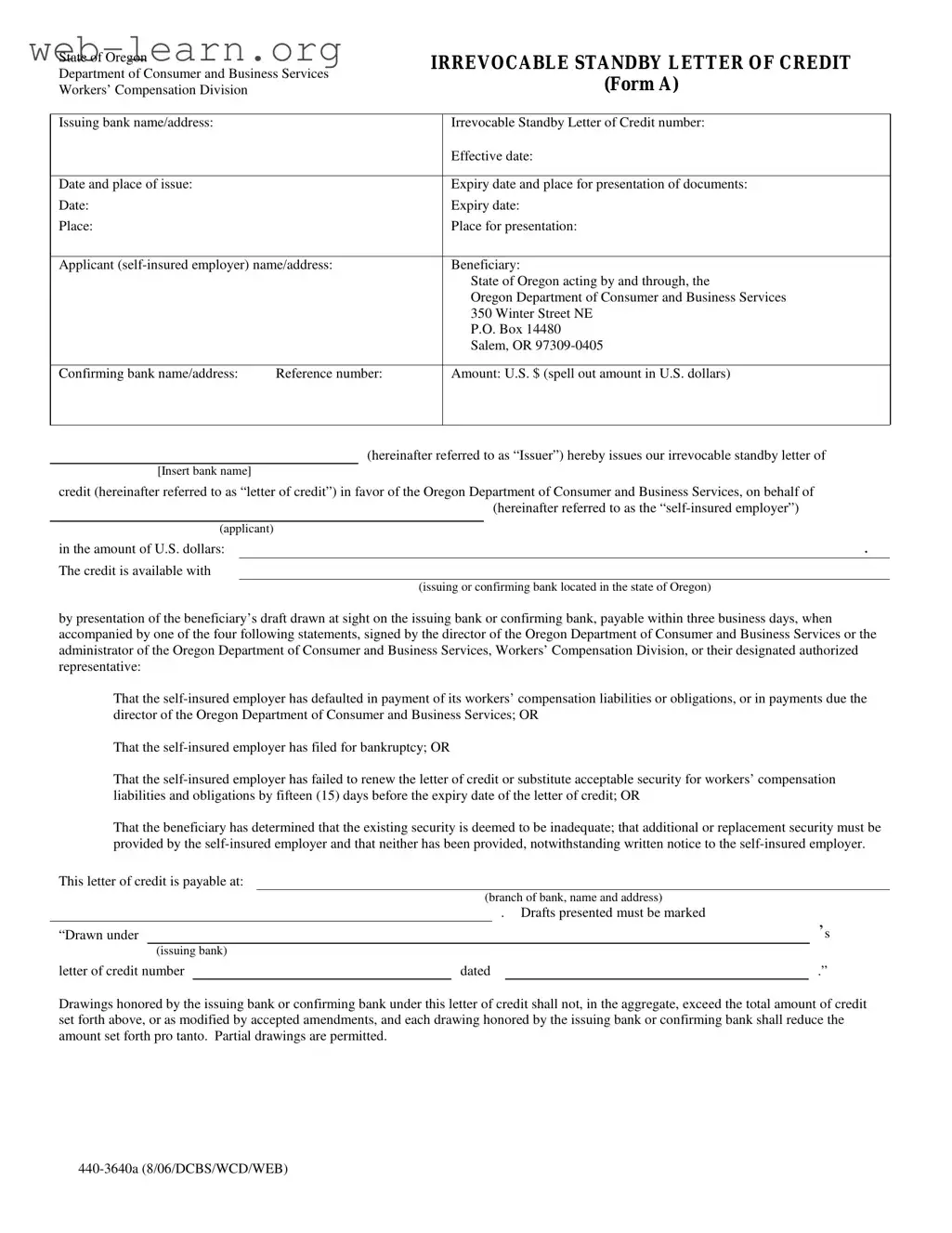
440-3640a (8/06/DCBS/WCD/WEB)
State of Oregon
Department of Consumer and Business Services
Workers’ Compensation Division
IRREVOCABLE STANDBY LETTER OF CREDIT
(Form A)
Irrevocable Standby Letter of Credit number:
Issuing bank name/address:
Effective date:
Date and place of issue: Expiry date and place for presentation of documents:
Date: Expiry date:
Place: Place for presentation:
Applicant (self-insured employer) name/address:
Beneficiary:
State of Oregon acting by and through, the
Oregon Department of Consumer and Business Services
350 Winter Street NE
P.O. Box 14480
Salem, OR 97309-0405
Confirming bank name/address: Reference number: Amount: U.S. $ (spell out amount in U.S. dollars)
(hereinafter referred to as “Issuer”) hereby issues our irrevocable standby letter of
[Insert bank name]
credit (hereinafter referred to as “letter of credit”) in favor of the Oregon Department of Consumer and Business Services, on behalf of
(hereinafter referred to as the “self-insured employer”)
(applicant)
in the amount of U.S. dollars:
.
The credit is available with
(issuing or confirming bank located in the state of Oregon)
by presentation of the beneficiary’s draft drawn at sight on the issuing bank or confirming bank, payable within three business days, when
accompanied by one of the four following statements, signed by the director of the Oregon Department of Consumer and Business Services or the
administrator of the Oregon Department of Consumer and Business Services, Workers’ Compensation Division, or their designated authorized
representative:
That the self-insured employer has defaulted in payment of its workers’ compensation liabilities or obligations, or in payments due the
director of the Oregon Department of Consumer and Business Services; OR
That the self-insured employer has filed for bankruptcy; OR
That the self-insured employer has failed to renew the letter of credit or substitute acceptable security for workers’ compensation
liabilities and obligations by fifteen (15) days before the expiry date of the letter of credit; OR
That the beneficiary has determined that the existing security is deemed to be inadequate; that additional or replacement security must be
provided by the self-insured employer and that neither has been provided, notwithstanding written notice to the self-insured employer.
This letter of credit is payable at:
(branch of bank, name and address)
. Drafts presented must be marked
“Drawn under
s
(issuing bank)
letter of credit number
dated .”
Drawings honored by the issuing bank or confirming bank under this letter of credit shall not, in the aggregate, exceed the total amount of credit
set forth above, or as modified by accepted amendments, and each drawing honored by the issuing bank or confirming bank shall reduce the
amount set forth pro tanto. Partial drawings are permitted.
440-3640a (8/06/DCBS/WCD/WEB)
Letter of Credit Number
Page 2
The purpose of this letter of credit is to create a primary obligation on the part of
(issuing bank)
and any confirming bank to the Oregon Department of Consumer and Business Services relating to the self-insured workers’
compensation liabilities and obligations of the self-insured employer
(applicant)
in accordance with Chapter 656 of the Oregon Revised Statutes. Except as stated herein, this letter of credit is not subject to any condition or
qualification and is the issuing and any confirming bank’s individual obligation which is in no way contingent upon reimbursement, and shall
cover all of the certified self-insured employer’s past, present, existing, and potential liability up to the total amount of credit set forth above for
assessments, contributions, or other obligations due from the certified self-insured employer to the Oregon Department of Consumer and Business
Services, Workers’ Compensation Division.
This letter of credit will be automatically extended without amendment for one year from the expiry date shown above, or any future expiry date,
unless at least 60 days prior to expiry, we notify the beneficiary by registered mail or overnight delivery that we elect not to extend this letter of
credit for such additional period. The notification will be addressed to the Administrator, Workers’ Compensation Division, Department of
Consumer and Business Services, State of Oregon, 350 Winter Street NE, P.O. Box 14480, Salem, OR 97309-0405.
Payment of any amount under this letter of credit by the issuing or a confirming bank shall be made by wire transfer to the Oregon Department of
Consumer and Business Services’ bank account, as instructed in the demand notice signed by the director or the administrator or their designated
authorized representative, for deposit to the account of the Oregon Department of Consumer and Business Services for the self-insured employer’s
workers’ compensation liabilities and obligations under ORS 656.
If the issuing bank or any confirming bank is closed at the time of the expiry of this letter of credit for any reason that would prevent the delivery
of a demand notice during its normal hours of operation, this letter of credit will be automatically extended for a period of 30 days commencing on
the next day of operation.
All bank charges for this letter of credit are for the account of the applicant.
Any amendments to this letter of credit must be approved by the beneficiary.
Except so far as otherwise expressly stated, this letter of credit is subject to the International Standby Practices 1998 (ISP 98) International
Chamber of Commerce Publication # 590 and to the laws of the state of Oregon. In the event of a conflict between these authorities, the laws of
the state of Oregon will control.
We hereby engage with drawers, endorsers, and/or bona fide holder that drafts drawn under and presented in strict conformity with the terms of
this credit will be duly honored on presentation to us.
The funds provided by this letter of credit are not construed to be an asset of the self-insured employer. If any legal proceedings are initiated with
respect to this letter of credit, it is agreed that such proceedings shall be subject to the courts and law of the state of Oregon.
is requested to add its confirmation to this letter of credit.
(name of confirming bank or N/A)
Issuing bank
Name: Date:
Title:
Signature:
hereby undertakes to honor any drafts presented to it when
(name of confirming bank or N/A)
drawn under and in strict conformity with the terms of this credit.
Confirming bank
Name: Date:
Title:
Signature:
Accepted by the Oregon Department of Consumer and Business Services
Name: Date:
Title:
Signature:

Form Information

Fact Name Fact Description
Form Title This form is officially titled the "Irrevocable Standby Letter of Credit (Form A)" and is used for workers' compensation purposes in Oregon.
Governing Law The form is governed by Chapter 656 of the Oregon Revised Statutes, which pertains to workers' compensation.
Issuing Bank The letter of credit must be issued by a bank located in the state of Oregon, ensuring local accountability.
Beneficiary The Oregon Department of Consumer and Business Services serves as the beneficiary, ensuring protection for workers' compensation liabilities.
Automatic Extension This letter of credit will automatically extend for one year unless the issuing bank notifies the beneficiary at least 60 days before the expiry date.
Payment Method Payments under this letter of credit are made via wire transfer to the Oregon Department of Consumer and Business Services' designated bank account.

Detailed Guide for Filling Out 440 3640A Oregon

Completing the 440 3640A Oregon form requires careful attention to detail. This form is essential for establishing an irrevocable standby letter of credit, which serves as a financial guarantee for self-insured employers. The following steps will guide you through the process of filling out the form accurately.

  1. Gather Required Information: Collect all necessary details, including the issuing bank's name and address, the effective date, and the expiry date.
  2. Fill in the Issuing Bank Details: Enter the name and address of the issuing bank at the top of the form.
  3. Enter the Letter of Credit Number: Provide the unique number assigned to the letter of credit.
  4. Specify the Effective Date: Indicate the date when the letter of credit becomes effective.
  5. Document the Expiry Date: Fill in the expiry date of the letter of credit.
  6. Identify the Applicant: Write the name and address of the self-insured employer (applicant).
  7. Complete Beneficiary Information: Clearly state that the beneficiary is the State of Oregon, including the address of the Oregon Department of Consumer and Business Services.
  8. Fill in the Confirming Bank Details: If applicable, provide the name and address of the confirming bank.
  9. Reference Number: Include any reference number relevant to the letter of credit.
  10. Specify the Amount: Enter the amount of the letter of credit in U.S. dollars, and spell out the amount in words.
  11. Draft Presentation Details: Indicate where drafts can be presented and include any necessary instructions for the drafts.
  12. Review Conditions: Ensure that you understand and comply with the conditions outlined in the form regarding defaults, bankruptcy, and security adequacy.
  13. Sign and Date: The authorized representative of the issuing bank must sign and date the form. If applicable, the confirming bank must also provide their signature and date.
  14. Submit the Form: Send the completed form to the Oregon Department of Consumer and Business Services at the specified address.

Once the form is completed and submitted, it will be processed by the relevant authorities. Ensure that all details are accurate to avoid any delays in establishing the letter of credit.

Obtain Answers on 440 3640A Oregon

  1. What is the purpose of the 440 3640A Oregon form?

    The 440 3640A form is used to create an irrevocable standby letter of credit. This document serves as a financial guarantee for self-insured employers in Oregon, ensuring they meet their workers’ compensation liabilities. It is issued by a bank and is intended to protect the Oregon Department of Consumer and Business Services from potential defaults by the self-insured employer.

  2. Who is the beneficiary of this letter of credit?

    The beneficiary of the letter of credit is the State of Oregon, specifically the Oregon Department of Consumer and Business Services. This agency oversees the compliance of self-insured employers regarding their workers’ compensation obligations.

  3. What conditions allow the Oregon Department of Consumer and Business Services to draw on the letter of credit?

    The Department can draw on the letter of credit under several conditions, including:

    • If the self-insured employer defaults on their workers’ compensation payments.
    • If the self-insured employer files for bankruptcy.
    • If the employer fails to renew the letter of credit or provide acceptable security at least 15 days before its expiration.
    • If the Department determines that the existing security is inadequate and the employer has not provided additional security after being notified.
  4. How long is the letter of credit valid?

    The letter of credit is typically valid until the expiration date specified in the document. However, it is automatically extended for one year unless the issuing bank notifies the beneficiary at least 60 days before the expiration date that it will not extend the letter.

  5. What happens if the issuing bank is closed at the time of expiration?

    If the issuing bank is closed at the time of expiration, the letter of credit will automatically extend for an additional 30 days. This extension begins the day after the bank resumes normal operations.

  6. Are partial drawings allowed under this letter of credit?

    Yes, partial drawings are permitted. Each drawing that is honored by the issuing or confirming bank will reduce the total amount available under the letter of credit accordingly.

  7. Who is responsible for bank charges related to the letter of credit?

    All bank charges associated with the letter of credit are the responsibility of the self-insured employer, also referred to as the applicant in the document.

  8. What legal framework governs the letter of credit?

    The letter of credit is subject to the International Standby Practices 1998 (ISP 98) and the laws of the state of Oregon. In case of any conflict between these regulations, the laws of Oregon will take precedence.

  9. What should be included when presenting a draft under the letter of credit?

    When presenting a draft, it must be marked “Drawn under [issuing bank’s name] letter of credit number [insert number].” The draft should also be accompanied by one of the specified statements signed by an authorized representative of the Oregon Department of Consumer and Business Services.

Common mistakes

Filling out the 440 3640A Oregon form can be challenging, and mistakes can lead to delays or complications. One common mistake is failing to provide accurate bank information. The issuing bank name and address must be correct. If this information is incorrect or incomplete, it can lead to confusion and prevent the letter of credit from being honored.

Another frequent error involves the expiration dates. Applicants often overlook the importance of specifying both the effective date and the expiry date clearly. If these dates are not filled out correctly, it can result in the letter of credit being deemed invalid. It is crucial to ensure that all dates align with the requirements set forth by the Oregon Department of Consumer and Business Services.

In addition, many applicants neglect to spell out the amount in U.S. dollars as required. Simply writing the numerical amount without spelling it out can cause issues. This requirement is essential for clarity and ensures that there is no misunderstanding regarding the amount covered by the letter of credit.

Lastly, some individuals fail to include the necessary signatures. The form requires signatures from authorized representatives of both the issuing and confirming banks. Without these signatures, the letter of credit may not be legally binding. Ensuring that all necessary parties sign the document is vital to avoid any potential disputes later on.

Documents used along the form

When dealing with the 440 3640A Oregon form, several other documents may be necessary to ensure compliance and clarity in the workers' compensation process. Each document serves a specific purpose and helps facilitate the overall procedure.

  • Form 440-3640B: This is a related document that outlines the conditions and terms for the irrevocable standby letter of credit. It provides additional details that may be necessary for understanding the obligations of the self-insured employer.
  • Form 440-3640C: This form is used to request an amendment to the existing letter of credit. If there are changes in the terms or conditions, this document helps formalize those adjustments.
  • Form 440-3640D: This document serves as a notice of cancellation for the letter of credit. It is essential for formally notifying the Oregon Department of Consumer and Business Services when a self-insured employer no longer requires the letter.
  • Financial Statements: These documents provide an overview of the financial status of the self-insured employer. They help assess the ability to meet workers' compensation obligations and may be required by the Oregon Department of Consumer and Business Services.
  • Bank Confirmation Letter: This letter from the issuing bank confirms the establishment of the letter of credit. It serves as proof that the bank is aware of and agrees to the terms outlined in the letter.
  • Proof of Insurance: This document verifies that the self-insured employer has adequate insurance coverage in place. It is crucial for ensuring that all liabilities are covered under the workers' compensation system.
  • Bank Transfer Instructions: These instructions detail how payments should be made to the Oregon Department of Consumer and Business Services. They ensure that funds are transferred correctly and efficiently when required.

Having these documents ready can simplify the process and help avoid potential issues down the line. Each document plays a vital role in maintaining compliance with Oregon's workers' compensation regulations.

Similar forms

The 440 3640A Oregon form is an Irrevocable Standby Letter of Credit used in the context of workers' compensation. It shares similarities with several other financial and legal documents. Below are six documents that are similar, along with a brief explanation of how they compare.

  • Letter of Credit (LOC): Like the 440 3640A, a standard LOC guarantees payment to a beneficiary upon presentation of specified documents. Both serve as security for obligations, ensuring funds are available when needed.
  • Performance Bond: A performance bond ensures that a contractor completes a project as per the contract terms. Similar to the 440 3640A, it provides a financial guarantee to the beneficiary if the principal defaults on obligations.
  • Bank Guarantee: A bank guarantee is a promise from a bank to cover a loss if a party fails to fulfill contractual obligations. It parallels the 440 3640A in that both documents protect the beneficiary from financial loss due to non-performance.
  • Surety Bond: A surety bond involves three parties: the principal, the obligee, and the surety. It functions similarly to the 440 3640A by providing a guarantee of performance and financial security to the obligee.
  • Collateral Agreement: This agreement involves assets pledged as security for a loan or obligation. Like the 440 3640A, it ensures that the lender has recourse in case of default by the borrower.
  • Escrow Agreement: An escrow agreement involves a third party holding funds until certain conditions are met. This is similar to the 440 3640A, as both documents involve conditions that must be satisfied before funds are released.

Dos and Don'ts

When filling out the 440 3640A Oregon form, it is important to follow specific guidelines to ensure accuracy and compliance. Below is a list of things to do and avoid:

  • Do provide the full name and address of the issuing bank clearly.
  • Do specify the amount in U.S. dollars and spell it out completely.
  • Do ensure that all required signatures are present, including those of the director or administrator.
  • Do confirm the expiry date and place for presentation of documents accurately.
  • Do include a clear statement regarding the purpose of the letter of credit.
  • Do keep a copy of the completed form for your records.
  • Don't leave any sections of the form blank; all fields must be filled out.
  • Don't use abbreviations or shorthand when stating the amount; spell it out.
  • Don't forget to notify the beneficiary if you choose not to extend the letter of credit.
  • Don't ignore the requirement for a registered mail or overnight delivery notification.
  • Don't present drafts that do not conform to the terms outlined in the letter of credit.
  • Don't assume that any changes can be made without approval from the beneficiary.

Misconceptions

Understanding the 440 3640A Oregon form, an Irrevocable Standby Letter of Credit, is crucial for self-insured employers. However, several misconceptions can lead to confusion. Here are nine common misconceptions about this form:

  • The form is only for large companies. This form is applicable to all self-insured employers, regardless of size. Any employer with self-insured workers' compensation liabilities must use this form.
  • It guarantees payment to the employer. The letter of credit guarantees payment to the Oregon Department of Consumer and Business Services, not the employer. It serves as security for the employer's obligations.
  • Once submitted, the letter of credit is unchangeable. Amendments can be made, but they must be approved by the beneficiary, which is the Oregon Department of Consumer and Business Services.
  • The issuing bank can deny payment at any time. Payment must be made if the terms of the letter of credit are met. The bank's obligation is independent of any other agreements.
  • Only one statement is needed to draw on the credit. Any of the four specified statements can trigger a draw, but all must be signed by an authorized representative of the Oregon Department of Consumer and Business Services.
  • It is automatically renewed indefinitely. The letter of credit is automatically extended for one year unless the issuing bank notifies the beneficiary at least 60 days prior to expiration.
  • Self-insured employers can use the funds as assets. The funds provided by the letter of credit are not considered assets of the self-insured employer. They serve solely as security for obligations.
  • The form is only relevant during financial difficulties. This letter of credit is a proactive measure to ensure compliance with workers' compensation obligations, not just a safety net during crises.
  • Legal proceedings regarding the letter can occur anywhere. Any legal actions must be conducted in the courts of the state of Oregon, as specified in the letter of credit.

Clarifying these misconceptions is essential for self-insured employers to ensure compliance and understand their obligations under Oregon law. Proper use of the 440 3640A form can help avoid legal complications and ensure financial security.

Key takeaways

Filling out the 440 3640A Oregon form, which serves as an Irrevocable Standby Letter of Credit, is a crucial step for self-insured employers in Oregon. Here are some key takeaways to consider:

  • Understand the Purpose: This form is designed to create a primary obligation for the issuing bank to cover a self-insured employer's workers' compensation liabilities.
  • Complete Information Accurately: Ensure that all fields, such as the issuing bank's name and address, are filled out correctly to avoid delays.
  • Know the Expiry Date: The letter of credit will automatically extend unless the issuing bank notifies the Oregon Department of Consumer and Business Services at least 60 days prior to expiry.
  • Document Presentation: Drafts must be presented with specific statements that indicate the reasons for drawing on the letter of credit, such as default or bankruptcy.
  • Partial Drawings Allowed: If needed, partial drawings can be made against the total amount of the credit, providing flexibility for the self-insured employer.
  • Bank Charges: Be aware that all bank charges related to the letter of credit will be the responsibility of the self-insured employer.
  • Legal Considerations: Any legal disputes regarding this letter of credit will be governed by the laws of the state of Oregon, so it's essential to understand your rights and obligations.

By keeping these points in mind, self-insured employers can navigate the process of completing the 440 3640A form with greater confidence and clarity.