Homepage Blank 3636A Michigan Form
Outline

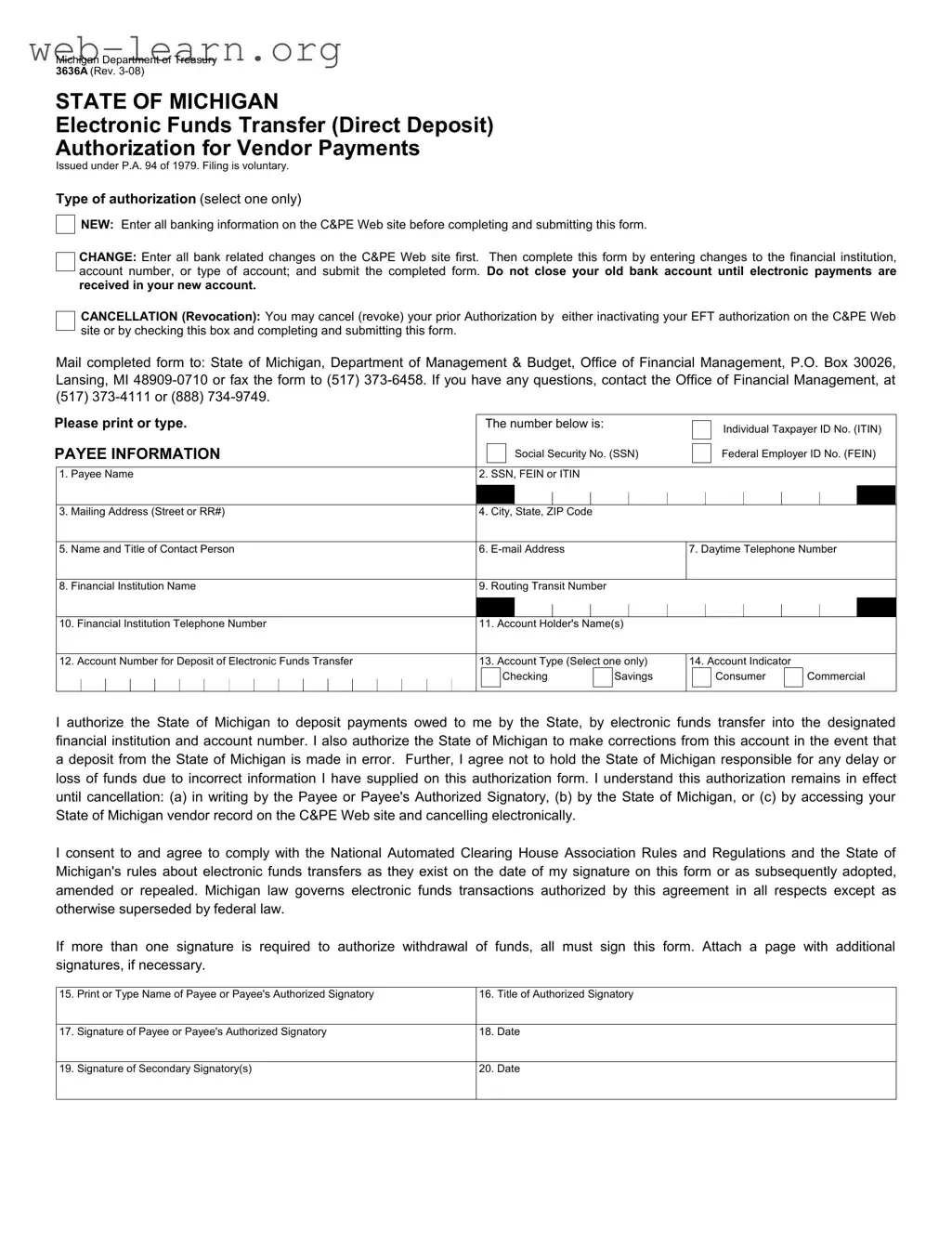
The 3636A Michigan form serves as an essential tool for vendors seeking to streamline their payment processes through electronic funds transfer (EFT). This form, issued by the Michigan Department of Treasury, allows vendors to authorize direct deposit for payments owed by the state. Vendors have the option to initiate a new authorization, make changes to existing banking information, or cancel their previous authorization. Each section of the form requires specific details, including personal identification numbers, contact information, and banking details such as the routing transit number and account type. The form emphasizes the importance of accuracy, as any errors in the provided information could lead to delays or losses in payment. Vendors must also agree to the rules governing electronic funds transfers, ensuring compliance with both state and federal regulations. By completing and submitting the 3636A form, vendors can enjoy the convenience of receiving payments directly into their bank accounts, making the process more efficient and reliable.

Sample - 3636A Michigan Form

14. Account Indicator13. Account Type (Select one only)
Michigan Department of Treasury
3636A (Rev. 3-08)
Type of authorization (select one only)
NEW: Enter all banking information on the C&PE Web site before completing and submitting this form.
Mail completed form to: State of Michigan, Department of Management & Budget, Office of Financial Management, P.O. Box 30026,
Lansing, MI 48909-0710 or fax the form to (517) 373-6458. If you have any questions, contact the Office of Financial Management, at
(517) 373-4111 or (888) 734-9749.
I authorize the State of Michigan to deposit payments owed to me by the State, by electronic funds transfer into the designated
financial institution and account number. I also authorize the State of Michigan to make corrections from this account in the event that
a deposit from the State of Michigan is made in error. Further, I agree not to hold the State of Michigan responsible for any delay or
loss of funds due to incorrect information I have supplied on this authorization form. I understand this authorization remains in effect
until cancellation: (a) in writing by the Payee or Payee's Authorized Signatory, (b) by the State of Michigan, or (c) by accessing your
State of Michigan vendor record on the C&PE Web site and cancelling electronically.
I consent to and agree to comply with the National Automated Clearing House Association Rules and Regulations and the State of
Michigan's rules about electronic funds transfers as they exist on the date of my signature on this form or as subsequently adopted,
amended or repealed. Michigan law governs electronic funds transactions authorized by this agreement in all respects except as
otherwise superseded by federal law.
If more than one signature is required to authorize withdrawal of funds, all must sign this form. Attach a page with additional
signatures, if necessary.
Checking ConsumerSavings Commercial
Social Security No. (SSN) Federal Employer ID No. (FEIN)
The number below is:
15. Print or Type Name of Payee or Payee's Authorized Signatory
17. Signature of Payee or Payee's Authorized Signatory
19. Signature of Secondary Signatory(s)
16. Title of Authorized Signatory
18. Date
20. Date
8. Financial Institution Name
11. Account Holder's Name(s)
9. Routing Transit Number
12. Account Number for Deposit of Electronic Funds Transfer
10. Financial Institution Telephone Number
1. Payee Name
3. Mailing Address (Street or RR#)
5. Name and Title of Contact Person
2. SSN, FEIN or ITIN
4. City, State, ZIP Code
6. E-mail Address 7. Daytime Telephone Number
STATE OF MICHIGAN
Electronic Funds Transfer (Direct Deposit)
Authorization for Vendor Payments
Issued under P.A. 94 of 1979. Filing is voluntary.
Please print or type.
CHANGE: Enter all bank related changes on the C&PE Web site first. Then complete this form by entering changes to the financial institution,
account number, or type of account; and submit the completed form. Do not close your old bank account until electronic payments are
received in your new account.
CANCELLATION (Revocation): You may cancel (revoke) your prior Authorization by either inactivating your EFT authorization on the C&PE Web
site or by checking this box and completing and submitting this form.
PAYEE INFORMATION
Individual Taxpayer ID No. (ITIN)

Form Information

Fact Name Description
Form Title The form is officially titled "Electronic Funds Transfer (Direct Deposit) Authorization for Vendor Payments."
Governing Law This form is issued under Public Act 94 of 1979, which governs electronic funds transfers in Michigan.
Filing Status Filing this form is voluntary for vendors wishing to receive payments electronically.
Types of Authorization There are three types of authorizations: New, Change, and Cancellation.
New Authorization Process For new authorizations, banking information must be entered on the C&PE Web site before submitting the form.
Change Authorization Process Changes to bank details should first be updated on the C&PE Web site, followed by completing this form.
Cancellation Process To cancel an authorization, one can either inactivate it on the C&PE Web site or check the cancellation box on this form.
Contact Information For questions, vendors can contact the Office of Financial Management at (517) 373-4111 or (888) 734-9749.
Account Types Vendors can select either a Checking or Savings account for electronic funds transfers.
Signature Requirement If multiple signatures are needed, all required parties must sign the form, with an option to attach additional signature pages.

Detailed Guide for Filling Out 3636A Michigan

Completing the 3636A Michigan form is an important step in setting up or modifying your electronic funds transfer for vendor payments. Following the steps outlined below will help ensure that your information is accurately submitted, allowing for timely processing of payments.

  1. Determine the type of authorization: Decide whether you are submitting a new authorization, making a change to an existing authorization, or cancelling a previous authorization.
  2. Access the C&PE Web site: If you are submitting a new authorization or making changes, enter all necessary banking information on the C&PE Web site before completing the form.
  3. Complete the payee information: Fill in the following details:
    • Payee Name
    • Social Security Number (SSN), Federal Employer ID Number (FEIN), or Individual Taxpayer ID Number (ITIN)
    • Mailing Address (Street or RR#)
    • City, State, ZIP Code
    • Name and Title of Contact Person
    • E-mail Address
    • Daytime Telephone Number
  4. Provide financial institution details: Enter the following banking information:
    • Financial Institution Name
    • Routing Transit Number
    • Financial Institution Telephone Number
    • Account Holder's Name(s)
    • Account Number for Deposit of Electronic Funds Transfer
    • Select Account Type (Checking or Savings)
  5. Authorize the deposit: Read and understand the authorization statement, confirming your consent to allow the State of Michigan to deposit payments into your designated account.
  6. Sign and date the form: Print or type your name, title, and sign the form. If required, include signatures of any secondary signatories.
  7. Submit the form: Mail the completed form to the State of Michigan, Department of Management & Budget, Office of Financial Management, P.O. Box 30026, Lansing, MI 48909-0710, or fax it to (517) 373-6458.

After submitting the form, it will be processed by the appropriate department. If you have any questions or require assistance, do not hesitate to reach out to the Office of Financial Management at the provided contact numbers. Your prompt attention to these steps will help facilitate smooth transactions moving forward.

Obtain Answers on 3636A Michigan

  1. What is the purpose of the 3636A Michigan form?

    The 3636A form is used to authorize electronic funds transfers (EFT) for vendor payments from the State of Michigan. By completing this form, vendors can receive payments directly into their designated bank accounts, streamlining the payment process.

  2. How do I complete the form if I am setting up a new account?

    If you are setting up a new account, first enter all required banking information on the C&PE website. After that, complete the 3636A form by selecting the "NEW" option and providing all necessary details, including your financial institution's name and account number. Submit the completed form to the State of Michigan.

  3. What should I do if I need to change my banking information?

    For changes to your banking information, first update your details on the C&PE website. Then, fill out the 3636A form, selecting the "CHANGE" option. Make sure to provide the updated financial institution, account number, or account type. Do not close your old bank account until you confirm that electronic payments are successfully received in your new account.

  4. Can I cancel my electronic funds transfer authorization?

    Yes, you can cancel your authorization. To do this, you can either inactivate your EFT authorization on the C&PE website or check the cancellation box on the 3636A form. Complete the form and submit it to the State of Michigan to finalize the cancellation.

  5. What happens if I provide incorrect information on the form?

    If you provide incorrect information, you agree not to hold the State of Michigan responsible for any delays or losses of funds. It is crucial to double-check all entries before submitting the form to ensure accurate processing of your payments.

  6. How can I contact the State of Michigan if I have questions?

    If you have questions regarding the 3636A form or the electronic funds transfer process, you can contact the Office of Financial Management at (517) 373-4111 or (888) 734-9749. They can provide assistance and clarify any concerns you may have.

Common mistakes

Completing the Michigan Department of Treasury 3636A form can be straightforward, yet many individuals make critical mistakes that can delay their payments. One common error is failing to select the correct type of authorization. The form requires the user to choose between a new authorization, a change to an existing authorization, or a cancellation. Skipping this step or misidentifying the type can lead to confusion and processing delays.

Another frequent mistake involves the banking information provided. Individuals often overlook the importance of accuracy when entering their financial institution’s name, routing transit number, and account number. A single digit error can result in funds being deposited into the wrong account. It is essential to double-check these details against official bank documents before submission.

Additionally, many users neglect to include complete contact information. This includes not only the payee’s name and mailing address but also the daytime telephone number and email address. Incomplete contact information can hinder the state’s ability to reach out for clarification or to provide updates regarding the payment process.

Lastly, some individuals fail to understand the implications of the authorization agreement. The form states that the signer agrees not to hold the State of Michigan responsible for any delays or losses due to incorrect information. This means that if errors occur, the responsibility falls solely on the individual who filled out the form. Awareness of this liability is crucial to avoid potential financial repercussions.

Documents used along the form

The Michigan Department of Treasury 3636A form is essential for setting up electronic funds transfers for vendor payments. However, several other documents often accompany this form to ensure a smooth and compliant process. Below is a list of these documents, each serving a unique purpose in the transaction process.

  • Vendor Registration Form: This form collects necessary information about the vendor, including contact details and tax identification numbers. It establishes the vendor's eligibility to receive payments from the state.
  • W-9 Form: The W-9 form is used to provide the correct taxpayer identification number (TIN) to the state. This ensures that the state can accurately report payments to the IRS.
  • Direct Deposit Agreement: This document outlines the terms and conditions of the direct deposit arrangement. It details the responsibilities of both the vendor and the state regarding electronic payments.
  • Change of Address Form: If a vendor needs to update their mailing address, this form allows for the official change in records. It ensures that all correspondence and payment notifications are sent to the correct location.
  • Cancellation Notice: Should a vendor wish to terminate their direct deposit authorization, this notice formally communicates that intent. It protects both parties by documenting the cancellation request.
  • Bank Verification Letter: This letter, typically from the vendor's bank, confirms the banking details provided on the 3636A form. It serves as an additional layer of verification to prevent errors in payment processing.
  • Compliance Certification: Some vendors may need to submit a compliance certification to verify that they adhere to state regulations and standards. This document helps maintain accountability in vendor transactions.

These forms and documents work together to facilitate the efficient processing of electronic payments in Michigan. Ensuring that all necessary paperwork is completed accurately can help prevent delays and misunderstandings in vendor transactions.

Similar forms

The Michigan Department of Treasury 3636A form is an important document for managing electronic funds transfers for vendor payments. Several other forms share similar purposes or processes, making it easier for individuals and businesses to understand their functions. Here are seven documents that are similar to the 3636A form:

  • IRS Form W-9: This form is used to provide taxpayer identification information to businesses or entities that need to report payments made to you. Like the 3636A, it requires accurate identification details to ensure proper processing of payments.
  • Direct Deposit Authorization Form: Many banks offer their own direct deposit forms for customers to authorize deposits into their accounts. This document is similar to the 3636A in that it collects banking information and consent for electronic deposits.
  • ACH Authorization Form: This form allows businesses to authorize automatic payments or deposits via the Automated Clearing House (ACH) network. It aligns with the 3636A in terms of facilitating electronic funds transfers.
  • Vendor Registration Form: Often required by government agencies or large corporations, this form collects essential information from vendors, including banking details for payment processing, similar to what the 3636A requires.
  • State Tax Withholding Form: This document is used to authorize withholding of state taxes from payments. It shares a commonality with the 3636A in that both involve financial transactions and require accurate taxpayer identification.
  • Electronic Payment Agreement: This agreement outlines the terms under which payments will be made electronically. Like the 3636A, it emphasizes the importance of correct banking information and the responsibilities of both parties involved.
  • Payment Change Request Form: Similar to the change option on the 3636A, this form is used to update payment information for ongoing transactions, ensuring that funds are directed to the correct account.

Each of these documents plays a vital role in ensuring smooth financial transactions, emphasizing the need for accurate information and consent from the parties involved. Understanding their similarities can help streamline the process for vendors and organizations alike.

Dos and Don'ts

When filling out the 3636A Michigan form, keep the following tips in mind:

  • Do ensure all banking information is entered correctly on the C&PE Web site before completing the form.
  • Do use your legal name as it appears on official documents.
  • Do provide accurate contact information for timely communication.
  • Do double-check your account number and routing transit number for errors.
  • Don't close your old bank account until electronic payments are confirmed in your new account.
  • Don't forget to sign and date the form before submission.

By following these guidelines, you can help ensure a smooth process for your electronic funds transfer authorization.

Misconceptions

There are several misconceptions regarding the Michigan Department of Treasury 3636A form, which is used for Electronic Funds Transfer (Direct Deposit) Authorization for Vendor Payments. Below are some common misunderstandings and clarifications about this form.

  • Filing is mandatory. Many believe that completing the 3636A form is required for all vendors. In reality, filing is voluntary.
  • Changes must be submitted before using the online system. Some think they need to submit changes to their banking information before accessing the C&PE Web site. However, you should first enter all bank-related changes on the C&PE Web site before completing the form.
  • Old bank accounts can be closed immediately. It is a common misconception that you can close your old bank account right after submitting the new information. You should wait until electronic payments are received in your new account.
  • Cancellations require a written letter. Some vendors believe they must send a formal letter to cancel their authorization. You can cancel electronically on the C&PE Web site or by checking a box on the form.
  • Only one signature is needed. Many assume that a single signature suffices for authorization. If more than one signature is required to authorize withdrawals, all necessary parties must sign the form.
  • The form is only for individuals. Some think the 3636A form is exclusively for individual vendors. In fact, it can be used by both individuals and businesses.
  • There are no consequences for incorrect information. Some vendors believe that submitting incorrect information has no repercussions. However, you agree not to hold the State of Michigan responsible for delays or losses caused by incorrect information provided on the form.
  • It is not necessary to understand the rules. Some may feel that they do not need to be aware of the National Automated Clearing House Association Rules and Regulations. However, compliance with these rules is essential when authorizing electronic funds transfers.

Understanding these misconceptions can help ensure that the process of using the 3636A form is smooth and efficient for all vendors involved.

Key takeaways

When filling out and using the Michigan Department of Treasury 3636A form for electronic funds transfer, keep these key points in mind:

  • Voluntary Filing: Submitting the form is optional, but it is necessary for those who wish to receive payments via electronic funds transfer.
  • Choose Authorization Type: Select only one option: NEW, CHANGE, or CANCELLATION. Each option has specific instructions that must be followed.
  • Banking Information: For a new authorization, ensure all banking details are entered on the C&PE website before completing the form.
  • Account Changes: If changing banking information, update the C&PE website first, then fill out the form with the new details.
  • Do Not Close Old Account: Wait until electronic payments are confirmed in the new account before closing the old one.
  • Mailing Instructions: Send the completed form to the specified address or fax it to the provided number for processing.
  • Contact Information: Include accurate contact details, including a daytime phone number and email address, to facilitate communication.
  • Signature Requirement: Ensure all necessary signatures are obtained. If multiple signatures are needed, attach an additional page for more signatories.

Following these guidelines will help ensure a smooth process for setting up or modifying your electronic funds transfer authorization.