Homepage Blank 33H Form
Outline

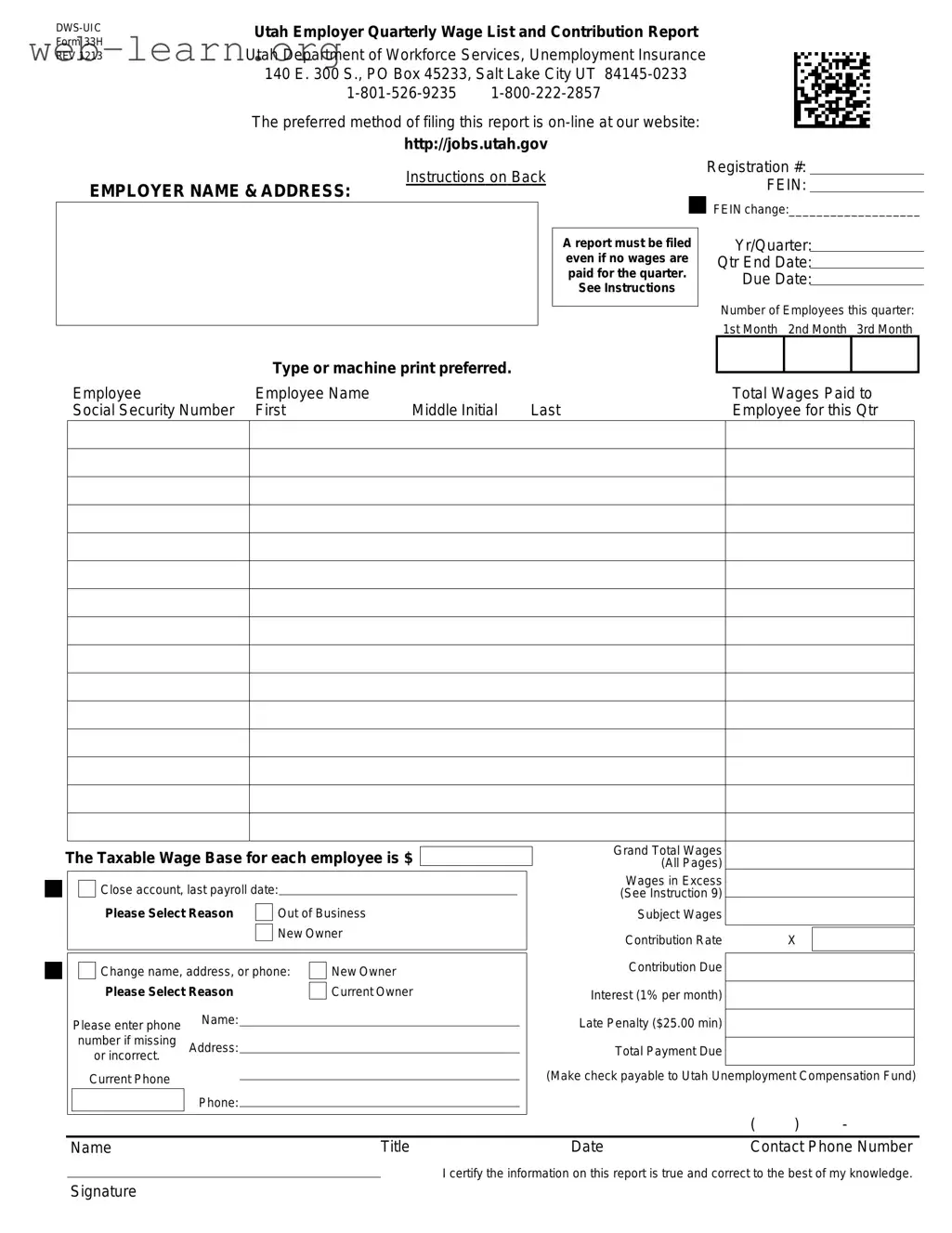
The 33H form, officially known as the Utah Employer Quarterly Wage List and Contribution Report, serves as a crucial document for employers in Utah. This form is mandated by the Utah Department of Workforce Services and is essential for reporting wages paid to employees within a given quarter. Employers must file this report even if no wages were disbursed during the reporting period. The form requires detailed information, including the employer's name, address, registration number, and federal employer identification number (FEIN). Additionally, it captures the total wages paid to each employee, along with their Social Security numbers. Employers are also responsible for calculating the taxable wage base, contribution rates, and any applicable penalties or interest for late submissions. The 33H form must be submitted by a specified due date, and while it can be filed online for convenience, it also includes a section for manual entry. Understanding the requirements and deadlines associated with this form is essential for compliance and to avoid potential penalties.

Sample - 33H Form

EMPLOYER NAME & ADDRESS:
The Taxable Wage Base for each employee is $
Utah Employer Quarterly Wage List and Contribution Report
Utah Department of Workforce Services, Unemployment Insurance
140 E. 300 S., PO Box 45233, Salt Lake City UT 84145-0233
1-801-526-9235 1-800-222-2857
The preferred method of filing this report is on-line at our website:
http://jobs.utah.gov
DWS-UIC
Instructions on Back
Registration #:
FEIN:
FEIN change:___________________
A report must be filed
even if no wages are
paid for the quarter.
See Instructions
Yr/Quarter:
Qtr End Date:
Due Date:
Number of Employees this quarter:
1st Month 2nd Month 3rd Month
Type or machine print preferred.
Employee
Social Security Number
Employee Name
First
Total Wages Paid to
Employee for this QtrMiddle Initial Last
Grand Total Wages
Wages in Excess
(See Instruction 9)
Subject Wages
Contribution Rate
Contribution Due
Interest (1% per month)
Late Penalty ($25.00 min)
Total Payment Due
X
(Make check payable to Utah Unemployment Compensation Fund)
Change name, address, or phone: New Owner
Current Owner
Address:
Phone:
Signature
Title Date Contact Phone Number
I certify the information on this report is true and correct to the best of my knowledge.
( ) -
Name:
(All Pages)
New Owner
Out of Business
Close account, last payroll date:
Please Select Reason
Current Phone
Please enter phone
number if missing
or incorrect.
Please Select Reason
Form 33H
REV 1213
Name
EMPLOYER NAME & ADDRESS:
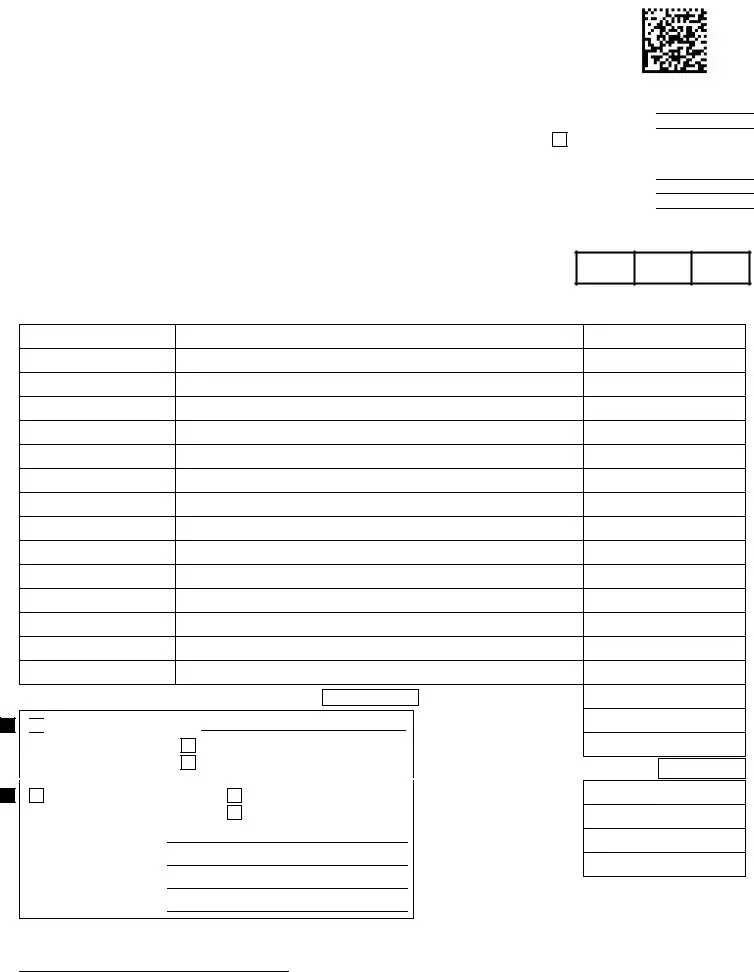
Utah Employer Quarterly Wage List Continuation Sheet
Utah Department of Workforce Services, Unemployment Insurance
140 E. 300 S., PO Box 45233, Salt Lake City UT 84145-0233
1-801-526-9235 1-800-222-2857
The preferred method of filing this report is on-line at our website:
http://jobs.utah.gov
Registration #:
Yr/Quarter:
Qtr End Date:
Due Date:
Type or machine print this report.
Employee
Social Security Number
Employee Name
First Middle Initial Last
Total Wages Paid to
Employee for this Qtr
REV 0813
Form 33HA
DWS-UIC

Form Information

Fact Name Details
Form Title DWS-UIC Utah Employer Quarterly Wage List and Contribution Report Form 33H
Governing Agency Utah Department of Workforce Services
Contact Information 140 E. 300 S., PO Box 45233, Salt Lake City, UT 84145-0233
Phone Numbers 1-801-526-9235, 1-800-222-2857
Filing Method The preferred method of filing is online at jobs.utah.gov.
Mandatory Filing A report must be filed even if no wages were paid during the quarter.
Due Date The due date for submission is specified on the form based on the quarter end date.
Contribution Rate The contribution rate and payment details are included within the form.

Detailed Guide for Filling Out 33H

After completing the 33H form, it is important to submit it by the due date specified for the quarter. This ensures compliance with reporting requirements. If there are any changes to your business status or employee information, those should be noted on the form as well.

  1. Begin by entering your Employer Name & Address at the top of the form.
  2. Fill in your Registration # and FEIN (Federal Employer Identification Number).
  3. If there has been a change to your FEIN, indicate that in the space provided.
  4. Specify the Year/Quarter and the Quarter End Date.
  5. Write the Due Date for submitting the report.
  6. Indicate the Number of Employees for each month of the quarter.
  7. For each employee, list their Full Name (First, Middle Initial, Last) and their Social Security Number.
  8. Record the Total Wages Paid to each employee for the quarter.
  9. If applicable, indicate the Close account and provide the last payroll date.
  10. Select the appropriate Reason for any changes (e.g., Out of Business, New Owner, etc.).
  11. If there are changes to your Name, Address, or Phone, provide the new information.
  12. Calculate the Grand Total Wages and any Wages in Excess.
  13. Determine the Contribution Rate and calculate the Contribution Due.
  14. Add any Interest (1% per month) and Late Penalty ($25.00 minimum).
  15. Sum these amounts to find the Total Payment Due.
  16. Make your check payable to the Utah Unemployment Compensation Fund.
  17. Complete the Name, Title, and Date sections.
  18. Provide a Contact Phone Number.
  19. Sign the form to certify that the information is true and correct.

Obtain Answers on 33H

  1. What is the purpose of the 33H form?

    The 33H form, also known as the Utah Employer Quarterly Wage List and Contribution Report, is used by employers in Utah to report wages paid to employees during a specific quarter. This form helps the Utah Department of Workforce Services monitor unemployment insurance contributions and ensure compliance with state regulations. Even if no wages were paid during the quarter, employers are still required to submit the form.

  2. How do I file the 33H form?

    The preferred method for filing the 33H form is online through the Utah Department of Workforce Services website at http://jobs.utah.gov. This online submission is efficient and helps ensure that your report is processed quickly. Alternatively, you can submit a paper form, but be aware that online filing is encouraged for faster processing.

  3. What information do I need to provide on the form?

    When filling out the 33H form, you will need to provide several key pieces of information, including:

    • Your employer name and address
    • Your registration number and Federal Employer Identification Number (FEIN)
    • The quarter and year for which you are reporting
    • The total wages paid to each employee, along with their Social Security numbers
    • The number of employees for the quarter
    • Any changes to your business status, such as being out of business or having a new owner

    Accurate reporting is crucial, as it affects your unemployment insurance contributions.

  4. What happens if I miss the filing deadline?

    If you fail to file the 33H form by the due date, you may incur penalties. A late penalty of at least $25.00 can be assessed, and interest charges may apply at a rate of 1% per month on any unpaid contributions. To avoid these penalties, it’s important to submit the form on time, even if you have no wages to report.

  5. Can I make corrections after submitting the form?

    Yes, if you realize that you made an error after submitting the 33H form, you can correct it. You may need to submit an amended report, depending on the nature of the correction. It’s best to contact the Utah Department of Workforce Services for guidance on how to proceed with corrections to ensure compliance and avoid potential issues.

Common mistakes

Filling out the 33H form can seem straightforward, but many people make common mistakes that can lead to complications. Understanding these pitfalls can help ensure that your submission is accurate and timely.

One frequent error occurs when employers forget to include their Employer Name and Address. This information is crucial for identification and communication. If this section is left blank or filled out incorrectly, it can delay processing and lead to further inquiries from the Department of Workforce Services.

Another common mistake is neglecting to report wages for employees. Some employers assume that if no wages were paid during the quarter, they do not need to file a report. However, a report must still be submitted, even if the total wages are zero. Failing to file can result in penalties.

Additionally, many individuals overlook the importance of the Registration Number and FEIN (Federal Employer Identification Number). These numbers must be accurately entered to ensure that the report is associated with the correct employer account. Errors in these fields can cause significant delays and confusion.

Another area where mistakes frequently occur is in the reporting of employee wages. Employers sometimes miscalculate the total wages paid to each employee. It is essential to double-check these figures to avoid discrepancies that could lead to audits or penalties.

Some individuals also fail to provide a correct Social Security Number for each employee. Missing or incorrect Social Security Numbers can create issues with the IRS and may affect employees' benefits. Ensuring that this information is accurate is vital for compliance.

Employers often neglect to indicate the Contribution Rate and the Total Payment Due. These figures must be calculated based on the taxable wage base and reported accurately. An oversight here can lead to underpayment or overpayment of unemployment contributions.

Another common error is not signing the form. The certification of the report is a legal requirement. Without a signature, the report may be considered incomplete, leading to potential penalties.

Moreover, some employers forget to include their contact information, such as a phone number. This information is crucial for the Department of Workforce Services to reach out if there are any questions or issues with the submission.

Finally, failing to file the form by the due date can result in late penalties. Employers should be aware of the deadlines and plan accordingly to avoid unnecessary fees. A proactive approach can save time and money in the long run.

Documents used along the form

When dealing with the DWS-UIC Utah Employer Quarterly Wage List and Contribution Report Form 33H, there are several other forms and documents that employers may find useful. These documents often accompany the 33H form, helping to ensure compliance with state regulations and streamline the reporting process. Below is a list of relevant forms that employers should consider.

  • Form 33HA: This is the continuation sheet for the 33H form. Employers use it to report additional employees when the primary form does not have enough space. It contains similar fields for employee information and wages.
  • Form 19: This form is used for reporting new hires to the Utah New Hire Reporting Center. Employers are required to report any new employee within 20 days of hire to help enforce child support orders.
  • Form 15: This form is the Utah Employer's Annual Wage Report. It summarizes the total wages paid to employees over the year and is essential for year-end reporting and tax purposes.
  • Form W-2: This is the Wage and Tax Statement that employers must provide to employees at the end of the year. It reports an employee's annual wages and the taxes withheld from their paycheck.
  • Form 941: This is the Employer's Quarterly Federal Tax Return. Employers use it to report income taxes, Social Security tax, and Medicare tax withheld from employee paychecks.
  • Form 1099: This form is used to report payments made to independent contractors. If a business pays a contractor $600 or more in a year, it must issue a 1099 form.
  • Form I-9: The Employment Eligibility Verification form is required to verify the identity and employment authorization of individuals hired for employment in the United States.
  • Form 940: This is the Employer's Annual Federal Unemployment (FUTA) Tax Return. Employers use it to report and pay unemployment taxes at the federal level.
  • Form DWS-UI-1: This is the Unemployment Insurance Employer Registration form. Employers must complete this form to register their business for unemployment insurance with the state of Utah.
  • Form 4562: This form is used to claim depreciation and amortization. If a business purchases significant assets, it may need to report these on its tax return.

Understanding these forms and how they relate to the 33H form is crucial for maintaining compliance and ensuring accurate reporting. By using the appropriate documents, employers can navigate the complexities of workforce regulations with greater ease.

Similar forms

The 33H form is an important document for employers in Utah, specifically related to reporting wages and contributions for unemployment insurance. Several other forms serve similar purposes in various contexts. Here’s a list of documents that share similarities with the 33H form:

  • Form 941: This is the Employer's Quarterly Federal Tax Return. Like the 33H, it requires employers to report wages paid and taxes withheld, helping ensure compliance with federal tax obligations.
  • Form 940: The Employer's Annual Federal Unemployment (FUTA) Tax Return is similar as it reports unemployment taxes. Both forms focus on unemployment contributions but differ in reporting frequency.
  • State Unemployment Insurance (SUI) Form: Each state has its own version of unemployment insurance reporting forms. These forms, like the 33H, require detailed wage reporting and employee information for state-level compliance.
  • W-2 Form: This form is used to report wages, tips, and other compensation paid to employees. It shares the need for accurate wage reporting, although it is more focused on individual employee earnings for tax purposes.
  • Form 1099-MISC: This form is used for reporting payments made to independent contractors. Like the 33H, it requires detailed reporting of payments, but it is specific to non-employee compensation.
  • Form 1095-C: This form is used to report health insurance coverage offered to employees. While its primary focus is on health benefits, it requires employer information and employee details, similar to the 33H.
  • Payroll Records: These are internal documents that track employee wages, hours worked, and deductions. They are similar in that they provide essential information for compliance with wage reporting requirements.

Dos and Don'ts

Filling out the 33H form can seem daunting, but following a few simple guidelines can make the process smoother. Here’s a list of dos and don’ts to help ensure accuracy and compliance.

  • Do file the report online for efficiency.
  • Do include the employer name and address clearly at the top.
  • Do report even if no wages were paid during the quarter.
  • Do use type or machine print for legibility.
  • Do verify the Social Security numbers for accuracy.
  • Don't leave any sections blank; fill out all required fields.
  • Don't forget to check the due date to avoid penalties.
  • Don't submit incorrect information; it can lead to fines.
  • Don't overlook the contribution rate; ensure it’s calculated correctly.
  • Don't forget to sign and date the form before submission.

By adhering to these guidelines, you can help ensure that your submission is processed without unnecessary delays or complications. Remember, accuracy is key!

Misconceptions

  • Misconception 1: The 33H form only needs to be filed if wages are paid.
  • This is incorrect. A report must be filed even if no wages were paid during the quarter. Employers are required to submit the form regardless of their payroll activity.

  • Misconception 2: The 33H form can only be filed by mail.
  • In fact, the preferred method of filing is online through the Utah Department of Workforce Services website. This method can save time and ensure quicker processing.

  • Misconception 3: Only large employers need to file the 33H form.
  • All employers, regardless of size, must file the 33H form if they have employees. This requirement applies to every business entity that has a payroll.

  • Misconception 4: The due date for the 33H form is flexible.
  • The due date is set and must be adhered to. Failure to file on time can result in penalties, so it is crucial to be aware of the specific deadlines.

  • Misconception 5: The information on the 33H form does not need to be accurate.
  • Accuracy is essential. Employers must certify that the information provided is true and correct to the best of their knowledge. Inaccurate information can lead to legal issues.

  • Misconception 6: The 33H form is only for reporting wages.
  • While it primarily reports wages, it also includes important information regarding contributions due, interest, and penalties. All sections must be completed for compliance.

  • Misconception 7: Once filed, the 33H form cannot be amended.
  • If an error is discovered after filing, employers can typically correct it. However, the process for amendments should be followed according to the guidelines provided by the Utah Department of Workforce Services.

Key takeaways

When filling out and using the 33H form, keep the following key takeaways in mind:

  • Filing Requirement: A report must be submitted even if no wages were paid during the quarter.
  • Preferred Filing Method: The Utah Department of Workforce Services encourages online submission via their website.
  • Accurate Information: Ensure that the employer name, address, and registration number are correctly filled out.
  • Employee Details: Provide complete information for each employee, including their total wages and Social Security number.
  • Taxable Wage Base: Be aware of the taxable wage base for each employee, which is a critical figure for calculating contributions.
  • Payment Calculation: Calculate the total payment due by considering the contribution rate and any applicable penalties or interest.
  • Signature Requirement: A signature is necessary to certify that the information provided is accurate and truthful.
  • Contact Information: Include a contact phone number in case there are questions regarding the report.
  • Due Dates: Note the due date for submission to avoid late penalties, which start at a minimum of $25.00.

By following these guidelines, you can ensure that the 33H form is filled out correctly and submitted on time.