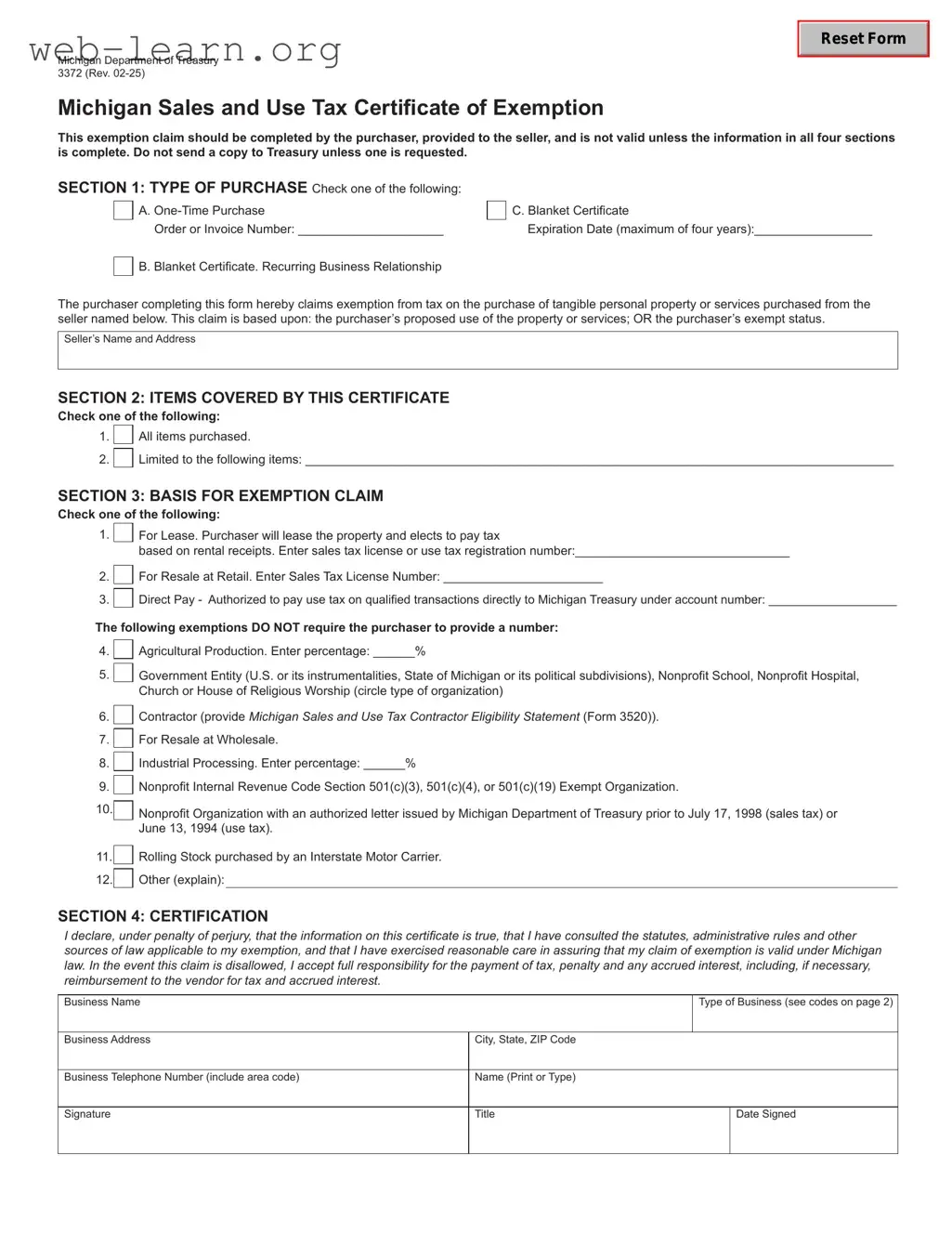
Homepage Blank 3372 Michigan Form
Outline

The Michigan Department of Treasury 3372 form, also known as the Michigan Sales and Use Tax Certificate of Exemption, serves an important purpose for purchasers looking to claim exemption from sales and use tax. This form must be filled out by the purchaser and provided to the seller to validate the exemption. It is crucial that all four sections of the form are completed, as an incomplete form is not valid. The first section allows the purchaser to specify the type of purchase, whether it is a one-time purchase or a blanket certificate for ongoing transactions. The second section identifies the items covered by the exemption, giving the purchaser the option to either exempt all items or specify limited items. In the third section, the purchaser must select the basis for the exemption claim, which includes various categories such as leasing, resale, and specific exemptions for agricultural production or nonprofit organizations. Finally, the fourth section requires certification from the purchaser, affirming the truthfulness of the information provided and acknowledging the responsibility for any tax liabilities if the claim is disallowed. Understanding the details of the 3372 form is essential for ensuring compliance and avoiding potential penalties.
Sample - 3372 Michigan Form

Michigan Department of Treasury
3372 (Rev. 02-25)
Michigan Sales and Use Tax Certicate of Exemption
This exemption claim should be completed by the purchaser, provided to the seller, and is not valid unless the information in all four sections
is complete. Do not send a copy to Treasury unless one is requested.
SECTION 1: TYPE OF PURCHASE Check one of the following:
A. One-Time Purchase
Order or Invoice Number: _____________________
C. Blanket Certicate
Expiration Date (maximum of four years):_________________
B. Blanket Certicate. Recurring Business Relationship
The purchaser completing this form hereby claims exemption from tax on the purchase of tangible personal property or services purchased from the
seller named below. This claim is based upon: the purchaser’s proposed use of the property or services; OR the purchaser’s exempt status.
Seller’s Name and Address
SECTION 2: ITEMS COVERED BY THIS CERTIFICATE
Check one of the following:
1. All items purchased.
2. Limited to the following items: _____________________________________________________________________________________
SECTION 3: BASIS FOR EXEMPTION CLAIM
Check one of the following:
1.
For Lease. Purchaser will lease the property and elects to pay tax
based on rental receipts. Enter sales tax license or use tax registration number:_______________________________
2. For Resale at Retail. Enter Sales Tax License Number: _______________________
3. Direct Pay - Authorized to pay use tax on qualied transactions directly to Michigan Treasury under account number: ___________________
The following exemptions DO NOT require the purchaser to provide a number:
4. Agricultural Production. Enter percentage: ______%
5.
Government Entity (U.S. or its instrumentalities, State of Michigan or its political subdivisions), Nonprot School, Nonprot Hospital,
Church or House of Religious Worship (circle type of organization)
6. Contractor (provide Michigan Sales and Use Tax Contractor Eligibility Statement (Form 3520)).
7. For Resale at Wholesale.
8. Industrial Processing. Enter percentage: ______%
9. Nonprot Internal Revenue Code Section 501(c)(3), 501(c)(4), or 501(c)(19) Exempt Organization.
10.
Nonprot Organization with an authorized letter issued by Michigan Department of Treasury prior to July 17, 1998 (sales tax) or
June 13, 1994 (use tax).
11. Rolling Stock purchased by an Interstate Motor Carrier.
12. Other (explain):
SECTION 4: CERTIFICATION
I declare, under penalty of perjury, that the information on this certicate is true, that I have consulted the statutes, administrative rules and other
sources of law applicable to my exemption, and that I have exercised reasonable care in assuring that my claim of exemption is valid under Michigan
law. In the event this claim is disallowed, I accept full responsibility for the payment of tax, penalty and any accrued interest, including, if necessary,
reimbursement to the vendor for tax and accrued interest.
Business Name Type of Business (see codes on page 2)
Business Address City, State, ZIP Code
Business Telephone Number (include area code) Name (Print or Type)
Signature Title Date Signed
Reset Form
3372, Page 2
Instructions for completing Michigan Sales and Use Tax Certicate of Exemption (Form 3372)
Purchasers may use this form to claim exemption from Michigan sales and use tax on qualied transactions. All elds must be
completed; however, if provided to the purchaser in electronic format, a signature is not required. All claims are subject to audit. The
purchaser must ensure eligibility of the exemption claimed; a purchaser who improperly claims an exemption is liable for tax, penalty,
and interest, with limited exceptions.
Sellers: Michigan does not issue “tax exempt numbers” and a seller is not permitted to rely on a number in lieu of a valid exemption
claim. Sellers are required to maintain proper records of exempt sales, including exemption forms or the same information in another
format. Records may be kept electronically. If the exemption certicate is received in electronic format, a signature is not required. A
seller who does not comply with these requirements may be liable for tax, penalty, and interest. See Revenue Administrative Bulletin
2024-11 for more information. All claims are subject to audit.
SECTION 1:
A) Choose “One-Time Purchase” and include the invoice number this certicate covers.
B) Choose “Blanket Certicate” if there is a “recurring business relationship.” This exists when a period of not more than 12 months
elapses between sales transactions between the seller and purchaser. Parties do not need to renew this blanket exemption claim as
long as the recurring business relationship exists.
C) Choose “Blanket Certicate” and enter the expiration date (maximum four years) when there may be a period of more than 12
months between sales transactions. This option is best when purchaser and seller anticipate more than one exempt transaction
before the expiration date but do not have or may not maintain a recurring business relationship.
SECTION 2:
Place a check in the box for “All items purchased” or choose “Limited to” and list the items that are covered by the exemption claim.
SECTION 3:
Check the box that applies and, if applicable, provide the required information. The exemptions listed are the most common. If the
exemption you are claiming is not listed, check “Other” and enter the qualifying exemption.
SECTION 4:
Purchaser must complete Section 4. A signature is only required if a paper form is used; in that case, the purchaser should sign and
provide their title (for example, Purchasing Manager, President, Owner). For Type of Business, enter the number from the following
list that best describes the purchaser’s business.
01 Accommodations 10 Utilities
02 Agricultural 11 Wholesale
03 Construction 12 Advertising, newspaper
04 Manufacturing 13 Non-Prot Hospital
05 Government 14 Non-Prot Educational
06 Rental or leasing 15 Non-Prot501(c)(3), 501(c)(4), or 501(c)(19)
07 Retail 16 Other (enter code and write in business type)
08 Church
09 Transportation

Form Information

Fact Name Details
Form Title Michigan Sales and Use Tax Certificate of Exemption
Form Number 3372
Revision Date Rev. 01-21
Purpose This form allows purchasers to claim exemption from Michigan sales and use tax.
Submission Requirement The form must be completed and given to the seller; do not send to Treasury unless requested.
Sections The form includes four sections: Type of Purchase, Items Covered, Basis for Exemption, and Certification.
Types of Purchase Options include One-Time Purchase or Blanket Certificate.
Exemption Basis Exemptions can be based on proposed use, exempt status, or specific categories like agricultural production.
Seller's Responsibility Sellers must maintain records of exempt sales and are not allowed to rely solely on exemption numbers.
Governing Law The form is governed by Michigan sales and use tax laws, as outlined in Revenue Administrative Bulletin 2016-14.

Detailed Guide for Filling Out 3372 Michigan

Completing the Michigan Sales and Use Tax Certificate of Exemption (Form 3372) is an important step in claiming an exemption from sales and use tax. It is essential to provide accurate information in all sections of the form. Once completed, the form should be given to the seller and kept for your records, as it will not be submitted to the Treasury unless requested.

  1. Section 1: Type of Purchase
    • Choose "One-Time Purchase" and enter the invoice number if applicable.
    • Select "Blanket Certificate" for a recurring business relationship.
    • If using a "Blanket Certificate" with no recurring relationship, enter an expiration date (maximum of four years).
  2. Section 2: Items Covered by This Certificate
    • Check "All items purchased" or select "Limited to" and list the specific items covered by the exemption.
  3. Section 3: Basis for Exemption Claim
    • Check the applicable box and provide any required information, such as sales tax license numbers or percentages for specific exemptions.
    • If your exemption is not listed, check "Other" and provide an explanation.
  4. Section 4: Certification
    • Complete the business name, type, address, and telephone number.
    • Print or type your name, sign the form, and include your title.
    • Enter the appropriate business type code from the provided list.

Obtain Answers on 3372 Michigan

  1. What is the Michigan Sales and Use Tax Certificate of Exemption (Form 3372)?

    The Michigan Sales and Use Tax Certificate of Exemption (Form 3372) is a document that allows purchasers to claim exemption from sales and use tax on specific transactions. This form must be filled out by the purchaser and presented to the seller. It is essential that all sections of the form are completed for it to be valid. The form does not need to be sent to the Michigan Department of Treasury unless requested.

  2. How do I complete the 3372 form?

    Completing the form involves several key steps:

    • Section 1: Indicate the type of purchase. You can choose a one-time purchase or a blanket certificate for ongoing transactions.
    • Section 2: Specify the items covered by the exemption. You can select all items or list specific ones.
    • Section 3: Identify the basis for your exemption claim. This could be for resale, lease, or other qualifying reasons.
    • Section 4: Certify the information provided is true and accurate. If using a paper form, you must sign it.

    Remember, all claims are subject to audit, so ensure that your exemption is valid under Michigan law.

  3. Who can use the 3372 form to claim an exemption?

    The 3372 form can be used by various entities, including businesses, government entities, nonprofit organizations, and certain agricultural producers. If you fall into one of these categories and are purchasing tangible personal property or services that qualify for exemption, you can utilize this form. However, it’s crucial to ensure that you meet the eligibility criteria for the exemption you are claiming.

  4. What happens if I improperly claim an exemption?

    If you incorrectly claim an exemption using Form 3372, you may be held responsible for any unpaid taxes, penalties, and interest. It’s important to exercise reasonable care in understanding the exemptions available and ensuring your claim is valid. Sellers are also required to maintain proper records of exempt sales, which include keeping the exemption forms on file. Failure to comply with these requirements can lead to additional liabilities for both the purchaser and the seller.

Common mistakes

Filling out the Michigan Department of Treasury 3372 form can be straightforward, but many people make common mistakes that can lead to complications. One frequent error occurs in Section 1, where individuals fail to select the correct type of purchase. This section requires the purchaser to indicate whether the transaction is a one-time purchase or a blanket certificate. Neglecting to check a box can invalidate the entire exemption claim.

Another mistake involves leaving out the invoice number or expiration date when applicable. For one-time purchases, the invoice number is essential. For blanket certificates, the expiration date must be included, as it cannot exceed four years. Omitting this information can result in the exemption being denied.

Section 2 often causes confusion as well. Some people check "All items purchased" without realizing that they must specify if the exemption only applies to certain items. Failing to accurately describe the items covered can lead to misunderstandings with the seller and potential tax liabilities.

In Section 3, individuals sometimes overlook the requirement to provide necessary identification numbers. Whether it is a sales tax license number or a use tax registration number, these details are crucial for verifying the exemption claim. Without them, the claim may be deemed invalid.

Another common error is related to the basis for the exemption claim. Purchasers may check the wrong box or fail to provide supporting information. It is vital to ensure that the selected exemption category accurately reflects the intended use of the purchased items or services.

Additionally, some purchasers do not take the time to read the instructions thoroughly. Each section has specific requirements that must be met for the exemption to be valid. Ignoring these guidelines can lead to incomplete submissions.

Section 4 requires a certification statement, which must be signed by the purchaser if the form is submitted in paper format. People often forget to sign or include their title, which can render the form incomplete. A missing signature can lead to the rejection of the exemption claim.

Another mistake occurs when individuals fail to consult the statutes and administrative rules relevant to their exemption claim. It is the purchaser's responsibility to ensure that their claim is valid. Ignorance of the law does not excuse improper claims, and individuals may find themselves liable for taxes, penalties, and interest.

Lastly, some purchasers mistakenly believe that the exemption certificate does not require any follow-up. In reality, all claims are subject to audit. Maintaining proper records of exempt sales, including the completed form, is essential for compliance. Failure to do so can lead to additional complications down the line.

Documents used along the form

The Michigan Department of Treasury Form 3372 is used to claim exemption from sales and use tax for specific purchases. In addition to this form, several other documents may be necessary to support or clarify the exemption claim. Below is a list of related forms and documents commonly utilized alongside Form 3372.

  • Form 3520 - Sales and Use Tax Contractor Eligibility Statement: This form is required for contractors claiming exemption on purchases made for construction projects. It certifies that the contractor is eligible for tax exemption based on their status and the nature of the work performed.
  • Sales Tax License: Businesses must obtain a sales tax license to collect and remit sales tax. This license number is often required on exemption forms to validate the purchaser's claim.
  • Direct Pay Permit: This permit allows certain businesses to pay use tax directly to the state rather than to sellers. It simplifies tax compliance for frequent exempt purchases.
  • Exempt Organization Letter: Nonprofit organizations may need a letter from the Michigan Department of Treasury confirming their exempt status. This letter is essential for establishing eligibility for tax exemptions.
  • Purchase Orders or Invoices: These documents provide proof of the transaction and may be required to accompany the exemption claim. They help clarify the items being purchased under the exemption.
  • Proof of Exempt Use: Documentation showing how the purchased items will be used can support the exemption claim. This is particularly important for exemptions based on intended use.
  • IRS Determination Letter: For organizations claiming exemption under IRS 501(c)(3) or similar statuses, this letter verifies their tax-exempt status at the federal level.
  • Farm Exemption Certificate: Farmers may use this certificate to claim exemptions on certain purchases related to agricultural production. It outlines the specific items eligible for tax exemption.
  • Government Entity Exemption Certificate: This document is used by government entities to claim tax exemption on purchases made for official purposes. It confirms the entity's exempt status.

Each of these documents plays a crucial role in substantiating claims for tax exemption in Michigan. Proper completion and submission of these forms can help ensure compliance and avoid potential tax liabilities.

Similar forms

  • IRS Form W-9: This form is used by individuals and businesses to provide their taxpayer identification number (TIN) to others who are required to report certain payments to the IRS. Like the Michigan 3372 form, it is a declaration of status that helps claim exemptions, although it pertains to federal tax purposes rather than state sales tax.
  • Michigan Sales Tax Exemption Certificate (Form 3372): While this is the same form, it is important to note that it serves as a claim for exemption from sales tax on specific purchases. It requires detailed information about the purchaser and the nature of the exemption, similar to the way exemptions are claimed on other tax forms.
  • Form ST-3 (Sales Tax Exemption Certificate): This form is used in various states, including Michigan, to claim an exemption from sales tax for certain types of purchases. It is similar to the 3372 form in that it requires the purchaser to specify the type of exemption being claimed and the intended use of the purchased items.
  • Form ST-4 (Sales Tax Resale Certificate): This document allows businesses to purchase goods tax-free if they intend to resell them. Like the 3372 form, it requires information about the purchaser and the nature of the purchase, ensuring that the seller can verify the legitimacy of the exemption.
  • Form ST-5 (Sales Tax Exempt Organization Certificate): Nonprofit organizations use this form to claim exemption from sales tax on purchases. Similar to the 3372 form, it requires the organization to provide proof of its exempt status and the nature of the purchases, ensuring compliance with tax laws.

Dos and Don'ts

When filling out the Michigan Department of Treasury 3372 form, follow these guidelines to ensure accuracy and compliance.

  • Do complete all four sections of the form. Each section is essential for the exemption claim to be valid.
  • Do check the appropriate box for the type of purchase: One-Time Purchase or Blanket Certificate.
  • Do specify the items covered by the exemption clearly in Section 2.
  • Do provide the necessary information for the basis of exemption in Section 3.
  • Do ensure that the form is signed if submitting a paper version.
  • Don't send a copy of the form to the Treasury unless specifically requested.
  • Don't leave any fields blank; incomplete forms may lead to disallowance of the exemption claim.
  • Don't assume that a tax-exempt number is sufficient; valid exemption claims must be documented properly.
  • Don't forget to keep a copy of the completed form for your records, as all claims are subject to audit.

Misconceptions

Misconceptions about the Michigan Department of Treasury 3372 form can lead to confusion regarding its proper use. Here are six common misconceptions:

  • It can be submitted to the Treasury. The 3372 form is not valid if sent to the Treasury unless specifically requested. It should be provided directly to the seller.
  • All fields can be left blank. The form must be fully completed in all four sections for the exemption claim to be valid.
  • Tax-exempt numbers are issued by Michigan. Michigan does not issue tax-exempt numbers. Sellers cannot rely on a number in lieu of a valid exemption claim.
  • Electronic submissions do not require a signature. A signature is not required if the form is provided in electronic format. However, if a paper form is used, a signature is necessary.
  • Blanket certificates are perpetual. Blanket certificates are not indefinite. They must be renewed every four years or if the business relationship changes.
  • All exemptions are the same. Different exemptions have specific criteria. It is essential to check the appropriate box and provide any required information to validate the claim.

Key takeaways

The Michigan Sales and Use Tax Certificate of Exemption, known as Form 3372, is a crucial document for purchasers seeking to claim exemption from sales tax on qualified transactions. Here are some key takeaways to consider when filling out and using this form:

  • Complete All Sections: Ensure that all four sections of the form are fully completed. An incomplete form is not valid.
  • Do Not Submit to Treasury: There is no need to send a copy of the completed form to the Michigan Department of Treasury unless specifically requested.
  • Types of Purchase: Select either a "One-Time Purchase" or a "Blanket Certificate" based on your purchasing needs. A blanket certificate can be used for recurring transactions.
  • Expiration Date: If using a blanket certificate, remember that it can be valid for a maximum of four years. Be sure to enter the expiration date if applicable.
  • Items Covered: Clearly indicate whether the exemption applies to all items purchased or specify limited items covered by the exemption.
  • Basis for Exemption: Choose the appropriate basis for your exemption claim from the provided options. Each option has specific requirements that must be met.
  • Responsibility for Accuracy: The purchaser must ensure that the exemption claim is valid. Improper claims can lead to tax liabilities, penalties, and interest.
  • Record Keeping: Sellers must maintain accurate records of exempt sales, including the exemption forms, to comply with audit requirements.
  • Signature Requirement: A signature is required only if the form is submitted in paper format. If the form is provided electronically, a signature is not necessary.

Understanding these key points can help ensure that the exemption process is handled correctly, minimizing the risk of future complications. It is important for both purchasers and sellers to be diligent and informed when using Form 3372.