Homepage Blank 3 Day Quit Notice California Form
Outline

In California, the 3 Day Quit Notice serves as a crucial tool for landlords seeking to address lease violations by tenants. This form is designed to inform tenants that they have a limited timeframe—specifically, three days—to either rectify the issues outlined in their lease agreement or vacate the property entirely. The notice details the specific provisions of the rental agreement that have been violated, providing clarity and transparency in the communication process. Should tenants fail to comply within the stipulated period, landlords are empowered to initiate legal proceedings to reclaim possession of the premises, which may also include seeking punitive damages and recovery of attorney fees. It’s important for both landlords and tenants to understand the implications of this notice, as it not only highlights the landlord's rights but also emphasizes the responsibilities tenants hold under their rental agreements. With clear instructions and a formal declaration of potential lease forfeiture, this document plays a pivotal role in the landlord-tenant relationship, ensuring that both parties are aware of their rights and obligations.
Sample - 3 Day Quit Notice California Form

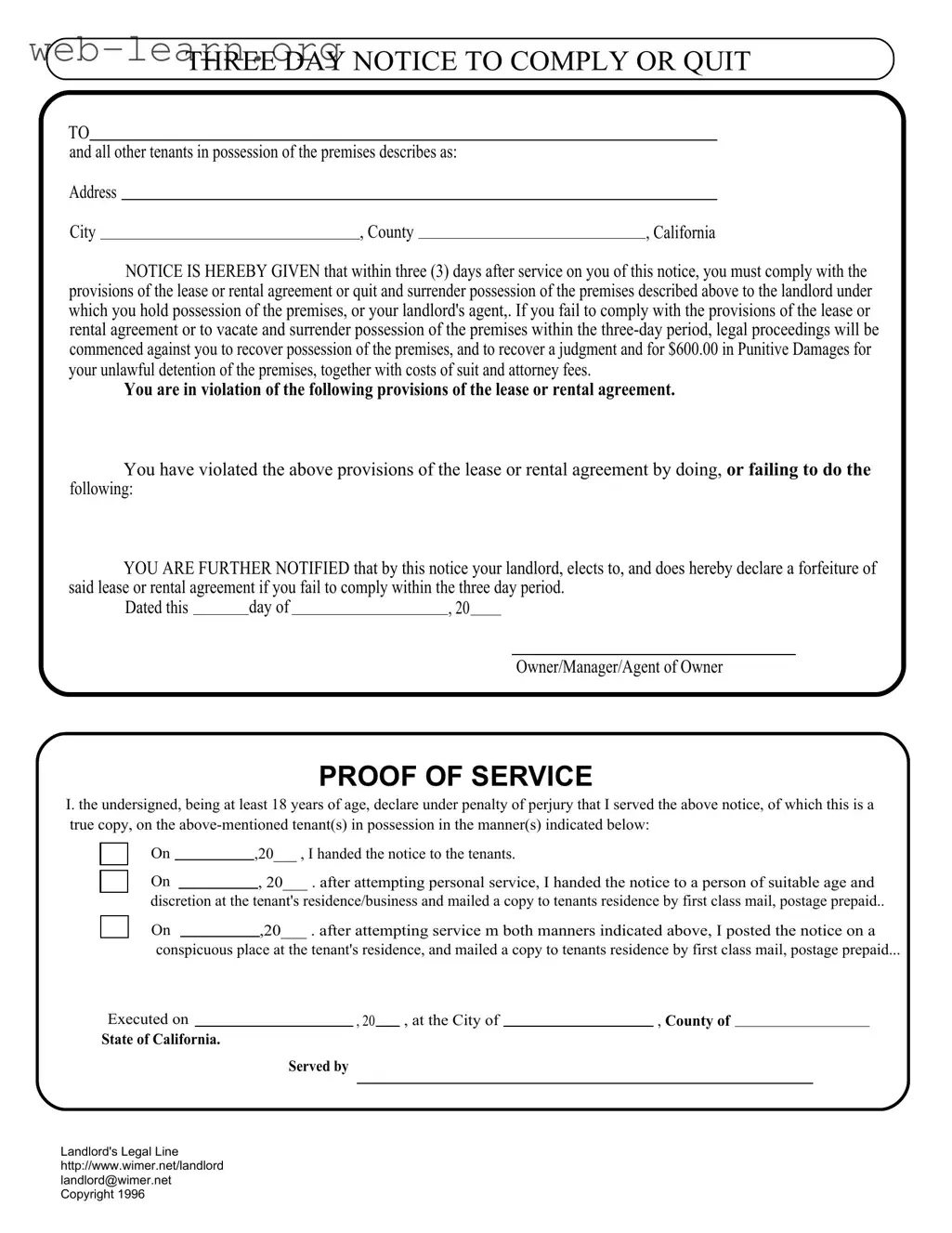
THREE DAY NOTICE TO COMPLY OR QUIT
TO
and all other tenants in possession of the premises describes as:
Address
City
, County
, California
NOTICE IS HEREBY GIVEN that within three (3) days after service on you of this notice, you must comply with the
provisions of the lease or rental agreement or quit and surrender possession of the premises described above to the landlord under
which you hold possession of the premises, or your landlord's agent,. If you fail to comply with the provisions of the lease or
rental agreement or to vacate and surrender possession of the premises within the three-day period, legal proceedings will be
commenced against you to recover possession of the premises, and to recover a judgment and for $600.00 in Punitive Damages for
your unlawful detention of the premises, together with costs of suit and attorney fees.
You are in violation of the following provisions of the lease or rental agreement.
You have violated the above provisions of the lease or rental agreement by doing, or failing to do the
following:
YOU ARE FURTHER NOTIFIED that by this notice your landlord, elects to, and does hereby declare a forfeiture of
said lease or rental agreement if you fail to comply within the three day period.
day of
Dated this
, 20
Owner/Manager/Agent of Owner
Landlord's Legal Line
http://www.wimer.net/landlord
Copyright 1996
PROOF OF SERVICE
I. the undersigned, being at least 18 years of age, declare under penalty of perjury that I served the above notice, of which this is a
true copy, on the above-mentioned tenant(s) in possession in the manner(s) indicated below:
On
,20___ , I handed the notice to the tenants.
On
, 20___ . after attempting personal service, I handed the notice to a person of suitable age and
discretion at the tenant's residence/business and mailed a copy to tenants residence by first class mail, postage prepaid..
On
,20___ . after attempting service m both manners indicated above, I posted the notice on a
conspicuous place at the tenant's residence, and mailed a copy to tenants residence by first class mail, postage prepaid...
Executed on
, at the City of
, 20
, County of
State of California.
Served by

Form Information

Fact Name Details
Purpose of the Notice The 3 Day Quit Notice is used by landlords to inform tenants that they must either comply with the lease terms or vacate the rental property within three days.
Legal Basis This notice is governed by California Civil Code Section 1946, which outlines the rights and responsibilities of landlords and tenants regarding lease agreements.
Consequences of Non-Compliance If tenants do not comply with the notice, landlords may initiate legal proceedings to recover possession of the property and may seek damages.
Service Requirements The notice must be served in specific ways, including personal delivery, leaving it with a suitable person, or posting it on the property and mailing a copy.
Punitive Damages The notice indicates that failure to comply may result in a claim for punitive damages up to $600, in addition to court costs and attorney fees.

Detailed Guide for Filling Out 3 Day Quit Notice California

Filling out the 3 Day Quit Notice form in California requires careful attention to detail. This notice is an important document that communicates specific requirements to tenants regarding their lease or rental agreement. After completing the form, it should be served to the tenant to ensure they are aware of the situation and the necessary actions they must take.

  1. Obtain the form: Download or print the 3 Day Quit Notice form from a reliable source.
  2. Fill in the tenant's information: Write the names of the tenant(s) in possession of the premises at the top of the form.
  3. Provide the property address: Enter the complete address of the rental property, including the city, county, and state.
  4. Specify the violation: Clearly state the specific provisions of the lease or rental agreement that have been violated by the tenant.
  5. Indicate the date: Fill in the date on which the notice is being issued.
  6. Sign the notice: The landlord or their agent must sign the notice at the bottom, indicating their authority to issue it.
  7. Complete the proof of service section: Choose the method of service and fill in the required details about how the notice was delivered to the tenant.
  8. Record the execution date: Write the date on which the notice was served, along with the city and county where the service took place.

Obtain Answers on 3 Day Quit Notice California

  1. What is a 3 Day Quit Notice in California?

    A 3 Day Quit Notice is a legal document that a landlord can use to notify tenants that they must either comply with the terms of their lease or vacate the rental property within three days. This notice is typically used when a tenant has violated specific provisions of the lease agreement, such as failing to pay rent or violating other terms of occupancy.

  2. When can a landlord issue a 3 Day Quit Notice?

    A landlord can issue a 3 Day Quit Notice when a tenant is in violation of the lease agreement. Common reasons for issuing this notice include non-payment of rent, unauthorized occupants, or property damage. The landlord must specify the violation in the notice to ensure clarity.

  3. What happens if a tenant does not comply with the notice?

    If the tenant does not comply with the 3 Day Quit Notice by either remedying the violation or vacating the premises within the specified three-day period, the landlord may begin legal proceedings. This can lead to an eviction process, where the landlord seeks to recover possession of the property through the court system.

  4. How is the 3 Day Quit Notice served to the tenant?

    The notice can be served in several ways:

    • Hand-delivered to the tenant.
    • Given to a person of suitable age and discretion at the tenant's residence or business, followed by mailing a copy to the tenant.
    • Posted in a conspicuous location at the tenant's residence, with a copy mailed to the tenant.

    Each method has specific requirements that must be followed to ensure proper service.

  5. What are the consequences of not responding to a 3 Day Quit Notice?

    If a tenant fails to respond to a 3 Day Quit Notice, the landlord may file an unlawful detainer action in court. This legal action can result in a judgment against the tenant, which may include the recovery of unpaid rent, punitive damages, and legal fees. Additionally, the tenant may face eviction from the property.

  6. Can a tenant contest a 3 Day Quit Notice?

    Yes, a tenant can contest a 3 Day Quit Notice. If the tenant believes the notice was issued in error or that they have complied with the lease terms, they can present their case in court during the eviction proceedings. It is advisable for tenants to seek legal counsel to understand their rights and options.

  7. Is there a way to resolve issues before receiving a 3 Day Quit Notice?

    Yes, tenants are encouraged to communicate openly with their landlords regarding any issues that may lead to a 3 Day Quit Notice. Addressing concerns such as late payments or maintenance issues proactively can often prevent the escalation to formal eviction proceedings.

Common mistakes

Filling out the 3 Day Quit Notice form in California can be a straightforward process, but there are common mistakes that individuals often make. One frequent error is failing to include the correct address of the tenant. It is essential to provide the full address of the premises where the tenant resides. Omitting any part of the address may lead to confusion and could invalidate the notice.

Another mistake is not specifying the date when the notice is served. The form requires a clear date to establish the three-day compliance period. Without this date, the tenant may not understand the timeline, which can result in unnecessary disputes.

People often forget to include their own name and contact information as the landlord or agent. This information is vital for the tenant to know whom to contact regarding the notice. Leaving this section blank can create barriers to communication and complicate the process.

Additionally, some individuals neglect to indicate the specific lease or rental agreement provisions that have been violated. Clearly stating the violations helps the tenant understand the reason for the notice and what actions they need to take. This clarity is crucial for compliance.

Another common error is not signing the notice. The form must be signed by the landlord or their authorized agent to be considered valid. A signature lends authenticity to the document and confirms that it has been properly executed.

People may also overlook the proof of service section. This part is essential to demonstrate that the notice was delivered to the tenant. If this section is incomplete, it could undermine the effectiveness of the notice and create legal complications later.

Moreover, some individuals fail to keep a copy of the completed notice for their records. Retaining a copy is important for future reference, especially if legal action becomes necessary. Having documentation can provide protection and support in any disputes that arise.

Lastly, many make the mistake of not understanding the implications of failing to comply with the notice. If the tenant does not respond within the three days, the landlord may proceed with legal action. It is crucial for both parties to understand their rights and responsibilities to avoid further complications.

Documents used along the form

When dealing with rental agreements in California, the 3 Day Quit Notice is just one of several important documents that may be necessary. Understanding these forms can help both landlords and tenants navigate their rights and responsibilities. Here’s a list of other documents commonly used alongside the 3 Day Quit Notice.

  • Lease Agreement: This is the foundational document that outlines the terms and conditions between the landlord and tenant. It includes details like rent amount, payment due dates, and rules regarding property use.
  • Notice to Pay Rent or Quit: This notice is issued when a tenant fails to pay rent. It gives the tenant a specific timeframe to pay the overdue rent or vacate the property.
  • 30-Day Notice to Terminate Tenancy: Landlords use this notice to inform tenants that their lease will not be renewed. It provides a 30-day period for tenants to vacate the property.
  • Proof of Service: This document confirms that the landlord has properly delivered notices to the tenant. It is crucial for legal proceedings if disputes arise.
  • Rent Increase Notice: When landlords decide to raise the rent, this notice must be provided to tenants, usually with a specified notice period, depending on the amount of increase.
  • Repair Request Form: Tenants can use this form to formally request repairs or maintenance from the landlord, ensuring that issues are documented and addressed promptly.
  • Security Deposit Receipt: This document details the amount of the security deposit and the conditions under which it may be withheld after a tenant vacates the property.

Each of these documents plays a significant role in the landlord-tenant relationship. Familiarity with them can prevent misunderstandings and promote a smoother rental experience. Always consider seeking professional guidance if you have questions about these forms.

Similar forms

The 3 Day Quit Notice in California serves as a formal notification to tenants who are in violation of their lease. There are several other documents that share similarities with this notice. Each of these documents typically serves to inform tenants of their obligations and the consequences of non-compliance. Here’s a breakdown of seven similar documents:

  • Notice to Pay Rent or Quit: This document is issued when a tenant fails to pay rent on time. It informs the tenant that they must pay the overdue rent or vacate the premises within a specified period, similar to the 3 Day Quit Notice's demand for compliance.
  • Notice of Lease Violation: This notice is used when a tenant violates specific terms of the lease agreement, such as noise complaints or unauthorized pets. It outlines the violations and gives the tenant a chance to correct them, much like the 3 Day Quit Notice.
  • Unlawful Detainer Notice: This document is often the next step after a 3 Day Quit Notice if the tenant does not comply. It initiates legal proceedings to regain possession of the property, similar to the consequences outlined in the 3 Day Quit Notice.
  • 30-Day Notice to Terminate Tenancy: This notice can be given for various reasons, including non-renewal of a month-to-month lease. It requires tenants to vacate the property within 30 days, serving as a longer-term alternative to the immediate demands of the 3 Day Quit Notice.
  • Notice of Intent to Evict: This notice is provided when a landlord intends to start eviction proceedings. It typically follows a 3 Day Quit Notice if the tenant has not complied, signaling the landlord's serious intent to regain possession.
  • Notice of Abandonment: This document is used when a landlord believes a tenant has abandoned the rental property. It informs the tenant of the landlord's intent to reclaim the property, similar to the 3 Day Quit Notice's aim of regaining possession.
  • Notice of Rent Increase: While not a compliance notice, this document informs tenants of upcoming changes in rent. It establishes a formal communication channel regarding lease terms, akin to how the 3 Day Quit Notice addresses lease violations.

Understanding these documents can help tenants navigate their rights and responsibilities, ensuring they are aware of the implications of their actions regarding their lease agreements.

Dos and Don'ts

When filling out the 3 Day Quit Notice in California, it's important to follow certain guidelines to ensure compliance and effectiveness. Below are some dos and don'ts to keep in mind.

  • Do clearly state the address of the rental property.
  • Do specify the exact violations of the lease or rental agreement.
  • Do provide the date of service on the notice.
  • Do include your name and contact information as the landlord or agent.
  • Don't use vague language; be specific about what needs to be corrected.
  • Don't forget to sign and date the notice before serving it.
  • Don't serve the notice without following proper legal procedures.
  • Don't delay in serving the notice; timely action is crucial.

Following these guidelines can help ensure that the notice is valid and that your rights as a landlord are protected. Taking the time to complete the form accurately can prevent complications in the future.

Misconceptions

Here are five common misconceptions about the 3 Day Quit Notice California form:

  • It gives tenants more time than three days. Some people believe that the three-day notice allows for more than three days to comply. In reality, tenants must act within the specified three-day period.
  • It can be ignored without consequences. Many think they can simply ignore the notice. However, failing to respond can lead to legal actions, including eviction.
  • All violations require a 3 Day Quit Notice. Not all lease violations warrant this notice. The form is specifically for certain breaches, such as non-payment of rent or other significant lease violations.
  • It must be served in person. Some assume that the notice can only be delivered in person. The law allows for several methods of service, including posting and mailing.
  • It guarantees immediate eviction. People often think that receiving a 3 Day Quit Notice means they will be evicted immediately. In truth, it starts a process that may lead to eviction if compliance does not occur.

Key takeaways

When dealing with the 3 Day Quit Notice in California, there are several important points to keep in mind. This notice is a critical document for landlords and tenants alike. Here are some key takeaways:

  • Purpose of the Notice: The 3 Day Quit Notice serves as a formal request for tenants to comply with the terms of their lease or to vacate the property within three days.
  • Compliance Timeframe: Tenants have three days from the date of service to either remedy the lease violation or leave the premises. This is a strict deadline.
  • Consequences of Non-Compliance: If tenants do not comply within the three-day period, landlords may initiate legal proceedings to regain possession of the property and seek damages.
  • Details Required: The notice must clearly state the address of the property and the specific lease violations that have occurred. Clarity is essential.
  • Service Methods: The notice can be served in various ways, including personal delivery, leaving it with someone at the residence, or posting it on the property if necessary.
  • Proof of Service: It is crucial for landlords to document how and when the notice was served. This proof will be important if legal action becomes necessary.

Understanding these key aspects can help ensure that both landlords and tenants navigate the process smoothly and avoid potential disputes.