Homepage Blank 2101 Texas Form
Outline

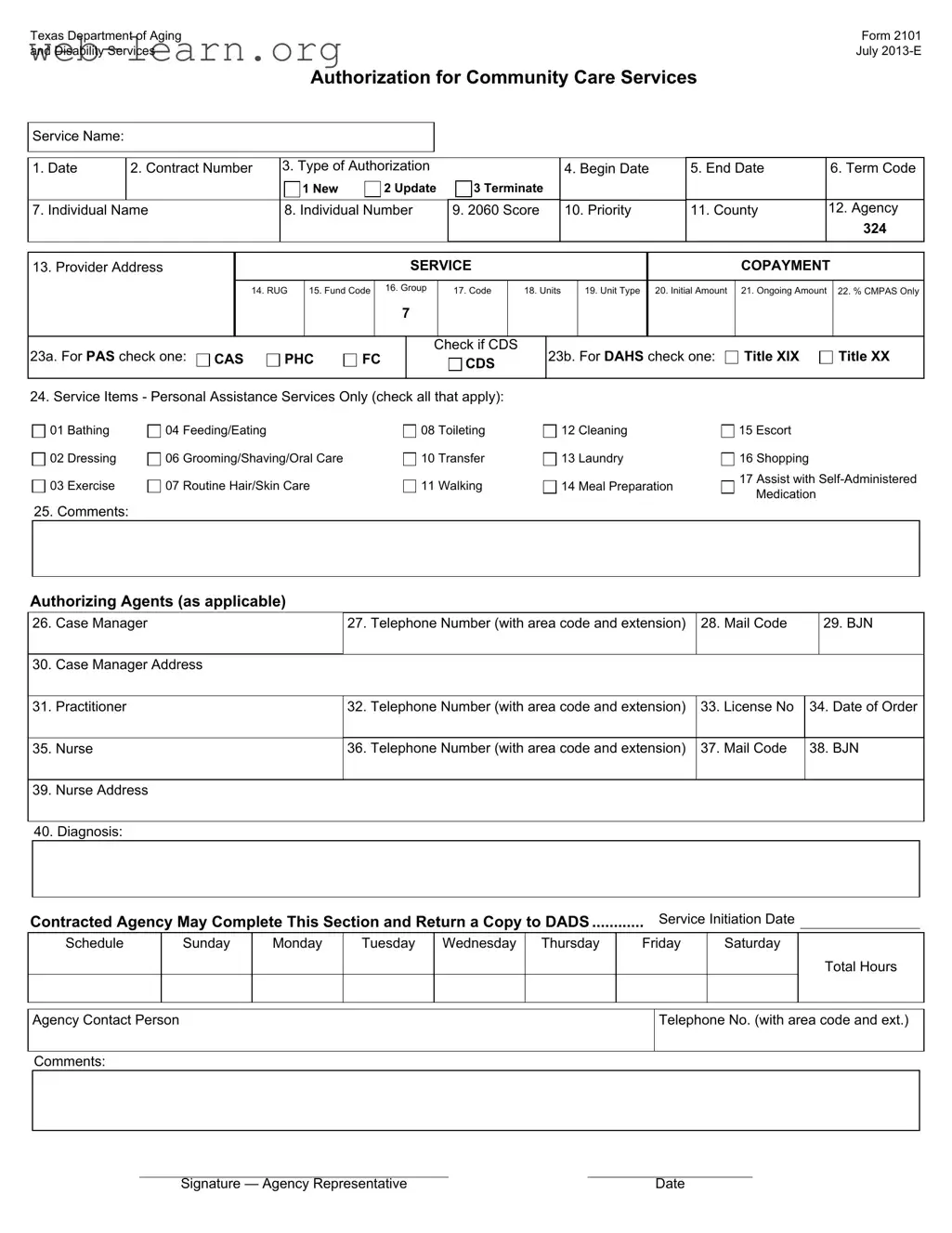
The Texas Department of Aging and Disability Services has developed Form 2101, a crucial document for individuals seeking community care services. This form serves multiple purposes, including authorizing new services, updating existing ones, or terminating them as necessary. It captures essential details such as the individual's name, identification number, and the specific services requested. For instance, users must indicate the type of authorization they need, whether it’s a new request, an update, or a termination. The form also requires information about the service's start and end dates, along with the county and agency involved. Furthermore, it outlines various personal assistance services, allowing individuals to specify the types of support they require, such as bathing, dressing, or meal preparation. Additionally, the form includes sections for authorizing agents, such as case managers and practitioners, to provide their contact information and credentials. This comprehensive approach ensures that all necessary information is gathered to facilitate the provision of care, making it a vital tool for both individuals and agencies involved in community care services in Texas.

Sample - 2101 Texas Form

Texas Department of Aging
and Disability Services
Form 2101
July 2013-E
Authorization for Community Care Services
Service Name:
1. Date 2. Contract Number
3. Type of Authorization
1 New
2 Update
3 Terminate
4. Begin Date
5. End Date 6. Term Code
7. Individual Name
8. Individual Number
9. 2060 Score 10. Priority 11. County
12. Agency
324
13. Provider Address
SERVICE
14. RUG 15. Fund Code
16. Group
7
17. Code 18. Units 19. Unit Type
COPAYMENT
20. Initial Amount 21. Ongoing Amount
22. % CMPAS Only
23a. For PAS check one:
CAS PHC FC
Check if CDS
CDS
23b. For DAHS check one: Title XIX Title XX
24. Service Items - Personal Assistance Services Only (check all that apply):
01 Bathing
02 Dressing
03 Exercise
04 Feeding/Eating
06 Grooming/Shaving/Oral Care
07 Routine Hair/Skin Care
08 Toileting
10 Transfer
11 Walking
12 Cleaning
13 Laundry
14 Meal Preparation
15 Escort
16 Shopping
17 Assist with Self-Administered
Medication
25. Comments:
Authorizing Agents (as applicable)
26. Case Manager
27. Telephone Number (with area code and extension) 28. Mail Code 29. BJN
30. Case Manager Address
31. Practitioner 32. Telephone Number (with area code and extension) 33. License No 34. Date of Order
35. Nurse
36. Telephone Number (with area code and extension) 37. Mail Code 38. BJN
39. Nurse Address
40. Diagnosis:
Contracted Agency May Complete This Section and Return a Copy to DADS ............
Service Initiation Date
Schedule Sunday Monday Tuesday Wednesday Thursday Friday Saturday
Total Hours
Agency Contact Person Telephone No. (with area code and ext.)
Comments:
Signature — Agency Representative Date

Form Information

Fact Name Fact Description
Form Title Texas Department of Aging and Disability Services Form 2101, Authorization for Community Care Services.
Effective Date The form was last updated in July 2013.
Governing Law This form is governed by Texas Health and Safety Code, Title 2, Chapter 142.
Service Types Three types of authorizations can be indicated: New, Update, or Terminate.
Individual Identification The form requires the individual's name and number for proper identification.
Service Copayment Information regarding service copayment is included, which may affect the overall cost to the individual.
Personal Assistance Services Specific personal assistance services can be checked off, such as bathing, dressing, and meal preparation.

Detailed Guide for Filling Out 2101 Texas

Filling out the Texas Department of Aging Form 2101 is an important step in securing community care services. This form collects essential information needed to process authorizations for these services. Follow the steps below to complete the form accurately.

  1. Begin by entering the Date at the top of the form.
  2. Next, fill in the Contract Number.
  3. Indicate the Type of Authorization by checking one of the options: New, Update, or Terminate.
  4. Provide the Begin Date and End Date for the services.
  5. Enter the Term Code.
  6. Fill in the Individual Name and Individual Number.
  7. Input the 2060 Score.
  8. Specify the Priority and the County.
  9. Complete the Agency and Provider Address.
  10. For SERVICE COPAYMENT, fill in the RUG, Fund Code, Group, Code, Units, and Unit Type.
  11. Enter the Initial Amount and Ongoing Amount.
  12. Fill in the % CMPAS Only section.
  13. For PAS, check one option: CAS, PHC, or FC. For DAHS, check either Title XIX or Title XX.
  14. In the Service Items section, check all applicable personal assistance services.
  15. Provide any additional Comments if necessary.
  16. Complete the Authorizing Agents section, including the Case Manager's details, Practitioner information, and Nurse's information.
  17. Fill in the Diagnosis if applicable.
  18. In the Service Initiation Date Schedule, indicate the total hours for each day of the week.
  19. List the Agency Contact Person and their Telephone Number.
  20. Finally, have the Agency Representative sign and date the form.

Obtain Answers on 2101 Texas

  1. What is the purpose of the 2101 Texas form?

    The 2101 Texas form is used to authorize community care services for individuals requiring assistance due to aging or disabilities. It helps streamline the process of providing necessary services and ensures that individuals receive the support they need.

  2. Who needs to fill out the 2101 Texas form?

    This form should be completed by authorized agents, such as case managers or healthcare practitioners, who are responsible for coordinating care for individuals. It is essential for ensuring that all necessary information is documented accurately.

  3. What information is required on the form?

    Key details include:

    • Individual’s name and number
    • Contract number and type of authorization (new, update, terminate)
    • Service start and end dates
    • Diagnosis and service items needed

    Providing complete and accurate information is crucial for timely processing.

  4. What types of services can be authorized using this form?

    The form covers a range of personal assistance services, including:

    • Bathing
    • Dressing
    • Feeding
    • Toileting
    • Medication assistance

    These services are designed to support individuals in their daily activities.

  5. How are service copayments handled on the form?

    Section 14 of the form includes a space to indicate the service copayment amount. This ensures that both the agency and the individual are aware of any financial responsibilities associated with the services provided.

  6. What should be done if there are changes to the service needs?

    If an individual's service needs change, the form must be updated. Select the "Update" option for the type of authorization and provide the new details to ensure continued support.

  7. How is the 2060 score relevant to the form?

    The 2060 score is an assessment tool used to evaluate the level of care an individual requires. It is an important part of the form, as it helps determine the appropriate services and resources needed for the individual.

  8. What happens if the form is not completed correctly?

    Incomplete or inaccurate forms can lead to delays in service initiation. It is vital for all required fields to be filled out thoroughly to avoid any issues with processing the authorization.

  9. Who can be contacted for questions regarding the form?

    If there are any questions or concerns about completing the 2101 Texas form, individuals should reach out to the designated agency contact person listed on the form. They can provide guidance and clarification as needed.

  10. What is the significance of the agency representative's signature?

    The signature of the agency representative at the bottom of the form indicates that the information provided is accurate and that the agency agrees to provide the authorized services. This step is crucial for accountability and compliance.

Common mistakes

Filling out the Texas Form 2101 can be a straightforward task, but many people make mistakes that can lead to delays or complications in receiving services. One common error is failing to provide the correct date. The form requires specific dates for the service initiation, including the begin and end dates. If these dates are incorrect or missing, it can cause confusion and hinder the processing of the application.

Another frequent mistake is not checking the right type of authorization. The form includes options for new, update, or terminate. Selecting the wrong option can result in the form being processed incorrectly, leading to unnecessary delays. It’s essential to carefully review this section before submitting.

People often overlook the importance of filling in the individual name and individual number accurately. This information is crucial for identifying the person receiving services. Any discrepancies can lead to issues with service delivery. Always double-check these details to ensure they match official records.

Additionally, many individuals forget to complete the service copayment section. This part of the form is vital for determining the financial responsibilities of the individual. Not providing this information can complicate billing and payment processes later on.

Another common oversight is neglecting to include all necessary contact information for the case manager and practitioners involved. Missing phone numbers or addresses can slow down communication and lead to misunderstandings. It’s a good practice to ensure that all contact details are complete and accurate.

Some people also fail to check all applicable service items in the personal assistance services section. Each service that applies should be marked clearly. Omitting a service can limit the assistance available to the individual, so it’s important to review this section thoroughly.

Lastly, forgetting to sign and date the form is a mistake that can render the application invalid. A signature is often required to confirm that the information provided is accurate and that the individual agrees to the terms. Always remember to sign and date the form before submission to avoid unnecessary setbacks.

Documents used along the form

The Texas Department of Aging Form 2101 is essential for authorizing community care services. However, several other forms and documents are often utilized in conjunction with this form to ensure comprehensive service delivery and compliance with regulations. Below is a list of these documents, each serving a specific purpose in the process.

  • Form 2060: This form is used to assess an individual’s needs and determine eligibility for services. It includes information about the individual’s functional abilities and limitations.
  • Form 2102: This form is a request for additional services or updates to existing authorizations. It helps ensure that the care plan remains relevant and effective as the individual’s needs change.
  • Service Plan: This document outlines the specific services to be provided, including details about frequency and duration. It serves as a roadmap for caregivers and service providers.
  • Provider Agreement: This agreement is between the agency and the service provider. It details the responsibilities of both parties and ensures compliance with state regulations.
  • Client Rights and Responsibilities Document: This document informs clients of their rights regarding care services and outlines their responsibilities in the process.
  • Service Delivery Log: This log tracks the services provided to the individual, including dates, times, and types of services. It is essential for accountability and monitoring service effectiveness.
  • Incident Report Form: This form is used to document any incidents or accidents that occur during service delivery. It is crucial for maintaining safety and addressing any issues promptly.
  • Feedback and Satisfaction Survey: This survey collects feedback from clients about the services received. It helps agencies improve service quality based on client experiences.
  • Authorization for Release of Information: This document allows the sharing of an individual’s personal health information with relevant parties involved in their care, ensuring coordinated services.

These documents collectively support the effective management of community care services, ensuring that individuals receive the necessary support while adhering to regulatory standards. Each form plays a vital role in maintaining clear communication and accountability among all parties involved.

Similar forms

The Texas Department of Aging Form 2101 is primarily used for authorizing community care services. It shares similarities with several other documents in the realm of health and community services. Below are four documents that are comparable to the 2101 Texas form, along with an explanation of their similarities:

  • Form 2060: This form is also used for assessing eligibility for community care services. Like the 2101 form, it collects essential information about the individual, including their needs and the services required.
  • Form 1720: This document is utilized for requesting home health services. Similar to the 2101 form, it outlines the type of services needed and includes details about the individual receiving care.
  • Form 3080: This form is designed for the authorization of long-term care services. It shares the same purpose as the 2101 form in that it seeks to establish the necessary support for individuals requiring ongoing assistance.
  • Form 3200: This document is used for assessing and approving personal assistance services. Like the 2101 form, it details the specific services requested and the duration of those services, ensuring that individuals receive the appropriate care.

Dos and Don'ts

When filling out the 2101 Texas form, it is important to be careful and thorough. Here are some guidelines to follow:

  • Do ensure all personal information is accurate, including the individual's name and number.
  • Do check the type of authorization you are requesting: new, update, or terminate.
  • Do include all relevant service items that apply to personal assistance services.
  • Do provide complete contact information for the case manager and any practitioners involved.
  • Do sign and date the form to validate the information provided.
  • Don't leave any sections blank unless they are not applicable.
  • Don't forget to double-check the dates, especially the start and end dates for services.
  • Don't use abbreviations or shorthand that may confuse the reviewers.
  • Don't submit the form without reviewing all entries for clarity and accuracy.
  • Don't neglect to include any necessary comments that might clarify the situation.

Misconceptions

Understanding the 2101 Texas form can be challenging due to various misconceptions. Here are ten common misunderstandings about this form, along with clarifications to help clear up any confusion.

  1. The 2101 form is only for new services. Many believe this form is solely for initiating new services. In reality, it can also be used for updates and terminations of existing services.
  2. All fields on the form are mandatory. While many fields are essential, some may not apply to every situation. It is important to fill out only the relevant sections based on the specific case.
  3. The form is only for personal assistance services. Although the form does highlight personal assistance services, it can also be utilized for various community care services, depending on the needs of the individual.
  4. Only case managers can fill out the form. This misconception suggests that only case managers have the authority to complete the form. In fact, authorized representatives from contracted agencies can also complete it.
  5. The service copayment is fixed. Many assume the service copayment is a set amount. However, it can vary based on the individual’s financial situation and the type of services provided.
  6. All services listed must be checked. Some think they need to select every service option available. It is crucial to check only the services that apply to the individual’s needs.
  7. The form does not require a signature. There is a belief that a signature is not necessary. However, the form must be signed by an authorized agency representative to validate it.
  8. The diagnosis section is optional. Some believe that providing a diagnosis is not important. In fact, this section helps to justify the need for services and should be completed when applicable.
  9. The form is only relevant for certain counties. There is a misconception that the 2101 form is limited to specific counties. It is applicable throughout Texas, regardless of the county of residence.
  10. Once submitted, the form cannot be modified. Many individuals think that after submission, no changes can be made. However, updates can be made using the same form if necessary.

By addressing these misconceptions, individuals can better navigate the 2101 Texas form and ensure they are utilizing it correctly for community care services.

Key takeaways

Filling out the Texas Department of Aging Form 2101 is a crucial step in securing community care services. Understanding the form can help ensure that individuals receive the support they need. Here are some key takeaways to keep in mind:

  • Accurate Information is Essential: Ensure that all fields, including the date, contract number, and individual details, are filled out accurately to avoid processing delays.
  • Types of Authorization: Familiarize yourself with the three types of authorization: New, Update, and Terminate. Selecting the correct option is vital for proper service management.
  • Service Details: Clearly indicate the service name and specify the begin and end dates. This helps in tracking the duration of services provided.
  • Understanding the 2060 Score: The 2060 score is a critical component that reflects the individual's needs. Be prepared to provide this information accurately.
  • Service Items: When selecting personal assistance services, check all applicable items. This could include bathing, grooming, and meal preparation, among others.
  • Contact Information: Include complete contact details for the case manager and any other relevant practitioners. This ensures that communication remains clear and effective.
  • Comments Section: Utilize the comments section to provide any additional information that may be pertinent to the individual's care. This can help clarify specific needs or concerns.
  • Signature Requirement: Remember that the agency representative must sign the form. This signature confirms the accuracy of the information provided and the agency’s commitment to the service.
  • Timely Submission: Submit the completed form promptly to avoid any interruptions in service. Timeliness is key in ensuring that individuals receive their necessary support without delay.

By keeping these points in mind, individuals and agencies can navigate the Form 2101 process more effectively, ensuring that community care services are delivered seamlessly and efficiently.