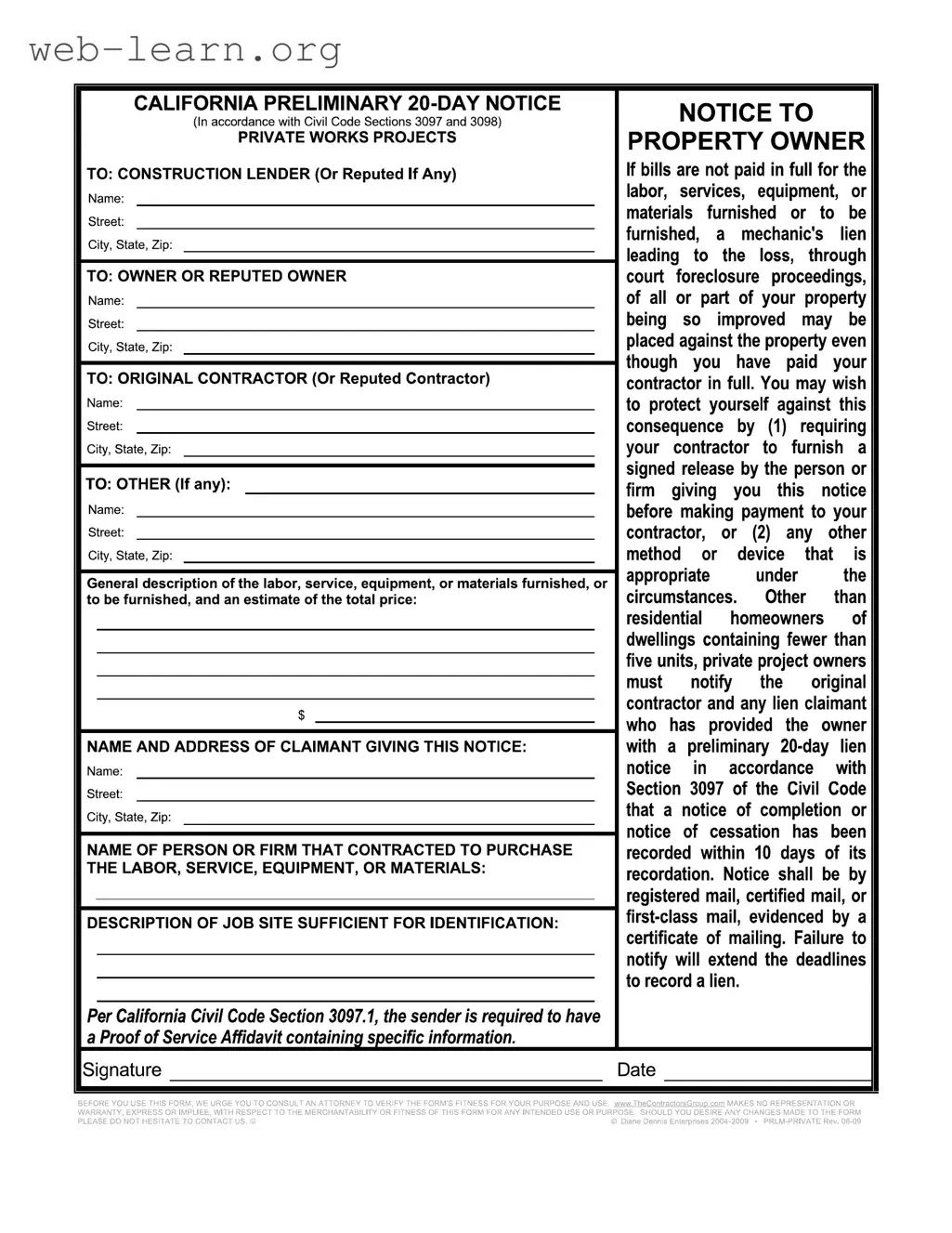
The 20 Day Notice form in California serves as a crucial document in the construction industry, particularly for private works projects. It is designed to protect the rights of subcontractors and suppliers by notifying property owners and contractors about unpaid bills for labor, services, equipment, or materials. This notice must be sent to various parties, including the construction lender, property owner, and original contractor, ensuring that all relevant stakeholders are informed. The form requires specific details such as the names and addresses of the parties involved, a description of the work performed, and an estimate of the total cost. Importantly, the notice warns property owners of the potential consequences of non-payment, including the risk of a mechanic's lien, which could lead to the loss of property through court proceedings. Additionally, it outlines the responsibilities of private project owners to notify contractors and lien claimants about any recorded notice of completion or cessation within a specified timeframe. Understanding the significance and requirements of the 20 Day Notice is essential for anyone involved in construction projects in California.
| Fact Name | Description |
|---|---|
| Governing Laws | This form is governed by California Civil Code Sections 3097 and 3098. |
| Purpose | The 20 Day Notice informs property owners and contractors about potential liens on a property. |
| Recipients | The notice must be sent to the construction lender, owner, original contractor, and any other relevant parties. |
| Deadline | Property owners must notify the original contractor and lien claimants within 10 days of recording a notice of completion or cessation. |
| Service Methods | Notices must be sent via registered mail, certified mail, or first-class mail, with proof of mailing required. |
| Mechanic's Lien Risk | If payments are not made, a mechanic's lien may be placed on the property, even if the contractor has been paid. |
| Legal Consultation | It is advised to consult an attorney before using this form to ensure it meets specific needs. |
Filling out the 20 Day Notice form is an important step in ensuring that all parties involved in a construction project are informed about the labor, services, equipment, or materials provided. After completing the form, it will need to be served to the relevant parties, which is crucial for protecting your rights in the event of payment disputes.
Once the form is completed, it is essential to serve it to the relevant parties promptly. Keep a copy for your records, and ensure you follow any additional notification requirements as outlined in the instructions.
What is the purpose of the 20 Day Notice in California?
The 20 Day Notice serves as a preliminary notice to property owners, contractors, and lenders regarding unpaid labor, services, equipment, or materials related to a construction project. It informs these parties that if payments are not made, a mechanic's lien may be placed on the property. This notice helps protect the rights of those providing labor or materials by ensuring that all relevant parties are aware of potential financial claims against the property.
Who should receive the 20 Day Notice?
The notice should be sent to the following parties:
Ensuring that all these parties receive the notice is crucial for protecting the rights of those providing labor or materials.
What information must be included in the 20 Day Notice?
The notice should include:
This information is essential for clarity and to ensure that the notice is legally valid.
What happens if I do not send the 20 Day Notice?
If the notice is not sent, you may lose your right to file a mechanic's lien against the property. This means that if you are not paid for your work or materials, you may have limited options for recovering your costs. Sending the notice is a critical step in protecting your financial interests.
How does a mechanic's lien work?
A mechanic's lien is a legal claim against a property for unpaid work or materials. If the debt remains unpaid, the lien can lead to foreclosure proceedings, potentially resulting in the loss of the property. This underscores the importance of the 20 Day Notice, as it serves to alert the property owner of potential claims before they escalate.
What is the deadline for sending the 20 Day Notice?
The notice must be sent within 20 days of starting work or delivering materials on the project. Timeliness is key, as failing to send the notice within this timeframe can jeopardize your ability to enforce a mechanic's lien later.
Do I need to notify anyone after the project is completed?
Yes, if you are a private project owner (not a residential homeowner with fewer than five units), you must notify the original contractor and any lien claimant who provided a 20 Day Notice that a notice of completion or cessation has been recorded. This notification must occur within 10 days of the recordation, and it should be sent via registered, certified, or first-class mail.
What is a Proof of Service Affidavit?
A Proof of Service Affidavit is a document that confirms the notice has been sent to all required parties. It must include specific information as outlined in California Civil Code Section 3097.1. This affidavit serves as evidence that you have complied with the legal requirements regarding notification.
Should I consult an attorney before using the 20 Day Notice?
Yes, it is highly advisable to consult with an attorney to ensure that the form is appropriate for your specific situation. An attorney can help verify that the notice meets all legal requirements and is properly tailored to your needs.
Can changes be made to the 20 Day Notice form?
Absolutely. If you need to make changes to the form, you should reach out to the provider of the notice. Customizing the form may be necessary to ensure it meets your specific circumstances and complies with applicable laws.
Filling out the California 20-Day Notice form can be straightforward, but many people make common mistakes that can lead to complications. One frequent error is failing to provide complete information about the construction lender or reputed lender. It’s essential to include the full name, address, and contact details. Incomplete information can delay communication and affect the notice's effectiveness.
Another mistake is not accurately identifying the owner or reputed owner of the property. Ensure that you have the correct name and address. If this information is incorrect, it could lead to disputes or challenges in enforcing the notice. Always double-check this critical detail.
Some individuals overlook the importance of detailing the labor, service, equipment, or materials provided. A vague description can create confusion. Instead, provide a clear and concise summary along with an estimate of the total price. This clarity helps all parties understand the scope of work involved.
Additionally, many people forget to include their own name and address as the claimant. This omission can render the notice invalid. Make sure your information is clearly stated to avoid any issues later on.
Another common error is neglecting to inform the original contractor or any lien claimant about the notice of completion or cessation. California law requires this notification within ten days of recordation. Failing to do so can extend the deadlines for recording a lien, complicating the process.
Proof of service is also often overlooked. According to California Civil Code Section 3097.1, a Proof of Service Affidavit must contain specific information. Without this proof, the notice may not be considered valid, leading to potential legal issues.
Finally, many individuals skip consulting an attorney before using the form. While the form may seem straightforward, legal nuances can significantly impact your rights and obligations. Seeking legal advice ensures that you understand the implications and that the form meets your specific needs.
The California Preliminary 20-Day Notice is an essential document in the construction process, particularly for those involved in private works projects. It serves as a protective measure for contractors and suppliers, ensuring they are compensated for their labor and materials. Several other forms and documents often accompany this notice, each playing a vital role in the construction and lien process.
Understanding these documents is crucial for anyone involved in construction projects in California. Each form serves a specific purpose and contributes to the overall legal framework that governs construction and payment obligations. Familiarity with these documents can help prevent disputes and ensure that all parties are adequately protected.
When filling out the California Preliminary 20-Day Notice form, it is important to follow certain guidelines to ensure accuracy and compliance. Here are some things you should and shouldn't do:
Misconceptions about the 20 Day Notice California form can lead to confusion and potential legal issues. Here are four common misconceptions explained:
Understanding these misconceptions can help protect your rights and ensure compliance with California's legal requirements.
When filling out and using the California 20 Day Notice form, consider the following key takeaways: