Homepage Blank 2 Step Tb Test Form
Outline

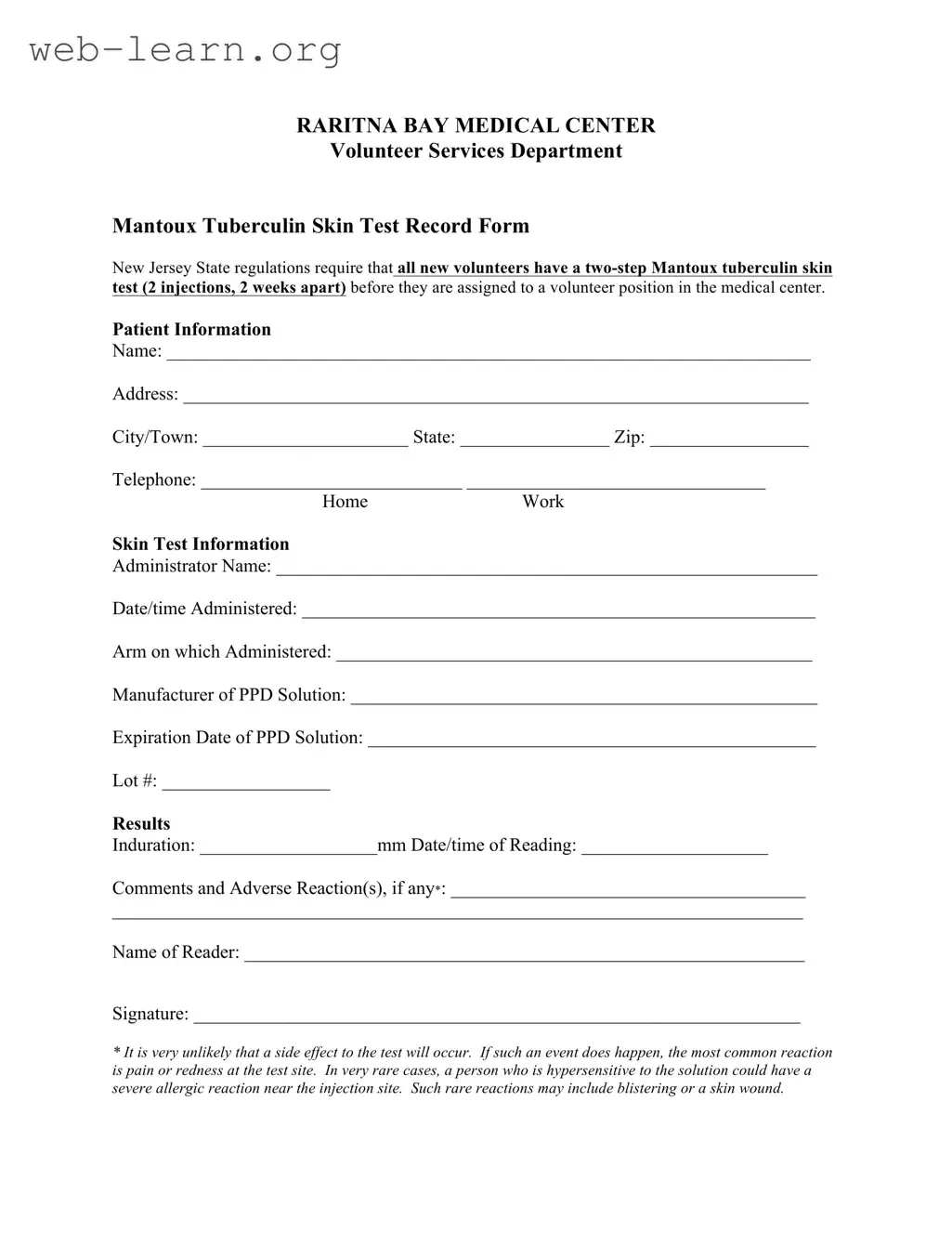
The 2 Step TB Test form is an essential document for anyone looking to volunteer at Raritan Bay Medical Center. This form is specifically designed to record the Mantoux tuberculin skin test, which is a requirement under New Jersey state regulations. Before a volunteer can begin their role, they must undergo two separate injections spaced two weeks apart. The form collects vital patient information, including the volunteer's name, address, and contact details. It also captures important test data, such as the administrator's name, the date and time the test was administered, and the specific arm used for the injection. Additionally, the form requires details about the PPD solution, including its manufacturer, expiration date, and lot number. Results from the test, including the size of induration and the date of reading, are also documented. While side effects are rare, the form provides a section for comments and any adverse reactions, ensuring that all necessary information is recorded. This thorough approach not only meets regulatory requirements but also prioritizes the health and safety of both volunteers and patients alike.

Sample - 2 Step Tb Test Form

RARITNA BAY MEDICAL CENTER
Volunteer Services Department
Mantoux Tuberculin Skin Test Record Form
New Jersey State regulations require that all new volunteers have a two-step Mantoux tuberculin skin
test (2 injections, 2 weeks apart) before they are assigned to a volunteer position in the medical center.
Patient Information
Name: _____________________________________________________________________
Address: ___________________________________________________________________
City/Town: ______________________ State: ________________ Zip: _________________
Telephone: ____________________________ ________________________________
Home Work
Skin Test Information
Administrator Name: __________________________________________________________
Date/time Administered: _______________________________________________________
Arm on which Administered: ___________________________________________________
Manufacturer of PPD Solution: __________________________________________________
Expiration Date of PPD Solution: ________________________________________________
Lot #: __________________
Results
Induration: ___________________mm Date/time of Reading: ____________________
Comments and Adverse Reaction(s), if any*: ______________________________________
__________________________________________________________________________
Name of Reader: ____________________________________________________________
Signature: _________________________________________________________________
* It is very unlikely that a side effect to the test will occur. If such an event does happen, the most common reaction
is pain or redness at the test site. In very rare cases, a person who is hypersensitive to the solution could have a
severe allergic reaction near the injection site. Such rare reactions may include blistering or a skin wound.

Form Information

Fact Name Description
Purpose The 2 Step TB Test is used to screen for tuberculosis in new volunteers at Raritan Bay Medical Center.
Regulatory Requirement New Jersey State regulations mandate that all new volunteers complete a two-step Mantoux tuberculin skin test.
Test Procedure The test involves two injections administered two weeks apart to ensure accurate results.
Patient Information The form requires detailed patient information, including name, address, and contact details.
Administrator Details The form must include the name of the administrator who performs the test and the date/time it was administered.
PPD Solution Information about the PPD solution, including the manufacturer, expiration date, and lot number, is required.
Results Documentation Results must be recorded, including the induration measurement and the date/time of reading.
Adverse Reactions Comments on any adverse reactions must be noted, although severe reactions are rare.
Signature Requirement The form must be signed by the reader who interprets the test results.
Legal Reference Compliance with New Jersey state regulations governing public health and volunteer services is essential.

Detailed Guide for Filling Out 2 Step Tb Test

After completing the 2 Step TB Test form, you will need to submit it to the appropriate department. Ensure that all information is accurate and legible. This form is essential for your volunteer position at the medical center.

  1. Begin by filling out your Name in the designated space at the top of the form.
  2. Next, provide your Address, including street, city, state, and zip code.
  3. Enter your Telephone number, including both home and work numbers if applicable.
  4. In the Skin Test Information section, write the name of the Administrator who will give you the test.
  5. Record the Date/Time Administered for the first injection.
  6. Indicate the Arm on which Administered by writing "left" or "right."
  7. Fill in the Manufacturer of PPD Solution used for the test.
  8. Write the Expiration Date of PPD Solution to ensure it is still valid.
  9. Include the Lot # of the PPD solution.
  10. Measure and record the Results Induration in millimeters.
  11. Document the Date/Time of Reading for when the test results are evaluated.
  12. If there are any Comments and Adverse Reaction(s), note them in the provided space.
  13. Write the Name of Reader who interprets the test results.
  14. Finally, the Signature of the reader must be provided at the bottom of the form.

Obtain Answers on 2 Step Tb Test

  1. What is the purpose of the 2 Step TB Test?

    The two-step Mantoux tuberculin skin test is required for all new volunteers at Raritan Bay Medical Center. This test helps identify whether someone has been infected with the bacteria that cause tuberculosis (TB). New Jersey state regulations mandate this test to ensure the safety of both volunteers and patients in the medical center.

  2. How does the 2 Step TB Test work?

    The test consists of two separate injections of the tuberculin solution, administered two weeks apart. The first injection establishes a baseline, while the second helps to confirm the results. After each injection, a healthcare professional will assess the reaction at the injection site, measuring any swelling or induration (hardness) that may occur.

  3. What should I expect after receiving the test?

    After each injection, you might experience mild discomfort, redness, or swelling at the site. These reactions are generally minor and resolve quickly. In very rare cases, a severe allergic reaction could occur, leading to blistering or skin wounds. If you experience any concerning symptoms, it is important to contact a healthcare provider.

  4. What information do I need to provide on the form?

    You will need to fill out personal information such as your name, address, and contact details. Additionally, the form requires information about the test itself, including the administrator's name, date and time of administration, the arm used for the injection, and details about the PPD solution, such as its manufacturer and expiration date.

  5. Who can administer the TB test?

    The test must be administered by a qualified healthcare professional. This ensures that the procedure is done correctly and that any potential reactions can be properly monitored. After the test, a trained reader will evaluate the results and document them on the form.

Common mistakes

When filling out the 2 Step TB Test form, many people make simple mistakes that can delay their volunteer process. One common error is failing to provide complete personal information. It’s important to fill in all fields, including name, address, and telephone number. Omitting any of this information can lead to confusion or miscommunication.

Another frequent mistake is neglecting to include the date and time the test was administered. This information is crucial for tracking the two-step process. Without it, the medical center may not be able to verify that the tests were conducted properly and within the required timeframe.

Many individuals also forget to specify the arm on which the test was administered. This detail helps healthcare providers keep accurate records and ensures that the test results can be easily referenced in the future. Leaving this section blank can create unnecessary complications.

Using the wrong manufacturer of the PPD solution is another mistake that can occur. The form requires this information to confirm the validity of the test. Double-checking the manufacturer’s name before submitting the form can save time and prevent issues later on.

Expiration dates are often overlooked as well. It’s essential to ensure that the PPD solution used is not expired. Submitting a form with an expired solution can invalidate the test results, leading to additional testing and delays.

Some people also fail to provide the results of the induration measurement. This measurement is critical for determining whether the test is positive or negative. Make sure to include this information clearly to avoid any confusion.

Finally, neglecting to sign the form is a common mistake. A signature is necessary to validate the information provided. Without it, the form may be considered incomplete, and the volunteer application process could be stalled.

Documents used along the form

The 2 Step TB Test form is essential for volunteers at Raritan Bay Medical Center, ensuring compliance with state regulations. Alongside this form, several other documents are often required to complete the volunteer onboarding process. Each of these documents serves a specific purpose in maintaining health and safety standards.

  • Volunteer Application Form: This document collects personal information about the volunteer, including contact details and previous experience. It helps the organization assess the suitability of the applicant for various roles.
  • Health History Questionnaire: Volunteers must complete this questionnaire to disclose any medical conditions or allergies. This information is crucial for ensuring the safety of both the volunteer and the patients they may interact with.
  • Consent for Treatment Form: This form grants permission for the medical center to provide necessary medical care to the volunteer in case of an emergency. It outlines the rights and responsibilities of both the volunteer and the facility.
  • Confidentiality Agreement: Volunteers are required to sign this agreement to protect patient privacy and sensitive information. It emphasizes the importance of maintaining confidentiality in a healthcare setting.
  • Volunteer Orientation Acknowledgment: After attending orientation, volunteers sign this document to confirm they understand the policies, procedures, and expectations of their role. It serves as a record of their commitment to the organization.

These documents collectively ensure that volunteers are well-prepared and compliant with the medical center's standards. Each form plays a vital role in safeguarding the health of volunteers and patients alike.

Similar forms

The 2 Step TB Test form serves a specific purpose within healthcare settings, particularly for volunteers. Several other documents share similarities in structure and function. Below is a list of ten such documents, highlighting their parallels with the TB Test form.

  • Vaccination Record Form: Similar to the TB Test form, this document tracks immunizations received by individuals, including dates and types of vaccines administered.
  • Health History Questionnaire: This form collects personal health information, including past illnesses and allergies, akin to how the TB Test form gathers patient information.
  • Consent for Treatment Form: Just as the TB Test form requires a signature for administration, this document confirms that patients consent to medical procedures or tests.
  • Emergency Contact Form: This document requests essential contact information for emergencies, paralleling the TB Test form’s need for accurate patient details.
  • Patient Registration Form: Like the TB Test form, this document captures demographic information necessary for healthcare providers to deliver appropriate care.
  • Medication Administration Record (MAR): This form tracks medications given to patients, similar to how the TB Test form records the administration details of the tuberculin skin test.
  • Informed Consent for Research Participation: This document ensures participants understand the study they are involved in, akin to the clarity needed in the TB Test form regarding potential reactions.
  • Physical Examination Form: This form documents the results of a physical exam, much like the TB Test form records the results of the skin test.
  • Release of Information Form: Similar to the TB Test form's requirement for signatures, this document allows healthcare providers to share patient information with third parties.
  • Incident Report Form: This form records any adverse events or reactions, similar to the comments section in the TB Test form for documenting any adverse reactions to the test.

Dos and Don'ts

When filling out the 2 Step TB Test form, it is essential to approach the task with care and attention to detail. Here are some guidelines to ensure the process goes smoothly.

  • Do provide accurate personal information, including your full name, address, and contact details.
  • Do ensure that the administrator's name and the date/time of the test are filled in correctly.
  • Do indicate the arm on which the test was administered clearly.
  • Do check the expiration date of the PPD solution before the test is conducted.
  • Don't leave any sections of the form blank; all fields must be completed.
  • Don't forget to sign the form after it has been filled out.
  • Don't ignore any comments or adverse reactions; report them accurately if they occur.

By adhering to these recommendations, you can help ensure that your form is processed without delays and that you meet the necessary requirements for volunteering at the medical center.

Misconceptions

Understanding the two-step Mantoux tuberculin skin test is crucial for new volunteers at medical centers. However, several misconceptions can lead to confusion. Here are eight common misconceptions about the 2 Step TB Test:

  • It's just one test. Many believe that the two-step TB test is a single injection. In reality, it involves two separate injections administered two weeks apart.
  • It's only for people with symptoms. Some think that only those showing symptoms of tuberculosis need this test. However, it is a requirement for all new volunteers, regardless of symptoms.
  • The test is always painful. While some may experience discomfort, most people report only minor pain or redness at the injection site.
  • Results are immediate. A common misconception is that results can be read right after the test. The reading must occur 48 to 72 hours after the injection.
  • It guarantees immunity to TB. Many believe that passing the test means they are immune to tuberculosis. The test only indicates exposure to the bacteria, not immunity.
  • Only one reading is necessary. Some think that only one reading of the test is sufficient. The two-step process requires readings for both injections to ensure accurate results.
  • There are no side effects. While side effects are rare, some people may experience mild reactions like redness or swelling. Severe reactions are extremely uncommon.
  • Anyone can administer the test. There is a belief that anyone can give the TB test. In fact, it must be administered by a qualified healthcare professional.

Addressing these misconceptions helps ensure that new volunteers understand the importance of the two-step TB test and comply with the requirements set by medical centers.

Key takeaways

When filling out and using the 2 Step TB Test form, it is essential to follow specific guidelines to ensure compliance and accuracy. Here are some key takeaways:

  • Complete Patient Information: Fill in all required fields accurately, including your name, address, and contact information. This information is crucial for proper identification and follow-up.
  • Two-Step Requirement: Remember that New Jersey regulations mandate two separate Mantoux tests, administered two weeks apart. This step is vital for ensuring reliable results.
  • Document Test Details: The form requires specific details about the skin test, such as the administrator's name, date and time of administration, and the arm used for the injection. Accurate documentation helps maintain a clear record.
  • Record Results: After the second test, you must note the induration measurement (in millimeters) and the date/time of reading. This information is critical for assessing the test's outcome.
  • Be Aware of Reactions: While side effects are rare, it’s important to document any comments or adverse reactions. Common reactions may include pain or redness, but severe allergic reactions are also possible, though uncommon.