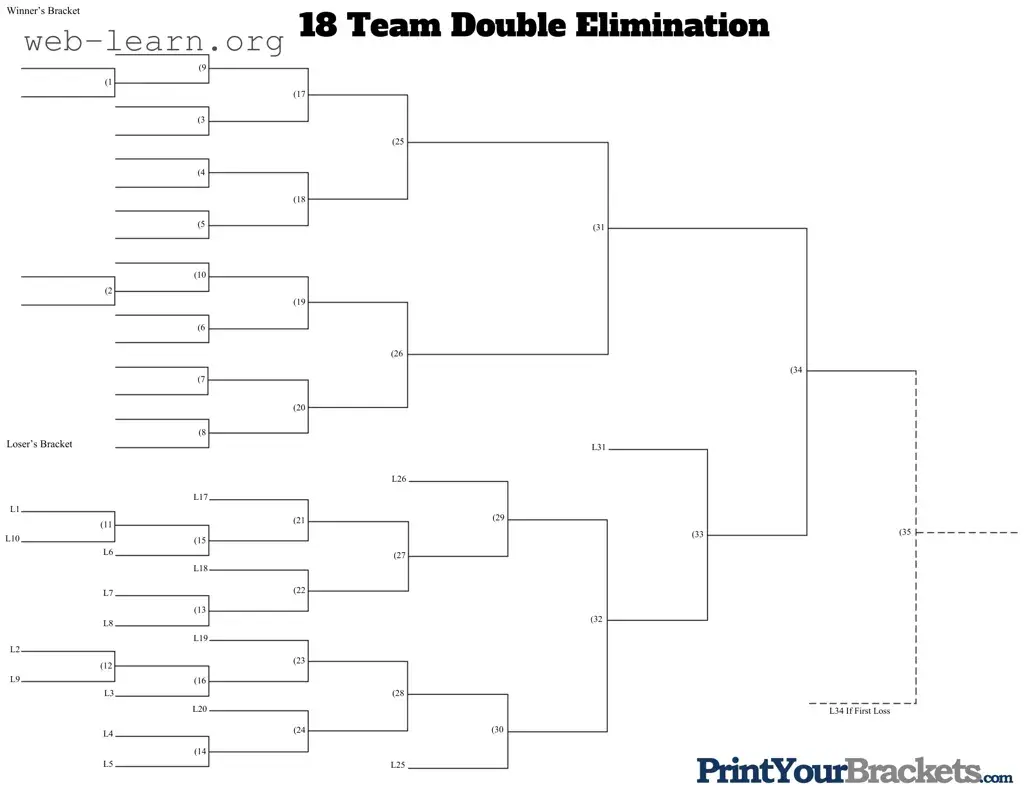
The 18 Double Elimination form is a popular structure used in tournaments to ensure that every team has a fair chance to compete, even after a loss. This format features two brackets: the Winner's Bracket and the Loser's Bracket. Teams start in the Winner's Bracket, and if they lose a match, they move to the Loser's Bracket. Here, they have the opportunity to continue competing, but with the understanding that a second loss will eliminate them from the tournament. The progression through the brackets is designed to maintain excitement and engagement, as teams battle for the championship title. The layout of the brackets is crucial, as it determines matchups and the path each team must take to reach the finals. The intricate flow of the tournament allows for a dynamic competition, where teams must adapt and strategize to overcome their opponents. Ultimately, the 18 Double Elimination format balances competitiveness with the chance for redemption, making it a favored choice among organizers and participants alike.
| Fact Name | Description |
|---|---|
| Format Overview | The 18 Double Elimination format allows teams to lose once and still compete for the championship. |
| Brackets Structure | It consists of two main brackets: the Winner's Bracket and the Loser's Bracket. |
| Advancement Rules | A team must win two matches to secure the championship, while a single loss moves them to the Loser's Bracket. |
| Matchups | Teams are paired based on their performance, with the highest-seeded teams facing the lowest-seeded teams initially. |
| State-Specific Laws | In many states, local sports governing bodies dictate the rules for double elimination tournaments. |
| Final Match Conditions | If the team from the Winner's Bracket loses in the final, a second match is played to determine the champion. |
| Loser's Bracket Dynamics | Teams in the Loser's Bracket must win every match to stay in contention for the championship. |
| Team Participation | This format is commonly used in youth and amateur sports, promoting inclusivity and extended competition. |
To complete the 18 Double Elimination form, participants must accurately fill in the required information to ensure proper tracking of team progress throughout the tournament. This process involves identifying teams, their matches, and outcomes in both the winner's and loser's brackets. Following these steps will help maintain clarity and organization during the competition.
What is the purpose of the 18 Double Elimination form?
The 18 Double Elimination form is designed to structure tournaments where teams compete in a way that allows them a second chance after losing a match. This format is particularly beneficial in ensuring that all participating teams have a fair opportunity to compete for the championship, as it requires a team to lose twice before being eliminated from the tournament.
How does the winner's bracket work?
In the winner's bracket, teams compete in a series of matches. The winning teams progress through the bracket, while the losing teams move to the loser's bracket. The structure is set up so that each match outcome determines the next round of matches. For instance, if a team wins its match, it advances to the next round in the winner's bracket, while the team that loses drops down to the loser's bracket.
What happens in the loser's bracket?
The loser's bracket serves as a second chance for teams that have lost in the winner's bracket. When a team loses in the winner's bracket, it moves to the loser's bracket, where it can continue to compete. However, if a team loses again in the loser's bracket, it is eliminated from the tournament. This format creates an exciting dynamic, as teams must fight to stay in contention even after a loss.
How are the final matches determined?
The final matches of the tournament are determined by the outcomes of the winner's and loser's brackets. The last remaining team in the winner's bracket faces off against the last remaining team in the loser's bracket. If the team from the winner's bracket wins, they are crowned the champions. However, if the team from the loser's bracket wins, they force a final match, as they have not yet lost twice. This adds an extra layer of excitement and suspense to the tournament's conclusion.
When filling out the 18 Double Elimination form, individuals often make several common mistakes that can lead to confusion or disqualification. Understanding these errors can help ensure a smoother process. Here are ten frequent mistakes to avoid.
One major mistake is failing to clearly indicate team names. In a tournament setting, each team must be easily identifiable. Omitting or incorrectly spelling a team name can create issues during the match. Ensure that all entries are accurate and legible.
Another common error is not following the proper bracket format. The form has a specific layout that must be adhered to. Participants often neglect to place teams in the correct positions within the winner’s and loser’s brackets, which can disrupt the flow of the tournament.
Inaccurate scoring is also a frequent problem. Some individuals mistakenly record scores that do not align with the results of the matches. This can lead to disputes and complications later in the tournament. It is crucial to double-check scores before submitting the form.
Additionally, missing deadlines can severely impact a team’s ability to compete. Each tournament has specific timelines for form submissions. Late submissions may result in exclusion from the event, so it is essential to be aware of these deadlines.
Participants sometimes overlook the importance of signatures. Many forms require signatures from team captains or coaches to validate the entries. Neglecting this step can render the form incomplete and void.
Another mistake involves incomplete information. Teams must provide all requested details, including contact information and player rosters. Failing to include this information can lead to delays or disqualification.
In some cases, individuals misinterpret the rules governing the double elimination format. Understanding how teams advance and when they are eliminated is crucial. Misunderstandings can lead to incorrect placements in the brackets.
Furthermore, not updating the form after changes can create issues. If there are last-minute changes to team members or match results, it is vital to update the form accordingly. Failing to do so can cause confusion during the tournament.
Another error is ignoring communication from tournament organizers. Organizers may provide important updates or changes regarding the tournament structure. Staying informed is key to ensuring that teams remain compliant with any new rules or adjustments.
Lastly, overlooking the importance of clarity in written communication can lead to misunderstandings. Use clear and concise language when filling out the form. Ambiguities can result in misinterpretations and complications during the tournament.
By being aware of these ten mistakes, participants can better navigate the complexities of the 18 Double Elimination form, thereby enhancing their chances of a successful tournament experience.
The 18 Double Elimination form is a key document used in organizing double elimination tournaments. However, several other forms and documents complement it to ensure smooth operations. Here’s a list of commonly used documents that work alongside the 18 Double Elimination form.
Each of these documents plays a vital role in the overall success of a double elimination tournament. Together, they help ensure that everything runs smoothly and that all participants have a clear understanding of the process.
The 18 Double Elimination form is a useful tool in organizing tournaments. Several other documents serve similar purposes in different contexts. Here are ten documents that share similarities with the 18 Double Elimination form:
When filling out the 18 Double Elimination form, it is important to follow specific guidelines to ensure accuracy and clarity. Here are six things to do and avoid:
By adhering to these guidelines, participants can help ensure a smooth and efficient tournament experience.
Understanding the 18 Double Elimination format can be challenging, and several misconceptions can arise. Below is a list of common misunderstandings about this tournament structure.
This is false. In a double elimination format, a team must lose twice before being eliminated. This allows teams a second chance to compete for the championship.
While the winner's bracket is crucial, the loser's bracket plays a significant role as well. Teams that lose in the winner's bracket have the opportunity to fight their way back to the finals through the loser's bracket.
This is not accurate. Teams in the winner's bracket may play fewer games than those in the loser's bracket. The number of games played depends on when a team loses.
This is incorrect. If a team from the winner's bracket reaches the finals, they must lose twice to be eliminated. If the team from the loser's bracket wins the first game, a second game is played to determine the champion.
While it may seem complex at first, the structure is quite straightforward once understood. Each team's progress can be tracked through the brackets, making it easier to follow the tournament's progression.
This is misleading. Seeding can significantly affect a team's path through the tournament. Higher-seeded teams generally face lower-seeded teams in the early rounds, which can provide a strategic advantage.
When utilizing the 18 Double Elimination form, several key points should be kept in mind to ensure clarity and proper usage. Below are important takeaways that can aid in effectively filling out and using the form: