Homepage Blank 14653 Form
Outline

The 14653 form, officially titled "Certification by U.S. Person Residing Outside of the United States for Streamlined Foreign Offshore Procedures," plays a crucial role for U.S. taxpayers living abroad who need to rectify their tax reporting. This form, issued by the Internal Revenue Service (IRS), allows eligible individuals to certify their compliance with U.S. tax laws while seeking to benefit from streamlined procedures designed to reduce penalties. Key aspects of the form include the requirement for taxpayers to submit delinquent or amended income tax returns for the past three years, along with any necessary information returns, such as Foreign Bank Account Reports (FBARs). Taxpayers must also provide detailed narratives explaining their reasons for failing to report income and must demonstrate that their actions were non-willful, meaning they were not intentional but rather due to negligence or misunderstanding. Additionally, the form requires individuals to confirm their residency status, ensuring they meet the non-residency criteria essential for the streamlined process. Overall, the 14653 form serves as a pathway for taxpayers to come into compliance with U.S. tax obligations while minimizing the potential for severe penalties.
Sample - 14653 Form

Catalog Number 67042A www.irs.gov
Form
14653 (Rev. 10-2017)
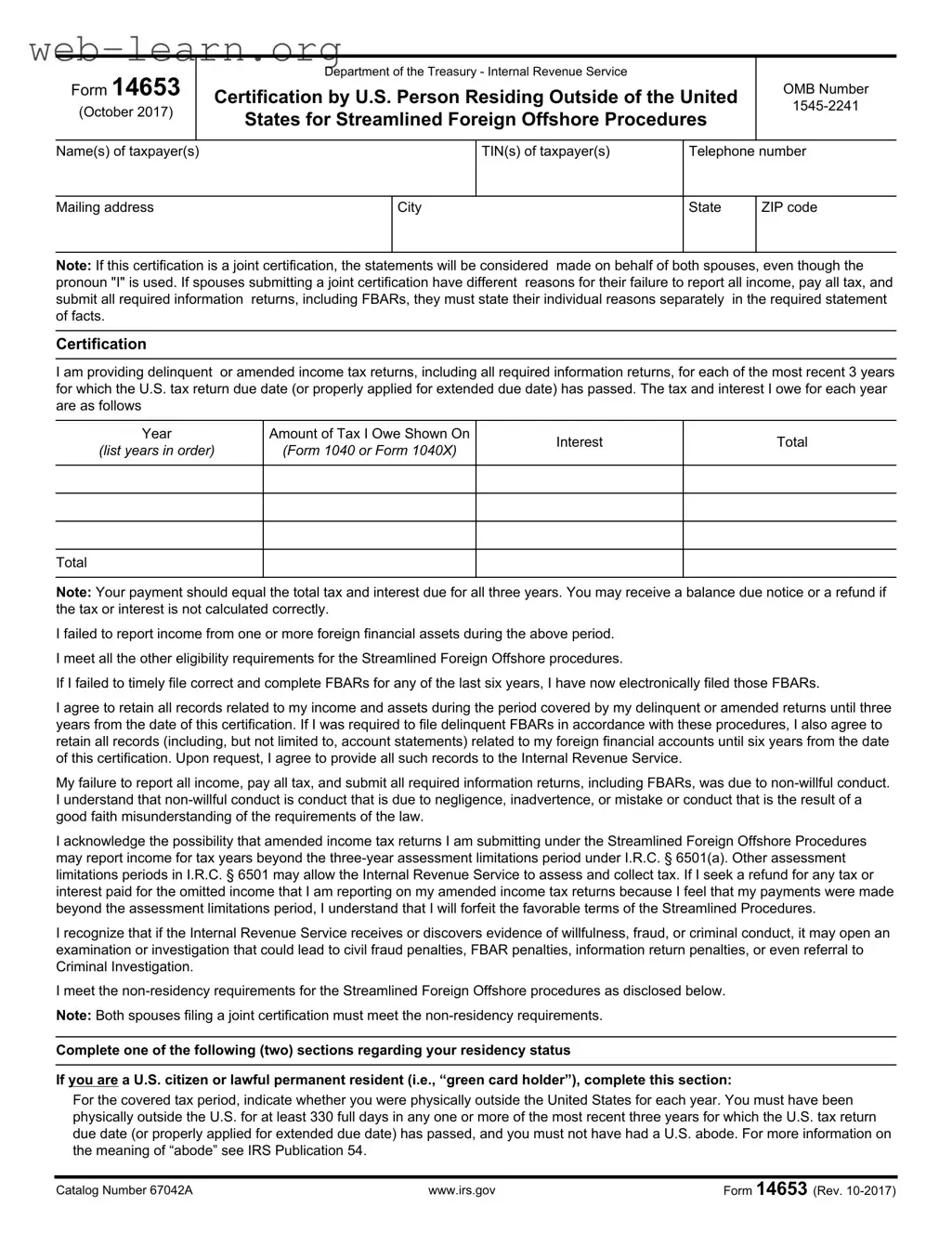
Form 14653
(October 2017)
Department of the Treasury - Internal Revenue Service
Certification by U.S. Person Residing Outside of the United
States for Streamlined Foreign Offshore Procedures
OMB Number
1545-2241
Name(s) of taxpayer(s) TIN(s) of taxpayer(s) Telephone number
Mailing address City State ZIP code
Note: If this certification is a joint certification, the statements will be considered made on behalf of both spouses, even though the
pronoun "I" is used. If spouses submitting a joint certification have different reasons for their failure to report all income, pay all tax, and
submit all required information returns, including FBARs, they must state their individual reasons separately in the required statement
of facts.
Certification
I am providing delinquent or amended income tax returns, including all required information returns, for each of the most recent 3 years
for which the U.S. tax return due date (or properly applied for extended due date) has passed. The tax and interest I owe for each year
are as follows
Year
(list years in order)
Amount of Tax I Owe Shown On
(Form 1040 or Form 1040X)
Interest Total
Total
Note: Your payment should equal the total tax and interest due for all three years. You may receive a balance due notice or a refund if
the tax or interest is not calculated correctly.
I failed to report income from one or more foreign financial assets during the above period.
I meet all the other eligibility requirements for the Streamlined Foreign Offshore procedures.
If I failed to timely file correct and complete FBARs for any of the last six years, I have now electronically filed those FBARs.
I agree to retain all records related to my income and assets during the period covered by my delinquent or amended returns until three
years from the date of this certification. If I was required to file delinquent FBARs in accordance with these procedures, I also agree to
retain all records (including, but not limited to, account statements) related to my foreign financial accounts until six years from the date
of this certification. Upon request, I agree to provide all such records to the Internal Revenue Service.
My failure to report all income, pay all tax, and submit all required information returns, including FBARs, was due to non-willful conduct.
I understand that non-willful conduct is conduct that is due to negligence, inadvertence, or mistake or conduct that is the result of a
good faith misunderstanding of the requirements of the law.
I acknowledge the possibility that amended income tax returns I am submitting under the Streamlined Foreign Offshore Procedures
may report income for tax years beyond the three-year assessment limitations period under I.R.C. § 6501(a). Other assessment
limitations periods in I.R.C. § 6501 may allow the Internal Revenue Service to assess and collect tax. If I seek a refund for any tax or
interest paid for the omitted income that I am reporting on my amended income tax returns because I feel that my payments were made
beyond the assessment limitations period, I understand that I will forfeit the favorable terms of the Streamlined Procedures.
I recognize that if the Internal Revenue Service receives or discovers evidence of willfulness, fraud, or criminal conduct, it may open an
examination or investigation that could lead to civil fraud penalties, FBAR penalties, information return penalties, or even referral to
Criminal Investigation.
I meet the non-residency requirements for the Streamlined Foreign Offshore procedures as disclosed below.
Note: Both spouses filing a joint certification must meet the non-residency requirements.
Complete one of the following (two) sections regarding your residency status
If you are a U.S. citizen or lawful permanent resident (i.e., “green card holder”), complete this section:
For the covered tax period, indicate whether you were physically outside the United States for each year. You must have been
physically outside the U.S. for at least 330 full days in any one or more of the most recent three years for which the U.S. tax return
due date (or properly applied for extended due date) has passed, and you must not have had a U.S. abode. For more information on
the meaning of “abode” see IRS Publication 54.
Page of
Form 14653 (Rev. 10-2017)
www.irs.govCatalog Number 67042A
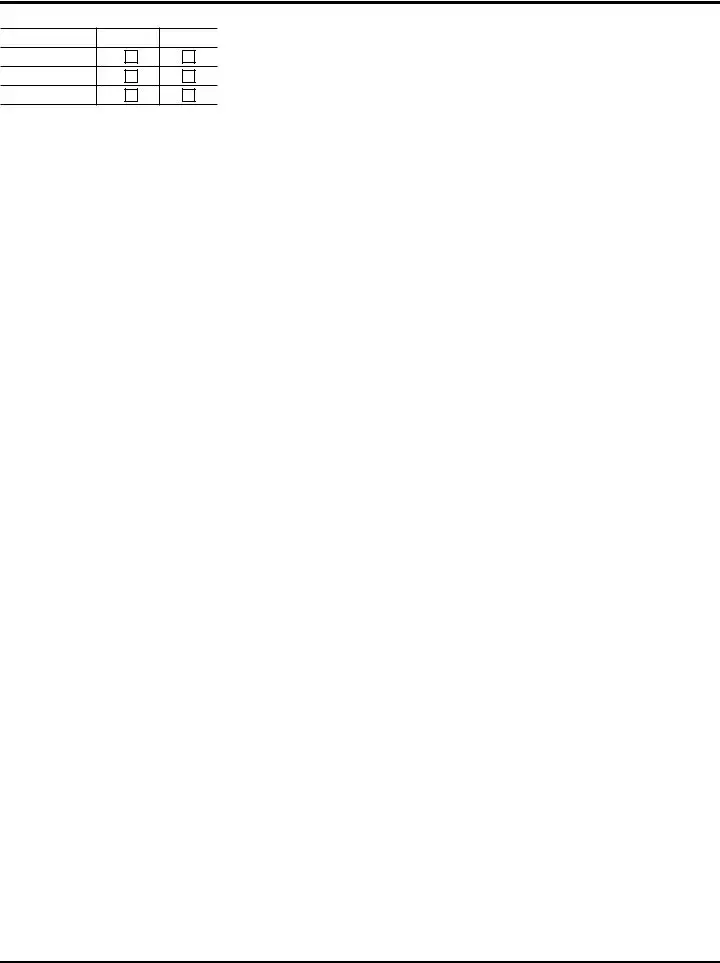
I was physically outside the United States for at least 330 full days (answer Yes or No for each year)
Year Yes No
Both spouses filing a joint certification must meet the non-residency requirement. If the number of days physically outside of the U.S.
differs for each spouse, disclose that on the chart above or in an attachment to this certification.
If you are not a U.S. citizen or lawful permanent resident, complete this section:
If you are not a U.S. citizen or a lawful permanent resident, please attach to this certification your computation showing that you did
not meet the substantial presence test under I.R.C. sec. 7701(b)(3). Your computation must disclose the number of days you were
present in the U.S. for the three years included in your Streamlined Foreign Offshore Procedures submission and the previous two
years. If you do not attach a complete computation showing that you did not meet the substantial presence test, your submission will
be considered incomplete and your submission will not qualify for the Streamlined Foreign Offshore Procedures.
Both spouses filing a joint certification must meet the non-residency requirement. If the number of days inside the U.S. differs for
each spouse, disclose that on the chart above or in an attachment to this certification.
Note: You must provide specific facts on this form or on a signed attachment explaining your failure to report all income, pay all tax,
and submit all required information returns, including FBARs. Any submission that does not contain a narrative statement of facts will
be considered incomplete and will not qualify for the streamlined penalty relief.
Provide specific reasons for your failure to report all income, pay all tax, and submit all required information returns,
including FBARs. Include the whole story including favorable and unfavorable facts. Specific reasons, whether favorable or
unfavorable to you, should include your personal background, financial background, and anything else you believe is
relevant to your failure to report all income, pay all tax, and submit all required information returns, including FBARs.
Additionally, explain the source of funds in all of your foreign financial accounts/assets. For example, explain whether you
inherited the account/asset, whether you opened it while residing in a foreign country, or whether you had a business reason
to open or use it. And explain your contacts with the account/asset including withdrawals, deposits, and investment/
management decisions. Provide a complete story about your foreign financial account/asset. If you relied on a professional
advisor, provide the name, address, and telephone number of the advisor and a summary of the advice. If married taxpayers
submitting a joint certification have different reasons, provide the individual reasons for each spouse separately in the
statement of facts. The field below will automatically expand to accommodate your statement of facts.
Page of
Form 14653 (Rev. 10-2017)
www.irs.govCatalog Number 67042A
Under penalties of perjury, I declare that I have examined this certification and all accompanying schedules and statements, and to the
best of my knowledge and belief, they are true, correct, and complete.
Signature of Taxpayer Name of Taxpayer Date
Signature of Taxpayer (if joint certification) Name of Taxpayer (if joint certification) Date
For Estates Only
Signature of Fiduciary Date
Title of Fiduciary (e.g., executor or administrator) Name of Fiduciary
For Paid Preparer Use Only (the signature of taxpayer(s) or fiduciary is required even if this form is signed by a paid preparer)
Signature of Preparer Name of Preparer Date
Firm’s name Firm’s EIN
Firm’s address City State ZIP code
Telephone number PTIN
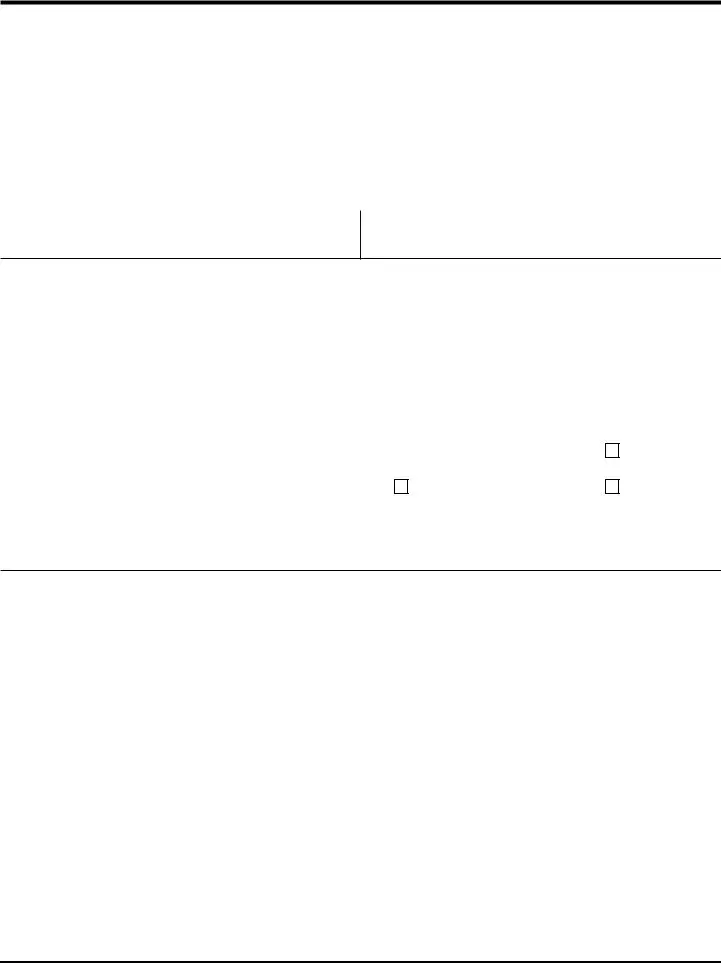
Check if
Self-Employed
Do you want to allow another person to discuss this form with the IRS No
Yes (complete information below)
Designee’s name Telephone number
Privacy Act and Paperwork Reduction Notice
We ask for the information on this certification by U.S. person residing in the United States for streamlined domestic offshore procedures to carry out the
Internal Revenue laws of the United States. Our authority to ask for information is sections 6001, 6109, 7801, 7803 and the regulations thereunder. This
information will be used to determine and collect the correct amount of tax under the terms of the streamlined filing compliance program. You are not
required to apply for participation in the streamlined filing compliance program. If you choose to apply, however, you are required to provide all the
information requested on the streamlined certification. You are not required to provide the information requested on a document that is subject to the
Paperwork Reduction Act unless the document displays a valid OMB control number. Books or records relating to a document or its instructions must be
retained as long as their contents may become material in the administration of any Internal Revenue law. Generally, tax returns and return information
are confidential, as required by section 6103. Section 6103, however, allows or requires the Internal Revenue Service to disclose or give this information
to others as described in the Internal Revenue Code. For example, we may disclose this information to the Department of Justice to enforce the tax
laws, both civil and criminal, and to cities, states, the District of Columbia, and U.S. commonwealths or possessions to carry out their tax laws. We may
also disclose this information to other countries under a tax treaty, to federal and state agencies to enforce federal nontax criminal laws, or to federal law
enforcement and intelligence agencies to combat terrorism. Failure to provide this information may delay or prevent processing your application.
Providing false information may subject you to penalties. The time needed to complete and submit the streamlined certification will vary depending on
individual circumstances. The estimated average time is: 8 hours

Form Information

Fact Name Description
Form Purpose Form 14653 is used by U.S. persons residing outside the United States to certify their eligibility for the Streamlined Foreign Offshore Procedures.
Governing Law The form operates under the Internal Revenue Code (IRC) sections related to tax compliance and reporting.
Eligibility Requirements Taxpayers must meet specific criteria, including providing delinquent or amended returns for the last three years.
Non-Willful Conduct Taxpayers must declare that their failure to report income was due to non-willful conduct, such as negligence or misunderstanding.
FBAR Compliance If applicable, taxpayers must have electronically filed their Foreign Bank Account Reports (FBARs) for the last six years.
Record Retention Taxpayers must retain records related to their income and assets for three years, and for FBARs, six years.
Joint Certification Spouses can file jointly, but both must meet the non-residency requirements and state their reasons separately if they differ.
Assessment Limitations Taxpayers acknowledge the possibility of reporting income beyond the three-year assessment period under IRC § 6501(a).
Consequences of Willfulness If the IRS finds evidence of willful conduct, it may lead to civil or criminal penalties.
Submission Completeness Failure to provide a narrative statement of facts will result in an incomplete submission, disqualifying the taxpayer from relief.

Detailed Guide for Filling Out 14653

Filling out Form 14653 is a crucial step for U.S. persons living abroad who wish to participate in the Streamlined Foreign Offshore Procedures. This form requires careful attention to detail, as it involves providing personal information, tax details, and an explanation of any previous reporting failures. Here’s how to proceed with filling out the form effectively.

  1. Gather necessary information: Collect your Taxpayer Identification Number (TIN), mailing address, and contact information. If applicable, have your spouse’s details ready for joint certifications.
  2. Complete taxpayer information: Fill in the names, TINs, telephone number, mailing address, city, state, and ZIP code in the designated fields.
  3. Indicate tax years: List the most recent three tax years for which the due date has passed. Write down the amount of tax owed for each year, the form used (1040 or 1040X), and the total interest.
  4. Provide residency status: Indicate whether you were physically outside the U.S. for at least 330 full days for each of the three years. Answer “Yes” or “No” for each year.
  5. Explain failure to report: In the designated area, provide a detailed narrative explaining your reasons for failing to report all income and submit required information returns. Include personal and financial background information.
  6. Attach necessary documents: If you are not a U.S. citizen or lawful permanent resident, attach a computation showing you did not meet the substantial presence test.
  7. Sign and date: Both taxpayers must sign and date the form. If it’s a joint certification, ensure both signatures are present.
  8. Provide preparer information (if applicable): If a paid preparer is assisting you, include their name, firm name, and contact information.

After completing the form, review it carefully to ensure all information is accurate and complete. Submit the form along with any required attachments to the IRS. This step is essential to ensure compliance and avoid potential penalties.

Obtain Answers on 14653

  1. What is Form 14653?

    Form 14653 is a certification used by U.S. persons residing outside of the United States who wish to participate in the Streamlined Foreign Offshore Procedures. This form allows individuals to certify their compliance with U.S. tax laws, particularly when they have failed to report income, pay taxes, or submit required information returns, including FBARs (Foreign Bank Account Reports). By submitting this form, taxpayers can potentially avoid penalties associated with non-compliance.

  2. Who should use Form 14653?

    This form is specifically designed for U.S. citizens and lawful permanent residents (green card holders) living abroad. It is applicable to those who have not reported all income from foreign financial assets and who meet the eligibility requirements for the Streamlined Foreign Offshore Procedures. Additionally, both spouses must meet the non-residency requirements if they are filing a joint certification.

  3. What are the key requirements for completing Form 14653?

    To complete Form 14653, individuals must:

    • Provide delinquent or amended income tax returns for the last three years.
    • List the total tax and interest owed for those years.
    • Indicate whether they were physically outside the United States for at least 330 full days during any of the last three years.
    • Include a narrative statement explaining the reasons for their failure to report income and submit required returns.
    • Agree to retain records related to income and foreign financial accounts for the specified periods.
  4. What happens if I fail to provide a complete narrative statement?

    Providing a complete narrative statement is crucial for the acceptance of Form 14653. If the statement is incomplete or missing, the submission will be considered invalid, and the taxpayer will not qualify for the streamlined penalty relief. The narrative should include specific reasons for the failure to report income, as well as any relevant personal and financial background information.

  5. What are the consequences of willful failure to report income?

    If the IRS finds evidence of willfulness, fraud, or criminal conduct, it may initiate an examination or investigation. This could lead to severe penalties, including civil fraud penalties, FBAR penalties, or even criminal charges. It is essential for taxpayers to demonstrate that their failure to report was non-willful, meaning it resulted from negligence, inadvertence, or a misunderstanding of the law.

Common mistakes

Filling out Form 14653 can be daunting, and mistakes can lead to delays or complications. One common error is failing to provide accurate taxpayer identification numbers (TINs). Ensure that all TINs listed are correct, as errors can cause processing issues.

Another frequent mistake involves incomplete narratives regarding the failure to report income. It's crucial to include specific details about why income was not reported, as well as any relevant personal or financial background. A vague explanation may result in the form being deemed incomplete.

Some individuals neglect to confirm their residency status accurately. If you are a U.S. citizen or a lawful permanent resident, you must indicate whether you were physically outside the United States for at least 330 full days in the relevant years. Misrepresenting this information can jeopardize your eligibility for streamlined procedures.

Additionally, many people forget to attach required documents, such as computations for those not meeting the substantial presence test. Without these attachments, the submission may be considered incomplete, which can delay the process significantly.

Another common oversight is not retaining records as stipulated. You must agree to keep all records related to your income and assets for the required periods. Failing to do so could lead to complications if the IRS requests documentation later.

Some filers also mistakenly assume that joint certifications mean they can provide a single narrative. Each spouse must include individual reasons for their failure to report income if their circumstances differ. This detail is essential for a complete submission.

Finally, individuals sometimes overlook the importance of signatures and dates. Ensure that all required signatures are present and that dates are accurate. Missing signatures can lead to the rejection of the form, causing further delays in resolution.

Documents used along the form

The Form 14653 is an important document for U.S. persons residing outside the United States seeking to participate in the Streamlined Foreign Offshore Procedures. Along with this form, several other documents may be required to ensure compliance and facilitate the process. Below is a list of these documents, along with brief descriptions of their purposes.

  • Form 1040: This is the U.S. individual income tax return. Taxpayers must submit their delinquent or amended returns for the last three years to demonstrate compliance with U.S. tax obligations.
  • Form 1040X: This form is used to amend a previously filed Form 1040. Taxpayers will need to submit this form if they are correcting errors or omissions in their original tax returns.
  • FBAR (FinCEN Form 114): The Foreign Bank Account Report is required for U.S. persons with foreign financial accounts exceeding certain thresholds. Taxpayers must file any delinquent FBARs electronically as part of the streamlined procedures.
  • IRS Publication 54: This publication provides information on tax issues for U.S. citizens and resident aliens abroad. It helps taxpayers understand residency requirements and other relevant tax obligations.
  • Statement of Facts: Taxpayers must provide a narrative explaining their failure to report income and file necessary returns. This statement should include personal and financial backgrounds, as well as any relevant circumstances.
  • Substantial Presence Test Calculation: For non-U.S. citizens or lawful permanent residents, this document shows the number of days present in the U.S. over the last five years. It helps establish eligibility for the streamlined procedures.
  • Record Retention Agreement: Taxpayers must agree to retain records related to their foreign financial accounts and assets for specified periods. This document outlines the requirements for maintaining these records.
  • Power of Attorney (if applicable): If a taxpayer designates someone to represent them before the IRS, a power of attorney form must be submitted. This allows the designated individual to discuss the case with the IRS on the taxpayer's behalf.
  • Form W-9: This form is used to provide the taxpayer's taxpayer identification number (TIN) to financial institutions or other payers. It may be necessary for certain transactions related to foreign financial accounts.

Each of these documents plays a crucial role in the Streamlined Foreign Offshore Procedures. Proper completion and submission of these forms can help taxpayers resolve their tax issues while minimizing penalties. It is essential to ensure that all required documents are accurate and submitted in a timely manner to facilitate the process.

Similar forms

The Form 14653 is an important document for U.S. persons residing outside the United States who need to certify their eligibility for the Streamlined Foreign Offshore Procedures. Several other forms serve similar purposes in addressing tax compliance and reporting requirements. Here are seven documents that share similarities with Form 14653:

  • Form 1040: This is the standard individual income tax return form used by U.S. taxpayers. Like Form 14653, it requires taxpayers to report their income and tax obligations, though Form 1040 is used for general reporting rather than for streamlined procedures.
  • Form 1040X: This form is used for amending a previously filed tax return. Similar to Form 14653, it allows taxpayers to correct errors or omissions in their income reporting, which is a key aspect of the streamlined procedures.
  • FBAR (FinCEN Form 114): This form is required for U.S. persons with foreign financial accounts exceeding certain thresholds. Like Form 14653, it emphasizes the importance of reporting foreign assets and accounts accurately.
  • Form 8854: This form is used by expatriates to certify compliance with U.S. tax obligations before renouncing citizenship. Both forms require detailed reporting of income and assets, ensuring compliance with U.S. tax laws.
  • Form 8938: This form is part of the FATCA requirements and is used to report specified foreign financial assets. Similar to Form 14653, it focuses on foreign asset disclosure and compliance with U.S. tax regulations.
  • Form 5471: This form is used to report information about foreign corporations in which U.S. persons have an ownership interest. Like Form 14653, it requires detailed disclosures to ensure proper reporting of foreign income and assets.
  • Form 8862: This form is used to claim the Earned Income Tax Credit after a prior denial. While its focus is different, it shares the requirement for detailed explanations and documentation to support claims, similar to the narrative statement required in Form 14653.

Each of these forms plays a role in ensuring compliance with U.S. tax laws, particularly in relation to foreign income and assets. Understanding their similarities can help in navigating the complexities of tax reporting for U.S. citizens living abroad.

Dos and Don'ts

When filling out Form 14653, it's essential to approach the process with care and attention. Below is a list of important dos and don’ts to help ensure your submission is complete and accurate.

  • Do provide accurate and complete information.
  • Do include a detailed narrative statement of facts explaining your failure to report income and submit required returns.
  • Do retain all relevant records related to your income and foreign financial accounts for the required periods.
  • Do ensure both spouses meet the non-residency requirements if filing jointly.
  • Do seek professional advice if you are unsure about any aspect of the form.
  • Don't leave any sections blank; incomplete forms may be rejected.
  • Don't fail to disclose any foreign financial assets or accounts.
  • Don't forget to sign and date the form; missing signatures can delay processing.
  • Don't provide vague or unclear explanations in your statement of facts.
  • Don't ignore the importance of meeting the filing deadlines; timely submission is crucial.

Misconceptions

Understanding the 14653 form is crucial for U.S. taxpayers residing outside the country who are seeking to correct past tax reporting issues. Unfortunately, several misconceptions can lead to confusion and mistakes. Here are four common misconceptions about the 14653 form:

  • Misconception 1: The 14653 form can be submitted without providing detailed reasons for non-compliance.
  • This is incorrect. Taxpayers must include a narrative statement explaining their failure to report income, pay taxes, and submit required information returns. A lack of detail can result in an incomplete submission, jeopardizing eligibility for streamlined procedures.

  • Misconception 2: Only one spouse needs to meet the non-residency requirement for joint certifications.
  • In reality, both spouses must meet the non-residency requirement. If the number of days each spouse was outside the U.S. differs, this must be disclosed in the form or an attachment.

  • Misconception 3: Filing amended returns under the streamlined procedures guarantees no penalties will be assessed.
  • This is misleading. While the streamlined procedures offer potential relief, if the IRS uncovers evidence of willfulness or fraud, penalties may still be imposed. It is essential to approach the process with transparency and honesty.

  • Misconception 4: The IRS does not require documentation of foreign financial accounts if the 14653 form is filed.
  • This is false. Taxpayers must retain records related to their foreign financial accounts for specified periods. Failure to do so can lead to complications or penalties if the IRS requests documentation.

Being aware of these misconceptions can help ensure a smoother process when filing the 14653 form. Take the time to understand the requirements fully, as doing so can save you from unnecessary stress and potential penalties.

Key takeaways

When filling out Form 14653, there are several important points to keep in mind. This form is designed for U.S. persons residing outside the United States who wish to participate in the Streamlined Foreign Offshore Procedures.

  • Eligibility Requirements: Ensure you meet all eligibility requirements for the Streamlined Foreign Offshore Procedures before submitting the form.
  • Joint Certification: If you are submitting a joint certification with your spouse, both of you must meet the non-residency requirements.
  • Income Reporting: You must provide delinquent or amended income tax returns for the last three years, including all required information returns.
  • FBAR Compliance: If you failed to file FBARs in the past, you must electronically file them before submitting Form 14653.
  • Record Retention: Keep all records related to your income and assets for three years after submitting the form.
  • Statement of Facts: Provide a detailed narrative explaining your failure to report income and file returns, including both favorable and unfavorable facts.
  • Non-Willful Conduct: Acknowledge that your failure to report was due to non-willful conduct, such as negligence or misunderstanding.
  • Residency Status: Clearly indicate your residency status and whether you were physically outside the U.S. for at least 330 days in any of the last three years.
  • Professional Advice: If you relied on a professional advisor, include their contact information and a summary of the advice you received.

Completing Form 14653 accurately and thoroughly is essential for a successful submission. Take your time to ensure that all information is correct, as incomplete submissions may not qualify for the streamlined penalty relief.