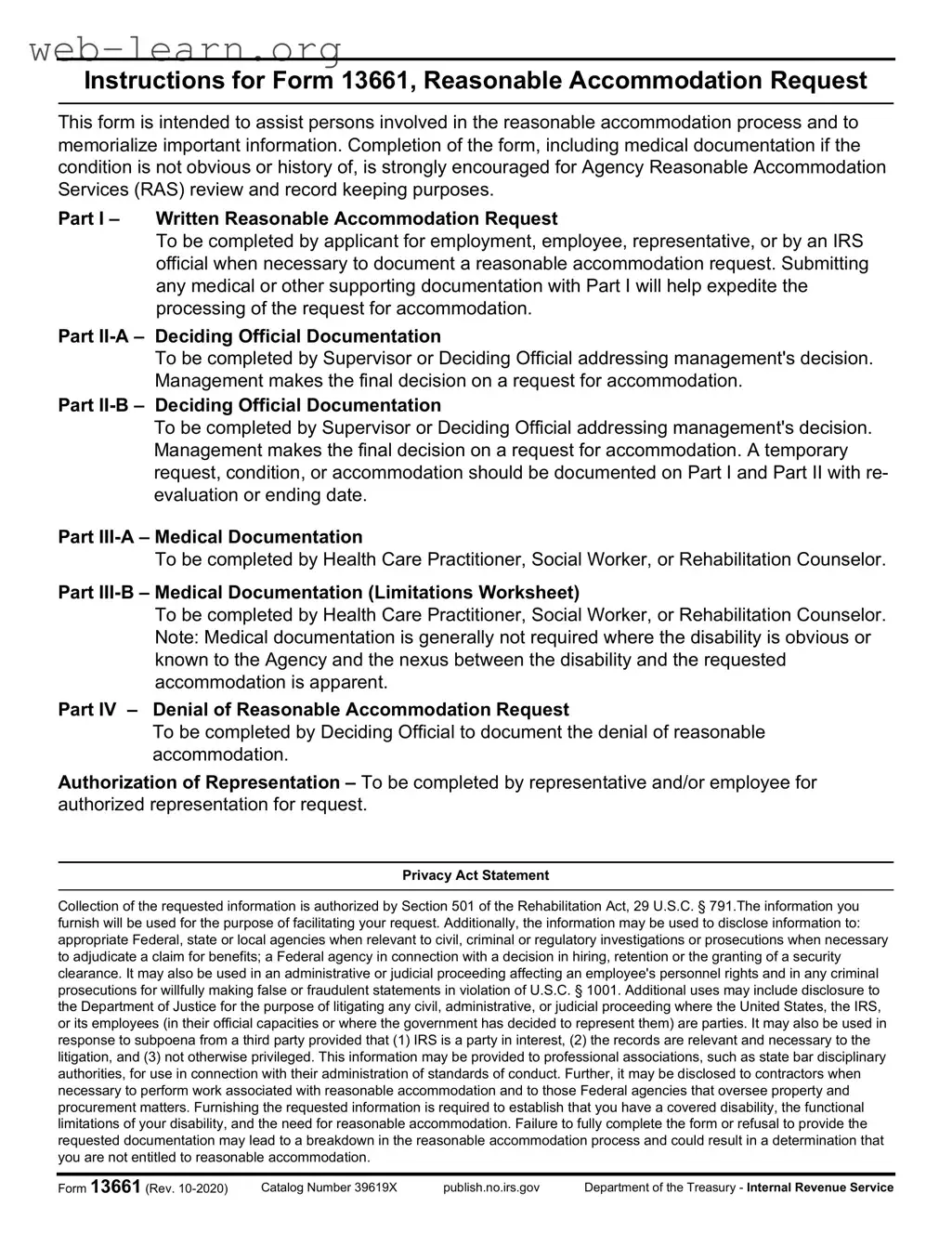
The 13661 form serves as a critical tool in the process of requesting reasonable accommodations for individuals with disabilities within the workplace. Designed for use by applicants, employees, and IRS officials, this form is divided into several parts, each serving a distinct purpose. Part I allows the individual seeking accommodation to provide essential information, including their medical condition and how it affects their job functions. This section emphasizes the importance of clearly articulating the accommodations needed to perform effectively. Following this, Part II is intended for the Deciding Official, who evaluates the request and documents their findings, ensuring that decisions are made based on comprehensive information. Medical professionals, such as health care practitioners or rehabilitation counselors, contribute in Parts III-A and III-B by providing necessary medical documentation that supports the accommodation request. In cases where a request is denied, Part IV allows for documentation of the reasons for the denial, ensuring transparency in the process. Additionally, the form includes a privacy statement, underscoring the importance of confidentiality and compliance with regulations like the Genetic Information Nondiscrimination Act (GINA). Understanding the structure and purpose of the 13661 form is vital for both employees seeking accommodations and the officials responsible for processing these requests.




| Fact Name | Description |
|---|---|
| Purpose of Form | The 13661 form is used to request reasonable accommodations for employees or applicants with disabilities. |
| Parts of the Form | The form consists of four main parts: the accommodation request, documentation by the deciding official, medical documentation, and denial documentation. |
| Privacy Act Statement | The form includes a statement explaining how the information collected will be used and protected under the Privacy Act. |
| Medical Documentation Requirement | Healthcare practitioners must provide documentation that outlines the individual's medical condition and how it affects their work capabilities. |
| GINA Compliance | The form adheres to the Genetic Information Nondiscrimination Act (GINA), ensuring that genetic information is not requested unless permitted by law. |
| Legal Basis | The form is governed by Section 501 of the Rehabilitation Act, which mandates reasonable accommodations for individuals with disabilities. |
| Submission Guidelines | Completed forms should be submitted via fax or to the assigned Reasonable Accommodation Coordinator for processing. |
| Consequences of Incomplete Forms | Failure to complete the form or provide necessary documentation may result in a denial of the accommodation request. |
Completing Form 13661 requires careful attention to detail to ensure that all necessary information is accurately provided. This form is essential for documenting a request for reasonable accommodation. Following the steps outlined below will help streamline the process and facilitate a timely response.
After submitting Part I, the Deciding Official will review your request and may need to complete Parts II and III. These sections require additional documentation and input from health care professionals, which may be necessary for your accommodation process.
Form 13661 is designed to facilitate requests for reasonable accommodations by applicants or employees who have a disability. The form allows individuals to document their medical condition, the limitations it imposes on their job functions, and the specific accommodations they are seeking. This process ensures that the needs of individuals with disabilities are adequately considered and addressed in the workplace.
The form is divided into several parts, each designated for specific individuals:
Form 13661 requires various types of information, including:
It is important to provide complete and accurate information to avoid delays in the accommodation process.
If a request for reasonable accommodation is denied, the Deciding Official must complete Part IV of the form. This section documents the reasons for the denial and may provide information on alternative accommodations considered. The applicant or employee should be informed of their right to appeal the decision or seek further clarification.
GINA prohibits employers from requesting or requiring genetic information about employees or their family members. When completing Form 13661, individuals are advised not to include any genetic information unless specifically allowed under exceptions related to the Family and Medical Leave Act (FMLA) or the Rehabilitation Act. This ensures compliance with GINA while still allowing for necessary medical documentation to support reasonable accommodation requests.
Completing the 13661 form can be a straightforward process, but many individuals make common mistakes that can hinder their reasonable accommodation requests. Understanding these pitfalls can help ensure a smoother experience.
One frequent error is incomplete information. Applicants often neglect to fill in all required fields, such as their contact information or details about their medical condition. Missing information can delay the processing of the request and may even result in a denial. Always double-check that every section is filled out accurately.
Another mistake involves insufficient medical documentation. When submitting medical information, it's crucial to provide clear and comprehensive documentation that supports the need for accommodation. Vague descriptions or lack of a diagnosis can lead to confusion and may cause the request to be rejected. Ensure that the medical documentation clearly links the condition to the requested accommodations.
Many applicants also fail to articulate how their medical condition affects job functions. It's essential to explain specifically how the condition limits the ability to perform essential job duties. A generic statement won't suffice; detailed descriptions help decision-makers understand the necessity of the accommodation.
Some individuals overlook the importance of alternative accommodations. When submitting the request, it’s beneficial to suggest multiple options for accommodations. This flexibility can make it easier for the deciding official to approve a solution that works for both parties.
Another common oversight is not providing a preferred method of contact. Applicants should indicate how and when they can be reached, whether by phone or email. This information facilitates communication and ensures that any follow-up questions can be addressed promptly.
Additionally, failing to review the Privacy Act Statement can lead to misunderstandings about how personal information will be used. Being aware of privacy protections helps applicants feel more secure when disclosing sensitive medical information.
Finally, some individuals mistakenly believe that they can submit the form without a signature. An unsigned form is incomplete and cannot be processed. Always remember to sign and date the form before submission to validate the request.
By avoiding these common mistakes, applicants can enhance their chances of successfully obtaining the reasonable accommodations they need.
The 13661 form is a key document for requesting reasonable accommodations in the workplace. However, several other forms and documents are often used alongside it to ensure a smooth process. Here’s a brief overview of those documents:
Using these forms and documents together with the 13661 form can streamline the reasonable accommodation process. Each document plays a vital role in ensuring that requests are handled fairly and efficiently, while also protecting the rights of employees.
The Form 13661, which is a Reasonable Accommodation Request Document, shares similarities with various other forms and documents used in employment and disability contexts. Below is a list of ten documents that are comparable to Form 13661, along with a brief explanation of how they are similar.
When filling out the 13661 form for a reasonable accommodation request, it is essential to follow certain guidelines to ensure your application is processed smoothly. Here are some important dos and don’ts:
Following these guidelines will help ensure that your reasonable accommodation request is processed efficiently and effectively.
This is not true. The 13661 form is designed for any applicant or employee who requires a reasonable accommodation due to a disability, regardless of whether that disability is visible or not. The process is inclusive and aims to support individuals with a range of conditions.
While submitting the form is an important step, it does not automatically ensure that the requested accommodation will be approved. The decision is made based on various factors, including the nature of the request and the ability of the accommodation to meet the needs of the employee while maintaining workplace efficiency.
In fact, providing medical documentation is often a necessary part of the process. The documentation helps to establish the need for accommodation and must be relevant to the specific limitations caused by the disability. Without sufficient medical information, the request may be denied or delayed.
This is a common misunderstanding. The information provided on the 13661 form is protected under privacy laws. Employers are required to handle this sensitive information with care, ensuring that it is only shared with individuals who need to know for the purpose of processing the accommodation request.
Complete all relevant sections of the 13661 form accurately to ensure a smooth reasonable accommodation request process.
Use attachments if additional space is needed. Each part of the form has specific requirements, and extra information may be necessary.
Medical documentation must clearly establish the disability and its impact on job functions. This information is crucial for the decision-making process.
Failure to provide complete information can hinder the accommodation process. Ensure all required documentation is submitted to avoid delays.