Homepage Blank 1 114 Texas Form
Outline

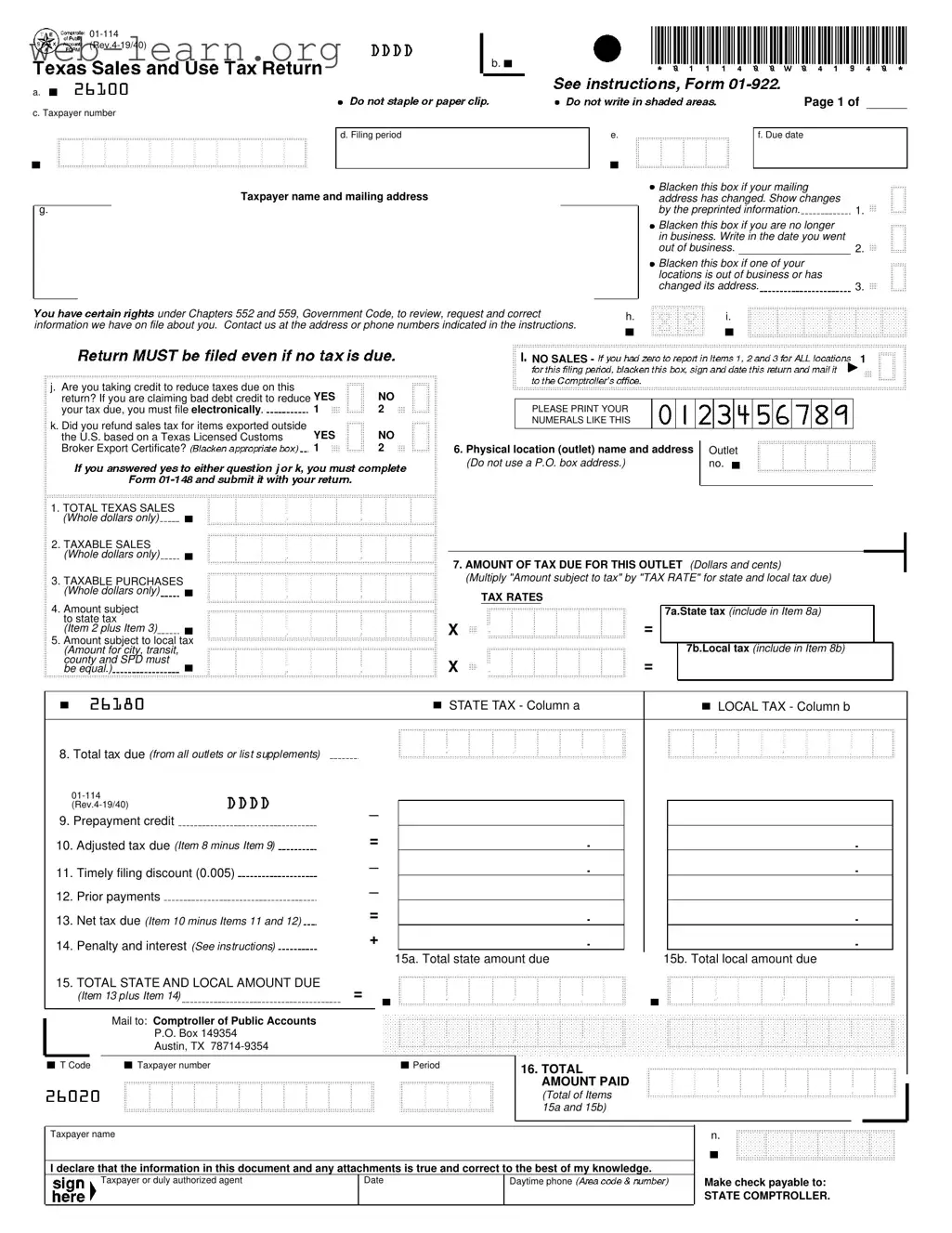
The 1-114 Texas form serves as a crucial document for businesses operating within the state, facilitating the reporting of sales and use taxes. This form requires businesses to provide essential information, such as the taxpayer number, filing period, and the name and mailing address of the taxpayer. It also includes sections for indicating any changes in business status, such as closure or address updates. Accurate reporting of total Texas sales, taxable sales, and taxable purchases is imperative, as these figures directly impact the calculation of taxes owed. Additionally, the form allows for claims related to tax credits, sales tax refunds for exported items, and adjustments for prior payments. Understanding how to complete this form correctly is vital for compliance with state tax regulations, and it ensures that businesses can take advantage of any applicable discounts or credits. The instructions accompanying the form provide guidance on filing electronically, as well as contact information for further assistance. By adhering to these requirements, businesses can maintain their standing with the Texas Comptroller of Public Accounts and avoid potential penalties.

Sample - 1 114 Texas Form

b
26180
b
STATE TAX - Column a
b
LOCAL TAX - Column b
8. Total tax due
(from all outlets or list supplements)
01-114
(Rev.4-19/40)
DDDD
_
9. Prepayment credit
10. Adjusted tax due
(Item 8 minus Item 9)
=
.
.
_
11. Timely filing discount (0.005)
. .
_
12. Prior payments
=
13. Net tax due (Item 10 minus Items 11 and 12)
. .
+
14. Penalty and interest
(See instructions)
. .
15a. Total state amount due 15b. Total local amount due
15. TOTAL STATE AND LOCAL AMOUNT DUE
(Item 13 plus Item 14)
=
b b
1. TOTAL
(Whole
2. TAXAB
(Whole
3. TAXAB
(Whole
4. Amount
to state
(Item 2
5. Amount
(Amoun
county
be equ
TEXAS SALES
dollars only)
b
LE SALES
dollars only)
b
LE PURCHASES
dollars only)
b
subject
tax
plus Item 3)
b
subject to local tax
t for city, transit,
and SPD must
al.)
b
7. AMOUNT OF TAX DUE FOR THIS OUTLET (Dollars and cents)
(Multiply "Amount subject to tax" by "TAX RATE" for state and local tax due)
TAX RATES
X
X
7a.State tax (include in Item 8a)
=
7b.Local tax (include in Item 8b)
=
j. Are you taking credit to reduce taxes due on this
return? If you are claiming bad debt credit to reduce
YES NO
your tax due, you must file electronically.
1 2
k. Did you refund sales tax for items exported outside
the U.S. based on a Texas Licensed Customs
YES NO
Broker Export Certificate?
(Blacken appropriate box)
1 2
DDDD
b.
*0111400W041940*
a.
c. Taxpayer number
d. Filing period e. f. Due date
Blacken this box if your mailing
Taxpayer name and mailing address
address has changed. Show changes
g. by the preprinted information.
1.
Blacken this box if you are no longer
in business. Write in the date you went
out of business.
2.
Blacken this box if one of your
locations is out of business or has
changed its address.
3.
h. i.
Page 1 of
01-114
(Rev.4-19/40)
Texas Sales and Use Tax Return
See instructions, Form 01-922.
26100
Do not staple or paper clip.
Do not write in shaded areas.
You have certain rights
under Chapters 552 and 559, Government Code, to review, request and correct
information we have on file about you. Contact us at the address or phone numbers indicated in the instructions.
l.
l.
NO SALES -
If you had zero to report in Items 1, 2 and 3 for ALL locations
1
for this filing period, blacken this box, sign and date this return and mail it
R
to the Comptroller's office.
PLEASE PRINT YOUR
NUMERALS LIKE THIS
Return MUST be filed even if no tax is due.
6. Physical location (outlet) name and address
Outlet
(Do not use a P.O. box address.)
no.
Taxpayer name
n.
I declare that the information in this document and any attachments is true and correct to the best of my knowledge.
Taxpayer or duly authorized agent
Date
Daytime phone
(Area code & number)
T Code Taxpayer number Period
16. TOTAL
AMOUNT PAID
26020
(Total of Items
15a and 15b)
If you answered yes to either question j or k, you must complete
Form 01-148 and submit it with your return.
Mail to: Comptroller of Public Accounts
P.O. Box 149354
Austin, TX 78714-9354
Make check payable to:
STATE COMPTROLLER.

Form Information

Fact Name Details
Form Number 1-114
Revision Date April 2019
Governing Laws Chapters 552 and 559 of the Texas Government Code
Filing Requirement Must file electronically if claiming debt credit to reduce tax due
Mailing Address Comptroller of Public Accounts, P.O. Box 149354, Austin, TX 78714-9354
Tax Calculation Tax due is calculated based on "Amount subject to tax" multiplied by applicable tax rates

Detailed Guide for Filling Out 1 114 Texas

Filling out the 1-114 Texas form is an important task for taxpayers. Completing this form accurately ensures compliance with state tax regulations. Follow the steps below to fill it out correctly.

  1. Gather necessary information, including your taxpayer number, name, and mailing address.
  2. Identify the filing period for which you are submitting the form.
  3. Check the box if your mailing address has changed and provide the updated information.
  4. If you are no longer in business, blacken the appropriate box and write the date you ceased operations.
  5. If one of your business locations is out of business or has changed its address, check the corresponding box.
  6. Determine if you are claiming a debt credit to reduce taxes due. If yes, remember that you must file electronically.
  7. Indicate whether you refunded sales tax for items exported outside the U.S. based on a Texas Licensed Customs Broker Export Certificate.
  8. Fill in the total Texas sales, taxable sales, and taxable purchases using whole dollars only.
  9. Provide the physical location (outlet) name and address. Do not use a P.O. box.
  10. Calculate the amount of tax due for this outlet by multiplying the amount subject to tax by the tax rate.
  11. Complete the sections for state tax and local tax, ensuring that the amounts for city, transit, county, and SPD equal the total.
  12. Add up the total tax due from all outlets or list supplements.
  13. Input any prepayment credits and calculate the adjusted tax due.
  14. Apply the timely filing discount, if applicable, and enter any prior payments made.
  15. Calculate the net tax due by subtracting the timely filing discount and prior payments from the adjusted tax due.
  16. Include any penalties and interest as instructed.
  17. Sum the total state amount due and the total local amount due.
  18. Calculate the total amount paid by adding the total state and local amounts due.
  19. Sign and date the form, declaring that the information provided is true and correct.
  20. Mail the completed form to the Comptroller of Public Accounts at the provided address.

Obtain Answers on 1 114 Texas

  1. What is the purpose of the 1-114 Texas form?

    The 1-114 Texas form is used for reporting sales and use taxes by businesses operating in Texas. It helps the state collect taxes on sales made within its jurisdiction. The form captures essential information about taxable sales, purchases, and the amount of tax due. Proper completion ensures compliance with Texas tax laws.

  2. Who needs to file the 1-114 Texas form?

    Any business that sells goods or services in Texas and is required to collect sales tax must file the 1-114 form. This includes retailers, wholesalers, and service providers. If a business is no longer operational or has changed its address, it must indicate these changes on the form.

  3. When is the 1-114 Texas form due?

    The due date for filing the 1-114 form typically aligns with the end of the reporting period, which can be monthly, quarterly, or annually, depending on the business's tax obligations. It's crucial to check the specific due date for your filing period to avoid penalties.

  4. What information is required on the 1-114 form?

    The form requires various details, including:

    • Taxpayer number
    • Filing period
    • Taxpayer name and mailing address
    • Total Texas sales, taxable sales, and taxable purchases
    • Amount of tax due for each outlet
    • Any prepayment credits and prior payments

    Accurate information is essential for proper tax calculation and compliance.

  5. What if my business address has changed?

    If your mailing address has changed, you should blacken the corresponding box on the form and provide the new address. It's important to keep your contact information current to ensure you receive any correspondence from the state.

  6. Can I claim a credit to reduce my tax due?

    If you are claiming a debt credit to reduce your tax due, you must file electronically. This is an important requirement to ensure that your claim is processed correctly and efficiently.

  7. How do I submit the 1-114 Texas form?

    The completed form should be mailed to the Comptroller of Public Accounts at the designated address. Ensure that you include all required information and calculations to avoid delays in processing.

  8. What happens if I miss the filing deadline?

    Failing to file the 1-114 form by the deadline may result in penalties and interest on the amount due. It is advisable to file as soon as possible to minimize any potential penalties. If you believe you may miss the deadline, consider reaching out to the Texas Comptroller's office for guidance.

Common mistakes

When filling out the 1-114 Texas form, individuals often make several common mistakes that can lead to delays or issues with their tax filings. One frequent error is not providing the correct taxpayer number. This number is essential for identifying the business and ensuring that the tax return is processed correctly. If this number is missing or incorrect, it can cause significant complications.

Another mistake occurs when taxpayers fail to specify their filing period. It is crucial to indicate the correct period for which the taxes are being filed. If the filing period is incorrect, it can result in penalties or miscalculations of tax owed. Additionally, many people overlook the importance of updating their mailing address if it has changed. This oversight can lead to important documents being sent to the wrong location, creating further confusion.

Claiming credits incorrectly is also a common issue. For instance, if a taxpayer is taking a credit to reduce taxes due, they must ensure they file electronically. Not doing so can result in the credit being denied. Furthermore, individuals sometimes forget to blacken the box indicating they are no longer in business or that one of their locations has changed its address. This information is vital for accurate record-keeping and tax assessment.

Another area where mistakes frequently happen is in reporting sales figures. Taxpayers should only enter whole dollars in the sections for total Texas sales, taxable sales, and taxable purchases. Entering cents or incorrect amounts can lead to miscalculations of the total tax due. Moreover, ensuring that the calculations for state and local taxes are accurate is essential. Errors in these calculations can result in underpayment or overpayment of taxes.

Finally, not signing the form or failing to provide a daytime phone number can lead to delays in processing. The declaration at the end of the form is a legal affirmation of the accuracy of the information provided. Without a signature, the form may be considered incomplete. Therefore, taking the time to review the form carefully before submission can help avoid these pitfalls.

Documents used along the form

When dealing with the 1-114 Texas form, it's important to understand that several other documents may be required to ensure compliance with state tax regulations. Each of these forms serves a specific purpose and can help clarify your tax obligations. Here’s a brief overview of some commonly associated documents.

  • Texas Sales and Use Tax Permit (Form 01-339): This document is essential for businesses that sell tangible personal property or taxable services in Texas. It allows you to collect sales tax from customers and remit it to the state.
  • Texas Franchise Tax Report (Form 05-158): If your business is structured as a corporation or limited liability company (LLC), you must file this report annually. It details your business's revenue and calculates the franchise tax owed to the state.
  • Texas Monthly Sales Tax Report (Form 01-114): This is a monthly report that businesses must file to report sales tax collected during the month. It provides a breakdown of taxable sales and the amount of tax due.
  • Exemption Certificates (Form 01-339): These certificates are used by buyers to claim exemption from sales tax on certain purchases. Sellers must keep these on file to validate the tax-exempt status of the sale.
  • Taxpayer Identification Number (TIN) Application (Form W-7): If you're a non-resident or foreign national, you may need to apply for a TIN to properly file taxes in Texas. This number is crucial for reporting income and tax obligations.

Having these forms and documents organized can streamline your tax filing process and help you avoid potential issues with the state. Always ensure that you are using the most current versions of these forms and consult with a tax professional if you have any questions about your specific situation.

Similar forms

  • Form 1040: This is the standard individual income tax return form used by U.S. taxpayers. Similar to the Texas 1 114 form, it collects information about income, deductions, and taxes owed, ensuring compliance with tax regulations.
  • Form 1065: Used for partnerships, this form reports income, deductions, gains, and losses. Like the 1 114 form, it requires detailed financial information and is filed annually to report tax obligations.
  • Form 941: Employers use this form to report income taxes, Social Security tax, and Medicare tax withheld from employee paychecks. Both forms require accurate reporting of financial data and due payments.
  • Form 1120: This is the corporate income tax return. Similar to the 1 114 form, it gathers financial information to calculate taxes owed, ensuring corporations meet their tax responsibilities.
  • Form W-2: Employers provide this form to employees to report annual wages and tax withholdings. Both the W-2 and the 1 114 form serve to inform tax authorities about income and tax obligations.
  • Form 1099: This form reports various types of income other than wages, salaries, and tips. Like the 1 114, it is used to ensure proper reporting of income for tax purposes.
  • Form 720: This is used to report and pay federal excise taxes. Both forms require detailed calculations of tax amounts owed based on specific criteria.
  • Form 990: Nonprofit organizations use this form to report financial information to the IRS. Similar to the 1 114, it provides transparency regarding financial activities and tax obligations.
  • Form 8862: This form is used to claim the Earned Income Tax Credit after it has been denied. Both forms require verification of eligibility and accurate reporting of financial information.
  • Form 4506-T: This form is a request for a transcript of tax return information. Like the 1 114, it involves communication with tax authorities to ensure accurate records and compliance.

Dos and Don'ts

When filling out the 1-114 Texas form, it is important to follow specific guidelines to ensure accuracy and compliance. Here are eight things you should and shouldn't do:

  • Do read all instructions carefully before starting.
  • Do use whole dollars only when reporting sales and tax amounts.
  • Do ensure that your taxpayer number and name are correct and match your records.
  • Do blacken the appropriate boxes for changes in business status or address.
  • Don't use a P.O. box for the physical location address; provide a street address instead.
  • Don't forget to file electronically if you are claiming a debt credit to reduce taxes due.
  • Don't skip any required fields; incomplete forms may lead to processing delays.
  • Don't forget to sign and date the form before submission.

Adhering to these guidelines can help streamline the process and minimize errors. Properly completing the 1-114 form is essential for accurate tax reporting and compliance with Texas state regulations.

Misconceptions

Understanding the 1 114 Texas form is essential for accurate tax filing. However, several misconceptions can lead to confusion. Here are seven common misconceptions about this form:

  • It is only for businesses with physical locations. Many believe that only businesses with a storefront need to file this form. In reality, any business operating in Texas, regardless of location, may be required to submit this form.
  • Filing is optional if there are no sales. Some think they can skip filing if they had no sales. However, even if a business had no sales, filing is often still necessary to maintain compliance.
  • All tax rates are the same across Texas. A common belief is that tax rates are uniform throughout the state. In fact, local jurisdictions may impose different rates, and businesses must account for these variations.
  • Changes to business information can be ignored. Many assume they can overlook updating their business information on the form. Failing to report changes, such as a new address or business status, can lead to penalties.
  • Tax credits can be claimed without electronic filing. Some individuals think they can claim tax credits without filing electronically. This is incorrect; electronic filing is often a requirement for claiming certain credits.
  • Penalties are only applied for late submissions. Some believe penalties are only incurred for late filings. However, inaccuracies or omissions can also result in penalties, regardless of submission timing.
  • Once filed, the form cannot be amended. There is a misconception that the form cannot be changed after submission. In fact, amendments can be made if errors are identified, but they must be done correctly and promptly.

By addressing these misconceptions, businesses can better navigate the requirements of the 1 114 Texas form and ensure compliance with state tax regulations.

Key takeaways

Filling out and using the 1-114 Texas form requires careful attention to detail. Below are key takeaways to consider when completing this form.

  • Accurate Information: Ensure that all fields, including taxpayer number, name, and mailing address, are filled out accurately. This information is crucial for processing your return.
  • Business Status: Indicate if you are no longer in business or if any of your locations have changed addresses. This helps maintain accurate records with the Comptroller's office.
  • Electronic Filing: If you are claiming a debt credit to reduce your tax due, you must file electronically. This requirement is important to adhere to for compliance.
  • Payment Details: Calculate the total amount due carefully. Include all necessary figures, such as state and local taxes, prepayment credits, and any penalties or interest. Double-check your calculations to avoid errors.

Following these guidelines can help ensure that your submission is complete and accurate, reducing the risk of delays or issues with your tax return.